
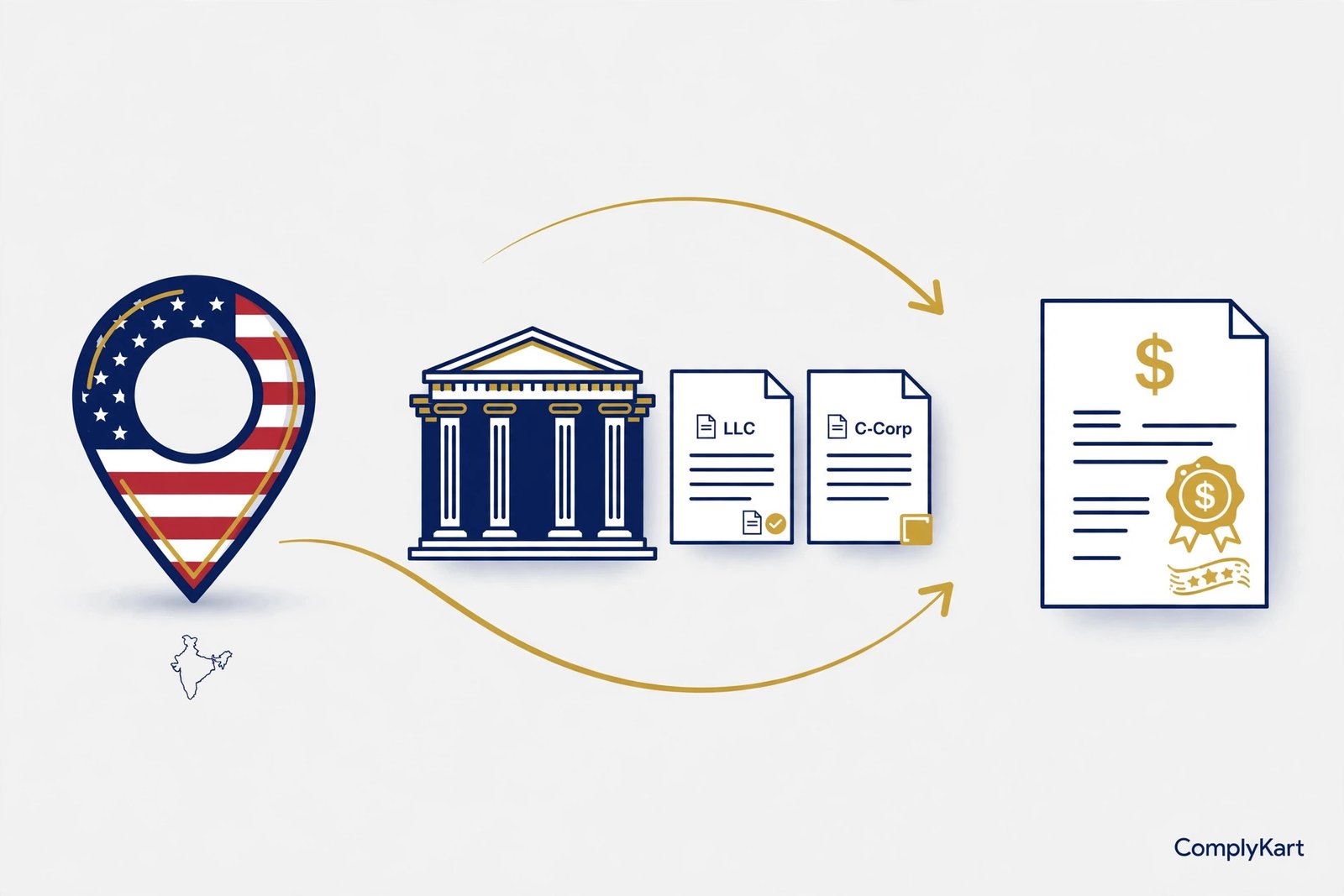
The short answer: an Indian founder can own 100% of a US company without visiting; pick a Delaware C-Corp for US fundraising, an LLC for simpler operations (but file Form 5472 — the penalty is $25,000 a year); get the EIN via Form SS-4 without an SSN; handle FEMA on the India side separately. Six to eight weeks, end to end.
Every few weeks, a founder calls with the same opening line: "I want to open a company in America." Then the questions. Can I own it fully? Do I have to fly there? How long? What will it cost? And the one asked in a lowered voice — will the IRS come after me if the company earns nothing?
Here are the answers, plainly.
Key takeaways
- No US citizenship or residency is needed to own a US company outright; incorporation runs online through a registered agent.
- Delaware C-Corp for venture funding; LLC for simpler businesses — but a foreign-owned single-member LLC must file Form 5472 yearly ($25,000 penalty for skipping).
- An EIN is obtainable without an SSN via Form SS-4 (fax/mail, several weeks) — file it the day the company is formed.
- India-side FEMA applies: Overseas Investment Rules, 2022 reporting plus APR by 31 December; individuals use the LRS $250,000/year route.
Can an Indian resident own 100% of a US company?
Yes. There is no citizenship or residency requirement to own a US company. Hold all the shares or membership interests from your desk in Bengaluru — full foreign ownership is completely normal.
LLC or C-Corp — which one do I actually need?
The one decision that genuinely matters, and most founders get it backwards by copying someone else.
A C-Corporation — usually in Delaware — is the standard vehicle for raising US investor money. VCs understand it, stock options fit cleanly, unlimited shareholders. The car built for the highway: heavier paperwork, but the only vehicle most investors ride in.
An LLC is simpler and cheaper to run. By default the IRS treats a single-owner LLC as "disregarded" — profits flow straight through to you personally — and a multi-owner LLC as a partnership. Fine for consulting income, a small SaaS, or holding US assets. But the catch founders miss: a foreign-owned single-member LLC still files paperwork with the IRS every year (a pro-forma Form 1120 with Form 5472), and the penalty for skipping it is $25,000. Per year. "Simpler" does not mean "paperwork-free."
My rule of thumb: raising institutional capital in the US? Delaware C-Corp. Services business or testing the waters? LLC, eyes open about the filings.
Do I need to travel to the US?
For the company itself — no. Incorporation happens online through a registered agent in the chosen state, typically in days to a couple of weeks. You never have to set foot in Delaware.
The bank account is where travel sometimes enters the picture. Traditional US banks generally want a signatory in a branch with ID. Digital-first banks and fintech platforms now open accounts for foreign-owned US companies remotely, with video verification. It works — but keep a backup option, because freezes during "compliance reviews" are a known headache with remote onboarding. If serious money will move, one trip to open an account in person is money well spent.
What is an EIN, and can I get one without a Social Security Number?
An EIN (Employer Identification Number) is the company's tax ID — the American PAN for the business. You need it for the bank account, hiring, and tax filings.
Yes, without an SSN or ITIN. File Form SS-4 with the IRS by fax or mail, marking "foreign" where it asks for the SSN. It's free. The trade-off is time: several weeks versus instant online. File it the day the company is formed.
What does it cost, roughly?
Honestly? Less than most people expect to set up, more than they expect to maintain. State filing fees run from under a hundred to a few hundred dollars. A registered agent — mandatory, since the state needs a local address for legal notices — typically costs $100–300 a year. Delaware's annual franchise tax for a standard startup C-Corp is a few hundred dollars. The expensive part is professional fees: a good US CPA for the annual filings and a lawyer for the founder agreements will cost multiples of the state fees. Budget for them. Skipping them is how founders end up with the $25,000 penalty mentioned above.
What are my ongoing US compliance duties?
Three things, every year: the state annual report or franchise tax (Delaware's is due March 1 for corporations); the federal return — Form 1120 for a C-Corp, even at zero income; and Form 5472 if it's a foreign-owned LLC. Miss these and penalties compound quietly — the IRS writes to your registered agent's Delaware address, which you never visit. The most common way Indian-owned US companies get into trouble isn't fraud, it's silence.
What about the India side — FEMA?
The part founders forget, and the part Indian regulators actually care about. Setting up abroad is an "overseas investment" under the FEMA Overseas Investment Rules, 2022.
If your Indian company invests, report it to the RBI through your bank (an Authorised Dealer), and file the Annual Performance Report every year by 31 December. Investing personally? The Liberalised Remittance Scheme caps you at $250,000 per financial year per person. The US doesn't care about your FEMA filings, and the RBI doesn't care about your Delaware franchise tax.
How do I bring the profits home?
Through dividends, paid to you or your Indian holding company. The US generally withholds tax on dividends to foreign owners — the India-US treaty typically brings this down to 25%, so confirm with your CPA. India then taxes the receipt, with credit for the US tax paid. The paperwork proving each step keeps both tax departments satisfied.
So, how long does the whole thing take?
Company formation: days. EIN: several weeks (start early). Bank account: two to six weeks depending on the route. FEMA reporting runs alongside, through your Indian bank. Realistically, six to eight weeks from "let's do this" to a fully operational company. Anyone promising it in 48 hours is selling you the certificate, not the working company.
Frequently asked questions
Can an Indian resident own 100% of a US company?
Yes. No citizenship or residency requirement exists — you can hold every share from your desk in India and be the sole shareholder and director without ever visiting. Full foreign ownership is completely normal; nobody in Delaware will ask for your passport.
Should I form an LLC or a C-Corp?
Raising US venture capital? Delaware C-Corp — investors understand it and stock options fit cleanly. Running a services business? An LLC is simpler and cheaper. The catch: a foreign-owned single-member LLC still files Form 5472 yearly, and skipping it costs $25,000 per year.
Can I get an EIN without a Social Security Number?
Yes. File Form SS-4 by fax or mail, marking "foreign" where it asks for the SSN — it's free. The trade-off is time: several weeks versus instant online. File it the day the company is formed, well before you need the bank account.
Can I open a US bank account without travelling there?
Sometimes. Traditional banks usually want a signatory in-branch, but digital-first banks now onboard foreign-owned US companies remotely with video verification. Keep a backup — remote accounts do get frozen in "compliance reviews." If serious money will move, one trip is money well spent.
What FEMA filings does an Indian founder need for a US company?
Company investing? Report to the RBI through your bank under the Overseas Investment Rules, 2022, plus the Annual Performance Report every year by 31 December. Investing personally? The LRS caps you at $250,000 per financial year. The US won't ask about FEMA and the RBI won't ask about Delaware.
Weighing the US against the UK, Singapore, or the UAE? The honest answer: the US wins when your customers or investors are American, and loses on simplicity everywhere else. Pick the jurisdiction your business actually needs, not the one that sounds impressive. And if you'd like someone to walk the whole path with you — entity choice, EIN, FEMA reporting, the lot — that's exactly what our team does every week.



Comments
No comments yet — ask the first question below.
Join the discussion
Questions go straight to our expert desk. Comments appear after a quick review — no spam, no noise.