Five steps, no guesswork — you always know exactly what comes next. Tap a step to see what it involves.
12345
You pay securely. Payment is confirmed instantly, and your receipt with the written fee breakup lands in your inbox.
Overview
The private limited company is India's default vehicle for doing business — and also its default vehicle for not doing business. Startups that pivoted, consultancies that wound down, subsidiaries whose purpose ended, companies incorporated for a deal that never closed: they stop operating but stay on the register, and the register does not forget. Annual returns, financial statements, auditor appointments, board meetings — the compliance clock keeps ticking, and the additional fees keep compounding.
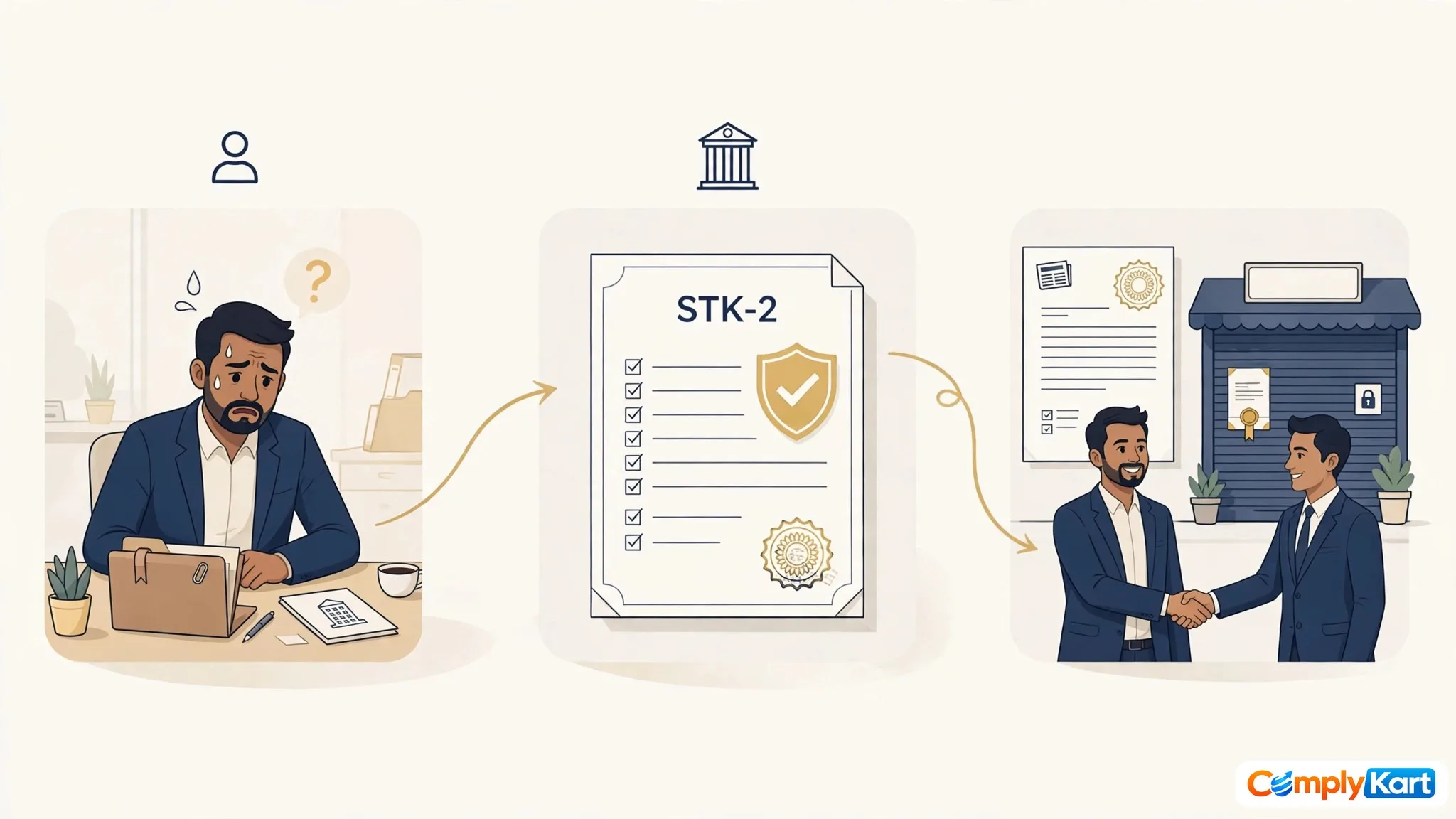
Strike-off is the dignified exit. Under Section 248 of the Companies Act, 2013, a private limited company with no assets and no liabilities can apply in Form STK-2 to have its name removed from the register. The application goes to C-PACE — the Centre for Processing Accelerated Corporate Exit — which has handled all Section 248 matters pan-India since May 2023. Get it right, and the company is dissolved on Gazette publication: no liquidator, no Tribunal, no years-long process.
But "administrative" is not "casual". Every director signs a notarised indemnity bond and affidavit. A practising Chartered Accountant certifies the statement of accounts. Shareholders approve through a special resolution or 75% consent. Every overdue annual filing is completed first — the days of walking away from unfiled returns ended with the Fast Track Exit scheme in 2016. And the liabilities directors think strike-off buries? Section 248(6) keeps them alive, with fraud punishable under Section 447.
This page is written specifically for private limited companies — the board and shareholder mechanics, the director liability position, the NOCs, and the traps unique to the Pvt Ltd structure.
A note on how to read it: strike-off rewards preparation and punishes improvisation. The companies that dissolve in three months are the ones whose directors settled liabilities, cleared filings, and lined up consents before the STK-2 was drafted. The companies that take a year are the ones that filed first and fixed problems later, under resubmission notices. Read the eligibility and document sections as a pre-flight checklist, not as background — and do not skip the director-liability section even if the balance sheet looks clean. Clean-looking balance sheets have ended more strike-off applications than dirty ones, because nobody checked.
Is strike-off right for your Pvt Ltd?
Strike-off fits when:
The company has had no business or operations for two immediately preceding financial years (or never commenced business at all)
All liabilities are extinguished — no loans, no creditors, no tax dues, no employee dues
All assets are disposed of, bank accounts closed, and there is nothing left to distribute
Shareholders agree — because a special resolution or 75% consent is non-negotiable
Strike-off does NOT fit when:
The company owes money to anyone. "Almost settled" is not settled.
There is pending litigation, a prosecution, or an inspection/investigation under Sections 206–210
Charges on the company's assets remain unsatisfied with the Registrar
Public deposits are outstanding or in default
The company is a Section 8 company — the strike-off route is barred for Section 8
Consider these instead:
Dormant status under Section 455 — if the business might restart within five years; minimal compliance, company stays alive
Voluntary liquidation under the IBC — where assets need distribution or liabilities need a formal settlement process
Fast-track merger into another group company — where the business continues inside a surviving entity
The shareholder approval — special resolution or 75% consent
Section 248(2) gives two routes, and founders often misunderstand the second. The company may apply after extinguishing all its liabilities, by:
A special resolution passed at a general meeting (21 clear days' notice, or shorter with 90% consent), or
Consent of 75% of the members in terms of paid-up share capital.
The 75% consent route avoids holding an EGM, but it is consent of members by paid-up capital — not a board decision, and not a majority of directors. In a two-founder company with a 60:40 split, neither founder alone can consent; you need both. Get the arithmetic wrong and C-PACE rejects the application at the threshold.
If you go the special resolution route, file MGT-14 within 30 days of the resolution — another deadline founders miss. And keep the attendance register, the notice, and the voting record with the closure file: C-PACE occasionally asks for proof that the meeting which authorised the strike-off was properly convened, and reconstructing board papers months later is exactly as painful as it sounds.
The two-year rule — and the never-commenced exception
Section 248(1)(b) requires that the company has not been carrying on any business or operation for a period of two immediately preceding financial years and has not applied for dormant status. Note the asymmetry with LLPs, which need only one year — companies get the longer clock.
Section 248(1)(a) covers the company that failed to commence business within one year of incorporation. A Pvt Ltd incorporated for a deal that died in the cradle can use this ground — but it still needs nil liabilities, current filings, and the full STK-2 documentation. "We never did anything" excuses nothing on paperwork.
Director liabilities that survive strike-off
This is the section founders skip and later regret. Section 248(6) provides that:
The assets of the company remain available for the payment of liabilities even after dissolution.
The Tribunal may order the company wound up as if it had not been struck off, on an application by the Registrar, the company, or any aggrieved person.
Where the application was made to evade liabilities or to defraud, every person in charge of management is jointly and severally liable and punishable for fraud under Section 447.
Strike-off ends the company. It does not launder its history. If creditors were left unpaid, the directors' indemnity bonds and affidavits become evidence, not protection.
NOCs — when your Pvt Ltd needs regulatory clearance
Most private limited companies need no NOC. But if the company operated in a regulated space, C-PACE expects the clearance enclosed:
NBFCs and housing finance companies — NOC from the RBI
Insurance intermediaries — NOC from IRDAI
SEBI-regulated intermediaries, mutual funds, collective investment schemes — NOC from SEBI
Companies that accepted public deposits — these cannot use strike-off at all while deposits are outstanding
If your Pvt Ltd was ever an NBFC (even a surrendered licence), check the record before filing.
Every document STK-2 needs
STK-8 statement of accounts — certified by a practising Chartered Accountant, made up to a date not more than 30 days before filing.
STK-3 indemnity bond — notarised, executed by every director.
STK-4 affidavit — by every director, declaring no liabilities and no pending proceedings.
Board resolution — authorising the strike-off application and the authorised signatory.
Special resolution or 75% member consent — with MGT-14 filed if the resolution route was used.
Regulatory NOCs — where applicable (RBI/IRDAI/SEBI).
STK-2 certification — by a Company Secretary, Chartered Accountant or Cost Accountant in whole-time practice.
Cleared filing backlog — all overdue AOC-4 and MGT-7 up to the FY of business cessation, filed with additional fees.
Step 1 — Confirm eligibility and extinguish liabilities
Verify the two-year inactivity (or never-commenced ground), settle every liability — loans, creditors, tax dues, employee dues — close bank accounts, and dispose of assets. Strike-off with a non-zero balance sheet is not a shortcut; it is a fraud risk.
Step 2 — Clear the ROC backlog
File all overdue AOC-4 (financial statements) and MGT-7 (annual returns) up to the financial year in which the company ceased operations. This is mandatory under the amended Rule 4 — and usually the most expensive step, because additional fees compound per day of delay.
Step 3 — Board meeting and shareholder approval
Convene a board meeting to approve the strike-off proposal and authorise a director to act. Then obtain shareholder approval — special resolution at an EGM (21 days' notice) or written consent of 75% of members by paid-up capital. File MGT-14 within 30 days if a special resolution was passed.
Step 4 — Obtain the CA-certified statement of accounts
Engage a practising Chartered Accountant to certify the STK-8 statement showing nil assets and nil liabilities. Time this carefully: it must be dated within 30 days before the STK-2 filing. Prepare it too early and it goes stale.
Step 5 — Execute indemnity bonds and affidavits
Every director executes the STK-3 indemnity bond (notarised) and the STK-4 affidavit. The bond language must undertake liability for obligations arising even after dissolution — generic wording draws objections.
Step 6 — Collect NOCs and get the form certified
If the company was in a regulated sector, obtain the RBI/IRDAI/SEBI NOC. Have a practising CS, CA or CMA certify Form STK-2 itself.
Step 7 — File STK-2 with C-PACE
File electronically with the ₹10,000 fee. C-PACE examines the application: eligibility, consents, the 30-day statement, cleared filings, and the bonds. Respond to resubmission notices promptly — most rejections trace to the backlog, the statement date, or defective bonds. A diary reminder for every C-PACE notice deadline is cheap insurance against the file going cold.
Step 8 — Public notice and dissolution
C-PACE publishes Form STK-6 as public notice with a 30-day objection window, intimating tax authorities and other regulators in parallel. If no disqualifying objection emerges, the name is struck off and the company stands dissolved on publication of STK-7 in the Official Gazette.
How long does it take?
Three to six months from a complete STK-2 filing to Gazette publication is the realistic range. The variables are the filing backlog (each overdue year adds preparation time), C-PACE's examination queue, and whether the 30-day public notice draws objections. A Pvt Ltd with five years of unfiled returns should budget longer — the backlog clearance, not C-PACE, is the critical path.
Fees — the honest breakdown
STK-2 government fee: ₹10,000.
Backlog clearance: additional fees on every overdue AOC-4 and MGT-7 — per day of delay, uncapped. For a company several years behind, this dwarfs the STK-2 fee.
Professional charges: board/shareholder documentation, bond and affidavit drafting, CA certification of STK-8, form certification, filing and C-PACE follow-up.
Stamp paper and notarisation: for each director's indemnity bond, per the registered office's state.
A worked example. Take a Pvt Ltd incorporated in 2020 that stopped operating in 2022, with directors deciding to close it in late 2026. The backlog: AOC-4 and MGT-7 for FY 2022-23 through 2025-26 — eight filings, each with per-day additional fees that compound without mercy. That clearance alone typically runs into tens of thousands of rupees, and that is before the STK-2 fee of ₹10,000, the CA certification of the STK-8, stamp paper and notarisation for every director's bond, the EGM and MGT-14 formalities, and professional charges for running the whole engagement. The all-in cost of closing a Pvt Ltd that has been dormant for four years routinely lands well into five figures — sometimes six, where the backlog is deep. Every year of delay adds to the pile. The cheapest strike-off is always the earliest one.
How ComplyKart helps
We run the full Pvt Ltd closure: eligibility and liability review, backlog clearance (AOC-4, MGT-7, MGT-14), board and shareholder documentation, CA-certified STK-8, drafting of STK-3 bonds and STK-4 affidavits, NOC coordination where needed, STK-2 filing and C-PACE follow-up through to Gazette publication.
What we do not do: we will not file STK-2 for a company with unsettled liabilities, pending litigation, or an inspection in progress — and we will tell you plainly if winding up or another route fits better. We do not backdate the STK-8 statement or manufacture consents.
Common mistakes that get STK-2 rejected
Stale STK-8 — certified more than 30 days before filing. The single most common rejection reason.
Wrong consent arithmetic — 75% of paid-up capital, not 75% of directors or a board majority.
Unfiled backlog — assuming old returns can be skipped. They cannot; Rule 4 as amended is explicit.
Missing MGT-14 — special resolution passed but never filed within 30 days.
Section 8 confusion — Section 8 companies attempting the strike-off route, which is barred for them.
Defective indemnity bonds — generic language instead of the specific post-dissolution undertaking, or inadequate stamping.
Tax closure — PAN, final ITR, GST cancellation
Strike-off dissolves the company with the Registrar; it does not settle the company's account with the tax department. Before STK-2, the tax position must be clean: file the final income tax return (even a nil return where one is due), ensure TDS returns are filed and matched, and cancel the GST registration if one was held — an active GSTIN alongside a "nil assets, nil liabilities" strike-off application is an inconsistency that invites an objection from the tax authorities during the 30-day notice window. Surrender of PAN is not automatic on strike-off; the PAN remains on record, which is actually useful — a struck-off company's PAN is sometimes needed for legacy assessments or refunds. Keep the final ITR acknowledgement, the GST cancellation order, and the STK-7 Gazette publication together permanently. In every due-diligence exercise on the directors' next venture, these three documents are what get asked for.
The name question — who gets the company name afterwards
A practical question founders ask: once our company is struck off, can someone else — including us — use the name? On dissolution, the name becomes available in the MCA system, subject to the usual name-availability rules under the Companies (Incorporation) Rules. There is no reservation in favour of the former directors. If the brand has residual value, the time to protect it is before strike-off — through a trademark registration in the relevant classes, which survives the company's dissolution as an asset of the former owners (properly assigned before dissolution). Waiting until after the Gazette publication to think about the name is how founders discover a stranger has incorporated it.
Strike-off vs dormant status — the five-year question
Section 455 allows a company to obtain dormant status — alive on the register, but with minimal compliance (a return of dormant status, board meetings as prescribed) for up to five years, and reactivable on application. The choice between strike-off and dormancy turns on one question: is there any realistic chance this company does business again within five years? If yes — a paused startup, a SPV between deals, a company waiting out a market — dormant status preserves the incorporation date, the name, the CIN, and the compliance history for a fraction of active-company cost. If no — the business model failed, the founders moved on permanently — strike-off gives finality that dormancy never does. The expensive mistake is choosing neither: an "inactive but not dormant" company accrues full compliance obligations and penalties indefinitely.
What C-PACE examines — and why files stall
C-PACE processes every Section 248 application centrally, which standardised the examination but also standardised the rejections. The examination sequence: eligibility (the two-year condition tested against filed financials), the shareholder approval (special resolution with MGT-14, or the 75% consent arithmetic), the STK-8 statement (CA membership, certification date within 30 days), the STK-3/STK-4 bonds and affidavits (every director, notarised, adequate stamp paper), the filing backlog (AOC-4/MGT-7 current to the FY of cessation), and NOCs where the company was regulated. Resubmission notices almost always cite one of these six. The files that sail through share three traits: the backlog was cleared before drafting began, the STK-8 was certified last, and a professional checked the consent arithmetic before filing.
The final-year audit question
A doubt that surfaces in every Pvt Ltd closure: does the company need audited financials for the final year before strike-off? The position is practical rather than doctrinal. The STK-8 statement of accounts — CA-certified, not older than 30 days — is the document C-PACE examines, and it stands on its own. But the filing backlog (overdue AOC-4s) must be cleared up to the FY of business cessation, and each AOC-4 carries financial statements that, for a private limited company above the audit thresholds, must be audited. In practice, then: if the company ceased business two years ago and its last filed financials are from that year, no fresh audit is manufactured for the strike-off — the STK-8 covers the current position. If the backlog includes years where audit was legally required, those audits must be completed before the AOC-4s can be filed. The auditor question also has a human dimension: the statutory auditor must be in place for filings being made now, and an auditor who resigned years ago without a successor leaves a gap the board must fill (with ADT-1/ADT-3 formalities) before the backlog can move. Sort the auditor position early — it is a frequent hidden blocker.
FAQ
Frequently asked questions
21 answers from our consultants.
You pay for our expert's time — document checking, filing, follow-ups — not the government. The government fee goes to the government; our fee is for the work we do so you don't have to figure it out yourself.
Section 248 of the Companies Act, 2013, read with the Companies (Removal of Names of Companies from the Register of Companies) Rules, 2016. Form STK-2 is the application, processed by C-PACE.
Two immediately preceding financial years without carrying on business or operation — or, alternatively, failure to commence business within one year of incorporation.
A special resolution, or the consent of 75% of members in terms of paid-up share capital. Board approval alone is never enough.
The Centre for Processing Accelerated Corporate Exit — a centralised Registrar under Section 396 with pan-India jurisdiction over Section 248 strike-off applications, operational since 1 May 2023.
₹10,000 per application.
Yes. All overdue AOC-4 and MGT-7 filings up to the financial year in which the company ceased operations must be filed before STK-2 — this has been mandatory since the 2019 rule amendment.
A statement of the company's accounts certified by a practising Chartered Accountant, showing the financial position, made up to a date not more than 30 days before the STK-2 filing.
Every director of the company — the STK-3 indemnity bond (notarised) and the STK-4 affidavit are executed by each director individually.
No. All liabilities must be extinguished first. An outstanding loan — even one the directors consider "manageable" — disqualifies the application.
No. Under Section 248(6), company assets remain available for liabilities after dissolution, the Tribunal can order the struck-off company wound up, and directors who applied to evade liabilities face joint and several liability and punishment for fraud under Section 447.
NBFCs and HFCs need RBI clearance; insurance intermediaries need IRDAI; SEBI-regulated entities need SEBI. Ordinary trading, services or manufacturing companies need none.
No. The strike-off route is barred for Section 8 companies under the Rules.
Strike-off dissolves the company. Dormant status under Section 455 keeps it alive with minimal compliance for up to five years, and it can be reactivated. Choose dormant if restart is possible.
Three to six months from a complete STK-2 filing to Gazette publication, depending on C-PACE processing, the backlog clearance, and any objections during the 30-day public notice.
C-PACE publishes Form STK-6 and intimates authorities including tax departments, who have 30 days to object. Substantiated objections — unpaid dues, pending proceedings — lead to rejection.
A Company Secretary, Chartered Accountant or Cost Accountant in whole-time practice. The STK-8 statement specifically requires a practising Chartered Accountant.
The charge must be satisfied with the Registrar (Form CHG-4) before applying. A repaid-but-unsatisfied charge still blocks strike-off.
No. The 75% consent route needs willing members holding 75% of paid-up capital. A dissenting minority above 25% blocks the consent route — the special resolution route (75% of votes cast) may still work at a properly convened meeting.
No. It ended on 26 December 2016 when Section 248 came into force. Any current "FTE" guidance is outdated.
The STK-7 Gazette publication, the filed STK-2 with all attachments, the STK-8 statement, board and shareholder resolutions, and bank closure proof — tax authorities and future due-diligence checks may ask for them years later.
What clients say about working with us
Real stories from businesses we've worked with.
Trademark Registration“
Our Trademark was applied in all the classes with a short span of time by Complykart Trademark Experts and I can say the level of expertise and commitment they carry is remarkable. It's an A+ from my side. We are now sticking to ComplyKart only.
Company Registration“
I found the professionalism of the staff at complykart.com, a pleasure to work with. As a foreigner to India, they took the time to explain the documentation and assisted in every question I raised. I was pleased that complykart.com made it easy for my Business.
Merger & Acquisition“
Trust, Commitment, Dedication and responsiveness are the best things with ComplyKart. Thanks for handling our Merger assignment with so much care. After my business disputes, complykart handles all things with own sense of understanding.
Company Law Specialist · Company Law & ROC Compliance · 10+ years experience
Naman Agarwal specialises in company law and ROC compliance. He manages incorporations, annual filings (AOC-4, MGT-7, ADT-1), board processes and statutory registers for private limited companies, LLPs and Section 8 companies.
Last reviewed: 16 November 2026
Get a free consultation
Talk to a ComplyKart professional about Strike Off a Private Limited Company. The first consultation is free.