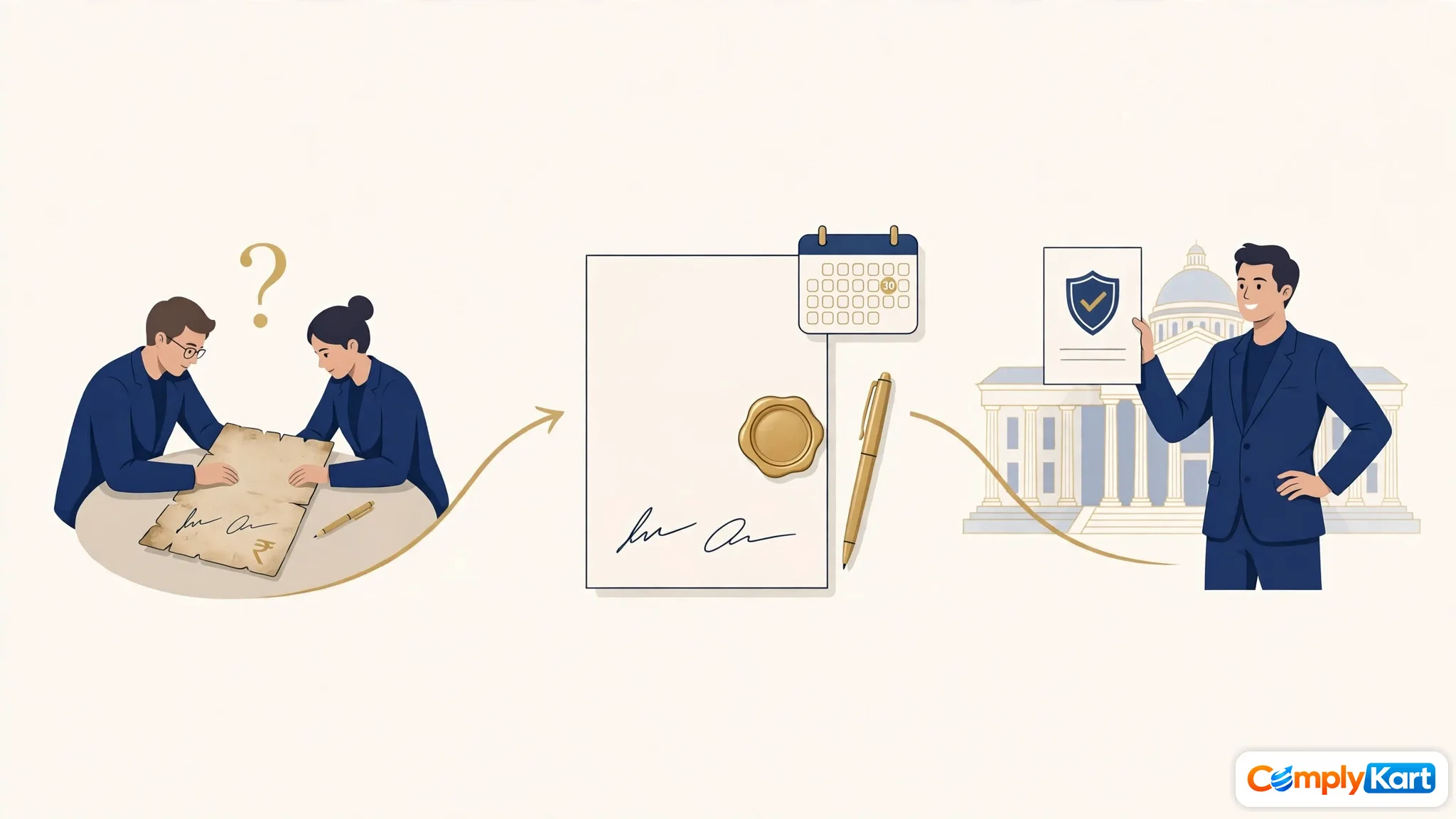
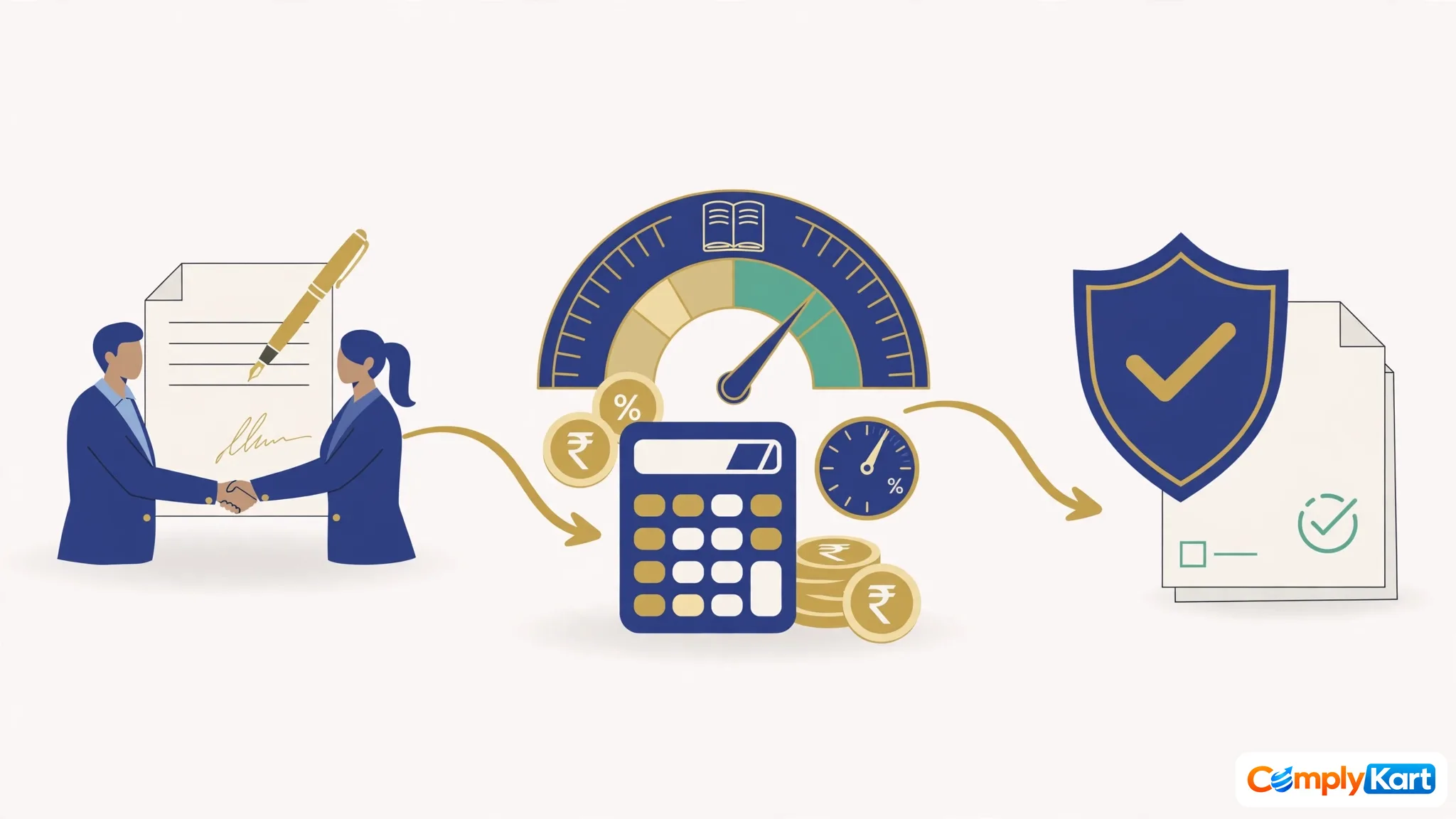
Five steps, no guesswork — you always know exactly what comes next. Tap a step to see what it involves.
12345
You pay securely. Payment is confirmed instantly, and your receipt with the written fee breakup lands in your inbox.
Is an NDA the right instrument for you?
You need an NDA if any of these fit:
You are pitching investors, partners, or acquirers and will share financials, technology, or strategy.
You are onboarding employees, contractors, or vendors who will see customer data, pricing, or proprietary processes.
You are discussing a merger, acquisition, or joint venture where both sides open their books.
You are sharing product designs, source code, or manufacturing know-how with a third party.
An NDA alone is not enough when:
You need to stop someone from *competing*, not just from *disclosing*. That requires different instruments — and in India, post-employment non-competes are void anyway. What you can protect is the information itself.
You are disclosing an invention you plan to patent. An NDA helps, but file the provisional patent first — public disclosure before filing can destroy novelty.
The "confidential information" is actually public knowledge. Courts will not restrain someone from using what everyone in the trade already knows.
Consider alternatives or supplements when:
The relationship is employment — fold confidentiality into a proper employment agreement with IP assignment, rather than a standalone NDA.
The relationship is a co-founder split — a founders' agreement with confidentiality, IP, and vesting covers more ground.
You need ongoing protection across a supply chain — a master services agreement with a confidentiality schedule scales better than dozens of one-off NDAs.
What must be decided before drafting
An NDA is not a form to fill. Five decisions shape the entire document, and getting them wrong at the start produces an agreement that looks complete and protects nothing.
1. One-way or mutual. If only you are sharing secrets — a founder pitching investors, a company briefing a vendor — a one-way NDA is honest and faster to sign. If both sides will exchange sensitive information, as in acquisition talks, insist on mutuality. A one-sided document in a two-sided conversation breeds resentment and renegotiation.
2. What exactly counts as confidential. This is the clause courts scrutinize first. "All information disclosed" is lazy and dangerous — it sweeps in general skills, public knowledge, and things the recipient already knew. List categories with specificity: customer lists with purchase histories, source code for named modules, pricing formulas, unreleased product designs. The more precise the definition, the more likely a court enforces it.
3. What is carved out. Every enforceable NDA excludes the same five things: information already public, information that becomes public through no fault of the recipient, information the recipient already possessed, information independently developed, and information disclosed under legal compulsion (with notice to you first). Omitting these exclusions does not make the NDA stronger — it makes it look unreasonable.
4. How long the duty lasts. Two clocks: the term of the agreement (the window during which information is shared — commonly 2 to 3 years) and the survival period (how long confidentiality lasts after the last disclosure — commonly 2 to 5 years, sometimes indefinite for genuine trade secrets like formulas or algorithms). A perpetual obligation on routine business information invites a court to read it down.
5. What happens on breach. Damages after a leak are slow and hard to quantify — the secret is already out. The valuable remedy is an injunction stopping further disclosure, which is why the NDA should expressly record that breach causes irreparable harm and that injunctive relief is appropriate. This language does not guarantee an injunction, but it makes the prima facie case easier under Order 39 of the Civil Procedure Code.
Advantages of a properly drafted NDA
It creates a legal duty where none would otherwise exist. Without a contract, Indian law offers only the equitable duty of confidence — a thinner, harder-to-prove protection. An NDA converts a vague expectation into an express contractual obligation with defined scope, defined duration, and agreed remedies.
It starts conversations that would not otherwise happen. Investors, acquirers, and enterprise clients expect NDAs before substantive discussions. Having a clean, fair, ready-to-sign draft removes friction from deals. A heavy, one-sided draft does the opposite — it signals distrust before the relationship starts.
It deters more than it litigates. Most NDA value is preventive. A signed agreement with clear definitions and an injunction clause makes the recipient think twice before forwarding your pitch deck. The best-drafted NDA is one never tested in court.
It defines the information precisely. The drafting process forces you to articulate what is actually secret — your client list, your margins, your algorithm — versus what is merely sensitive. That inventory is valuable in itself, and it is exactly what a court needs to see to grant relief.
It survives the relationship. Properly drafted confidentiality obligations outlive termination of the business relationship. The survival clause is what protects you two years after the vendor engagement ended and the ex-contractor joined a competitor.
It supports injunctive relief. Courts grant interim injunctions more readily where the parties themselves agreed that breach causes irreparable harm. The NDA's remedies clause is not decorative — it is the foundation of the urgent relief application.
It signals seriousness to counterparties. A founder who sends a crisp, balanced NDA before sharing financials looks professional. One who shares everything over email and asks for confidentiality afterwards looks naive. Counterparties calibrate their own care to yours.
Documents and information we need from you
Unlike a registration filing, an NDA draft needs facts, not certificates. What you provide determines how specific — and therefore how enforceable — the definitions can be.
About the parties:
Full legal names of both parties (individual or entity), registered addresses, and authorized signatories.
Nature of each party's business, in a sentence or two — this contextualizes the "purpose" clause.
About the information:
Categories of confidential information to be protected. Be concrete: "customer database with purchase histories," "pricing model for enterprise contracts," "source code for the payments module." Vague input produces vague definitions produces unenforceable clauses.
What should be expressly excluded, if anything beyond the standard five carve-outs.
About the deal:
The purpose of disclosure — why the information is being shared (evaluation of investment, vendor assessment, acquisition due diligence). The purpose clause limits how the recipient may *use* the information, which matters as much as the non-disclosure duty.
Whether the NDA is one-way or mutual.
Desired term and survival period, or guidance on what is standard for your industry.
Whether you want an arbitration clause, and if so, the seat and rules — or whether courts should have jurisdiction, and which city's courts.
Execution formalities:
State of execution, so correct stamp duty can be applied. E-stamping is available in most states and is faster than physical stamp paper.
The drafting process — step by step
Step 1: Fact intake. A short call or questionnaire captures the parties, the information categories, the purpose, and your preferences on term, survival, and dispute resolution. This takes 20 minutes and determines the quality of everything downstream.
Step 2: Structure selection. We confirm one-way versus mutual, and whether the NDA should stand alone or sit inside a larger agreement (employment, vendor, founders'). Standalone NDAs are faster to sign; embedded clauses travel with the relationship.
Step 3: First draft. We draft the full agreement: definitions with your specific information categories, the five standard exclusions, purpose limitation, term and survival, return-or-destroy obligations, remedies including the irreparable-harm acknowledgement, and your chosen dispute resolution mechanism. Severability and entire-agreement clauses are included as standard.
Step 4: Your review. You read the draft against your commercial reality — is anything you consider secret left out? Is anything captured that should not be? Most clients request one round of adjustments here, typically around the definition scope or the survival period.
Step 5: Counterparty negotiation. If the other side marks up the draft, we advise on which changes are cosmetic and which gut the protection — narrowed definitions, deleted injunction language, and added loopholes in the exclusions are the three to watch. We handle the back-and-forth.
Step 6: Stamping and execution. The final version is printed on stamp paper of the correct state denomination or e-stamped, signed by authorized signatories on all pages, and exchanged. Witnesses are not legally required for a private contract but are good practice.
Step 7: Custody. You receive the executed original (or a certified e-stamped copy) with a summary of key dates — term expiry, survival expiry — so the protection does not silently lapse.
How long does it take?
A straightforward NDA — standard structure, no negotiation — is drafted within 2 working days of receiving your inputs. If the counterparty negotiates, add 3 to 7 days for the markup rounds. Stamping and execution add a day. Most NDAs move from first call to signed document inside one working week.
Urgent investor meeting tomorrow? We do same-day turnarounds on simple one-way NDAs when the facts are complete. Say so upfront and we will prioritize it.
How ComplyKart helps
We draft for Indian enforceability, not from a US template. Every clause is written against the Indian Contract Act, the Specific Relief Act, and current case law — including the Section 27 limits the Supreme Court and Delhi High Court have enforced. No "governed by the laws of California" surprises.
We interview before we draft. The definition of confidential information is only as good as your description of it. We ask the questions that extract specificity, because specificity is what courts enforce.
We negotiate the other side's markup. Receiving a counterparty's redline is normal. We tell you which changes are harmless, which are deal-breakers, and we push back on the ones that matter — in language the other side's lawyer respects.
We handle stamping correctly. State, denomination, e-stamp versus physical — we get the execution formalities right so the document is admissible if it ever needs to be.
What we will not do: We will not draft an NDA that functions as a disguised non-compete — it would be void under Section 27 and we will tell you so. We will not promise that any agreement prevents all leaks; no contract does. What we promise is a document a court can enforce.
What happens after signing
During the term: Share information normally, but mark genuinely sensitive documents "Confidential" — it costs nothing and helps enormously if there is ever a dispute about what was covered. Keep a record of what was disclosed to whom and when.
On expiry of the term: The sharing window closes, but the survival clock keeps running. Do not assume obligations ended because the agreement's headline term passed — check the survival clause.
On suspected breach: Act fast. The single most important factor in NDA enforcement is speed — an injunction application filed within days of discovering a leak succeeds far more often than one filed months later. Preserve evidence (screenshots, forwarded emails, access logs) before confronting the recipient. Then send a legal notice demanding cessation, and file for interim relief if they do not comply.
On expiry of survival: The contractual duty ends. If the information is still genuinely secret and valuable — a formula, an algorithm — consider whether trade-secret-style protection through fresh agreements with current holders is warranted.
Common mistakes that kill NDAs
The everything-is-confidential definition. "All information disclosed by either party" captures public knowledge, general skills, and prior knowledge alongside real secrets. Courts read such clauses down, and the overreach taints the legitimate parts. Specificity is not optional.
No exclusions. Omitting the five standard carve-outs (public, independently developed, prior possession, etc.) does not strengthen the NDA. It makes the recipient's compliance impossible and the clause look unreasonable.
The disguised non-compete. Defining confidential information as "anything relating to the discloser's business" and binding the recipient for five years is a restraint on livelihood wearing an NDA's clothes. Section 27 voids it, and the blue-pencil doctrine may not save the rest if the overreach infects the core.
Skipping stamp duty. An unstamped NDA is not void, but it is inadmissible as evidence until impounded and duty paid with penalty. In an urgent injunction application, that delay can be fatal. Stamp it at signing — the cost is trivial.
Using a foreign template verbatim. US templates reference foreign law, contain jury-trial waivers meaningless in India, and often include post-employment non-competes void here. They also miss Indian execution formalities entirely.
No return-or-destroy clause. Without it, the recipient has no duty to give back or delete your materials when the relationship ends. Your secrets sit on their servers indefinitely, protected only by a fading memory of the agreement.
Perpetual survival on ordinary information. A lifetime confidentiality duty on routine business discussions looks punitive. Courts are likelier to enforce a 3-year survival on defined secrets than a perpetual duty on everything.
NDA vs alternatives — when each fits
Instrument
Protects
Best when
Standalone NDA
Defined confidential information
Pre-deal discussions, pitches, due diligence
Confidentiality clause in employment agreement
Employee's access to secrets + IP
Any hire with meaningful access
Non-solicitation clause
Clients and employees from poaching
Exits where relationships are the asset
IP assignment clause
Ownership of work product
Contractors, consultants, employees creating IP
Patent filing
The invention itself
Before any disclosure of patentable matter
An NDA protects *information*. It does not transfer *ownership* (that is IP assignment), does not stop *competition* (non-competes are void post-employment in India), and does not stop *poaching* (that needs a non-solicitation clause). Use the right tool for each risk.
Sources
Indian Contract Act, 1872 — Sections 10 (valid contracts), 23 (lawful object), 27 (restraint of trade), 73–74 (damages)
Specific Relief Act, 1963 — Sections 36–37 (injunctions)
Percept D'Mark (India) Pvt. Ltd. v. Zaheer Khan, (2006) 4 SCC 227 — post-termination non-competes void under Section 27
Niranjan Shankar Golikari v. Century Spinning (1967) 2 SCR 378 — legitimate proprietary interest vs restraint of trade
Superintendence Co. of India v. Krishan Murgai, (1981) 2 SCC 246 — reasonableness test inapplicable under Section 27
Varun Tyagi v. Daffodil Software Pvt. Ltd., Delhi High Court, June 2025 — post-employment non-compete void
N.N. Global Mercantile Pvt. Ltd. v. Indo Unique Flame Ltd., Supreme Court Constitution Bench, December 2023 — unstamped arbitration clauses curable
22nd Law Commission of India report (2024) — recommended Protection of Trade Secrets Bill (not yet enacted)
State Stamp Acts (duty on agreements is a state subject)
*Last verified: October 2026. Agreement drafting reflects the law as it stands; we update this page when statutes or key rulings change.*
FAQ
Frequently asked questions
7 answers from our consultants.
You pay for our expert's time — document checking, filing, follow-ups — not the government. The government fee goes to the government; our fee is for the work we do so you don't have to figure it out yourself.
Yes — and it is usually the better practice. When both sides will share sensitive information (co-founder talks, partnerships, M&A discussions), a mutual NDA protects everyone.
Quote-based and usually quick — a standard draft versus a negotiated markup of a complex counterparty draft. Request a quote.
Happens all the time. We review their draft, mark up the risky clauses — overbroad definitions, one-sided obligations, excessive survival periods — and negotiate on your behalf.
Tell us your situation in plain words — what you're trying to do, not which form you think you need. Half our job is stopping clients from buying the wrong service. The first consultation is free and honest.
Yes. We quote professional fee + government charges + taxes separately, in writing, before you pay. The number doesn't change midway. If the government fee changes, we show you the notification.
Every engagement gets a tracker — you see what's filed, what's pending and what's next. No chasing on WhatsApp for status updates.
What clients say about working with us
Real stories from businesses we've worked with.
Trademark Registration“
Our Trademark was applied in all the classes with a short span of time by Complykart Trademark Experts and I can say the level of expertise and commitment they carry is remarkable. It's an A+ from my side. We are now sticking to ComplyKart only.
Company Registration“
I found the professionalism of the staff at complykart.com, a pleasure to work with. As a foreigner to India, they took the time to explain the documentation and assisted in every question I raised. I was pleased that complykart.com made it easy for my Business.
Merger & Acquisition“
Trust, Commitment, Dedication and responsiveness are the best things with ComplyKart. Thanks for handling our Merger assignment with so much care. After my business disputes, complykart handles all things with own sense of understanding.
Senior Consultant · ESOP, Trademark & General Advisory · 14+ years experience
Pankaj Jain is a senior consultant covering ESOP structuring, trademark and IP protection, accounting advisory and legal documentation. With the broadest practice at the firm, he handles the matters that don’t fit neatly in one box.
Last reviewed: 16 November 2026
Get a free consultation
Talk to a ComplyKart professional about Non-Disclosure Agreement. The first consultation is free.