★★★★★4.7Google ratingPan-IndiaClients across IndiaCS-LedCA · CS · Advocate networkJanakpuriNew Delhi officeTransparentPricing, no hidden fees
ComplyKart Services
Payroll Processing Services India
Salaries on time, every month. PF, ESI and TDS handled — your team stays happy.
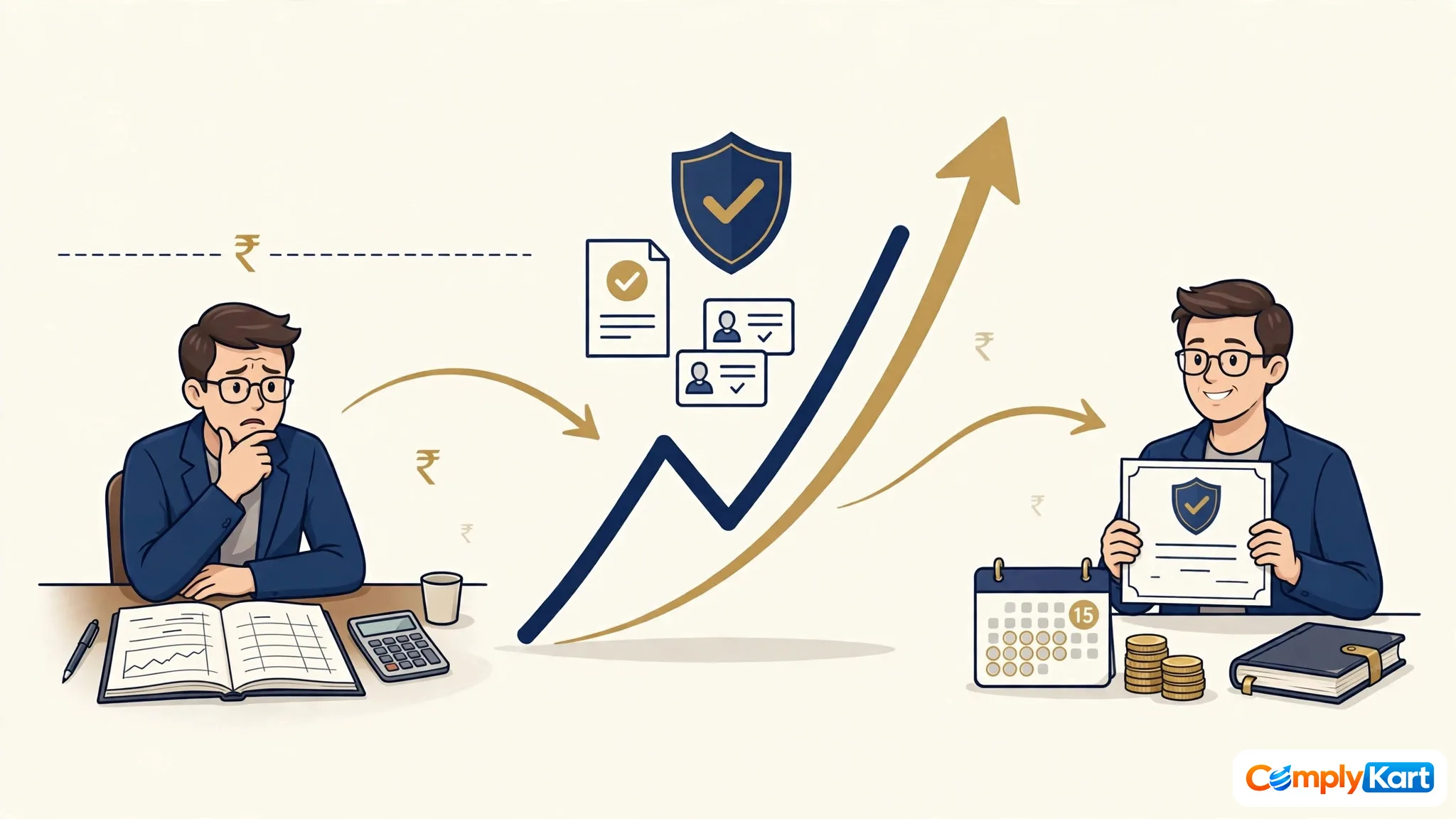
Payroll looks simple from the outside. Money goes in, salaries come out. Inside, it is a monthly machine with a dozen moving parts that must all land on time: attendance frozen, leave adjusted, overtime computed, PF deducted and deposited, ESI filed, professional tax mapped state by state, TDS computed under two competing tax regimes, challans paid, returns filed, payslips issued, and the whole thing reconciled before the next month starts. Miss one part and the interest clock starts — PF damage
CA/CS-guided reviewYour documents and structure are checked before anything is filed.
Written scope firstInclusions and payable charges are explained before work begins.
Support till it’s doneOne team owns your filing, from the first call to the final handover.
Price on request
This work is scoped case by case. You get a fixed written quote before any work starts — no charge for asking.
Five steps, no guesswork — you always know exactly what comes next. Tap a step to see what it involves.
12345
You pay securely. Payment is confirmed instantly, and your receipt with the written fee breakup lands in your inbox.
Is payroll processing right for your business?
Managed payroll processing fits if any of these describe you:
You have 10 or more employees and the monthly compliance cycle is consuming real staff time or getting done late.
You operate in more than one state — professional tax slabs, registrations, and return frequencies differ by state, and multi-state payroll is where in-house processes most often break.
You engage contract workers alongside employees and need the wage, PF, and ESI treatment kept cleanly separate.
Your team includes employees who switch tax regimes, claim HRA, or submit investment proofs — the TDS computation is getting complicated.
You have faced a notice, a late-deposit interest charge, or an ECR mismatch and want the calendar owned by someone whose job it is.
You probably do not need it if:
You have fewer than 5 employees with simple fixed salaries and no state complications — a basic payroll tool plus a quarterly CA review may be enough.
You are a solo founder with no employees — there is no payroll to process, though director remuneration has its own TDS treatment worth getting right.
You already run a tight in-house payroll with a dedicated resource and clean audit history — in that case, a periodic compliance review is the better buy.
What must be decided before payroll starts
Salary structure. The split between basic, HRA, special allowance, and reimbursements determines PF liability (PF applies to basic + dearness allowance, and to other allowances that are universally paid), gratuity base, and TDS. A structure designed once, correctly, pays off every month for years.
Tax regime default. The new regime is the default from FY 2023-24. Employees must actively opt for the old regime, and the employer must collect and record each employee's choice at the start of the year — TDS is computed on the chosen regime, and getting this wrong means under- or over-deduction for twelve months.
Attendance and leave policy. Payroll needs clean inputs: attendance, approved leave, overtime hours, and loss-of-pay days, frozen by a cutoff date each month. The policy behind those inputs — leave types, encashment rules, overtime rates — must be written down before the first run.
Joiners, exits, and notice periods. The process for onboarding (UAN generation, ESI IP registration, Form 12B for mid-year joiners) and exits (F&F computation, notice recovery) must be defined, because ad-hoc handling is where data goes missing.
Advantages of proper payroll processing
Every statutory due date met, every month
The core value is calendar discipline. PF by the 15th, ESI by the 15th, PT per the state schedule, TDS by the 7th — a managed process hits all of them without depending on any one person's memory or availability. Lateness interest simply stops happening.
TDS computed correctly across both regimes
With employees split between the old and new tax regimes, each with different deduction and exemption treatment, manual TDS computation is error-prone. A proper process tracks each employee's regime choice, validates investment proofs for old-regime claimants, handles HRA exemption correctly, and adjusts for mid-year salary changes — then reconciles the whole thing in Form 24Q each quarter.
Clean audit trails for every rupee
Each month's run produces reconciled workings: gross to net for every employee, challans matched to deductions, ECR files matched to the payroll register, and 24Q figures tied back to the books. When a PF inspector, an income-tax notice, or a due-diligence team asks questions, the answers exist in files, not in someone's recollection.
Employees trust the payslip
Accurate, on-time payslips with correct PF numbers, TDS breakups, and leave balances reduce HR queries dramatically. Nothing erodes employee trust faster than a wrong deduction that takes three months to fix.
Bonus, gratuity, and leave encashment handled right
Annual computations — bonus at 8.33% to 20%, gratuity at 15 days per year after eligibility, leave encashment with correct tax treatment — are done once a year and done correctly, instead of being reconstructed under pressure.
Multi-state compliance without the spreadsheet chaos
Professional tax alone has different slabs, registration forms, and return frequencies in every levying state. A managed process maintains a state-wise compliance map and files each one on its own schedule, instead of discovering a missing registration during an inspection.
Scales without rebuilding
Going from 20 to 80 employees, adding a second state, or onboarding a batch of contract staff does not require rebuilding the process. The system absorbs the change; the calendar stays the same.
Documents and inputs required
Employee master. For each employee: name, PAN, Aadhaar, UAN (or details to generate one), ESI IP number where applicable, bank account, date of joining, salary structure, tax regime choice, and investment declarations.
Monthly variables. Attendance, approved leave, overtime hours, loss-of-pay days, arrears, incentives, and any one-time payments — frozen by the agreed cutoff date.
Statutory registrations. The company's PF code, ESI code, professional tax registrations (per state), and TAN for TDS. If any registration is missing, it must be obtained before the first compliant run — payroll cannot be compliant on unregistered codes.
Policy documents. Leave policy, notice period terms, bonus applicability, and the salary structure template. These are the rules the monthly run applies.
Payroll process — step by step
Step 1: Input collection and freeze
Attendance, leave, overtime, and variable pay inputs are collected from HR and frozen by the cutoff date. Late inputs go into the next month's arrears — this discipline is what keeps the cycle on schedule.
Step 2: Gross salary computation
Basic, allowances, overtime, arrears, and one-time payments are computed per the salary structure. Joiners are pro-rated; exits trigger the F&F track.
Step 3: Statutory deductions
PF at 12% on applicable wages (up to the ₹25,000 ceiling), ESI at 0.75% where the employee is covered (up to ₹21,000), professional tax per the state slab, and TDS on salary computed on estimated annual income under the employee's chosen regime. Each deduction is validated against ceilings and exemptions.
Step 4: Net pay and bank file
Net salaries are computed, the bank payment file is generated and verified — account numbers, totals, and exception reports checked before release.
Step 5: Challan deposits
PF challan after ECR upload on the EPFO portal, ESI challan after the contribution file, PT challan on the state portal, and TDS challan against the company's TAN. Each payment is matched to its computation before it is made.
Step 6: Returns and filings
Monthly ECR (which is itself the PF return), monthly ESI filing, PT returns at state frequency, and quarterly Form 24Q for TDS. Each filing is reconciled to the challans.
Step 7: Payslips and reports
Payslips are generated and issued, statutory ledgers are updated, and the monthly MIS — headcount, cost, variance, compliance status — goes to management.
Step 8: Reconciliation
Payroll payable is reconciled to the general ledger, statutory dues to challans, and TDS to Form 26AS. Exceptions are investigated and closed before the next cycle begins.
How long does it take?
A monthly payroll cycle runs 5 to 7 working days from input freeze to payslip issue for a typical SME — shorter once the process is bedded in. The first month takes longer: employee master setup, UAN/KYC validation, registration checks, and salary-structure review usually need two to three weeks. Full-and-final settlements run on a separate 30-to-45-day track from the last working day. Annual items — Form 16 by 15 June, bonus computation, gratuity provisioning — follow the statutory calendar.
What does it cost?
Managed payroll is typically priced per employee per month, with the rate depending on headcount, number of states, and service depth (processing only, versus processing plus compliance filings, versus full HR support). As a sense of scale, the compliance failures it prevents — PF damages, TDS interest at 1% to 1.5% per month, ESI penalties, and the staff time spent firefighting — routinely exceed the fee for companies above 15 to 20 employees.
The PF/ESI/PT compliance bundle — the statutory core of every payroll
Every payroll in India carries three statutory deductions beyond income tax, and they are the most audited part of the entire cycle. This section is the reference.
Provident Fund. Under the EPF Scheme, 2026, PF applies at 12% of wages from the employee and a matching 12% from the employer. The wage ceiling is ₹25,000 per month (raised from ₹15,000 by S.O. 5109(E) in September 2026) — contributions are computed on wages up to this ceiling. Of the employer's 12%, 8.33% is diverted to the pension scheme (EPS) and 3.67% stays in the provident fund. The monthly ECR upload on the EPFO portal is itself the return; the challan follows the ECR. Late payment attracts interest and damages — this is the single most expensive payroll default.
ESI. Under the Code on Social Security, 2020 (operational for ESIC from November 2025), ESI applies where wages are up to ₹21,000 per month: 0.75% from the employee, 3.25% from the employer. The contribution file is uploaded monthly on the ESIC portal. New joiners need IP registration; exits must be marked — a missed exit blocks the member's own benefit claims later.
Professional tax. Levied by states under their own Acts, capped at ₹2,500 per person per year by Article 276 of the Constitution. Slabs, registration forms (PTEC for the employer certificate, PTRC for deduction), and return frequencies differ by state — Maharashtra, Karnataka, West Bengal, and others each run their own system. Multi-state payroll means a separate PT track for every state with employees.
The monthly rhythm. Freeze inputs, compute, deduct, deposit each head on its own portal by its own due date, file each return, reconcile everything. The bundle is where payroll providers earn their fee — it is repetitive, deadline-driven, and unforgiving of lapses.
TDS on salary — Section 192 and the quarterly machinery
TDS on salary is the income-tax head of payroll, and it has its own complete compliance cycle.
The computation. Under Section 192 (Section 392 from 1 April 2026 under the Income-tax Act, 2025), the employer estimates each employee's annual salary income, applies the employee's chosen tax regime — new regime is the default; the old regime must be actively opted — reduces the standard deduction (₹75,000 under the new regime, ₹50,000 under the old, for FY 2025-26), applies exemptions (HRA for old-regime claimants with valid rent proofs) and Chapter VI-A deductions (80C, 80D and others, old regime only, against verified proofs), computes tax at the slab rates in force, adds 4% health and education cess, and spreads the resulting annual TDS across the remaining salary payments. Mid-year changes — increments, bonuses, regime switches, new declarations — require recomputation; the employer may adjust shortfalls or excesses in later months.
Deposit. TDS deducted in a month must be deposited by the 7th of the following month (30th April for March deductions), via e-payment against the company's TAN. Late deposit attracts interest at 1.5% per month; late deduction at 1% per month.
Form 24Q. The quarterly TDS statement for salary, due 31 July, 31 October, 31 January, and 31 May. It reports employee-wise salary paid and TDS deducted. (Under the Income-tax Act, 2025, the form numbering is being revised — confirm the current form at filing time.) Late filing attracts a fee of ₹200 per day, capped at the TDS amount.
Form 16. The annual TDS certificate issued to each employee by 15 June, showing the salary breakup, deductions considered, and TDS deducted. Employees match it against Form 26AS and AIS before filing their returns. Errors in Form 16 — wrong PAN, missing perquisites, unadjusted regime — are among the most common payroll complaints, and they surface at ITR filing time when fixing them is hardest.
The declaration cycle. At the start of each financial year: collect regime choices and investment declarations. Through the year: compute monthly. Before the last quarter: collect and verify proofs (80C, 80D, HRA rent receipts, home-loan certificates) for old-regime claimants. In the last quarter: finalize, adjust, and close. Miss the proof-collection window and the TDS for the year is wrong.
What happens after payroll goes live
In the first 30 days: the employee master is validated — PANs verified, UANs generated or linked with KYC, ESI IPs registered, bank accounts confirmed with penny-drop or equivalent verification. The first run is reconciled line by line; exceptions are expected and fixed.
In the first 6 months: the process beds in. Input discipline improves, the proof-collection cycle runs once, the first Form 24Q is filed and reconciled, and the monthly MIS starts showing trends — headcount cost, attrition-linked F&F volumes, and compliance status at a glance.
The recurring compliance you are signing up for
Monthly. PF ECR and challan, ESI contribution file and challan, PT deposit per state schedule, TDS deposit by the 7th, payslips, and the full reconciliation.
Quarterly. Form 24Q filing and challan-to-return reconciliation; PF and ESI ledger reviews.
Annual. Form 16 issuance by 15 June; bonus computation and payment; gratuity provisioning; leave encashment settlement; salary-structure review against minimum-wage revisions; investment-proof collection for the new financial year.
Event-based. Joiner onboarding (UAN, ESI IP, Form 12B), exit F&F, salary revisions, regime switches, and inspections or notices from any of the four authorities.
Common mistakes and how to avoid them
Treating the TDS regime choice as a formality. The new regime is the default; employees who want the old regime must opt in, and the employer must record the choice. Computing everyone's TDS on one regime is the most common systematic payroll error.
Missing the investment-proof window. Old-regime TDS computed on declarations without verified proofs collapses at year-end. Collect proofs before the last quarter, verify them, and recompute — not after Form 16 is issued.
Late PF deposits. PF damages and interest are the most expensive payroll default because they compound monthly and cannot be waived easily. The ECR-and-challan discipline must be non-negotiable.
ESI exits not marked. A leaver whose ESI exit is never marked continues to appear as an active insured person, blocking their own claims and corrupting the contribution file. Exit marking is part of F&F, not an afterthought.
Wrong PT slab mapping. Applying one state's slab to another state's employees, or missing a new state's registration when hiring there, creates multi-year arrears. Maintain a state-wise PT map and update it with every new location.
F&F computed without tax treatment. Leave encashment, gratuity, and notice-pay recovery each have specific tax treatments. An F&F done as a simple net-pay calculation gets the tax wrong and the employee comes back with questions.
Penalties that actually bite
PF: late payment attracts interest plus damages that scale with the delay — and the liability is personal to the employer. ESI: similar interest and damages structure, plus prosecution provisions for persistent default. TDS: 1% per month interest for late deduction, 1.5% per month for late deposit, ₹200 per day for late 24Q filing, and the employer can be treated as an assessee-in-default with recovery of the tax itself. Professional tax: state-specific penalties and interest, typically with prosecution provisions for unregistered deduction. None of these are waived because the payroll was "almost" on time.
Comparison: what payroll covers vs adjacent services
Area
Covered in payroll processing
Separate service
Monthly salary + deductions
Yes
—
PF/ESI/PT deposits and returns
Yes
Registrations via PF/ESI/PT services
TDS on salary + 24Q + Form 16
Yes
TDS filing service for non-salary TDS
Bonus and gratuity computation
Yes
—
Full-and-final settlement
Yes
—
Labour law registers (muster, wages)
Often included
Shops Act / Factory Act compliance
Employee contracts and appointment letters
No
Legal documentation
Income-tax return filing for employees
No
ITR filing service
How ComplyKart helps in this entire process
Setup and migration. We build the employee master, validate PANs and UANs, complete KYC, verify bank accounts, review the salary structure for PF and gratuity correctness, and record every employee's tax regime choice.
Monthly processing. We run the full cycle — inputs, computation, deductions, bank file, challans, returns, payslips, and reconciliation — on a fixed calendar, with exception reports for your approval before any payment is released.
Statutory calendar ownership. PF, ESI, PT (every state), and TDS deposits and filings are diarised and executed. You see a monthly compliance dashboard; we handle the portals.
Quarterly and annual closure. Form 24Q every quarter with challan reconciliation; Form 16 by 15 June; bonus and gratuity computations; the annual proof-collection cycle managed end to end.
Exits handled cleanly. Full-and-final settlements computed with correct tax treatment, ESI exits marked, UAN exit dates updated, and experience letters supported with accurate data.
What we will not do: we cannot backdate statutory deposits to avoid interest, create proofs for deductions employees did not actually make, or process payroll on unregistered PF/ESI/PT codes — registrations must be in place first, and we will tell you exactly which ones are missing.
Sources
This page is built on the EPF Scheme, 2026 and S.O. 5109(E) (September 2026) for the ₹25,000 wage ceiling; the Code on Social Security, 2020 as operational for ESIC; state Professional Tax Acts and Article 276 of the Constitution; the Income-tax Act, 1961 (Section 192) and the Income-tax Act, 2025 (Section 392) for salary TDS, with Form 24Q and Form 16 timelines from the Income-tax Rules; the Payment of Bonus Act, 1965; and the Payment of Gratuity Act, 1972. Statutory rates, ceilings, and form numbers change — we verify the current position at the time of engagement.
FAQ
Frequently asked questions
21 answers from our consultants.
You pay for our expert's time — document checking, filing, follow-ups — not the government. The government fee goes to the government; our fee is for the work we do so you don't have to figure it out yourself.
₹100 per day, per form, with no maximum cap. A one-year delay on AOC-4 and MGT-7 together can cross ₹70,000 in late fees alone. File on time — it's the cheapest compliance you'll ever do.
Yes. Dormant or not, a private limited company must file AOC-4, MGT-7, hold board meetings and conduct a statutory audit every year. Zero turnover doesn't mean zero compliance.
AOC-4 is your financial statements (balance sheet, profit & loss) filed with the ROC. MGT-7 is your annual return (shareholding, directors, meetings). Both are due after your AGM — AOC-4 within 30 days, MGT-7 within 60 days.
Processing is the computation — gross to net, deductions, payslips. Compliance is the deposit-and-filing layer — challans, ECR, ESI returns, PT returns, 24Q. A complete service does both, because computing a deduction without depositing it is worse than useless: it creates a liability with your name on it.
8.33% of wages goes to the Employees' Pension Scheme (EPS) and 3.67% stays in the provident fund. The split applies up to the wage ceiling. This is why the EPS number on an employee's passbook never matches 12%.
Employees with wages up to ₹21,000 per month in covered establishments and areas. The deduction is 0.75% from the employee and 3.25% from the employer. Coverage is establishment-linked — check whether your location and industry are covered before assuming exemption.
A state-level tax on employment, deducted from the employee's salary and deposited with the state. It cannot exceed ₹2,500 per person per year (Article 276). Slabs, registration, and return frequency differ by state — and some states and union territories do not levy it at all.
The employer estimates the employee's full-year salary income, applies the chosen tax regime, reduces the standard deduction and verified exemptions/deductions, computes annual tax at the slab rates plus 4% cess, divides by the remaining pay periods, and deducts that amount monthly — adjusting for mid-year changes as they happen.
The new regime applies by default. The employer must still record the default explicitly and compute TDS accordingly. An unrecorded choice that is later disputed is the employer's problem, not the employee's.
When an employee joins mid-year, Form 12B collects the salary already paid and TDS already deducted by the previous employer. Without it, the new employer computes TDS on only part of the year's income and under-deducts — the shortfall surfaces in the employee's ITR.
By the 7th of the following month for April-to-February deductions, and by 30th April for March deductions. Late deposit attracts interest at 1.5% per month from the deduction date.
31 July, 31 October, 31 January, and 31 May for the four quarters. Late filing costs ₹200 per day up to the TDS amount. Note that form numbering is being revised under the Income-tax Act, 2025 — confirm the current form at filing time.
By 15 June following the financial year. It is the employee's proof of salary TDS and the starting document for their ITR filing. Issue it late and you will hear about it from every employee with a filing deadline.
Under the Payment of Bonus Act, employees earning up to ₹21,000 with at least 30 working days in the year are eligible. Bonus ranges from 8.33% to 20% of wages, computed on wages up to ₹7,000 (or the minimum wage, whichever is higher, for the calculation base). It must be paid within 8 months of the accounting year-end.
After 4 years and 10 months of continuous service (the courts treat this as 5 years for gratuity purposes). It is computed at 15 days' wages per completed year of service, capped at ₹20 lakh. It is paid on exit — resignation, retirement, or termination — and is a defined-benefit liability the employer must provision for.
Unpaid salary for the notice period served, leave encashment, bonus if due, gratuity if eligible, and any reimbursements — less deductions for notice-period shortfall, advances, loans, and asset recovery. Each component carries its own tax treatment, which is why F&F done as a single net figure is usually wrong.
Most companies complete it within 30 to 45 days of the last working day. Some state rules prescribe shorter timelines — confirm your state's position. Deliberate delay beyond the norm invites complaints to the labour department.
No — and they must not. Contract workers are on the contractor's payroll; your obligation is to ensure the contractor holds a valid license, deducts and deposits PF/ESI for its workers, and pays at least minimum wages. Putting contractor workers on your payroll creates an employment relationship you did not intend.
The payroll register with employee-wise gross, deductions, and net; challans for PF, ESI, PT, and TDS; ECR files; 24Q acknowledgements; Form 16 copies; bonus and gratuity workings; and leave and attendance records. A PF or income-tax inspector will ask for these first.
Yes, and this is routine — but each state adds a professional tax track (registration, slab, return frequency) and potentially a labour welfare fund deduction. The payroll system must maintain a state-wise compliance map; a single national template will get PT wrong somewhere.
What clients say about working with us
Real stories from businesses we've worked with.
Trademark Registration“
Our Trademark was applied in all the classes with a short span of time by Complykart Trademark Experts and I can say the level of expertise and commitment they carry is remarkable. It's an A+ from my side. We are now sticking to ComplyKart only.
Company Registration“
I found the professionalism of the staff at complykart.com, a pleasure to work with. As a foreigner to India, they took the time to explain the documentation and assisted in every question I raised. I was pleased that complykart.com made it easy for my Business.
Merger & Acquisition“
Trust, Commitment, Dedication and responsiveness are the best things with ComplyKart. Thanks for handling our Merger assignment with so much care. After my business disputes, complykart handles all things with own sense of understanding.
Labour Law Specialist · Labour Laws & Payroll Compliance · 7+ years experience
Vedant Kulkarni handles ComplyKart’s labour law and payroll compliance practice. He manages PF, ESI, Professional Tax and Shops & Establishments registrations, payroll structuring, and compliance under the new Labour Codes. He keeps companies audit-ready across every state they operate in.
Last reviewed: 16 November 2026
Get a free consultation
Talk to a ComplyKart professional about Payroll Processing. The first consultation is free.