Five steps, no guesswork — you always know exactly what comes next. Tap a step to see what it involves.
12345
You pay securely. Payment is confirmed instantly, and your receipt with the written fee breakup lands in your inbox.
The five reconciliations every business needs
Most Indian businesses need five reconciliations running on a rhythm. Each answers a different question, each protects against a different failure.
Bank reconciliation answers: does our cash book match what the bank says? Differences arise from cheques issued but not presented, deposits recorded but not yet credited, bank charges and interest not yet booked, direct debits (EMI, utility) the accountant never saw, and plain errors on either side. A bank reconciliation statement bridges the two balances and every item on it must either clear in the next cycle or be investigated.
Vendor ledger reconciliation answers: do we agree with our suppliers on what we owe? Mismatches come from purchase invoices booked twice, debit notes not recorded, payments applied to the wrong invoice, and rate or tax differences. Beyond accuracy, there is a tax reason to get this right: Section 43B(h) of the Income-tax Act disallows expenses payable to micro and small enterprises if not paid within the statutory time limit (45 days where no agreement specifies a shorter period). An unreconciled creditor ledger can quietly convert deductible purchases into disallowed expenses.
Customer ledger reconciliation answers: do our customers agree on what they owe us? Unreconciled receivables hide bad debts, unadjusted advances, and credit notes never issued. It also feeds directly into GST — advances received and credit notes issued both have return implications.
GST 2A/2B reconciliation answers: does the ITC we claimed match what the portal allows? This is the highest-stakes reconciliation in Indian compliance today, and it gets its own section below.
TDS reconciliation answers: does the tax deducted on our income appear in our Form 26AS and AIS? Missing TDS credits mean paying tax twice — once deducted, once demanded.
Bank reconciliation: the monthly non-negotiable
Bank reconciliation should be done every month, for every account, within days of the statement date — not in March for the whole year. The method is straightforward:
Start with the two balances: cash book and bank statement as of the same date. List every difference. Classify each as a timing difference (it will clear on its own — an unpresented cheque, a deposit in transit) or a permanent difference needing action (bank charges to book, an error to correct, an unknown debit to investigate).
Two rules govern the follow-up. First, timing differences must actually clear — an "unpresented cheque" sitting on the reconciliation for six months is not a timing difference, it is a stale cheque to cancel and reissue. Second, unknown debits are never written off casually; a debit you cannot identify could be an error, a duplicate charge, or fraud. Ask the bank, in writing, and keep the correspondence.
Businesses with high transaction volumes should reconcile using accounting software imports rather than manual ticking — the software matches amounts and dates automatically, leaving humans to investigate only the exceptions. The control that matters is not the tool but the discipline: prepared by one person, reviewed by another, signed off monthly.
Vendor and customer ledgers: where relationships meet records
Ledger reconciliation with counterparties is part accounting, part relationship management. The process: obtain the supplier's statement of account (or send your own to the customer), compare invoice by invoice, and bucket the differences — timing (invoice recorded in different months), errors (wrong amount, wrong tax, duplicate entry), and genuine disputes (short supply, rate disagreement, quality claim).
Each bucket has a different resolution path. Timing differences need nothing but patience and a note. Errors need a correcting entry or a debit/credit note. Genuine disputes need a commercial conversation — and here reconciliation earns its keep twice over, because a documented, invoice-level position is what gets disputes settled instead of festering.
For vendors, run this quarterly at minimum, and always before year-end — your auditor will ask for balance confirmations from major creditors anyway, and a pre-reconciled ledger turns that exercise from a fire drill into a formality. For customers, tie the rhythm to your credit policy: monthly for large debtors, quarterly for the rest. Ageing analysis (how long each balance has been outstanding) should come out of the same exercise — a receivable over 180 days old needs a provision decision, not just a reconciliation tick.
GST 2A/2B reconciliation: the one the law now demands
No reconciliation has changed more in recent years than GST input tax credit matching. The position today is strict:
GSTR-2B is the only document that matters for claiming ITC. Generated on the 14th of each month from suppliers' GSTR-1 and IFF filings, it is static — unlike the dynamic GSTR-2A, it does not change after generation. Since 1 January 2022, Rule 36(4) allows zero provisional credit: ITC can be claimed only on invoices and debit notes that appear in GSTR-2B. GSTR-2A remains useful as an early-warning view of what suppliers have filed, but it confers no claim right.
The monthly routine: on the 14th, download GSTR-2B; match it invoice-wise against your purchase register; classify every gap. Gaps fall into three buckets — timing (supplier filed late; the invoice will appear in a later 2B), supplier error (wrong GSTIN, wrong invoice number, missed invoice — needs the supplier to correct via GSTR-1A), and genuine absence (no ITC available — reverse or do not claim).
Three related provisions make this reconciliation consequential rather than academic. Section 16(4) sets a hard expiry: ITC on an invoice for a financial year must be claimed by 30 November of the following year, after which it lapses permanently. Rule 37A requires reversal by 30 November if the supplier reported the invoice but failed to file GSTR-3B by 30 September following the year — with re-availment allowed if the supplier files later. Rule 88D automates scrutiny: if your GSTR-3B ITC exceeds your GSTR-2B ITC beyond ₹25 lakh or 5% (whichever is higher), the system generates a DRC-01C notice demanding payment or explanation within seven days.
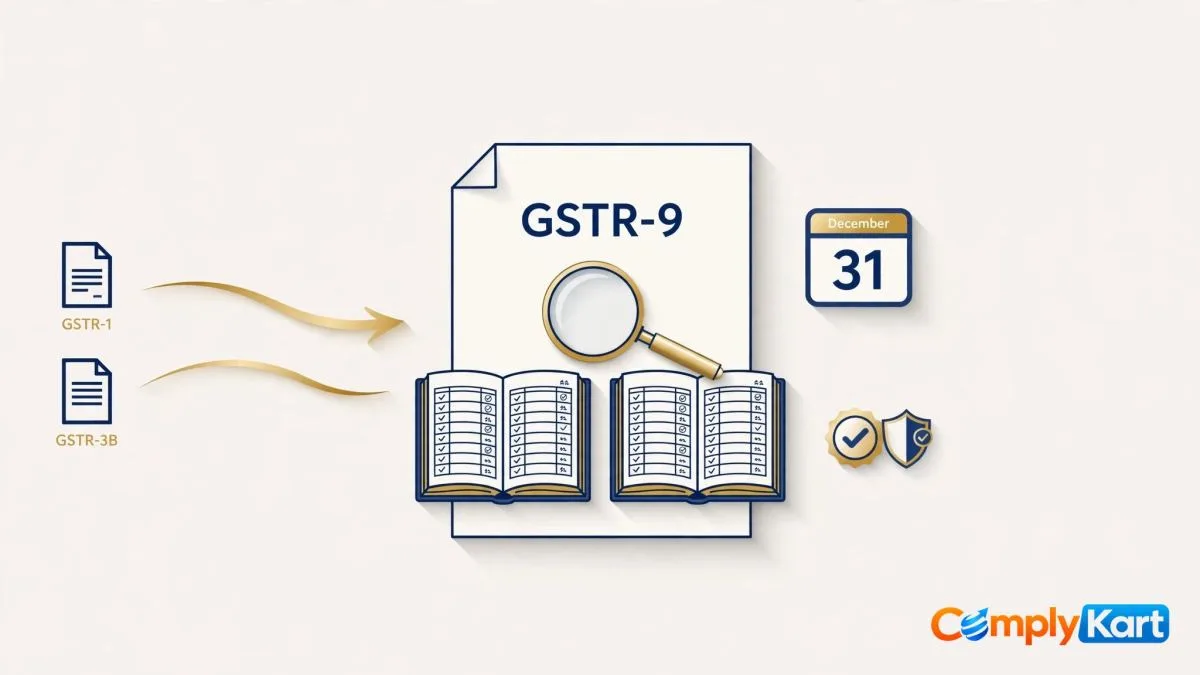
At year-end, the annual reconciliation feeds GSTR-9: since Notification 20/2024, Table 8 of the annual return reconciles ITC against GSTR-2B, not 2A. A business that reconciles monthly files GSTR-9 from a workbook; one that does not, files it from memory and hope.
TDS reconciliation: stop paying tax twice
Every quarter, compare three things: TDS deducted per your books (on income you earned), TDS credits in Form 26AS, and the Annual Information Statement (AIS) with its Taxpayer Information Summary (TIS). Differences are common — deductors file late, quote wrong PANs, or deduct under the wrong section — and each has a fix: follow up with the deductor for a revised return, or reconcile the section mismatch with documentation.
The AIS deserves special attention because the department's systems now cross-verify your return against it automatically. Securities transactions, high-value deposits, foreign remittances, and GST turnover all appear in AIS. A difference between your books and AIS that you cannot explain is a scrutiny trigger waiting for a notice number.
Intercompany and branch reconciliations
Groups with multiple entities — subsidiaries, branches, sister concerns — need intercompany reconciliation: every rupee one entity shows as receivable from another must appear as payable in the other's books, in the same period, for the same amount. Unmatched intercompany balances are a classic audit qualification and, where cross-border transactions exist, a transfer-pricing documentation gap. Reconcile monthly, settle periodically, and document the settlement.
Why auditors care so much about reconciliation
Ask any statutory auditor what they test first and reconciliation tops the list. The reasons are structural: CARO 2020 (the Companies Auditor's Report Order) requires specific reporting on matters that only reconciled records can answer; tax audit Form 3CD has clauses that assume reconciled GST and TDS data; and the auditor's fundamental duty — to state whether the accounts give a true and fair view — cannot be discharged over unreconciled balances.
A business that hands its auditor pre-reconciled ledgers, a clean bank reconciliation file, and a GST 2B workbook gets a faster, cheaper audit with fewer qualifications. A business that hands over chaos gets management letters, qualifications, and a fee that reflects the extra work. Reconciliation done monthly is a cost; reconciliation done at audit time is a crisis.
Our reconciliation process — step by step
Step 1 — Map every balance that needs reconciling
We list all bank accounts, major vendors and customers, GSTINs, TANs, and intercompany relationships, and assign each a frequency and an owner. Nothing gets reconciled "when someone has time" — everything has a slot in the calendar.
Step 2 — Pull the independent source
Bank statements, supplier statements of account, GSTR-2A/2B downloads, Form 26AS and AIS, counterparty confirmations. The source must be independent of your books — reconciling your sales register against your own invoice copies proves nothing.
Step 3 — Match at the transaction level
Invoice to invoice, amount to amount. Software does the bulk matching; humans handle the exceptions. We do not accept aggregate-only matching for GST or bank — differences hide in totals.
Step 4 — Classify every difference
Timing, error, or genuine dispute. Each classification dictates the next action, and the classification itself is documented — "timing difference, expected to clear in May 2B" is a control; an unexplained gap is a finding.
Step 5 — Chase the external party where needed
Supplier corrections via GSTR-1A, deductor revisions for TDS, bank queries for unknown debits, customer follow-ups for disputed invoices. We draft the follow-ups and track them to closure — a reconciliation with 40 open follow-ups is a to-do list, not a control.
Step 6 — Book the corrections
Charges, interest, errors, provisions — the books are updated so that next month starts clean. Corrections are passed with narration referencing the reconciliation, so the audit trail is complete.
Step 7 — Age and escalate the stubborn items
Any difference open beyond 90 days gets escalated: stale cheques cancelled, old receivables provided for, long-pending supplier disputes taken to management. Reconciliation items must not become permanent residents of the balance sheet.
Step 8 — Report and file
A monthly reconciliation pack — BRS for each account, ledger summaries, GST 2B match report, TDS status — goes to management with exceptions highlighted. The pack is filed as the month's evidence, ready for auditors, lenders, and the department.
How ComplyKart helps — and what we do not do
We run your reconciliations as a monthly service: bank reconciliations for all accounts, vendor and customer ledger matching with follow-up drafting, GST 2A/2B invoice-level matching with ITC classification, quarterly TDS reconciliation against 26AS and AIS, and intercompany matching for groups. You get a monthly pack with every difference classified, chased, or corrected — and an audit-ready file at year-end.
What we do not do: we do not invent confirmations or sign off on balances we have not verified. We do not "adjust" differences into profit and loss to make them disappear — every write-off or provision is proposed to you with the evidence, and booked only on your approval. Reconciliation that hides problems is worse than no reconciliation at all.
Common mistakes we see
Reconciling annually. A year's worth of bank differences investigated in March is archaeology, not accounting. Monthly is the only frequency that works.
Claiming ITC without 2B matching. The provisional-credit era ended on 1 January 2022. Every rupee of ITC in GSTR-3B must trace to GSTR-2B, or it is excess credit carrying interest.
Treating timing differences as resolved. An unpresented cheque from eight months ago, a "timing" GST gap that never appears in a later 2B — these need action, not patience.
Ignoring the AIS. The department sees your AIS before it sees your return. Unexplained AIS differences are the commonest trigger for automated notices.
No maker-checker. The person who prepares the bank reconciliation should not be the person who operates the bank account. This is the oldest fraud control in accounting, and skipping it is how embezzlements run for years.
FAQ
Frequently asked questions
23 answers from our consultants.
You pay for our expert's time — document checking, filing, follow-ups — not the government. The government fee goes to the government; our fee is for the work we do so you don't have to figure it out yourself.
Tell us your situation in plain words — what you're trying to do, not which form you think you need. Half our job is stopping clients from buying the wrong service. The first consultation is free and honest.
Yes. We quote professional fee + government charges + taxes separately, in writing, before you pay. The number doesn't change midway. If the government fee changes, we show you the notification.
Every engagement gets a tracker — you see what's filed, what's pending and what's next. No chasing on WhatsApp for status updates.
Matching your books against bank statements, supplier and customer ledgers, GST portal data (2A/2B), and TDS records (26AS/AIS); investigating every difference; chasing external parties for corrections; booking the resulting adjustments; and delivering a monthly reconciliation pack with an audit trail.
Usually timing — suppliers filed their GSTR-1 after the 2B generation cut-off — or supplier errors like wrong GSTIN or invoice numbers. Since 1 January 2022, only 2B-appearing invoices support an ITC claim, so the gap must be classified and followed up, not ignored.
No. Rule 36(4) permits zero provisional credit since 1 January 2022. ITC is available only for invoices furnished by the supplier and communicated to you in GSTR-2B. Claiming beyond 2B creates excess credit liable to reversal with interest.
Section 16(4): ITC on invoices of a financial year must be claimed by 30 November of the following year (the due date for the November GSTR-3B). After that, the credit lapses permanently.
If a supplier reports your invoice but fails to file GSTR-3B by 30 September following the financial year, you must reverse the ITC by 30 November. If the supplier files later, you can re-avail it. This makes monitoring supplier 3B filing — not just GSTR-1 — part of reconciliation.
Rule 88D: when ITC claimed in GSTR-3B exceeds ITC in GSTR-2B by more than ₹25 lakh or 5% of the 2B ITC (whichever is higher), the system auto-generates DRC-01C. You get seven days to pay the difference with interest or explain it with evidence.
Quarterly at minimum, monthly for large or critical suppliers, and always before year-end. Your statutory auditor will seek balance confirmations from major creditors — a pre-reconciled ledger makes that a formality instead of a fire drill.
Payments to micro and small enterprises not made within the statutory time limit (45 days where no shorter period is agreed) are disallowed as business expenditure for that year. A reconciled creditor ageing report is how you spot at-risk payments before the disallowance crystallises.
Each quarter, compare TDS deducted per your books against credits in Form 26AS and the AIS. For missing credits, get the deductor to file or revise their TDS return with your correct PAN; for section mismatches, keep the underlying documents. Never assume a missing credit will "appear later" — chase it.
2A is dynamic — it updates as suppliers file or amend, and serves as an early-warning view. 2B is static — generated once on the 14th of each month and frozen. For ITC claims, only 2B counts (Rule 36(4)); for annual analysis and GSTR-9 workpapers, 2A's completeness makes it the reference.
Yes. Every receivable in one group entity must mirror a payable in the other, in the same period. Unmatched intercompany balances draw audit qualifications, and for cross-border transactions they create transfer-pricing documentation gaps. Settle the balances periodically rather than letting them accumulate.
Read-only access to bank statements (or statement files), your accounting software backup or trial balance, supplier and customer ledgers, GST portal credentials for 2A/2B downloads (or the downloads themselves), and Form 26AS/AIS access. We work with Tally, Zoho Books, Busy, SAP exports, and Excel.
For a mid-sized business with a year of backlog, typically three to six weeks: one week to map and extract, two to three weeks of matching and follow-ups, and a final week of corrections and reporting. Ongoing monthly reconciliation thereafter takes days, not weeks.
Usually yes. Auditors price the risk and effort of unverified balances. Handing over reconciled ledgers, a clean BRS file, and a GST 2B workbook shortens fieldwork materially — and it sharply reduces the chance of qualifications that cost far more than fees.
A tracker for ITC on invoices in your books but not yet in GSTR-2B — timing differences you expect to cure within the Section 16(4) window. It stops you from either claiming early (excess credit) or forgetting entirely (lapsed credit). Every parked item needs a supplier-follow-up date.
It is one of the best fraud detectors available. Unknown bank debits, payments without purchase invoices, customer receipts not credited, and round-tripping patterns all surface in reconciliations — provided the preparer is independent of the person operating the accounts.
They do not vanish — they sit in suspense, inflate or deflate balances, and become audit findings. Material unreconciled items can lead to qualified audit opinions, tax additions (unexplained credits or disallowed expenses), and lender concerns during credit reviews.
A five-person firm needs at least monthly bank reconciliation and GST 2B matching — the ITC rules apply regardless of size, and a single DRC-01C notice costs more than a year of basic reconciliation. Scale the scope with transaction volume, not with headcount.
Bookkeeping records transactions; reconciliation verifies them against independent sources. They are complementary — good bookkeeping makes reconciliation faster, and reconciliation catches what bookkeeping missed. Most of our clients run both with us on a single monthly cycle.
What clients say about working with us
Real stories from businesses we've worked with.
Trademark Registration“
Our Trademark was applied in all the classes with a short span of time by Complykart Trademark Experts and I can say the level of expertise and commitment they carry is remarkable. It's an A+ from my side. We are now sticking to ComplyKart only.
Company Registration“
I found the professionalism of the staff at complykart.com, a pleasure to work with. As a foreigner to India, they took the time to explain the documentation and assisted in every question I raised. I was pleased that complykart.com made it easy for my Business.
Merger & Acquisition“
Trust, Commitment, Dedication and responsiveness are the best things with ComplyKart. Thanks for handling our Merger assignment with so much care. After my business disputes, complykart handles all things with own sense of understanding.
Senior Consultant · ESOP, Trademark & General Advisory · 14+ years experience
Pankaj Jain is a senior consultant covering ESOP structuring, trademark and IP protection, accounting advisory and legal documentation. With the broadest practice at the firm, he handles the matters that don’t fit neatly in one box.
Last reviewed: 16 November 2026
Get a free consultation
Talk to a ComplyKart professional about Reconciliation Services. The first consultation is free.