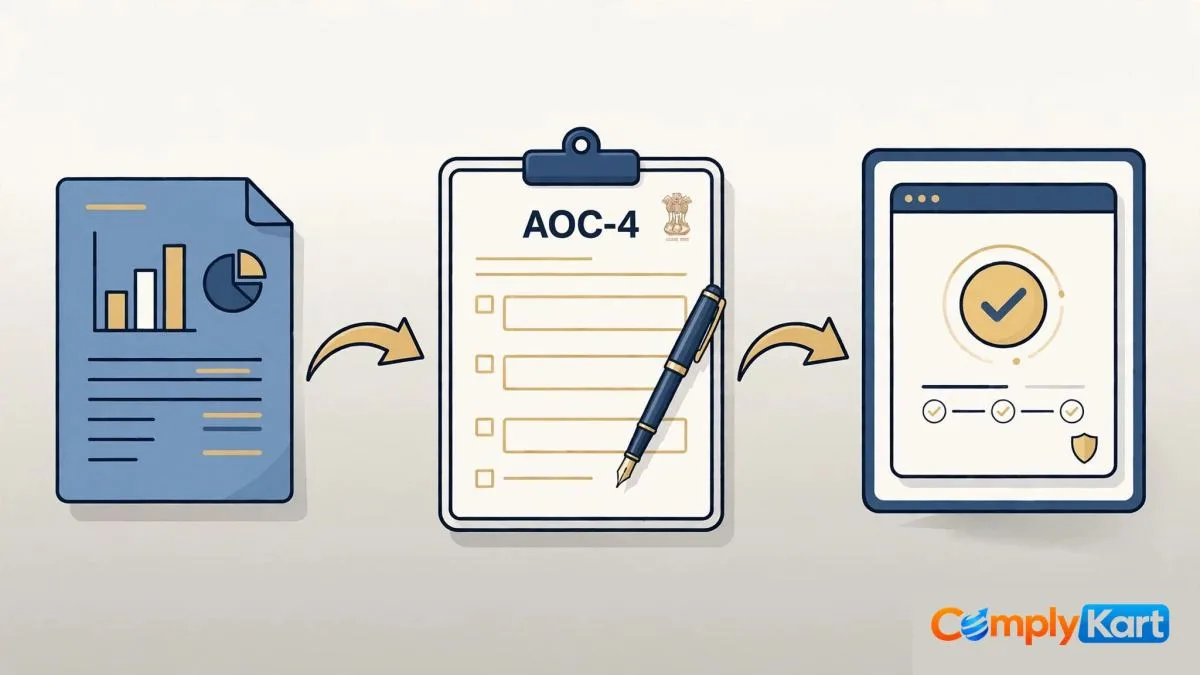
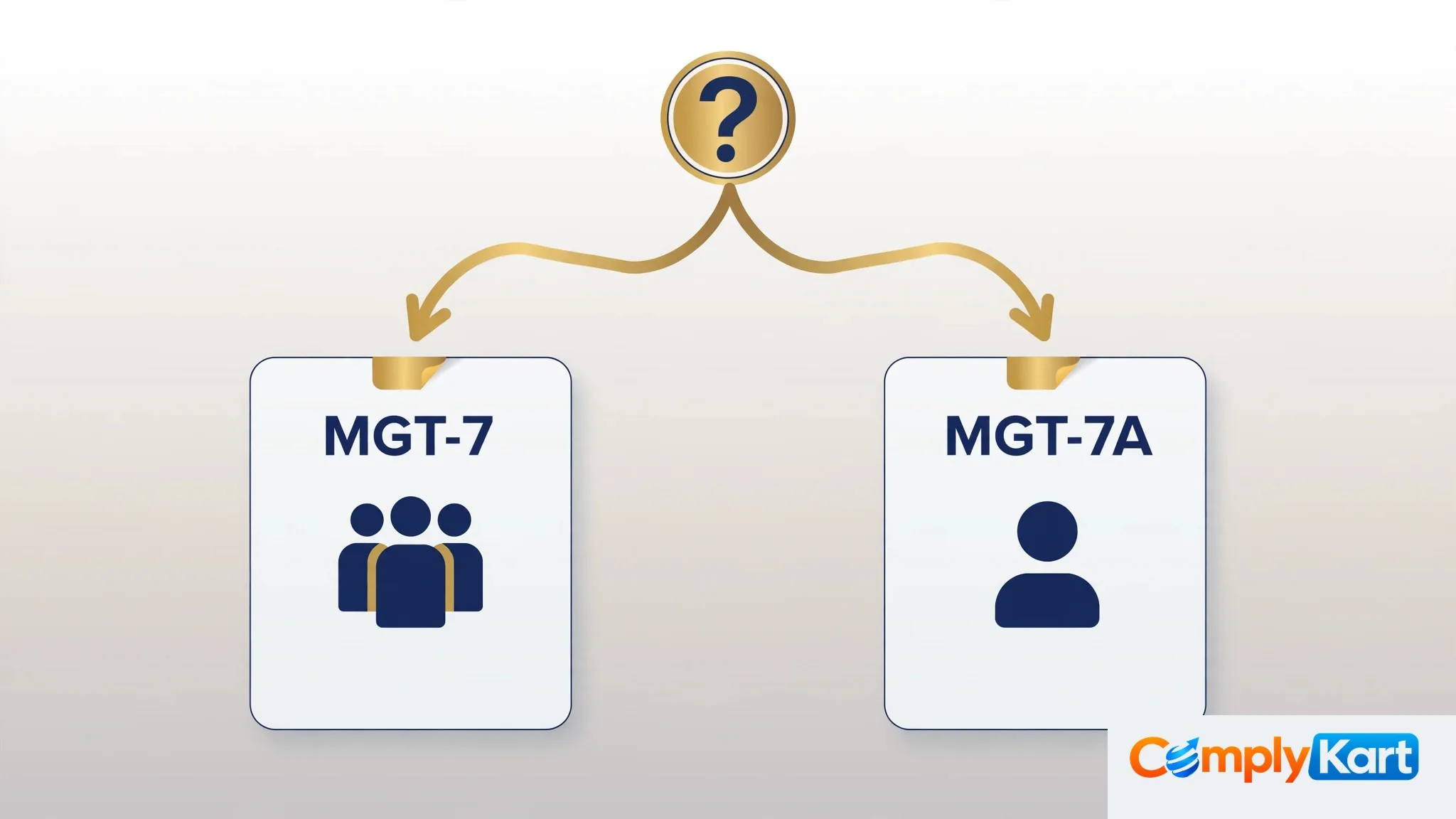
These are the government's numbers, not ours. The meter runs every single day, with no ceiling.
AOC-4 additional fee
₹100 per day
Every day past the due date (30 days after AGM). No upper cap — it keeps accumulating.
MGT-7 additional fee
₹100 per day
Charged separately from AOC-4. Due 60 days after AGM. Also no upper cap.
Non-filing penalty
Up to ₹2 lakh
Under Sections 92(5) and 137(3): ₹10,000 plus ₹100/day of continuing default, per form.
Director disqualification
Section 164(2)
Three consecutive years of default disqualifies every director for five years. Continued non-filing risks strike-off.
Put it in perspective: A company one year late on both forms pays about ₹73,000 in additional fees alone — with no upper limit.
Deadline + late-fee checker
How many days do you have — and what is the delay already costing?
Every annual-filing clock runs from your AGM date, not from a fixed calendar date. Enter the date your company held (or will hold) its AGM for FY 2025-26 and the date you expect to file — the checker works out each deadline and the additional fee meter.
ADT-1 · Auditor appointment
Due —
Enter your AGM date
Delay fee: 2×–12× of the normal fee (slab-based)
AOC-4 · Financial statements
Due —
Enter your AGM date
₹100 per day of delay · no cap
MGT-7 / 7A · Annual return
Due —
Enter your AGM date
₹100 per day of delay · no cap
Most March year-end companies held it on 30 September 2026 — that date is pre-filled.
Starts at today. Move it forward to see what waiting costs.
Additional fee for AOC-4 + MGT-7
₹0
File by the dates above and the meter never starts.
Additional fee under the Companies (Registration Offices and Fees) Rules, 2014 — ₹100 per day per form, with no upper cap. Adjudication penalties under Sections 92(5) and 137(3) sit on top of this and are not included here.
Five steps, no guesswork — you always know exactly what comes next. Tap a step to see what it involves.
12345
You pay securely. Payment is confirmed instantly, and your receipt with the written fee breakup lands in your inbox.
Overview
ROC annual filing is the yearly set of filings every company registered in India must submit to the Registrar of Companies (ROC) — the audited financial statements in Form AOC-4, the annual return in Form MGT-7 or MGT-7A, and the auditor intimation in Form ADT-1, all anchored to the Annual General Meeting. Treat it as the yearly report card your company hands to the Registrar. It is not one form. It is a sequence of forms, each with its own clock, all triggered by the Annual General Meeting. Miss the sequence and the penalty meter starts running at ₹100 per day, per form, with no ceiling.
Here is the shape of it. Your company holds its AGM. Within 15 days, it tells the ROC who its auditor is (ADT-1). Within 30 days, it files the audited financial statements the shareholders adopted (AOC-4). Within 60 days, it files the annual return — the company's identity statement for the year (MGT-7). Along the way, the board's approval of the financial statements itself triggers an MGT-14. Each form carries a different section of the Act, a different deadline, and a different penalty. Filing one does nothing for the other.
This page covers the full annual filing package: which forms, whose deadlines, what each carries, what it costs, what happens when you fall behind, and how to get back on track. If you want the deep dive on a single form, the linked pages go form by form.
Updated for FY 2025-26 · Reviewed 24 October 2026 · Fees, dates and penalty figures verified against the Companies Act, 2013, the Companies (Registration Offices and Fees) Rules, 2014 and the MCA's own circular list.
The deadlines that actually matter (FY 2025-26)
For FY 2025-26, with the AGM held on 30 September 2026: ADT-1 by 15 October 2026, AOC-4 by 30 October 2026, and MGT-7 / MGT-7A by 29 November 2026. Those three dates are the whole season. Every day of delay on AOC-4 and MGT-7 costs ₹100 per form in additional fees, with no cap — but for FY 2025-26 the MCA has relaxed the additional fee: General Circular No. 05/2026, dated 24 October 2026, lets companies file AOC-4 (and its CFS, XBRL and NBFC variants) up to 31 December 2026 and MGT-7/MGT-7A up to 31 January 2027 without additional fees. The statutory dates do not move — the AGM deadline is not extended — and once the relaxation window closes, the additional fee is counted from the original due date.
The AGM is the anchor. For a company with a March year-end, the AGM must be held within six months of the financial year-end — by 30 September — under Section 96. Everything else is computed from the date the AGM is actually held, not from a fixed calendar date. Hold your AGM on 15 September and every deadline below shifts fifteen days earlier.
For a company holding its AGM on 30 September 2026:
ADT-1 (auditor appointment): within 15 days of the AGM → 15 October 2026. Only needed when an auditor is appointed or reappointed at that AGM; an auditor continuing within a five-year term needs no fresh filing.
AOC-4 (financial statements): within 30 days of the AGM → 30 October 2026 (Section 137).
MGT-7 / MGT-7A (annual return): within 60 days of the AGM → 29 November 2026 (Section 92). MGT-7A is the simplified form for One Person Companies and small companies.
MGT-14 (board resolution approving financials): within 30 days of the board meeting where the financial statements and board's report were approved (Section 117 read with Section 179(3)). This one is easy to forget and heavily penalised in adjudication.
Two dates outside the AGM cycle:
DPT-3 (return of deposits): 30 June every year, regardless of the AGM.
DIR-3 KYC: director KYC is now triennial — next due 30 June 2028 under the 31 March 2026 framework (G.S.R. 943(E)). It no longer sits on the September calendar.
Form
What it files
Statutory window
Due date (AGM 30 Sep 2026)
ADT-1
Auditor appointment intimation
15 days from the AGM
15 October 2026
AOC-4
Audited financial statements
30 days from the AGM
30 October 2026
MGT-7 / MGT-7A
Annual return
60 days from the AGM
29 November 2026
MGT-14
Board resolution approving the financials
30 days from the board meeting
Depends on board date
A note on extensions: the MCA granted a one-off relaxation for FY 2024-25 filings, and for FY 2025-26 it has done the same. The Institute of Company Secretaries of India formally asked the MCA on 9 October 2026 to extend the annual filing dates to 31 December 2026 without additional fees — and on 24 October 2026 the MCA answered with General Circular No. 05/2026: AOC-4 (and its CFS, XBRL and NBFC variants) may be filed up to 31 December 2026 and MGT-7/MGT-7A up to 31 January 2027 without additional fees. The statutory dates above still stand — the circular does not extend the AGM — so treat the relaxation as breathing room, not a new deadline.
One counting note, because it generates real panic every October: Section 137 says AOC-4 is due "within 30 days of the AGM", and the MCA's own form help counts 29 October on an inclusive reading. The practitioner convention — the one MCA calendars and every date in this guide use — counts from the day after the AGM, which gives 30 October 2026. Both readings circulate; the safe move is to file by 29 October and make the argument disappear.
The full annual compliance calendar of a private limited company
Annual filing season is where directors look, but the ROC calendar runs all year. This is the complete recurring cycle for a private limited company — every filing, its due date for the current cycle, and what missing it costs. Keep this table; it is the one your compliance tracker should be built from.
Filing
Who it applies to
Due date
If you miss it
AGM (Section 96)
Every company except an OPC
30 September 2026
Fine under Section 99 — up to ₹1 lakh, plus ₹5,000 per day of continuing failure
ADT-1
Companies appointing or reappointing an auditor
15 October 2026
Additional fee at 2×–12× of the normal fee (slab-based)
AOC-4
Every company
30 October 2026
₹100 per day, no cap, plus the Section 137(3) penalty
MGT-7 / MGT-7A
Every company
29 November 2026
₹100 per day, no cap, plus the Section 92(5) penalty
MGT-14
Where the board resolution must be filed (public companies; private companies where the articles or Section 117 require it)
30 days from the board meeting
Slab-based additional fee
DPT-3
Companies with loans, deposits or exempted borrowings
30 June 2026
Slab-based additional fee; loan reporting gaps surface in diligence
MSME Form I
Companies buying from micro and small enterprises
30 April and 31 October 2026
Slab-based additional fee; the unpaid dues themselves lose tax deduction under Section 43B(h)
BEN-2
Companies with significant beneficial owners
Within 30 days of the BEN-1 declaration
Slab-based additional fee
CRA-4
Companies under cost audit
Within 30 days of receiving the cost audit report
Slab-based additional fee
DIR-3 KYC
Every director
Triennial — next 30 June 2028
₹5,000 late fee and DIN deactivation
Two of these dates move with your AGM, the rest are fixed to the calendar — which is exactly why companies miss one while watching the other. Our compliance calendar turns this table into your company’s own dates, and the compliance fee calculator prices the whole year in one pass. If you would rather hand the season over entirely, the ROC annual filing bundle covers the full package as one engagement.
AOC-4 vs MGT-7 vs ADT-1 — what each one actually is
Prospects routinely treat annual filing as a single task. It is three, and the confusion costs money. Here is the clean separation.
AOC-4 is the money. Filed under Section 137, it carries the audited financial statements the shareholders adopted at the AGM — balance sheet, profit and loss, cash flow where applicable — plus the auditor's report and the board's report with its annexures. Variants exist for special cases: AOC-4 CFS for consolidated statements, AOC-4 XBRL for listed companies and large companies (paid-up capital ₹5 crore or more, or turnover ₹100 crore or more), and NBFC-specific taxonomies. It is certified by a director and, for most companies, by a practising CA, CS or CMA.
MGT-7 is the identity. Filed under Section 92, the annual return is the company's corporate-identity statement: registered office, shareholding pattern, directors and key managerial personnel, meetings held, remuneration, indebtedness, and share transfers. It is signed by a director and the company secretary, or by a practising company secretary where the company has none. Companies with paid-up capital of ₹10 crore or more, or turnover of ₹50 crore or more, need MGT-8 certification by a practising CS. Small companies and OPCs use the shorter MGT-7A.
ADT-1 is the auditor's paperwork. Filed under Section 139 within 15 days of the AGM at which the auditor was appointed or reappointed. It is the shortest clock of the three and the easiest to miss, because the appointment decision happens at the AGM itself and the 15-day window closes before most teams have started thinking about AOC-4.
The relationship between them matters for sequencing: the auditor's report attaches to AOC-4, so the audit must be complete before the board approves the financials; the board's approval triggers the MGT-14; the AGM adopts the statements; and then the 30-day and 60-day clocks start. Do the work in the wrong order and you will be re-running board meetings.
Who must file — and the companies that wrongly think they are exempt
Every company registered under the Companies Act files annual forms. That includes private limited companies, public companies, One Person Companies, Section 8 companies, producer companies, and foreign companies with a place of business in India (FC-3/FC-4). The exemptions people assume do not exist:
Dormant companies (Section 455) still file AOC-4 and MGT-7 every year.
Zero-revenue companies with no transactions file too. "No business" is not a defence.
Companies with no auditor change still file AOC-4 and MGT-7; only ADT-1 drops out.
Strike-off is the only exit — until the ROC strikes the name off or the NCLT dissolves the company, the filing obligation continues, and the ₹100-a-day meter keeps running.
The one genuine carve-out: a One Person Company does not hold an AGM at all. Its AOC-4 is due within 180 days of the financial year-end (27 September for a March year-end), and its annual return clock runs 60 days from the financial year-end.
The first AGM plays by a different clock. A newly incorporated company gets nine months from the close of its first financial year to hold its first AGM under Section 96(1) — not six. The Registrar may extend an AGM deadline by up to three months for special reasons — applied for in Form GNL-1 before the deadline passes — but never for a first AGM, and whatever happens, the gap between two AGMs cannot exceed fifteen months. Young companies that assume the standard 30 September date, or assume an extension will cover year one, start their filing life already in default — and every clock in this guide then runs from the AGM they should have held.
Incorporated
First financial year ends
First AGM by
Then AOC-4 / MGT-7 (AGM on the last day)
January 2025 – December 2025
31 March 2026
31 December 2026
30 January 2027 / 1 March 2027
January 2026 – March 2026
31 March 2027
31 December 2027
Nothing due in the FY 2025-26 season
The January rule catches people out: a company incorporated on or after 1 January gets a first financial year that runs to the following 31 March (Section 2(41)), which is why early-2026 incorporations owe nothing this season — and why late-2025 incorporations owe their first set by the dates above, not by the standard September calendar.
Documents and information checklist
Annual filing is mostly an information-gathering exercise. Get these together before the AGM and the filing itself becomes mechanical.
Financials package (for AOC-4): audited balance sheet, profit and loss account, cash flow statement (where applicable), auditor's report, board's report with annexures (including the annual return extract where still required, CSR annexure where applicable), and notes to accounts. XBRL filers need the financials tagged in the applicable taxonomy.
Corporate records (for MGT-7): shareholding pattern as on the AGM date, list of directors and KMP, dates of board and general meetings held during the year, share transfer register entries, debenture and indebtedness details, and remuneration figures.
Auditor details (for ADT-1): auditor's consent letter, certificate of eligibility under Section 141, firm registration number, and the AGM resolution appointing or reappointing them.
Standing prerequisites: valid DSCs of the authorised signatories, an active DIN for each director (a deactivated DIN blocks the filing), and the company's CIN and registered-office details as per the MCA master data.
The filing sequence, step by step
Step 1 — Close the audit. The statutory audit must be complete and the auditor's report signed before the board can approve the financials. For FY 2025-26, the tax audit deadline was extended to 21 October 2026 — but that extension does not move the Companies Act AGM date. Do not let the income-tax calendar dictate the ROC calendar.
Step 2 — Board meeting approves the financials. The board approves the financial statements and the board's report. This resolution is a Section 179(3) matter and must be filed in MGT-14 within 30 days of the meeting. Fix the AGM date at this meeting and issue 21 clear days' notice.
One drafting change matters this season: for FY 2025-26 the Board's Report itself carries new disclosures under the Companies (Accounts) Second Amendment Rules, 2025 (G.S.R. 357(E), effective 14 July 2025) — the number of sexual-harassment complaints received, disposed of, and pending beyond 90 days; a statement confirming compliance with the Maternity Benefit Act, 1961; and the male, female and transgender employee counts as at year-end in the prescribed extract. A board that re-issues last year's report format files an incomplete report — and AOC-4 attaches what the board approved, defects included.
Step 3 — Hold the AGM. Adopt the financial statements, appoint or reappoint the auditor, declare dividends if any, and transact the ordinary business. Record the minutes; the MGT-7 will ask for the meeting date.
Step 4 — File ADT-1 within 15 days. The shortest clock. File the auditor appointment first, because it expires before the others.
Step 5 — File AOC-4 within 30 days. Upload the financials package with the auditor's report and board's report. Get the professional certification done before the last week — certifying professionals will not backdate.
Step 6 — File MGT-7 within 60 days. Compile the annual return from the registers. This is the form where sloppy record-keeping shows: missing meeting dates and unreconciled shareholding are the usual hold-ups.
Step 7 — Confirm SRNs and challans. Download the filed forms and payment challans. Keep them with the statutory registers; the secretarial auditor will ask for them.
Government fees and the real cost of delay
The normal filing fee is modest — a few hundred rupees depending on authorised capital. The additional fee is the story: ₹100 per day per form from the day after the due date until the filing date, with no upper cap. Two forms delayed by a year each costs roughly ₹73,000 in additional fees alone. Five years of default on three forms crosses ₹5 lakh.
Normal government fees — by authorised capital
The normal fee is charged per form and set by authorised (nominal) share capital, under the Companies (Registration Offices and Fees) Rules, 2014. One slab serves all four annual forms — AOC-4, MGT-7, MGT-7A and ADT-1:
Authorised share capital
Normal fee per form
Up to ₹1,00,000
₹200
Above ₹1,00,000 up to ₹5,00,000
₹300
Above ₹5,00,000 up to ₹25,00,000
₹400
Above ₹25,00,000 up to ₹1,00,00,000
₹500
Above ₹1,00,00,000
₹600
Company with no share capital
₹200
A typical small private company with ₹10 lakh authorised capital therefore pays ₹400 per form in government fees — ₹1,200 for the ADT-1 + AOC-4 + MGT-7 set. Professional fees for preparation, certification and filing are on top of that, and the checker at the top of this page shows what delay does to the bill.
What the ₹100-a-day meter adds up to
Worked from a 30 September 2026 AGM, with both forms filed on the same day. MGT-7’s column always trails AOC-4’s because its clock starts 30 days later — the gap is a trap for anyone who assumes the two forms cost the same on any given date:
Filed this late*
AOC-4 additional fee
MGT-7 additional fee
Both together
15 days
₹1,500
₹0 — still in window
₹1,500
30 days
₹3,000
₹0 — due that day
₹3,000
60 days
₹6,000
₹3,000
₹9,000
100 days
₹10,000
₹7,000
₹17,000
365 days
₹36,500
₹33,500
₹70,000
*Days counted from AOC-4’s due date of 30 October 2026, both forms filed together. ADT-1 delays are charged differently — at multiples of the normal fee (2× within 30 days, rising to 12× beyond 180 days), not per day.
Beyond the fee meter, the Act adds its own penalties. Since the December 2020 amendments, both defaults carry the same penalty structure. Section 137(3) (financial statements) and Section 92(5) (annual return) each expose the company to ₹10,000 plus ₹100 for every day the default continues, up to ₹2,00,000 — and every officer in default to ₹10,000 plus ₹100 a day, up to ₹50,000. One relief is built into the Act: under Section 446B, an OPC, small company, start-up or producer company pays at most half of these penalties (ceilings of ₹2,00,000 for the company and ₹1,00,000 for the officer). Section 446B softens penalties only — the ₹100-a-day additional fee runs in full for every company. And the long tail is Section 164(2): if the company fails to file financial statements or annual returns for three consecutive financial years, every director is disqualified for five years from all directorships. The disqualification is not lifted by late filing — it needs an NCLT petition.
The CCFS 2026 lesson. The MCA ran the Companies Compliance Facilitation Scheme 2026 (General Circular 01/2026, 24 February 2026), letting defaulting companies file pending annual forms at the normal fee plus only 10% of the accumulated additional fee — a 90% waiver. The window ran 15 April to 15 September 2026 (extended twice, finally by General Circular 04/2026 of 31 August 2026). It has now closed. Companies that missed it are back on the full ₹100-a-day meter, and the ROC has signalled accelerated enforcement against non-filers. If you have pending years, the cheapest day to file is today.
Common mistakes that cost companies real money
Treating AOC-4 as the whole job. The most common error. AOC-4 filed on time, MGT-7 forgotten, and the company discovers the default a year later when the additional fee has compounded.
Missing the ADT-1 window. Fifteen days is short. The auditor's appointment feels done at the AGM, but the ROC does not know about it until ADT-1 is filed.
Forgetting MGT-14 for the financials approval. The board resolution approving the financial statements is a Section 179(3) resolution and needs MGT-14 within 30 days. Adjudication orders routinely penalise this exact default — see the dedicated MGT-14 page.
DIN deactivation mid-season. A director whose KYC lapsed cannot sign. Check DIN status before the filing season, not during it.
XBRL tagging left to the last week. XBRL conversion and validation takes time, and taxonomy errors need correction cycles. Start the tagging when the audit is signed, not when the AOC-4 deadline looms.
Assuming the auditor's firm handles ROC filing. Many auditors do the audit and stop there. ROC filing is a separate engagement — confirm who owns it.
What happens after you file
In the first week, download the SRN-wise filed forms and challans, and reconcile them against the compliance calendar: ADT-1, AOC-4, MGT-7, MGT-14 all showing "taken on record." Update the statutory registers with the AGM minutes and the adopted financials.
Over the next quarter, watch for the filings that sit outside the AGM cycle: DPT-3 by 30 June, MSME Form I half-yearly returns (April and October) for specified companies, and BEN-2 within 30 days of any significant-beneficial-owner declaration. If the company paid dividends, the dividend distribution compliances follow their own track.
If you filed late, keep the challans showing the additional fee paid — they are your evidence of regularisation, and the secretarial auditor will want to see them.
How ComplyKart helps
Calendar ownership. We build your company's filing calendar from its actual AGM date — not generic dates — covering ADT-1, AOC-4, MGT-7/7A, MGT-14, DPT-3, MSME-1 and BEN-2, and we chase you before each deadline.
Pre-AGM preparation. We reconcile the shareholding, meeting dates and registers before the AGM so the MGT-7 writes itself, and we prepare the AOC-4 package from the signed financials.
End-to-end filing. We prepare, certify (through our network of practising professionals where certification is required), DSC-sign and file every form on MCA21 V3, and hand you the SRNs and challans in one file.
Default clean-up. For companies with pending years, we compute the exact additional-fee position, sequence the filings to stop the fastest meters first, and regularise the record.
What we will not do: we will not backdate filings or certifications, we cannot waive the ROC's additional fee (the CCFS 2026 window has closed), and we do not guarantee ROC processing timelines.
Filings that travel with the annual package
Annual filing season is also when the satellite filings come due. DPT-3 (return of deposits) is due 30 June every year and has nothing to do with the AGM. MSME Form I is half-yearly for specified companies — April and October. BEN-2 follows within 30 days of any significant beneficial owner declaration. CRA-4 follows the cost audit report. And MGT-14 shadows the board meeting that approved the financials. Treat the annual package as a constellation, not a single form, and nothing slips.
Sources
This page is built on the Companies Act, 2013 (Sections 92, 96, 117, 137, 139, 164, 403, 460), the Companies (Registration Offices and Fees) Rules, 2014, the Companies (Management and Administration) Rules, 2014, MCA General Circular 01/2026 (CCFS 2026, 24 February 2026) and General Circular 04/2026 (extension to 15 September 2026), G.S.R. 880(E) (small-company thresholds, effective 1 December 2025), and G.S.R. 943(E) (triennial DIR-3 KYC, 31 March 2026). Due-date positions for FY 2025-26 were verified on 24 October 2026 against the MCA’s General Circular list — which carries no annual-filing extension for this year; the latest circular remains General Circular 04/2026 of 31 August 2026 — and against the ICSI’s representation to the MCA dated 9 October 2026.
FAQ
Frequently asked questions
24 answers from our consultants.
You pay for our expert's time — document checking, filing, follow-ups — not the government. The government fee goes to the government; our fee is for the work we do so you don't have to figure it out yourself.
For a company holding its AGM on 30 September 2026: ADT-1 by 15 October 2026, AOC-4 by 30 October 2026, and MGT-7/MGT-7A by 29 November 2026. The clocks run from your actual AGM date — an earlier AGM means earlier deadlines throughout.
AOC-4 carries the audited financial statements, auditor's report and board's report under Section 137 — it is the money. MGT-7 is the annual return under Section 92 — the company's identity statement covering shareholding, directors, meetings and indebtedness. Different forms, different sections, different deadlines.
An additional fee of ₹100 per day per form accrues with no cap. The company and officers face adjudication penalties, and if the default continues for three consecutive financial years, every director is disqualified for five years under Section 164(2).
Yes. Dormant companies, zero-revenue companies and companies with no transactions must still file AOC-4 and MGT-7 every year. The obligation ends only when the company is struck off or dissolved.
No. An OPC does not hold an AGM. It files AOC-4 within 180 days of the financial year-end and the simplified MGT-7A within 60 days of the financial year-end.
ADT-1 is the form for informing the ROC of the auditor's appointment or reappointment under Section 139. It is due within 15 days of the AGM at which the appointment was made. No fresh ADT-1 is needed if the auditor continues within an existing five-year term.
Yes. The MCA accepts belated filings with the ₹100-per-day additional fee per form. There is no final cut-off, but the fee has no cap and prosecution risk grows with delay. The CCFS 2026 amnesty window (90% fee waiver) closed on 15 September 2026.
₹100 per day from the day after the due date until the filing date, with no upper limit. One year of delay on AOC-4 alone costs roughly ₹36,500 in additional fees.
MGT-7A is the simplified annual return for One Person Companies and small companies — currently companies with paid-up capital up to ₹10 crore and turnover up to ₹100 crore (revised by G.S.R. 880(E), effective 1 December 2025).
MGT-8, certified by a practising company secretary, is required with MGT-7 where Rule 11(2) of the Companies (Management and Administration) Rules is triggered — for listed companies and companies with paid-up capital of ₹10 crore or more or turnover of ₹50 crore or more.
No. Director KYC is now triennial. The framework changed on 31 March 2026 (G.S.R. 943(E)); the next KYC is due 30 June 2028. Some older articles still show the September date — they are describing the repealed annual regime.
DPT-3 is the annual return of deposits, due 30 June every year. It is not linked to the AGM — it covers deposits and exempted borrowings outstanding as on 31 March, including loans from directors and shareholders that qualify as exempted deposits.
For most companies, yes. AOC-4 must be certified as correct by a practising chartered accountant, company secretary or cost accountant, in addition to being signed by a director. Small companies below the prescribed thresholds may be exempt from professional certification — confirm against the current Rules.
If a company fails to file its financial statements or annual returns for any three consecutive financial years, every director of that company is disqualified from all directorships for five years. Late filing after the disqualification does not lift it automatically — it needs an NCLT order.
Not holding the AGM is a separate and more serious default than filing late. Section 96 requires the AGM; Section 99 penalises the company and officers in default. If the AGM cannot be held, the filings still cannot be completed properly — the company should regularise the position rather than skip.
The board's report is the directors' narrative account of the year's performance, attached to the financial statements in AOC-4. MGT-7 is the annual return — a structured statement of shareholding, directors, meetings and indebtedness filed separately. Both describe the year, but they serve different statutory purposes.
Yes. MCA General Circular 03/2025 (22 September 2025) permits AGMs and EGMs through video conferencing or other audio-visual means until further orders. The Section 96 deadline is unchanged — the virtual meeting must still conclude by 30 September.
The SRN-wise filed forms, payment challans, AGM minutes, adopted financials, and the registers the MGT-7 was compiled from. The secretarial auditor and any future due diligence will ask for all of them.
The filing cannot be signed. DIR-3 KYC must be completed (with the ₹5,000 fee where applicable) to reactivate the DIN before any MCA form can be filed. Check DIN status before the season starts.
The company, through its board and officers. Many auditors do the statutory audit and stop there; ROC filing is a separate engagement. Confirm in writing who owns each form, or engage a CS firm for the full package.
Yes — on 24 October 2026. The Institute of Company Secretaries of India wrote to the MCA on 9 October 2026 asking for the annual filing dates to be extended to 31 December 2026 without additional fees, and on 24 October 2026 the MCA issued General Circular No. 05/2026 granting that relief: AOC-4 (and its CFS, XBRL and NBFC variants) up to 31 December 2026 and MGT-7/MGT-7A up to 31 January 2027 without additional fees. The statutory dates still stand — AOC-4 by 30 October 2026 and MGT-7 by 29 November 2026 for a 30 September AGM — because the circular waives the additional fee; it does not move the statutory date or extend the AGM.
It is charged per form and set by authorised capital, with one slab for AOC-4, MGT-7/7A and ADT-1 alike: ₹200 for authorised capital up to ₹1 lakh, ₹300 up to ₹5 lakh, ₹400 up to ₹25 lakh, ₹500 up to ₹1 crore, and ₹600 above ₹1 crore (a company with no share capital pays ₹200). A typical small private company therefore pays ₹400–₹500 per form in government fees. Professional fees for preparation, certification and filing are separate — and every day of delay adds ₹100 per form on top of both.
Two charges run in parallel. The additional fee is ₹100 for every day of delay, with no cap. Separately, if the ROC adjudicates, Section 92(5) exposes the company to a penalty of ₹10,000 plus ₹100 per day of continuing default (maximum ₹2,00,000) and every officer in default to ₹10,000 plus ₹100 per day (maximum ₹50,000). One relief exists: OPCs, small companies, start-ups and producer companies pay at most half of these penalties under Section 446B — but the ₹100-a-day additional fee itself is never halved.
Two filings follow. The outgoing auditor files Form ADT-3 with the Registrar within 30 days of resigning, with the reasons recorded. Your board fills the vacancy within 30 days, shareholders approve the appointment at a general meeting within three months, and the new auditor’s ADT-1 goes in within 15 days of the appointment. Do not leave the chair empty in between — without an auditor in office the audit cannot close, and AOC-4 has nothing to attach to when the AGM date arrives.
Changing your share capital?
Annual filing keeps the record straight; these are the filings when the capital itself moves:
Our Trademark was applied in all the classes with a short span of time by Complykart Trademark Experts and I can say the level of expertise and commitment they carry is remarkable. It's an A+ from my side. We are now sticking to ComplyKart only.
Company Registration“
I found the professionalism of the staff at complykart.com, a pleasure to work with. As a foreigner to India, they took the time to explain the documentation and assisted in every question I raised. I was pleased that complykart.com made it easy for my Business.
Merger & Acquisition“
Trust, Commitment, Dedication and responsiveness are the best things with ComplyKart. Thanks for handling our Merger assignment with so much care. After my business disputes, complykart handles all things with own sense of understanding.
Company Law Specialist · Company Law & ROC Compliance · 10+ years experience
Naman Agarwal specialises in company law and ROC compliance. He manages incorporations, annual filings (AOC-4, MGT-7, ADT-1), board processes and statutory registers for private limited companies, LLPs and Section 8 companies.
Last reviewed: 9 November 2026
Get a free consultation
Talk to a ComplyKart professional about Annual Filing of Company. The first consultation is free.