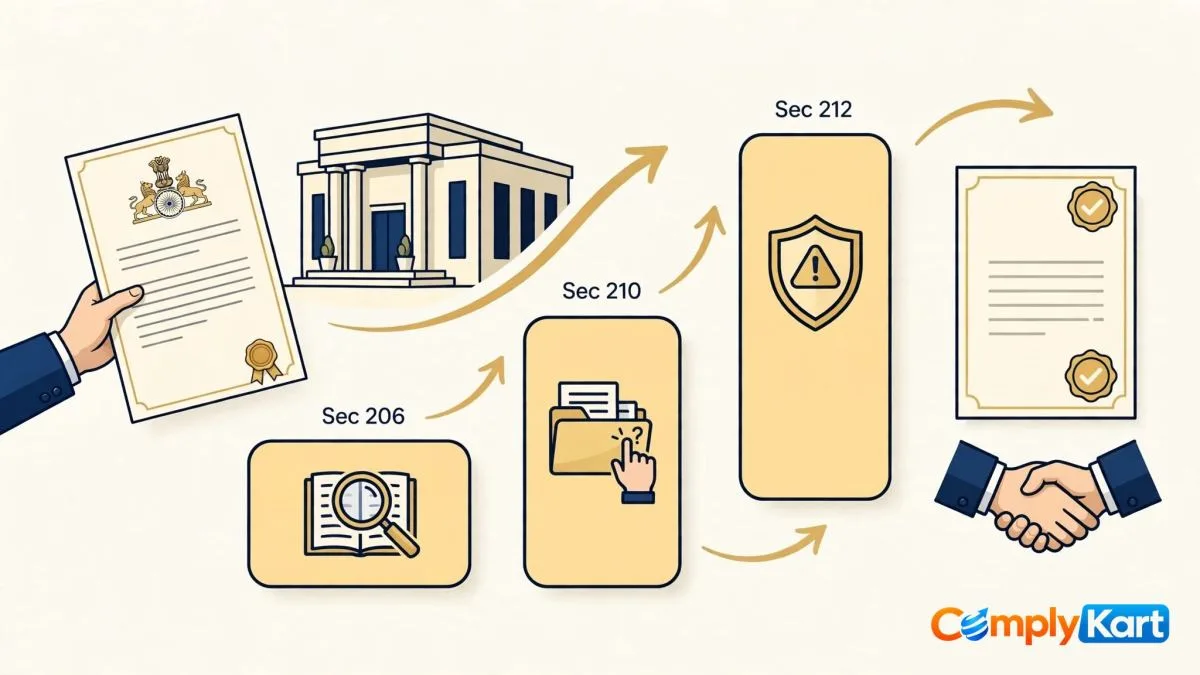
Five steps, no guesswork — you always know exactly what comes next. Tap a step to see what it involves.
12345
You pay securely. Payment is confirmed instantly, and your receipt with the written fee breakup lands in your inbox.
What a secretarial audit actually is
A secretarial audit is not an audit of your secretarial department. The name comes from "company secretary" — the officer whose job, under Section 205, is to ensure the company complies with secretarial standards and applicable laws. The audit tests whether that compliance actually happened during the financial year.
The Practising Company Secretary conducting it examines the company's books, papers, minute books, forms and returns filed, and other records, and verifies whether the company complied with the statutory provisions listed in the MR-3 format. The standard MR-3 scope covers the Companies Act, 2013 and its rules; the Securities Contracts (Regulation) Act, 1956; the Depositories Act, 1996; the Foreign Exchange Management Act, 1999; and the applicable SEBI regulations — takeovers, insider trading, issue of capital, employee benefits, non-convertible securities, delisting and buyback. It also covers the Secretarial Standards issued by ICSI (SS-1 on board meetings, SS-2 on general meetings) and listing agreements for listed companies. Industry-specific laws are covered through a management representation, with the auditor testing the compliance mechanism rather than re-auditing the factory.
The output is a report, not a certificate. It can be clean, or it can carry qualifications, reservations, adverse remarks or disclaimers — and Section 204(3) requires the Board to explain every single one of them in the Board's Report. A qualification in the secretarial audit report cannot be quietly filed away. It must be answered, in writing, to the shareholders.
One more thing worth understanding early: the secretarial auditor must be independent of the company. A company secretary in employment — even the company's own whole-time company secretary — cannot sign the MR-3. Only a member of ICSI holding a valid certificate of practice can. The company is legally bound to give the auditor all assistance and facilities, and the auditor enjoys the same powers as a statutory auditor under Section 143(14).
Is a secretarial audit mandatory for your company?
Run these three tests. If any one of them is a yes, the audit is mandatory for that financial year.
Test 1 — Are you listed? Every listed company needs a secretarial audit every year, whatever its size.
Test 2 — Are you a large unlisted public company? Rule 9 prescribes two alternative triggers: paid-up share capital of ₹50 crore or more, or turnover of ₹250 crore or more. Either one alone is enough. Figures are tested on the last date of the latest audited financial statement — so the audit for FY 2025-26 is triggered by the FY 2024-25 audited numbers. Turnover means what Section 2(91) says: the aggregate value of realisation from sale, supply or distribution of goods, or services rendered, or both, during the financial year.
Test 3 — Do you carry heavy institutional debt? The test most companies miss. Every company — public or private — with outstanding loans or borrowings from banks or public financial institutions of ₹100 crore or more needs a secretarial audit. A private company with ₹30 crore of capital and a ₹120 crore bank term loan is in the net.
What if none of the tests apply? Then the audit is not mandatory — but it is available voluntarily, and many companies take it: before a fundraising round, during IPO preparation, when a bank's credit appraisal asks for governance comfort, or when a board grows uneasy about whether filings have actually been on time. A voluntary MR-3 follows the same format and professional standards as a mandatory one.
MR-3 vs MGT-7 — the distinction everyone confuses
These two get mixed up constantly, including by directors. They sound similar, they both involve the company secretary, and they both appear around AGM season. They are fundamentally different things.
MR-3 is a judgement. MGT-7 is a filing. The secretarial audit report in Form MR-3 is the Practising Company Secretary's professional opinion on whether the company complied with the law during the year. It examines, tests and concludes. The annual return in Form MGT-7 is the company's own factual statement — shareholding pattern, directors, key managerial personnel, indebtedness, meetings held — filed with the Registrar of Companies. Nobody opines in an MGT-7; it reports.
Different authors. An MR-3 can only be signed by a Company Secretary in practice — an independent professional. An MGT-7 is signed by a director and the company secretary (if the company has one), and certified by a PCS only for certain classes of companies. The independence requirement that defines the secretarial audit does not apply to the annual return.
Different destinations. The MR-3 is annexed to the Board's Report and travels to shareholders, lenders and anyone who reads the annual report. The MGT-7 goes to the ROC on the MCA portal and becomes part of the company's public filing record.
Different consequences. A qualified MR-3 forces the Board to explain itself in writing to shareholders under Section 204(3). A defective MGT-7 is a filing defect — correctable, but it sits on the public record.
Why this matters to you: companies sometimes assume that because their MGT-7 and AOC-4 were filed on time, a secretarial audit would find nothing. Filing on time is one input. The MR-3 also tests whether board meetings were validly convened and minuted under SS-1, whether general meetings followed SS-2, whether related-party transactions had prior approvals, whether statutory registers are maintained, whether charges were registered in time, and whether FEMA and SEBI provisions were followed. On-time filings are necessary. They are not sufficient.
The Annual Secretarial Compliance Report — listed companies, read this
If your company is listed, Section 204 is only half the story. Regulation 24A of the SEBI (Listing Obligations and Disclosure Requirements) Regulations, 2015 requires every listed entity to obtain an Annual Secretarial Compliance Report from a Practising Company Secretary and submit it to the stock exchanges within 60 days of the end of the financial year — in practice, by the end of May.
This report is separate from the MR-3 and examines something different: compliance with the SEBI regulations and circulars applicable to the listed entity — LODR itself, the insider trading regulations, the takeover code, share transfer and demat requirements, website disclosures, and related SEBI circulars. The PCS certifies compliance (or flags deviations) regulation by regulation.
The practical point: a listed company needs both reports every year, from a PCS, on overlapping but distinct scopes, on different timelines, going to different recipients. The MR-3 goes to shareholders with the Board's Report; the compliance report goes to the exchanges by end-May. We handle both together for listed clients — the document set overlaps heavily, and one exercise costs less than two.
What must be decided before the audit begins
Mandatory or voluntary? If mandatory, the scope follows the MR-3 format and the law. If voluntary, the scope is agreed in the engagement letter — full MR-3 format, or a narrower review of specific areas (FEMA compliance, board processes) ahead of a transaction.
Which financial year? The audit covers one financial year — for a mandatory audit, the year just ended. Companies sometimes engage the PCS mid-year for a voluntary health check of the year to date, useful before a fundraise.
Who is the auditor? Only a PCS — and the same person cannot also be the company's statutory or internal auditor for the period. Independence is the whole point. Verify the certificate of practice is valid.
What access will you give? Section 204(2) obliges the company to give all assistance and facilities. In practice: one point of contact, access to minute books, statutory registers and MCA filing records, and management time for queries. Audits stall most often on document collection, not technical issues — decide the SPOC and timeline upfront.
How will qualifications be handled? Agree at the start that the PCS will discuss draft observations with management before finalising — standard practice — so factual errors get corrected and genuine non-compliances get their responses recorded. This does not mean negotiating qualifications away; it means the report is accurate.
Why companies value a proper secretarial audit
It finds the non-compliance before the regulator does
Most secretarial defaults are not dramatic — a charge registered late, a board meeting convened on short notice without proper consent, a related-party contract missing an audit committee approval, a register not updated after a transfer. Each is fixable when found early and expensive when found by the ROC, SEBI or a lender. The audit's first value is discovery: a trained eye going through a year's records and listing what drifted.
It gives the board something to rely on
Directors — especially independent directors — carry personal liability for company law defaults. A clean MR-3, or one whose qualifications have been addressed, is the board's evidence that governance processes were working. Independent directors ask for it, because their reputation is on the line at every company they serve.
It answers the Board's Report obligation properly
Section 204(3) requires the Board to comment on every qualification in the MR-3. Boards that receive the report late, or full of surprises, end up writing defensive explanations under time pressure. A well-run audit delivers the report with time to spare, observations discussed in advance, so the Board's explanations are considered rather than panicked.
It de-risks fundraising and M&A
Investors and acquirers run their own legal due diligence, and secretarial compliance is always on the checklist. A company that can hand over two or three years of clean MR-3s shortens diligence, avoids price chips for "governance risk," and signals a management team that takes the law seriously. Companies heading for a fundraise often commission a voluntary audit a year early for exactly this reason.
It disciplines the compliance calendar going forward
The audit does not just report the past year — it typically ends with a discussion on recurring gaps: filings that always run late, registers nobody maintains, approvals taken after the fact. Companies that act on these findings find the next year's audit shorter, cheaper and cleaner. The first audit is the painful one; it gets easier.
It protects the PCS relationship itself
A company that engages its secretarial auditor early, gives full access, and discusses observations openly gets a better audit — more thorough, more accurate, more useful. The adversarial version, where documents trickle in and queries go unanswered, produces a report full of disclaimers that helps nobody.
Documents and records we will ask for
Corporate and board records. MOA/AOA, incorporation certificate, minute books for board, committee and general meetings, statutory registers (members, directors, charges, related-party contracts, loans and investments).
MCA filing record. Forms filed during the year — MGT-7, AOC-4, ADT-1, DIR-12, MGT-14, CHG-1/CHG-4, BEN-2, DPT-3 — with challans and SRNs, plus due dates versus actual filing dates.
Capital and borrowings. Shareholding pattern, transfer deeds and approvals, demat reconciliations, dividend records, ESOP/buyback papers; loan agreements, sanction letters, charge creation and satisfaction documents.
Approvals and registers. Section 189 contracts register, related-party transaction approvals (audit committee and board), CSR records, deposit records.
FEMA and SEBI (where applicable). FC-GPR/FC-TRS filings, FDI reporting, insider trading code and disclosures, SAST disclosures, LODR records for listed companies.
Management representation. A letter confirming record completeness and the position on industry-specific law compliance — the auditor tests the mechanism, but the representation is the starting point.
The audit process — step by step
1. Engagement and scoping
We confirm whether the audit is mandatory or voluntary, agree the financial year under audit, and issue an engagement letter setting out the scope, timelines, fee and the SPOC on your side. For listed clients we align the MR-3 and the Reg 24A compliance report into one timetable.
2. Document collection
You share the records against our checklist — usually through a shared drive or data room. We review what arrives and raise a first round of queries for anything missing. This stage sets the pace for everything after it: complete records in week one mean a smooth audit.
3. Compliance testing
We test the year's record against the MR-3 checklist: board and general meeting processes under SS-1 and SS-2, filing timeliness, registers, charges, related-party approvals, share transactions, borrowings, dividend compliance, and the applicable FEMA and SEBI provisions. Where the law requires a specific approval or filing, we verify it happened — and happened on time.
4. Query resolution with management
We discuss draft observations with your team before finalising anything. Some turn out to be documentation gaps (the approval exists, the paper is misplaced). Some are genuine non-compliances. This stage separates the two, records management's responses, and gives you the chance to rectify what is still rectifiable before the report is signed.
5. Draft MR-3 and management discussion
We share the draft report — including any qualifications with precise legal references — and walk the board or audit committee through it. This is also when the Board begins drafting its Section 204(3) explanations for the Board's Report.
6. Final report and Board's Report support
We issue the signed MR-3 in time for annexation to the Board's Report. For listed clients, we separately finalise the Annual Secretarial Compliance Report for submission to the exchanges within the 60-day window. We stay available while the Board finalises its explanations, so the two documents are consistent with each other.
How long does it take?
A straightforward secretarial audit for a company with complete records typically takes three to six weeks from document receipt to signed report. The variables are record completeness, the number of applicable laws, and how fast management answers queries. Audits that stretch to three months are almost always the ones where documents arrive in instalments.
Plan backwards from your Board meeting. The MR-3 must be in hand before the Board approves the Board's Report. Most companies run the secretarial audit alongside the statutory audit between April and August — engaging the PCS in April rather than July is the single biggest lever on timeline.
How ComplyKart helps
Applicability check. We test your company against all three Rule 9 triggers — listing status, the ₹50 crore capital / ₹250 crore turnover tests, and the ₹100 crore borrowing test — on the latest audited numbers, so you know with certainty whether the audit is mandatory this year.
Independent PCS engagement. The MR-3 is signed by a Practising Company Secretary — independent of your company and your statutory auditor. We staff the engagement with PCS professionals who do secretarial audits as core work.
One timetable for MR-3 + Reg 24A. For listed clients we run both reports as a single engagement: one document request, one query cycle, two coordinated reports.
Board-ready reporting. We discuss observations with management before finalising, deliver in time for the Board's Report, and support the Board in drafting its Section 204(3) explanations so the two documents tell a consistent story.
Remediation roadmap. Where the audit finds gaps, you get a prioritised fix list — what to file, what to regularise, what to change in process — so next year's audit is cleaner and cheaper.
What we do not do: we do not sign an MR-3 where we lack independence; we do not suppress qualifications to make a report "clean"; and we do not backdate records or create minutes for meetings that did not happen.
What happens after the MR-3 is issued
The Board responds. Under Section 204(3), the Board's Report must explain every qualification, reservation, adverse remark or disclaimer. This is not optional — and a generic "noted for compliance" does not satisfy the provision.
Qualifications get fixed. Most point to rectifiable defaults: a late filing to compound, a register to update, an approval to regularise. Fix what can be fixed before the AGM, disclose honestly what cannot, and change the process so it does not recur.
The report lives in the public record. The Board's Report, with the MR-3 annexed, is filed with the ROC and available to lenders, investors and regulators. A clean report is a governance asset. What damages companies is the same qualification three years running — it signals a board that is not listening.
Next year's planning starts now. The best time to fix the compliance calendar is the month after the audit, when the gaps are fresh. A short closing meeting to agree fixes and owners takes an hour and saves weeks next year.
Common mistakes companies make
Engaging the PCS in August. By then the Board meeting is weeks away and the audit becomes a rushed exercise. April engagement is the norm for a reason.
Treating it as a signature exercise. A PCS who signs without testing risks their own certificate of practice — and a report that says nothing useful is money wasted. Worth doing properly or not at all.
Hiding the messy files. Withholding records produces disclaimers ("subject to management representation...") which read worse than an honest qualification with a remediation plan.
Confusing MR-3 with MGT-7. Filing the annual return on time does not mean the audit will be clean. They test different things. Budget for both.
Ignoring the borrowing test. Private companies check capital and turnover against the thresholds and forget the ₹100 crore borrowing leg. A large term loan or working-capital facility can pull an otherwise small company into the mandatory net.
Letting qualifications repeat. The same qualification three years running invites regulatory attention and tells investors the board does not act on findings.
Penalties that actually bite
Section 204(4) is blunt: if the company, any officer, or the PCS contravenes the section, each — the company, every officer in default, and the PCS in default — faces a fine of not less than ₹1 lakh, up to ₹5 lakh. The PCS is also liable, which is why reputable professionals will not sign a report they cannot stand behind.
Beyond the fine, an unaddressed default surfaces in worse places: a lender's covenant review, SEBI surveillance, or an acquirer's due diligence — where the cost is measured in deal value, not penalties.
Sources
This page is built on the Companies Act, 2013 (Sections 2(91), 134, 204, 205 and 143(14)), Rule 9 of the Companies (Appointment and Remuneration of Managerial Personnel) Rules, 2014, Regulation 24A of the SEBI (Listing Obligations and Disclosure Requirements) Regulations, 2015, the Secretarial Standards SS-1 and SS-2 issued by ICSI, and the Form MR-3 format. Threshold figures and regulatory timelines are verified against the statute and rules as in force; where a claim could not be verified against a primary source, it is marked.
FAQ
Frequently asked questions
21 answers from our consultants.
You pay for our expert's time — document checking, filing, follow-ups — not the government. The government fee goes to the government; our fee is for the work we do so you don't have to figure it out yourself.
Tell us your situation in plain words — what you're trying to do, not which form you think you need. Half our job is stopping clients from buying the wrong service. The first consultation is free and honest.
Yes. We quote professional fee + government charges + taxes separately, in writing, before you pay. The number doesn't change midway. If the government fee changes, we show you the notification.
Every engagement gets a tracker — you see what's filed, what's pending and what's next. No chasing on WhatsApp for status updates.
Both. Startups get incorporation + early compliance bundles; established companies get annual retainers. About half our clients started with us at incorporation.
Only a Company Secretary in practice — an ICSI member holding a valid certificate of practice, independent of the company. A whole-time company secretary cannot sign the MR-3 for their employer, and the PCS must not be the company's statutory or internal auditor for the period.
A statutory audit examines the financial statements and is conducted by a Chartered Accountant. A secretarial audit examines legal and procedural compliance — board processes, filings, registers, approvals — and is conducted by a Practising Company Secretary. Complementary; neither replaces the other.
In time to be annexed to the Board's Report, which the Board approves before the AGM. Most companies complete it between April and August. There is no separate MCA filing for the MR-3 — it travels with the Board's Report.
Not separately. It is annexed to the Board's Report under Section 134, and becomes public through that filing.
Section 204(3) requires the Board to explain every qualification, reservation, adverse remark or disclaimer in the Board's Report. Fix what is fixable — compound late filings, update registers, regularise approvals — so the qualification does not repeat next year.
Under Regulation 24A, every listed entity must get an Annual Secretarial Compliance Report from a PCS and submit it to the stock exchanges within 60 days of the financial year end. It examines SEBI-regulation compliance specifically, and is separate from the MR-3.
No. The MR-3 under Section 204 examines compliance with the Companies Act and a defined list of corporate and economic laws, and goes to shareholders with the Board's Report. The Reg 24A report examines SEBI-regulation compliance and goes to the stock exchanges. Listed companies need both.
Turnover has the Section 2(91) meaning: the aggregate value of the realisation of the amount of sale, supply or distribution of goods, or services rendered, or both, by the company during the financial year. It is tested on the last date of the latest audited financial statement.
The test applies on the last date of the latest audited financial statement. Below ₹100 crore on that date, the test is not triggered for the following year. But watch the trajectory — facilities have a way of growing back.
SS-1 (board meetings) and SS-2 (general meetings) are part of what the audit tests — whether meetings were convened, conducted and minuted as the standards require. Non-observance is a standard audit observation.
Each company is tested on its own numbers against Rule 9. A subsidiary is not automatically covered because its parent is listed — but check the borrowing test, and note that group auditors and lenders often expect subsidiary-level comfort anyway.
It depends on company size, applicable laws, and record condition — a clean mid-size unlisted company costs far less than a listed company with FEMA exposure and a messy file room. We quote a fixed fee after a short scoping call.
Largely, yes — records are shared digitally and queries resolved over calls. But the PCS needs reliable access to originals where verification demands it (minute books, statutory registers), and a site visit is sometimes necessary.
A written confirmation from management on record completeness and the compliance position — particularly on industry-specific laws, where the auditor tests the mechanism rather than re-auditing operations. It supports, but never replaces, the auditor's own verification.
Get it done for the current year, and consider a voluntary audit for the missed year to identify what went wrong — the Section 204(4) penalty applies per default, and a lender or investor discovering the gap asks harder questions than the statute does.
The MR-3's core is corporate, securities and economic laws. Operational laws (factories, labour, environment, tax filings) are covered through the management representation and the auditor's review of the compliance mechanism — not by re-performing a tax or labour audit.
What clients say about working with us
Real stories from businesses we've worked with.
Trademark Registration“
Our Trademark was applied in all the classes with a short span of time by Complykart Trademark Experts and I can say the level of expertise and commitment they carry is remarkable. It's an A+ from my side. We are now sticking to ComplyKart only.
Company Registration“
I found the professionalism of the staff at complykart.com, a pleasure to work with. As a foreigner to India, they took the time to explain the documentation and assisted in every question I raised. I was pleased that complykart.com made it easy for my Business.
Merger & Acquisition“
Trust, Commitment, Dedication and responsiveness are the best things with ComplyKart. Thanks for handling our Merger assignment with so much care. After my business disputes, complykart handles all things with own sense of understanding.
Secretarial Audit Lead · Secretarial Audit & Listing Compliance · 10+ years experience
Atharv Iyer leads ComplyKart’s secretarial audit and listing compliance practice. He conducts secretarial audits for listed and large unlisted companies, manages SEBI LODR compliance, board evaluations and annual report disclosures. His audit reports have stood up to the toughest regulatory scrutiny.
Last reviewed: 16 November 2026
Get a free consultation
Talk to a ComplyKart professional about Secretarial Audit of Company. The first consultation is free.