
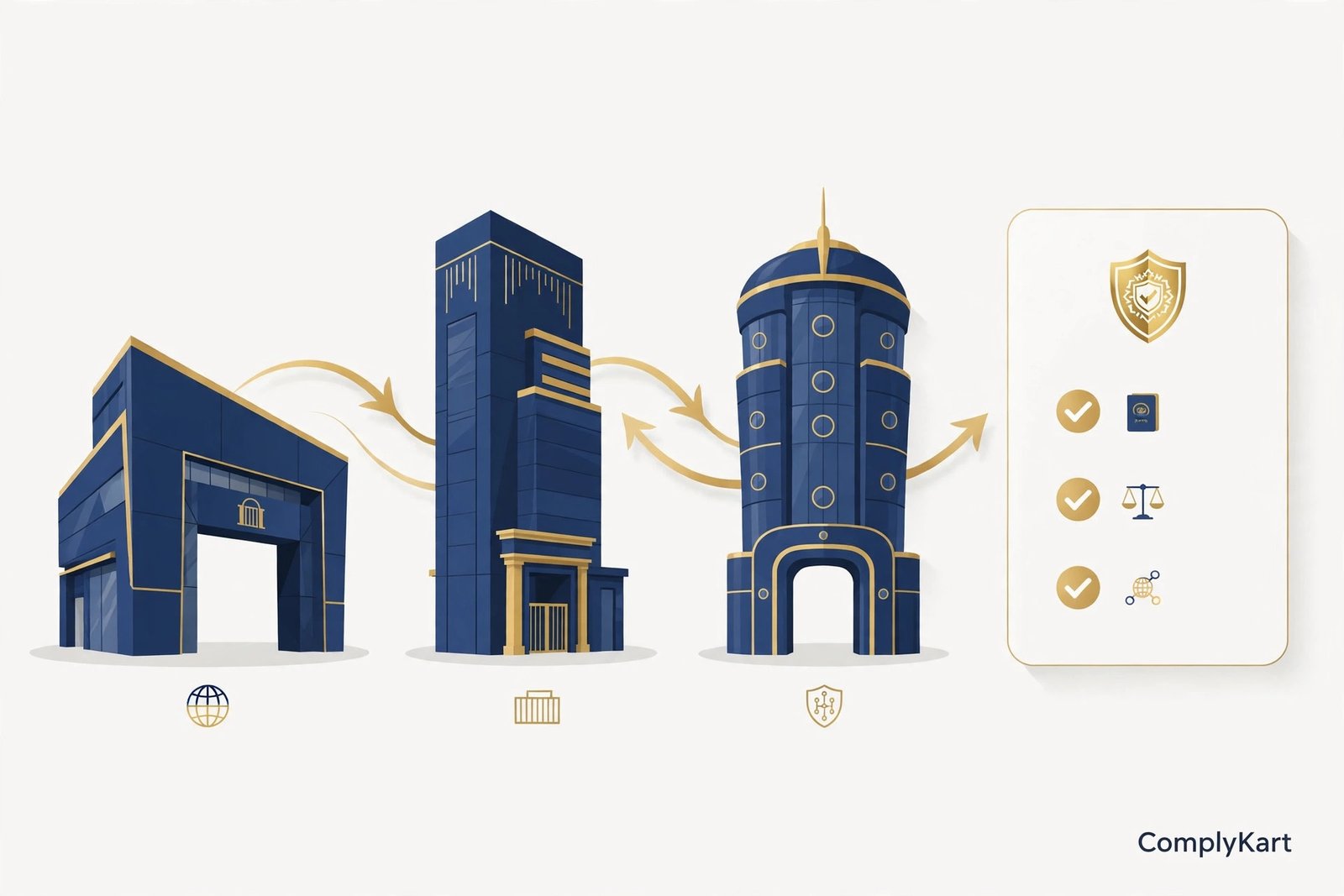
The short answer: match the zone to your profile — DMCC for credibility (AED 38k–52k year one), IFZA for low-friction multi-activity setups (AED 16k–22k), Meydan for the fastest cheap Dubai address (AED 19k–29k). Size the package for the visas you need, confirm the 0% tax position for your activity, and handle India-side FEMA separately.
What is a Dubai free zone, in one paragraph
A free zone is a designated area where a company can be 100% foreign-owned, set up fast, and run with a lighter administrative load than the mainland. The trade-off: a free zone company can't freely trade with the UAE domestic market — for that you sell through a local distributor or agent. So the free zone fits businesses whose customers are outside the UAE, or who operate entirely online. If your customers are in Dubai itself, stop here and read the mainland piece instead.
How to compare free zones: the five things that actually differ
Forget the glossy brochures. Free zones differ on five practical things: entry cost, visa quota, whether you must take physical office space, how banks treat the zone's licences, and whether the zone audits you yearly. Everything else is marketing. Here's how the main Dubai options line up — described by profile, so you can match yourself rather than take my word for which is "best."
Key takeaways
- A free zone company suits businesses whose customers are outside the UAE or fully online; it can't freely trade with the UAE domestic market.
- Compare zones on five things only: entry cost, visa quota, office requirement, bank acceptance, and mandatory audit.
- Year-one ranges with one visa: DMCC roughly AED 38,000–52,000, IFZA roughly AED 16,000–22,000, Meydan roughly AED 19,000–29,000.
- The 0% free-zone corporate tax applies only to Qualifying Free Zone Persons meeting substance and activity conditions — confirm before pricing around it.
DMCC — the prestige address
Its natural residents: commodity traders, crypto and fintech firms, and businesses that need counterparties to take them seriously on sight.
What it costs you: DMCC is the premium option. A realistic year-one with one visa lands roughly in the AED 38,000–52,000 range. Two structural reasons for the gap: DMCC doesn't offer a genuine zero-visa virtual licence — you take at least a flexi-desk in JLT — and it requires an annual audit of every licensed company, even a dormant one, adding a few thousand dirhams a year from the second renewal. What you get: the strongest banking acceptance of any Dubai free zone and serious brand weight. If your business lives or dies on counterparty trust, that premium buys something real.
IFZA — the broad, low-friction option
The International Free Zone Authority, at Dubai Silicon Oasis, has the widest activity list of the Dubai zones — well over a thousand — making it the default for consultants, agencies, and multi-activity service firms that don't fit one box.
Entry licences start around AED 12,900, and a realistic year-one with one visa and a flexi-desk lands roughly AED 16,000–22,000. Visa quotas scale with your package: a virtual setup gets you one to three visas, a flexi-desk three to six. No blanket audit requirement for small companies. Banking acceptance is moderate — expect the bank to ask for a business plan and to understand your transaction profile. The honest summary: IFZA is where you go for a Dubai address, a wide activity menu, and controlled costs.
Meydan — the fast, cheap Dubai address
Meydan Free Zone, next to the racecourse near Downtown, has built its name on two things: transparent published pricing and speed. Its standard package starts around AED 12,500, and it offers a fast-track option that can issue a licence in about an hour for straightforward single-shareholder applications.
A realistic year-one with a visa lands roughly AED 19,000–29,000 depending on the package. Visa allocation is package-driven — typically one to three visas on virtual-style packages. Like IFZA, no mandatory audit for small companies. Natural residents: solo founders, e-commerce operators, digital agencies, freelancers formalising into a company. The watch-out is banking: newer and cheaper zones mean more diligence, so arrive with clean documents and a coherent story.
DAFZA and the specialists
Dubai Airport Free Zone suits logistics and trading businesses that benefit from the location — entry roughly from AED 25,000. Beyond these: Internet City for tech (pricey, team-scale), Healthcare City for medical, JAFZA for industrial. Only pay for a specialist zone if your activity genuinely needs it. A consultancy doesn't need a tech-park licence.
The visa question, answered plainly
Every free zone ties visa quota to package or office size — no zone offers unlimited visas on a virtual licence. Roughly: virtual packages one to three, flexi-desks three to six, dedicated offices scale from there (commonly one per 9 square metres). If visas are your main reason for setting up, size the package for the visas, not the other way round. The establishment card and immigration file add a couple of thousand dirhams on top.
The tax question
Free zone companies can qualify for 0% corporate tax on qualifying income — but "can" is doing heavy lifting. The 0% rate needs Qualifying Free Zone Person status with substance and activity conditions; mainland-customer or non-qualifying income is taxed at 9% above AED 375,000. Registration is mandatory regardless. Don't build your pricing around 0% until your activity is confirmed as qualifying.
The India-side paperwork (same as mainland)
Nothing about a free zone changes your FEMA obligations. Resident individuals: LRS ceiling of USD 250,000 per financial year, with reporting. Indian companies: Overseas Investment Rules, 2022 with upfront reporting and the Annual Performance Report by 31 December yearly. The free zone authority will never ask about FEMA. Your Indian bank will.
The decision framework: five questions
Answer these honestly and the choice mostly makes itself. One: where are my customers — inside the UAE or outside it? (Inside: mainland. Outside: free zone.) Two: do I need visas, and how many? (Size the package to the visas.) Three: does my business need institutional credibility on day one? (If yes, DMCC's premium is worth pricing.) Four: what's my real year-one budget including visas, establishment card, and next year's renewal? (Cheap licence, expensive year two is the classic trap.) Five: will my bank take this licence seriously? (Ask the bank before you pick the zone, not after.)
Get those five right and the zone almost picks itself. Get them wrong and you'll be paying for a prestige address your e-commerce store never needed — or explaining to a bank why your bargain licence doesn't impress them.
Frequently asked questions
Which Dubai free zone is best for an Indian founder?
Match the zone to your profile, not the brochure. Need counterparty trust on sight? DMCC. Widest activity list at controlled cost? IFZA. Cheapest Dubai address, fast? Meydan. Logistics by the airport? DAFZA. Run the five-question framework above and the answer picks itself.
Can a Dubai free zone company do business inside the UAE?
Not freely. Free zone companies serve customers outside the UAE or operate online; selling into the domestic market needs a local distributor or agent. If your revenue comes from customers in Dubai or Abu Dhabi, the mainland route usually fits better.
How many visas does a free zone package include?
Roughly: virtual packages one to three visas, flexi-desks three to six, dedicated offices scale from there (commonly one per 9 square metres). If residency is your main goal, size the package for the visas first — and budget extra for the establishment card and immigration file.
Do free zone companies really pay 0% corporate tax?
Only if they qualify. The 0% rate needs Qualifying Free Zone Person status with substance and activity conditions; mainland-customer or non-qualifying income is taxed at 9% above AED 375,000. Registration is mandatory either way — confirm before pricing around 0%.
Does a free zone company change my FEMA obligations in India?
Not at all. Individuals still use the LRS (USD 250,000/year, with reporting); companies still follow the Overseas Investment Rules, 2022 with upfront reporting and the APR by 31 December yearly. The free zone authority will never mention FEMA. Your Indian bank will.
If you want this mapped to your situation — activity, budget, visa count, and the India-side FEMA filings — ComplyKart's team sets up UAE companies for Indian founders every week, mainland and free zone both. One conversation, no obligation, and you'll leave knowing exactly which route fits.



Comments
No comments yet — ask the first question below.
Join the discussion
Questions go straight to our expert desk. Comments appear after a quick review — no spam, no noise.