If our experts find your requirement can't be fulfilled as scoped, you get a full refund of the professional fee — no questions, no fine print. Government charges already paid are pass-through and go to the government, not us.
Written breakup before you pay
Every quote shows the professional fee, government charges and taxes as separate lines — you approve the full breakup in writing before paying anything.
Government charges are pass-through
Filing fees and department charges go to the government, not to us. They vary by state and case, so we show them separately for your situation.
No payment without your sign-off
The free consultation comes first. You only pay after you have seen the exact scope, the exact breakup and the expected timeline — no surprises later.
1
Free consultation. Tell us what you need; a CA, CS or advocate maps the exact scope.
2
Written quote. You receive the plan, the line-by-line breakup and the timeline in writing.
3
You approve, then pay. Work starts only after you sign off on the quote.
Private Limited Company Registration Package Inclusions
Company name approval (RUN/SPICe+) with MCA
DIN and Class-3 DSC for all directors
MOA and AOA drafting as per your business objects
PAN, TAN, EPFO, ESIC and GST-ready incorporation (AGILE-PRO)
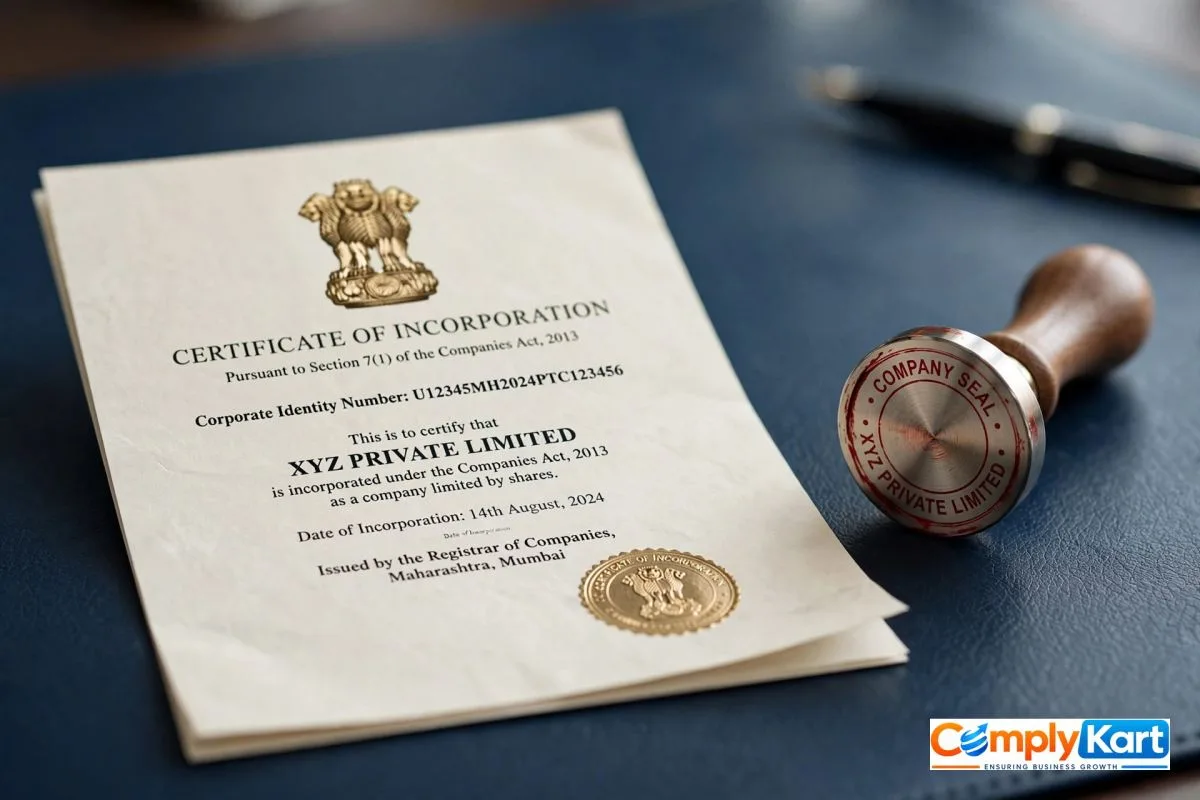
Certificate of Incorporation with first-year compliance checklist
Clear scope
You know exactly which filings, documents and handover items belong to your selected plan.
Extra costs shown separately
State-specific and case-specific government charges are shown separately.
No blind upgrade
Choose the tier around the way you plan to operate, not simply the highest price.
30-second check
What will your registration actually cost?
Four quick answers — an honest breakup of government fees, stamp duty, DSC and professional charges. No signup.
Stamp duty varies by state — this affects your total.
Each director needs a DSC (Digital Signature Certificate).
A CA/CS handles name approval, filings, follow-ups and resubmissions. Doing it yourself saves money but costs time — and mistakes cause delays.
Your estimated cost breakup
Estimated total
Estimates based on typical MCA fees and market rates as of 2026. Actual stamp duty depends on your MOA/AOA. GST extra where applicable.
Registration is the easy part. Then the clock starts: first board meeting, INC-22 and auditor appointment inside 30 days, share certificates in 60, INC-20A within 180. Our free checklist tracks all 16 post-incorporation tasks against your own incorporation date — with due dates, not just names.
Five steps, no guesswork — you always know exactly what comes next. Tap a step to see what it involves.
12345
You pay securely. Payment is confirmed instantly, and your receipt with the written fee breakup lands in your inbox.
The short answer. A private limited company is a company whose owners' liability is limited to their shares, registered with the Registrar of Companies under the Companies Act, 2013. Registering a private limited company in India takes seven to fifteen working days and starts at ₹8,499 with ComplyKart, government expenses included in the written breakup. The MCA charges no SPICe+ filing fee for authorised capital up to ₹15 lakh, so for most new companies the government cost is state stamp duty on the MOA and AOA, plus DSCs for the directors.
Dates that matter right now. For FY 2025-26, MCA General Circular 05/2026 allows the AOC-4 family of forms to be filed without additional fees till 31 December 2026, and MGT-7 / MGT-7A till 31 January 2027. The circular does not extend AGM timelines, and once a window closes the additional fee counts from the original due date.
Planning the full year? The compliance fee calculator maps every filing, due date and cost for your company in one pass.
Why the private limited company dominates Indian business
Walk into any startup pitch, any vendor negotiation, any bank loan application — the private limited company is the default vehicle. There are structural reasons, not just habit.
Separate legal identity. The company owns assets, signs contracts, sues and gets sued in its own name. Your personal assets sit behind the corporate veil, limited to whatever share capital remains unpaid.
Equity fundraising. This is the decisive one. Only a company can issue shares — which means only a company can take on investors, run ESOP pools, or do a preference-share round. Every funded startup in India is a private limited company for exactly this reason.
Perpetual succession. Directors and shareholders change; the company continues. Contracts, licences and bank relationships survive founder exits.
Credibility. Enterprise procurement teams, banks and government tenders treat "Pvt. Ltd." as a seriousness filter. It is not fair to LLPs, but it is real.
The price is compliance. Board meetings, statutory audit, annual filings, registers — a private limited company demands ongoing attention in a way an LLP does not. If you will never raise money and never hire with ESOPs, be honest with yourself about whether you need all of this.
What you need before you start
1. Two directors. Individuals, at least 18, with DINs. At least one must be resident in India — stayed here 182 days or more during the financial year (Section 149(3)).
2. Two shareholders. The same two people can be both directors and shareholders. A company can also be a shareholder.
3. DINs. Up to three DINs are allotted inside SPICe+ itself. Beyond three, file DIR-3 separately.
4. Class 3 DSCs for everyone signing — directors and the professional certifying the forms.
5. A unique name ending in "Private Limited". Check the MCA database and the trademark registry before you fall in love with one.
6. A registered office in India. Rented, owned or co-working with an NOC. The state of this address decides your ROC jurisdiction and your stamp duty — choose deliberately.
No minimum paid-up capital. You can incorporate with ₹10,000 or ₹10 lakh of authorised capital; the number mainly affects stamp duty and, above ₹15 lakh, the MCA fee.
ROC jurisdiction — which office handles you
Company incorporation filings are processed centrally by the Central Registration Centre, but your registered office state fixes your ROC for everything after — annual filings, inspections, approvals. The 2026 restructuring (S.O. 4850(E), effective 16.02.2026) redrew several jurisdictions: Delhi split into Delhi-I and Delhi-II, Haryana moved to Chandigarh, new offices for UP-II (Noida) and Mumbai-II, among others. Confirm the current jurisdictional office for your state at filing — our city-wise pages carry the per-city detail.
The registration process
Step 1 — Class 3 DSC for directors and the certifying professional
Every MCA form is digitally signed. Class 3 DSCs need video verification against PAN and Aadhaar — 1 to 3 working days per person. Line up all signatories in the same week; a travelling director is the classic delay.
Step 2 — Name reservation in SPICe+ Part A
File Part A with two proposed names in order of preference. The MCA checks against existing companies, LLPs and trademarks, and applies the naming rules (no identical/similar names, no restricted words without approval, must end in "Private Limited"). Approval takes 2 to 4 working days and the name is held for 20 days — Part B must be filed inside that window. A trademark search alongside is cheap insurance.
Step 3 — Draft the e-MOA and e-AOA
The electronic Memorandum (INC-33) and Articles (INC-34) are the company's constitution. The MOA states the objects — draft them wide enough to cover your actual business plus adjacent activities, because narrowing them later needs a shareholder resolution and filing. The AOA governs internal management: share transfer restrictions (mandatory for private companies), director appointment, meetings, dividends. Do not accept a copy-paste AOA — the transfer restrictions and pre-emption clauses in it decide how cleanly you can raise money later.
Step 4 — File SPICe+ Part B (INC-32)
Part B is the incorporation application itself: director and shareholder details, DIN applications (up to three), registered office address, capital structure, and the e-MOA/e-AOA. Attach ID and address proofs, office address proof (utility bill under two months old plus NOC/rent agreement), and consent letters. A practising CA, CS or advocate must certify the form.
Step 5 — AGILE-PRO-S (INC-35)
Filed alongside Part B, this single form applies for GST registration (optional), EPFO and ESIC registration, profession tax (Maharashtra), and opening a bank account. Take GST here only if you need it immediately — interstate supply, e-commerce, or input tax credit from day one. Otherwise register later when you cross the threshold.
Step 6 — Certificate of Incorporation
The Central Registration Centre processes Part B in 3 to 7 working days for a clean filing. On approval you receive the Certificate of Incorporation (INC-11) carrying the CIN — plus PAN and TAN allotted automatically. This date starts every post-incorporation clock.
Step 7 — PAN, TAN, bank account, first compliances
PAN and TAN arrive with the CoI. Open the current account, deposit the subscription money, and diary the first-year deadlines: INC-20A within 180 days, first auditor within 30 days, first board meeting within 30 days, share certificates within 60 days.
Costs — the honest breakdown
Component
Typical range
MCA filing fee (SPICe+)
Zero up to ₹15 lakh authorised capital; slab-based above
Stamp duty on MOA/AOA
State-wise — varies significantly
Class 3 DSC (per signatory)
₹2,500
Name reservation
Included in SPICe+
Professional fees
₹10,000 – ₹30,000 depending on drafting depth
The zero-fee concession up to ₹15 lakh authorised capital covers most startups and small businesses — your government cost is then stamp duty plus incidentals. Stamp duty is the variable: it follows the state of your registered office, and the difference between states is material. Maharashtra's rates are the highest; several states are nominal. This is one legitimate reason the choice of registered-office state matters beyond convenience.
Timelines
Stage
Typical time
DSC issuance
1–3 working days
Name reservation (Part A)
2–4 working days
Drafting MOA/AOA + documents
2–3 working days
SPICe+ Part B processing (CRC)
3–7 working days
PAN/TAN
With the CoI
Total, clean filing
7–15 working days
Resubmissions add 3–5 working days each. Name rejections are the most common cause — which is why the trademark and MCA pre-checks matter.
Post-incorporation — the first 180 days
Incorporation is the beginning, not the end. The Companies Act front-loads obligations:
INC-20A (declaration of commencement). Within 180 days, declare that subscribers have paid for their shares. Miss it and the company faces heavy penalties and cannot commence business formally. This is the single most-missed deadline for new companies.
First auditor. The board appoints the first auditor within 30 days of incorporation; ADT-1 is filed within 15 days of that appointment.
First board meeting. Within 30 days of incorporation. Routine afterwards: at least 4 board meetings a year with gaps under 120 days.
Share certificates. Issued within 60 days of incorporation (Section 56).
Statutory registers. Register of members, directors, charges — maintained from day one.
Annual filings. AOC-4 (financials, 30 days from AGM), MGT-7 (annual return, 60 days from AGM), statutory audit every year without exception, DIR-3 KYC for directors (triennial since 2026 — next due 30 June 2028).
Private limited vs LLP — the decision that matters most
This is the comparison prospects search for, so here it is plainly. Choose the private limited company if you might ever raise equity, grant ESOPs, or sell the business — the share structure makes all of it possible, and conversions later are expensive. Choose the LLP if you are professionals or partners who want limited liability with minimal compliance and will never need investors. The tax picture differs too: companies can access the 22% rate under Section 115BAA; LLPs pay 30% flat. Model both with your CA at realistic profit levels before deciding — the structure should follow the economics, not fashion.
Name rules — the detail that decides your timeline
The Registrar rejects more names than any other single cause of delay, so this deserves care. Your proposed name must not be identical to or too nearly resemble any existing company, LLP or registered trademark. It must end with "Private Limited". Certain words — Bank, Stock Exchange, University, National, and a list of others — need prior approval from the relevant regulator, and some are simply off-limits.
The MCA applies a similarity test, not just an exact-match test. "Apex Consulting Private Limited" will collide with "Apex Consultancy Private Limited". Pluralisation, spacing and punctuation do not create distinctiveness in the Registrar's eyes. Before filing Part A, run three checks: the MCA company/LLP master data, the trademark registry (a registered trademark owner can object even after incorporation, forcing a name change), and a plain web search for unregistered but established users of the name.
Descriptive beats clever at this stage. Founders who pick a distinctive coined word plus a plain descriptor — "Zyphor Technologies Private Limited" rather than "Zyphor Private Limited" — clear faster and trademark better. File Part A with two well-researched options, not one perfect one.
DIN and DSC — the identity layer
Every director needs two digital identity items, and they serve different purposes. The Director Identification Number (DIN) is a lifetime unique number issued by the MCA — one person, one DIN, forever. Up to three DINs are allotted inside SPICe+ Part B itself; if any proposed director already holds a DIN, quote it instead of applying fresh. A fourth or fifth director needs a separate DIR-3 filing.
The Digital Signature Certificate (DSC) is the signing key. Class 3 DSCs, issued after video verification against PAN and Aadhaar, sign every form in the incorporation chain. DSCs expire (typically two years) while DINs do not — a lapsed DSC at filing time is a silly, common delay. Check expiry dates before you start, and renew early.
Foreign directors follow the same structure with attested documents — passport for identity, overseas address proof duly apostilled or consularised. Their DSC video verification sometimes needs scheduling across time zones; start it first, not last.
Authorised vs paid-up capital — the money mechanics
Two capital numbers confuse every first-time founder, so here is the clean version. Authorised capital is the ceiling — the maximum the company can issue without amending its MOA. Paid-up capital is what shareholders actually pay in. You can authorise ₹10 lakh and pay up ₹1 lakh on day one.
The authorised figure drives two costs: stamp duty (state-wise, on the MOA) and, above ₹15 lakh, the MCA filing fee. Declaring ₹1 crore of authorised capital "to look serious" multiplies your stamp duty for zero benefit — investors do not check authorised capital; they check the cap table. Start with authorised capital modestly above your near-term needs (₹10–15 lakh is plenty for most), and increase it by ordinary resolution when a funding round actually requires it.
Paid-up capital is simply the subscription money the founders put in against their shares — received into the company's bank account after incorporation and declared in INC-20A. There is no minimum. Put in what the business needs, not a round number for vanity.
What the Certificate of Incorporation actually gives you
The INC-11 is not just a certificate — it is a bundle. On approval you receive the Corporate Identification Number (CIN), a 21-character code embedding the listing status, industry code, state code, year and registration number. You also get the company's PAN and TAN allotted automatically — no separate applications. Learn to read a CIN: the first character is the listing status (L for listed, U for unlisted), the next five digits are the industry code, characters seven and eight are the two-letter state code, the next four digits are the year of incorporation, the next three letters show the class of company (PTC, PLC, OPC), and the last six digits are the registration number. Clients and banks verify CINs on the MCA portal, so quote it correctly on letterheads from day one.
OPC vs private limited — the solo founder question
If you are alone, the private limited company is structurally closed to you — it needs two members. The One Person Company (OPC) exists for exactly this situation: one shareholder, limited liability, company-law credibility, with lighter compliance (no AGM in the usual form, fewer board meeting requirements). The trade-offs: an OPC must convert to a private limited company when paid-up capital crosses ₹50 lakh or turnover crosses ₹2 crore for the relevant period, and it cannot have more than one member by definition. Solo founders who expect a co-founder within a year often incorporate the private limited company directly with a placeholder second shareholder — but that placeholder arrangement needs honest legal structuring, not a handshake.
Foreign founders — incorporating from outside India
Foreign nationals and foreign companies can own 100% of an Indian private limited company in most sectors under the automatic FDI route — no prior government approval needed. The structure is the same SPICe+ process with three additions.
First, document attestation. Passports, address proofs and board resolutions from abroad must be notarised and apostilled (Hague Convention countries) or consularised through the Indian mission. This is the longest lead item — start it before anything else.
Second, the resident director. At least one director must have stayed in India 182+ days during the financial year. Foreign founding teams meet this through their Indian co-founder, or by appointing a professional director — a common interim arrangement.
Third, FDI reporting. After incorporation and capital infusion, the company files Form FC-GPR with the RBI (through the FIRMS portal) within 30 days of share allotment, plus the annual FLA return. Miss the FC-GPR window and compounding follows.
Sectoral caps still apply — a handful of sectors (multi-brand retail, defence beyond limits, certain media) need government approval or have caps. Check the current FDI policy circular for your sector before structuring. Where a sector is restricted, founders sometimes consider an LLP — but FDI in LLPs is permitted only where 100% FDI is allowed under the automatic route with no performance conditions.
Common mistakes
Copy-paste MOA objects. "To carry on any lawful business" gets queried. Draft objects that describe your actual business with room for adjacent lines.
Ignoring the AOA. Founders obsess over the name and ignore the articles. The share-transfer restrictions and drag-along/tag-along mechanics live here — investors read them before term sheets.
Taking GST in AGILE-PRO-S unnecessarily. If you do not need GST on day one, skip it. An unnecessary registration means monthly filings from the start.
Forgetting INC-20A. Mentioned twice because it is missed twice as often as any other deadline.
Authorised capital far above need. Declaring ₹1 crore "for prestige" multiplies your stamp duty. Authorised capital can be increased later when you actually raise.
How ComplyKart helps — and what we do not do
We run the full chain: name strategy with trademark screening, DSC coordination, DIN, SPICe+ Part A and B drafting and filing, e-MOA/e-AOA drafted for your actual business (not a template), AGILE-PRO-S, PAN/TAN, and a first-180-days compliance calendar so INC-20A, ADT-1 and the first board meeting never slip.
What we do not do: we do not guarantee name approval; we do not backdate filings or invent board minutes; and if your plan clearly fits an LLP or OPC better than a private limited company, we say so upfront — even though the company engagement is larger.
FAQ
Frequently asked questions
27 answers from our consultants.
You pay for our expert's time — document checking, filing, follow-ups — not the government. The government fee goes to the government; our fee is for the work we do so you don't have to figure it out yourself.
Two directors, two shareholders (can be the same two people), a unique name ending in "Private Limited", and a registered office in India. One director must be resident in India.
Typically 7 to 15 working days for a clean filing — DSC in 1–3 days, name approval in 2–4 days, SPICe+ Part B processing in 3–7 working days.
Zero MCA filing fee for authorised capital up to ₹15 lakh. State stamp duty on the MOA/AOA applies separately, plus DSC and professional fees.
No. There is no minimum paid-up capital. Declare authorised capital sensibly — it drives stamp duty and, above ₹15 lakh, the MCA fee.
The MCA's integrated incorporation form (INC-32) combining name reservation, DIN, PAN, TAN, EPFO, ESIC, optional GST and bank-account opening in one filing.
Up to three. Beyond that, file DIR-3 separately for additional directors.
Yes. Foreign nationals can be both, but one director must satisfy the resident-director rule, and foreign documents need notarisation/apostille as applicable. FDI reporting applies where relevant.
Yes, with an NOC from the owner and a recent utility bill. The state of the address decides your ROC and stamp duty.
The declaration that subscribers paid for their shares, due within 180 days of incorporation. Missing it brings heavy penalties and blocks formal business commencement. Diary it on day one.
Within 30 days of incorporation by the board, with ADT-1 filed within 15 days of the appointment.
No — it is optional via AGILE-PRO-S. Take it at incorporation only if you need it immediately; otherwise register when you cross the threshold.
The MOA defines what the company can do (objects clause); the AOA defines how it is run (share transfers, meetings, directors). Both are filed electronically as INC-33 and INC-34.
Yes, under Section 366 via Form 18, subject to conditions. It is doable but paperwork-heavy — and tax neutrality needs strict conditions. Choose deliberately at the start.
Statutory audit every year, AOC-4 (30 days from AGM), MGT-7 (60 days from AGM), at least 4 board meetings, and DIR-3 KYC for directors (triennial since 2026).
At least one director must have stayed in India for 182 days or more during the financial year (Section 149(3)) — at incorporation and ongoing.
Yes — ESOPs and sweat equity are standard, governed by the AOA, board and shareholder approvals, and the Share Capital Rules. One more reason the company structure suits startups.
Propose alternatives in a fresh Part A filing. This is why we run MCA and trademark pre-checks before filing — rejections cost a week each.
No. The Companies (Amendment) Act, 2015 made the common seal optional.
No — 200 is the statutory maximum for members (Section 2(68)). Beyond that, consider a public company.
The ROC of the state where your registered office is located. The 2026 restructuring changed several jurisdictions, so verify the current office for your state.
Your liability is limited to the amount unpaid on your shares. If you hold 10,000 shares of ₹10 each and you have paid ₹10 each, you owe nothing more — even if the company owes crores. The two exceptions: if you have given personal guarantees to banks (common for loans), or if there is fraud, courts can pierce the corporate veil. For honest business, the shield holds.
Authorised capital is the ceiling — the maximum the company can issue without amending its MOA. Paid-up capital is what shareholders actually pay in. You can authorise ₹15 lakh and pay up ₹1 lakh on day one. The authorised figure drives stamp duty and, above ₹15 lakh, the MCA filing fee. Do not inflate it for prestige — investors look at your cap table, not your authorised capital.
Seven steps: (1) Get Class 3 DSCs for all directors (1–3 days). (2) Reserve your name via SPICe+ Part A (2–4 days). (3) Draft the e-MOA and e-AOA. (4) File SPICe+ Part B with director, shareholder and office details. (5) File AGILE-PRO-S for GST, EPFO and ESIC if needed. (6) Receive the Certificate of Incorporation with CIN, PAN and TAN (3–7 days). (7) Open the bank account, deposit the subscription money, and diary your first deadlines — INC-20A within 180 days, first auditor within 30 days. Total: 7–15 working days for a clean filing.
An LLC is an American structure — it does not exist under Indian law. If you are choosing for an Indian business, the real comparison is Private Limited Company vs LLP. Pick a Pvt Ltd if you might ever raise equity funding, offer ESOPs, or sell the business — only a company can issue shares. Pick an LLP if you are professionals or partners who want limited liability with minimal compliance and will never need investors. The Pvt Ltd costs more to maintain (audit, board meetings, annual filings) but it opens the funding path.
Government costs: zero MCA filing fee up to ₹15 lakh authorised capital; stamp duty on the MOA/AOA varies by state (roughly ₹5,000–₹30,000); Class 3 DSCs cost ₹1,000–₹2,000 per signatory. Professional fees typically run ₹10,000–₹30,000 depending on drafting depth. All-in, most founders spend ₹15,000–₹35,000 including everything. Our packages start at ₹8,499 with a written breakup before you pay — no surprises.
No. Incorporation and GST registration are separate. You need GST only when you cross the turnover threshold (₹40 lakh for goods, ₹20 lakh for services in most states; lower in special-category states), or if you do interstate supply, sell on e-commerce platforms, or want input tax credit from day one. You can opt for GST during incorporation via AGILE-PRO-S, but if you do not need it immediately, skip it — an unnecessary registration means monthly filings from the start.
What clients say about working with us
Real stories from businesses we've worked with.
Trademark Registration“
Our Trademark was applied in all the classes with a short span of time by Complykart Trademark Experts and I can say the level of expertise and commitment they carry is remarkable. It's an A+ from my side. We are now sticking to ComplyKart only.
Company Registration“
I found the professionalism of the staff at complykart.com, a pleasure to work with. As a foreigner to India, they took the time to explain the documentation and assisted in every question I raised. I was pleased that complykart.com made it easy for my Business.
Merger & Acquisition“
Trust, Commitment, Dedication and responsiveness are the best things with ComplyKart. Thanks for handling our Merger assignment with so much care. After my business disputes, complykart handles all things with own sense of understanding.
Company Law Specialist · Company Law & ROC Compliance · 10+ years experience
Naman Agarwal specialises in company law and ROC compliance. He manages incorporations, annual filings (AOC-4, MGT-7, ADT-1), board processes and statutory registers for private limited companies, LLPs and Section 8 companies.
Last reviewed: 9 November 2026
Get a free consultation
Talk to a ComplyKart professional about Private Limited Company. The first consultation is free.