Five steps, no guesswork — you always know exactly what comes next. Tap a step to see what it involves.
12345
You pay securely. Payment is confirmed instantly, and your receipt with the written fee breakup lands in your inbox.
Overview
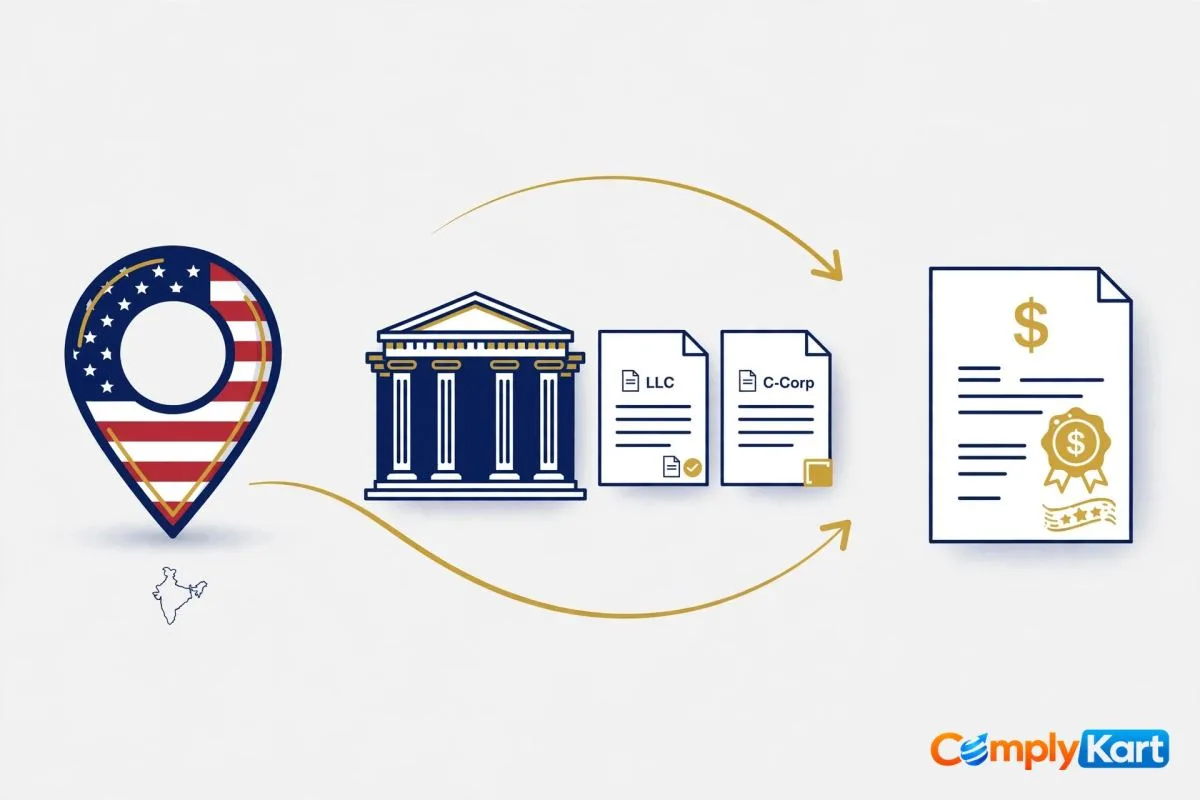
Every year, thousands of Indian founders form US companies — to sell to American customers in dollars, to raise from US investors, or to put a credible entity behind a SaaS or services business. The good news: you can do all of it from your desk in India. No flight to Delaware, no US visa, no Social Security Number. A registered agent files with the state online, the IRS issues your EIN by fax, and a US bank account follows.
The bad news is that the internet is full of half-true advice about this. "Form a Delaware LLC, pay no tax" is the most common — and the most dangerous. A single-member LLC owned by a nonresident alien has a mandatory annual IRS filing (Form 5472) with a $25,000 penalty for missing it, even when it owes zero tax. Choose the wrong entity and a future fundraise gets expensive to fix. And the Indian side — FEMA, the LRS limit, ODI reporting — is where most founders actually trip, not the US filing.
This guide walks through the whole thing the way a practitioner would: which entity, which state, what it costs, how the EIN really works for foreigners, what changed on BOI reporting in 2025, how to fund it legally from India, and what the ongoing compliance looks like on both sides of the ocean.
One terminology note: Americans say "LLC" and "corporation" the way Indians say "private limited". An LLC is closer to an LLP in spirit (flexible, pass-through) but with a corporate-style liability shield. A C-Corp is the closest thing to an Indian private limited company — and it is what US venture capital expects.
Is a US company right for you?
A US entity is a good fit if:
Your customers are primarily in the US and you want to bill in dollars without friction
You plan to raise from US venture funds (they invest in Delaware C-Corps, full stop)
You want access to US payment rails (Stripe US, US ACH) or US app stores and marketplaces
You are building a holding structure with an Indian operating subsidiary
Think twice if:
Your customers and team are all in India — an Indian private limited company is cheaper and simpler
You only need to receive dollars occasionally — a freelance inward-remittance setup may do
You cannot spare 4–6 weeks for the EIN — the US timeline has one unavoidable bottleneck
The three decisions you make before filing
1. LLC or C-Corp. This is the big one. An LLC is flexible: by default a single-member LLC is "disregarded" for US tax (profits flow to the owner), and a multi-member LLC is taxed as a partnership. Administration is light — no board meetings, no share certificates. A C-Corp is a separate taxpayer at 21% federal tax, with formalities (directors, officers, bylaws, stock ledger), but it is the only structure US VCs will fund, and it allows proper ESOP pools and preferred-share rounds. Converting an LLC to a C-Corp later is possible in Delaware (statutory conversion) but it is a taxable event with real advisory cost — decide with your fundraise plans in view, not after.
2. Which state. Delaware for the C-Corp, almost always: the Court of Chancery, the century of case law, and investor familiarity make it the default. For an LLC, Delaware is the prestige choice but Wyoming is the value choice — $100 to file, $60 a year, no state income tax, and member names are not on the public record. New Mexico is the budget outlier ($50 filing, no annual report) but lacks Delaware's legal infrastructure. Nevada used to be popular; its fees and disclosure requirements have made it less attractive than it was. Pick the state where you file — you do not need a physical presence there, the registered agent covers that.
3. Who owns it and how money reaches it. If you as an individual fund the company, that is an LRS remittance ($250,000 per person per financial year). If your Indian company funds it, that is Overseas Direct Investment under the 2022 Rules with its own limits and reporting. Get the India-side paperwork right at the time of funding — reconstructing FEMA compliance two years later is painful and expensive.
Delaware LLC vs Delaware C-Corp vs Wyoming LLC
Delaware LLC
Delaware C-Corp
Wyoming LLC
Filing fee
$110
from $89
$100 (online)
Annual state tax
$300 flat
from $175 (franchise tax)
from $60
US federal tax (default)
Pass-through / disregarded
21% corporate
Pass-through / disregarded
VC fundraise
Possible, rarely preferred
The standard
Possible, rarely preferred
Formalities
Minimal
Board, bylaws, stock ledger
Minimal
Owner privacy
Members not public
Directors/officers public
Members not public
Annual IRS filing (foreign-owned)
5472 + pro-forma 1120
Form 1120
5472 + pro-forma 1120
BOI reporting (2026)
Exempt
Exempt
Exempt
Documents required
Written for an Indian individual forming a US company from India. The list is shorter than the internet makes it look, and two negative points matter as much as the documents themselves: no US authority asks for your Aadhaar, and you do not need an SSN, an ITIN or a US visa at any point in this section. Your PAN appears once, in the India-side group, because only your Indian bank needs it.
Documents from you, the Indian founder
Passport copy — every owner (LLC member) or shareholder and director (C-Corp). Your primary ID. It is used for the EIN responsible-party details and for bank KYC; most states do not even take a copy at formation.
Indian address proof — a bank statement or utility bill in your name, recent (keep it within 3 months). The registered agent does not file this. Banks and payment platforms check it, so have it ready before the account application, not after.
Your choices, in writing: 2–3 company names in order of preference, LLC or C-Corp, and the state. Not documents, but the filing cannot start without them. We run the name-availability check in your chosen state first, so nobody pays for a rejected application.
What you do NOT need: an apostilled passport. No state asks for one to form an LLC or a corporation, and the IRS does not ask for a passport copy with Form SS-4. If an agent tries to sell you apostille or notarisation for US formation, ask them which filing requires it — there isn't one.
Country documents — prepared and filed for you
Certificate of Formation / Articles of Organization (LLC) or Certificate of Incorporation (C-Corp). The state filing that creates the company, filed with the Secretary of State in Delaware, Wyoming or your chosen state.
Registered agent appointment. Every state requires an agent with a physical in-state address to receive legal documents. We arrange a professional agent for the full first year.
EIN application — Form SS-4 to the IRS. As a foreign owner with no SSN or ITIN you cannot use the IRS online tool; the form goes by fax or phone, with "Foreign" written where line 7b asks for the responsible party's tax ID. The IRS charges nothing. The EIN arrives as letter CP 575 — keep it safe; banks ask for it.
Operating Agreement (LLC) or bylaws and stock ledger (C-Corp). Not filed with the state, but a bank will treat an LLC without an operating agreement as unfinished. We draft the version that fits a foreign-owned company.
For the bank account: the CP 575, the filed formation certificate, the operating agreement or bylaws, your passport and your Indian address proof. Fintech platforms that onboard non-residents remotely (Mercury and Relay are the usual routes) work from exactly this set; traditional US banks may additionally want an in-person visit.
India-side paperwork — your bank in India, not the US
PAN. India-side only — your AD bank's LRS/FEMA file. The US filing never asks for it, and the two filings must simply tell the same ownership story.
Form A2 and the LRS declaration for the remittance. A resident individual remits under the Liberalised Remittance Scheme, up to USD 250,000 per financial year, through an authorised dealer bank with the overseas-investment purpose code.
ODI reporting where shares are issued to you: Form FC through your AD bank, and the Annual Performance Report (APR) each year. Keep the share certificate or stock-ledger entry as evidence of the investment for the bank's file.
TCS check before you remit. Tax collected at source applies on LRS remittances above the threshold in force under section 206C(1G). Rates and thresholds have moved in recent budgets — confirm the current position with your bank before the transfer, not from an old blog post.
The formation process — step by step
Step 1 — Entity and state selection
LLC or C-Corp, Delaware or Wyoming (or New Mexico for a lean LLC). This drives everything downstream — tax filings, fundraise readiness, annual costs. If there is any chance of US venture funding in the next 3 years, form the Delaware C-Corp now.
Step 2 — Name check
Search the chosen state's business-entity database for conflicts. LLC names must contain "LLC" or "Limited Liability Company"; corporations need "Inc.", "Corp.", "Incorporated" or similar. Reserve the name if you are not filing immediately (small fee, 120 days in Delaware).
Step 3 — Appoint a registered agent
Every state requires one — an individual or company with a physical address in the state, available during business hours to accept legal documents. Commercial agents charge roughly $100–300 a year. This is also the address that appears on public records, which is why founders use a service rather than a friend's address.
Step 4 — File with the state
Delaware LLC: Certificate of Formation ($110). Delaware C-Corp: Certificate of Incorporation (from $89, scaled by authorised shares). Wyoming LLC: Articles of Organization ($100 online). Standard processing is 1–3 business days; Delaware offers same-day and 30-minute expedited filing for additional fees.
Step 5 — Operating agreement / bylaws and internal records
Draft the LLC operating agreement (ownership percentages, profit splits, management, exit mechanics) or the corporate bylaws, stock ledger, and initial board consents. States do not ask for these at filing, but banks, investors, and the IRS do — and a single-member LLC with no operating agreement looks unfinished to everyone who matters.
Step 6 — EIN from the IRS
The bottleneck. Foreign founders without an SSN or ITIN cannot use the IRS online application; the responsible party files Form SS-4 by fax to the IRS international unit (or applies by phone). Processing runs about 4–6 weeks. The EIN arrives as letter CP 575 — guard it like a PAN card.
Step 7 — US bank account
With the EIN and formation documents, open the account. Founders outside the US typically use fintech-first options (Mercury, Relay, Brex) or specialist introducers to traditional banks — policies for non-resident founders tightened across the industry in 2024–2025, so confirm current onboarding requirements before assuming approval.
Step 8 — State business licences and tax registrations
If the company has US operations or employees, register for state employer accounts and any required business licences. A pure holding or contracting entity with no US presence usually has nothing further at the state level beyond the annual tax.
BOI reporting in 2026 — what actually changed
This deserves its own section because most online guides are now wrong. The Corporate Transparency Act's BOI regime took effect on 1 January 2024 and originally caught every small US company. Then came the reversal: on 26 March 2025, FinCEN published an interim final rule that exempts all entities formed in the United States — every Delaware LLC and C-Corp you form from India included — from BOI reporting entirely. The "reporting company" definition now covers only foreign entities registered to do business in a US state.
Practical meaning: your new Delaware or Wyoming entity files nothing with FinCEN. If you formed before the rule change and filed a BOI report, you are exempt from updating it. Do not pay anyone a "BOI filing fee" for a domestic entity in 2026 — that service is selling you something the law no longer requires.
Fees and costs
Item
Typical cost
Delaware LLC formation (state fee)
$110
Delaware LLC annual tax
$300 / year
Delaware C-Corp formation (state fee)
from $89
Delaware C-Corp annual franchise tax
from $175 / year
Wyoming LLC formation
$100
Wyoming LLC annual licence tax
from $60 / year
Registered agent
~$100–300 / year
EIN
$0 (IRS issues free)
Expedited state filing (optional)
$50–1,000+ depending on speed and state
Professional fees for the full setup (entity, agent coordination, EIN, operating agreement/bylaws, banking support, India-side FEMA paperwork) vary by provider; get a fixed quote that itemises what is included.
The India side — FEMA, LRS and ODI
Forming the US company is the easy half. Moving money into it legally is the half that gets founders into trouble.
Individual founders — the LRS route. A resident individual may remit up to $250,000 per financial year under the Liberalised Remittance Scheme for permitted capital-account transactions, which include acquiring shares of a foreign company. The remittance goes through an authorised dealer bank with a Form A2 declaration and the purpose code for overseas investment. Each founder has their own $250,000 limit — two co-founders can remit $500,000 between them in a year. TCS (tax collected at source) applies on LRS remittances above thresholds under section 206C(1G) — check the current TCS position before remitting, as rates and thresholds have moved in recent budgets.
Indian company investing — the ODI route. An Indian company investing in the US entity follows the Overseas Investment Rules, 2022: limits linked to net worth (up to 400% for automatic-route ODI in most cases), reporting through the AD bank on the FIRMS portal, and an Annual Performance Report each year. Get the reporting done at the time of investment — late or missing ODI reporting draws compounding fees.
Tax residency and the place of effective management. A US C-Corp controlled from India can be treated as tax-resident in India under the POEM rules if its effective management sits here — which would defeat the purpose of the structure. Document where key decisions are actually made, and take advice before the structure goes live, not after the first board meeting.
Transfer pricing. If your Indian company provides services to the US entity (development, support, back office), the cross-border charges must be at arm's length with transfer-pricing documentation. This is the single most-audited aspect of India-US startup structures.
US tax — the honest version
Single-member LLC, Indian owner, no US operations. The LLC is disregarded: no US federal income tax on non-US-source income that is not effectively connected with a US trade or business. But — and this is the part the cheap-formation sites bury — you must still file Form 5472 (information return) with a pro-forma Form 1120 every year. The penalty for not filing is $25,000. There is no de minimis exception and no "but we had no income" defence.
C-Corp. 21% federal tax on worldwide income (with foreign tax credits), plus state tax where the company has nexus. A Delaware C-Corp with no Delaware operations typically owes no Delaware corporate income tax but still pays the annual franchise tax. Dividends to Indian shareholders suffer US withholding — 25% under the India-US tax treaty in most cases (15% where a company holds at least 10% of voting stock), creditable in India.
Founder's Indian tax. As an Indian resident you are taxed on global income. LLC profits attributed to you, C-Corp dividends, and any salary — all taxable in India with foreign tax credit for US taxes paid. Plan the structure with both countries' tax in view from day one.
How ComplyKart helps
We handle the full formation: entity and state selection advice, name check, registered-agent coordination, state filing, operating agreement or bylaws with founder vesting, EIN application, banking introductions, and the India-side FEMA/LRS or ODI paperwork with your bank. Post-formation, we line up the annual calendar — state taxes, Form 5472/1120, and Indian reporting — so nothing falls through the cracks.
What we do not do: we are not US attorneys or CPAs. Entity documents are prepared on standard practitioner templates; where your situation involves venture financing, complex tax positions, or litigation risk, we bring in US counsel and say so upfront. We also do not promise bank-account approval — the bank decides, and we tell you the current onboarding reality before you pay.
What happens after formation
EIN letter (CP 575) — file it with your formation documents; you will produce it constantly.
Bank account — open as soon as the EIN arrives; do not let formation documents sit idle.
Accounting from day one — even a pre-revenue entity needs clean books; reconstructing a year of transactions at tax time costs multiples of monthly bookkeeping.
Registered agent renewal — calendar it; a lapsed agent means missed legal notices and eventual administrative dissolution.
Annual state tax — Delaware LLC $300 due 1 June; Wyoming $60 on the anniversary month; Delaware C-Corp franchise tax due 1 March.
Recurring compliance calendar
Obligation
Frequency
Notes
State annual tax / report
Annual
DE LLC: $300 by 1 June; WY: from $60 anniversary month; DE Corp: franchise tax by 1 March
Form 5472 + pro-forma 1120 (foreign-owned LLC)
Annual
$25,000 penalty for failure
Form 1120 (C-Corp)
Annual
15th day of 4th month after year-end
FinCEN BOI
None
Domestic entities exempt since March 2025 rule
India: LRS purpose tracking
Per remittance
Stay within $250k/person/FY
India: ODI APR (company route)
Annual
Through AD bank on FIRMS portal
If there are co-founders
Put vesting in the operating agreement or founders' stock purchase agreements from day one — typically 4-year vesting with a 1-year cliff. Founder splits agreed on a handshake have destroyed more startups than bad products. For a C-Corp, file 83(b) elections within 30 days of stock issuance where applicable — missing that deadline is a classic, expensive, unfixable mistake.
Delaware LLC vs C-Corp — the decision, once more
If there is any realistic path to US venture funding: Delaware C-Corp, now, not later. If the company is a lifestyle business, agency, or holding vehicle with no institutional fundraise planned: an LLC (Delaware for prestige, Wyoming for cost) is simpler and usually more tax-efficient. What you must not do is form the LLC "for now" while telling investors a C-Corp story — the conversion is doable but it is a taxable event that your future investors' lawyers will price into the round.
FAQ
Frequently asked questions
18 answers from our consultants.
You pay for our expert's time — document checking, filing, follow-ups — not the government. The government fee goes to the government; our fee is for the work we do so you don't have to figure it out yourself.
Yes. Formation needs no SSN — only the EIN application does, and foreign founders apply for the EIN on Form SS-4 by fax or phone without an SSN. Your passport is the ID for everything else.
Delaware if you might convert to a C-Corp or want the prestige and case law; Wyoming if you want the lowest cost ($100 filing, $60 annual) and owner privacy. For a pure operating LLC with no fundraise plans, Wyoming is usually the better value.
No. Formation, EIN, and banking can all be completed remotely. Some traditional banks want an in-person visit, which is why most non-resident founders use fintech-first banking options.
The EIN is the federal tax ID — needed for banking, hiring, and tax filings. The IRS online application requires the responsible party to have an SSN or ITIN, which foreign founders don't have, so they apply on paper Form SS-4 by fax or by phone instead.
No. FinCEN's interim final rule of 26 March 2025 exempts every entity formed in the United States from BOI reporting. Only foreign entities registered to do business in a US state must report.
As an individual, through the LRS — up to $250,000 per financial year per person via your bank with a Form A2 declaration. As an Indian company, through the ODI route under the Overseas Investment Rules, 2022, with AD-bank reporting.
If it has no US effectively connected income, generally zero US federal income tax — but the annual Form 5472 information return is still mandatory, with a $25,000 penalty for missing it. Your Indian tax on the income still applies as a resident.
21% federal, plus state corporate tax where the company has nexus. A Delaware C-Corp operating outside Delaware typically owes no Delaware income tax but still pays the annual franchise tax (from $175).
It can engage Indian contractors directly, but hiring employees in India generally needs an Indian presence (subsidiary, branch, or employer-of-record) because Indian labour, PF/ESI, and withholding obligations attach where the work is performed.
The registered agent is the legal point of contact in the formation state for service of process and state notices — mandatory. A business address (or virtual office) is for commercial correspondence and banking. Most founders need both, and providers often bundle them.
Yes — the Form 5472 + pro-forma 1120 for a foreign-owned single-member LLC is due every year regardless of activity, and the state annual tax is due regardless of activity. "No activity" is not an exemption from either.
In Delaware, yes, by statutory conversion — but it is generally a taxable event and needs proper valuation and documentation. It is cleaner and cheaper to start as a C-Corp if venture funding is on the roadmap.
It is the IRS information return a US corporation or foreign-owned disregarded entity files to report transactions with related foreign persons — including its own foreign owner. The $25,000 penalty applies per year per failure, and the IRS does enforce it.
Yes. LRS limits are per resident individual — two founders can remit up to $250,000 each in a financial year toward the same company, each through their own bank with their own documentation.
Not legally, but banks and payment providers often require one for verification. A VoIP US number usually satisfies this; confirm with the specific bank before relying on it.
The entity goes into penalty and eventually administrative dissolution ("void" status) — it loses the ability to sue or defend in Delaware courts and the liability shield gets shaky. Revival is possible but costs back taxes plus penalties. Calendar the 1 June (LLC) and 1 March (Corp) deadlines.
The classic "flip" puts the US C-Corp on top for fundraising, with the Indian entity as subsidiary — but flipping an existing Indian company abroad has tax and FEMA costs (this is why founders decide the structure before incorporating, not after). If the business is India-first with US customers, an Indian parent with a US subsidiary is often simpler.
What clients say about working with us
Real stories from businesses we've worked with.
Trademark Registration“
Our Trademark was applied in all the classes with a short span of time by Complykart Trademark Experts and I can say the level of expertise and commitment they carry is remarkable. It's an A+ from my side. We are now sticking to ComplyKart only.
Company Registration“
I found the professionalism of the staff at complykart.com, a pleasure to work with. As a foreigner to India, they took the time to explain the documentation and assisted in every question I raised. I was pleased that complykart.com made it easy for my Business.
Merger & Acquisition“
Trust, Commitment, Dedication and responsiveness are the best things with ComplyKart. Thanks for handling our Merger assignment with so much care. After my business disputes, complykart handles all things with own sense of understanding.
Company Law Specialist · Company Law & ROC Compliance · 10+ years experience
Naman Agarwal specialises in company law and ROC compliance. He manages incorporations, annual filings (AOC-4, MGT-7, ADT-1), board processes and statutory registers for private limited companies, LLPs and Section 8 companies.
Last reviewed: 16 November 2026
Get a free consultation
Talk to a ComplyKart professional about Company Formation in USA. The first consultation is free.