Five steps, no guesswork — you always know exactly what comes next. Tap a step to see what it involves.
12345
You pay securely. Payment is confirmed instantly, and your receipt with the written fee breakup lands in your inbox.
Why Canada, and why the jurisdiction question matters first
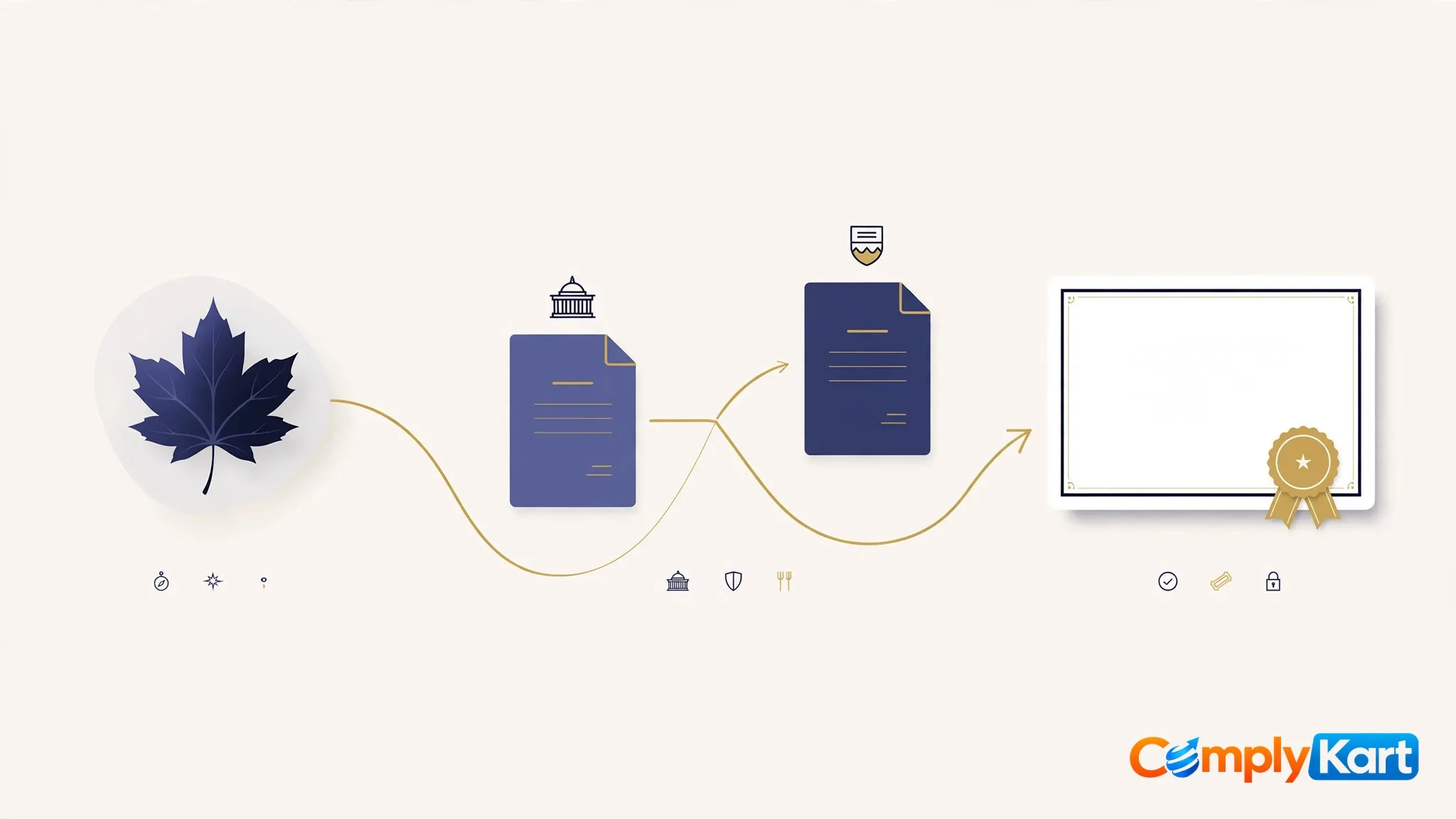
Every Indian founder who asks about Canada asks the wrong question first. They ask "how do I register a company in Canada?" The right first question is "federal or provincial?" — because Canada has two completely separate company-law systems, and the choice changes your costs, your director requirements, and where you file every year.
Think of it like this. A federal incorporation is an all-India driving licence: valid everywhere in the country, respected everywhere. But you still need to register the vehicle in each state where you actually drive it day to day. In Canada, that second step is called extra-provincial registration, and skipping it is the single most common compliance miss among foreign-owned Canadian companies.
The good news: Canada is genuinely open to foreign founders. There is no minimum capital requirement for a standard corporation, 100% foreign ownership is permitted, and two of the three most popular provinces — Ontario and British Columbia — impose no Canadian residency requirement on directors at all. You can be the sole director and sole shareholder from your desk in India.
Federal vs Ontario vs BC — the decision that shapes everything
Factor
Federal (CBCA)
Ontario (OBCA)
British Columbia (BCA)
Incorporation fee (government)
$200 online
~$300
~$350
Name search
Federal NUANS (~$13.80)
Ontario name search
$30 name request
Director residency
25% resident Canadians (min 1 if fewer than 4 directors)
None
None
Name protection
Canada-wide
Ontario only
BC only
Extra-provincial for other provinces
Required everywhere you operate
Required outside Ontario
Required outside BC
Annual filings
$12 federal + provincial returns where registered
Ontario annual return
$43.39 BC annual report
Best for
National presence, cross-province operations
Ontario-centred business (Toronto/GTA)
BC-centred business, simplest non-resident route
Federal incorporation suits founders who will operate in more than one province, want the strongest name protection, or value the credibility of a federal charter with investors and partners. The trade-off is the director residency rule: at least 25% of directors must be resident Canadians, and with fewer than four directors, at least one must qualify. A work permit does not satisfy this test. Most Indian founders without a Canadian-resident partner solve this with a professional resident-director arrangement — but read the banking section before you celebrate, because banks verify residency too.
Ontario incorporation suits founders centred on Toronto and the GTA — finance, technology, professional services. Ontario removed its director residency requirement in 2021, so an Indian founder can be the sole director. Filing is through the Ontario Business Registry, and a federally incorporated company operating in Ontario files its initial return free of charge — which is why some founders incorporate federally and register extra-provincially in Ontario rather than incorporating in Ontario directly.
BC incorporation is the simplest route for a non-resident founder with no Canadian connections at all. No residency requirement, straightforward BC Registry filing, and the province's 5% GST-only regime keeps sales-tax administration light. The catch: if you later expand to Ontario or Alberta, you will be doing extra-provincial registrations there anyway — so BC-first makes sense when your operations genuinely sit in BC.
One honest note on names: provincial name approval does not check the federal register. A name approved in BC can still collide with an existing federal corporation. If brand protection matters, run the federal NUANS even for a provincial filing.
What you need before filing
Proposed name and NUANS report (or choose a numbered company — "12345678 Canada Inc." — which skips name approval entirely and incorporates faster)
Directors: minimum one. Federal: mind the 25% resident rule. Ontario/BC: any adult, anywhere
Share structure: classes of shares, voting rights, any transfer restrictions — your Articles of Incorporation lock this in
Registered office address in the jurisdiction of incorporation (a real street address; providers sell registered-office services to foreign founders)
Incorporator details and director consents (kept in your minute book)
Documents required
Written for an Indian individual incorporating in Canada from India. Canada is precise about what the registry needs — names, addresses, share structure — and it does not collect your passport at incorporation at all. Your passport still matters, for provider KYC and above all for the bank, which is the hardest step in a Canadian setup. Two corrections to older versions of this checklist: no Canadian registry asks for your Aadhaar (obviously), and none asks for apostilled documents either — see the note in the first group. Your PAN belongs only to the India-side group.
Documents and information from you, the Indian founder
Passport — every director and shareholder. The registry does not take a copy at incorporation; your passport is the ID your Canadian provider uses for KYC and the ID the bank will insist on at account opening, where a notarised copy is commonly asked for. Keep a clear colour scan ready.
Indian residential address proof — a bank statement or utility bill, not older than 3 months, in your name. Names, date of birth and address must match across every document in the file; mismatches are the most common reason Canadian files stall.
Signed consent to act, from every director. A short form, kept in the corporate minute book. It is a mandatory corporate record even though it is not filed publicly.
What you do NOT need: apostilled documents. Canada joined the Hague Apostille Convention in January 2024, but neither Corporations Canada nor the Ontario and BC registries require an apostille on a foreign founder's passport or address proof for incorporation. An earlier draft of this very page said they "should carry an apostille" — that was wrong, and it has been removed. If a bank or provider asks for a notarised passport copy, that is their KYC rule, not the registry's.
Federal route only — a resident Canadian director. A federal (CBCA) corporation needs at least 25% of its directors to be resident Canadians (at least one, on a small board). If you incorporate federally, that director's residency details join the file. Ontario, British Columbia and Alberta have no director residency requirement — on those routes every director can be an Indian resident, and this item disappears.
Country documents — prepared and filed for you
NUANS name search report — for a named corporation. The report checks your proposed name against Canada's corporate and trademark records and must be less than 90 days old when you file (a federal NUANS for a federal filing). Choosing a numbered corporation — "12345678 Canada Inc." — skips this step entirely.
Articles of Incorporation. Share structure, director details and the registered office, filed federally with Corporations Canada (CAD 200 online) or provincially — Ontario (OBCA) or British Columbia (BCA), depending on the route we settle with you.
Registered office address in Canada. A real address in the jurisdiction of incorporation where legal notices are received. We arrange a compliant provider address if you do not have one.
Organisation records. First directors' resolutions, the share register and the register of Individuals with Significant Control (ISC), set up in the minute book at organisation. Canada takes these registers seriously — they must be accurate from day one, not reconstructed at tax time.
CRA Business Number and program accounts. After incorporation we register the corporation for its Business Number and open the corporate income tax (RC) and, when needed, GST/HST (RT) accounts. Without the Business Number the company cannot file or charge tax properly.
India-side paperwork — your bank in India, not the Canadian registry
PAN. For your AD bank's FEMA file only. No Canadian authority asks for it; it keeps the Indian and Canadian filings describing the same owner.
Form A2 and the LRS declaration for the remittance. Resident individuals invest under the Liberalised Remittance Scheme, up to USD 250,000 per financial year, through an authorised dealer bank.
ODI reporting: Form FC through your AD bank, share-issue evidence (share certificate or register extract) for the bank's file, and the Annual Performance Report (APR) each year. Report any later restructuring or disinvestment the same way.
TCS check before you remit. Tax collected at source applies on LRS remittances above the threshold in force under section 206C(1G); confirm the current rate and threshold with your bank before transferring.
The incorporation process — step by step
Step 1 — Clear the name with NUANS
Order a NUANS report for a federal filing (about $13.80) or the provincial equivalent. The report lists confusingly similar existing names and trademarks. Corporations Canada examines it when you file; a weak name gets bounced and costs you weeks. Numbered companies skip this step entirely.
Step 2 — Draft the Articles of Incorporation
Your company's constitution: legal name, registered office, share classes and their rights, restrictions on share transfers, and the number of directors (a fixed number or a range like 1–10). Get the share structure right now — fixing it later means filing Articles of Amendment and paying again.
Step 3 — Settle the director question
Federal: confirm your resident Canadian director(s) and collect signed consents. Ontario/BC: record your directors — all can be Indian residents. Every director's consent stays in the corporate records; it is not filed publicly, but you must have it.
Step 4 — File with Corporations Canada or the provincial registry
Federal filing is online through Corporations Canada ($200; $250 on paper; $100 extra for 4-hour express). Ontario and BC file through their own registries. Approval typically takes a few business days; express federal service can turn around in hours.
Step 5 — Receive the Certificate of Incorporation
This is your company's birth certificate. It carries the corporation number and date — keep it with your minute book forever.
Step 6 — Register extra-provincially wherever you operate
Federal company with an office or employees in Ontario: file the Ontario initial return (free). Operating in BC: register extra-provincially (about $350 plus the BC name reservation). The two-month clock in BC starts when you begin carrying on business there. Miss it and you are operating unregistered — fines and an inability to sue in BC courts follow.
Step 7 — Get the CRA Business Number
Apply through CRA Business Registration Online. The BN is a 9-digit number; program accounts hang off it — RT0001 for GST/HST, RP for payroll, RC for corporate income tax. Since November 2025, CRA no longer accepts BN registration by phone; it is online or through an authorised representative only.
Step 8 — Organise the company
First directors' meeting (or written resolutions): issue shares, appoint officers, adopt by-laws, open the registers — including the Individuals with Significant Control (ISC) register, which federal corporations must maintain and keep current. Dissolution is the penalty for letting annual returns and registers slide.
Tax and GST/HST after incorporation
Canada's corporate tax has two layers: federal plus provincial. The combined general rate sits around 26.5% federally-plus-Ontario, but the small business deduction cuts the rate on the first $500,000 of active business income substantially for Canadian-controlled private corporations. Here is the catch for Indian founders: a corporation controlled by non-residents generally does not qualify as a CCPC, so it does not get the small business deduction. Plan your effective rate on the general rate, not the headline small-business rate your Canadian friends quote.
GST/HST is the value-added tax. You must register once taxable supplies exceed $30,000 over four consecutive calendar quarters (a rolling period, not the calendar year), and within about 30 days of crossing. The rate depends on the province of the customer, not where you sit: Ontario 13% HST, BC 5% GST (plus 7% PST on top for most goods), Alberta 5% GST. Voluntary registration below the threshold is allowed and is often smart — you claim input tax credits on your startup spending from day one, at the cost of charging tax and filing returns.
Payroll, if you hire in Canada, needs an RP account; the corporation withholds income tax, CPP and EI. Corporate income tax returns (T2) are due six months after year-end.
The India side: FEMA and ODI compliance
Owning a Canadian company from India is a capital account transaction under FEMA, and it has its own compliance track that runs parallel to everything above.
Resident individuals invest under the Liberalised Remittance Scheme: up to USD 250,000 per financial year per person for permitted capital account transactions, including setting up or acquiring a foreign wholly owned subsidiary. Since October 2023, LRS remittances above ₹7 lakh in a financial year attract 20% TCS (education and medical excepted) — budget for the cash-flow impact.
Indian companies and LLPs invest under the FEMA (Overseas Investment) Rules, 2022: up to 400% of net worth as per the latest audited balance sheet through the automatic route. ODI is prohibited in foreign entities engaged in real estate trading, gambling, or INR-linked financial products without RBI approval.
Reporting runs through the RBI's FIRMS portal: report the investment, file the Annual Performance Report each year, and report any disinvestment or restructuring. The 2022 framework widened what counts as Overseas Investment and tightened post-investment compliance — this is not a file-and-forget step.
Practical structuring note: many Indian founders fund the first year personally under LRS (fast, no board process) and have the Indian operating company invest once revenues justify it. Either way, keep the remittance purpose codes and FIRC/BRC paperwork clean — your bank is the first compliance checkpoint.
Banking — the step everyone underestimates
Opening a Canadian business bank account from India is the hardest part of the whole exercise. The Big Five banks (RBC, TD, Scotiabank, BMO, CIBC) generally want a director to appear in person with ID, and they verify the resident director's status independently — which is where nominee-style arrangements get scrutinised. Realistic options: travel to Canada for account opening, use a Canadian fintech/EMI for the first months while you arrange a visit, or work through a provider with established banking relationships. Do not assume the account opens on incorporation day. Build 4–8 weeks into your plan. One more practical point: keep your incorporation documents, NUANS report, and director consent forms in a single digital folder — the bank will ask for all of them, and scrambling for paperwork mid-KYC is how timelines slip by another month.
Fees and realistic timelines
Item
Typical range
Federal incorporation (government)
$200 online
NUANS (federal)
~$13.80
Ontario incorporation (government)
~$300
BC incorporation + name request (government)
~$380
Extra-provincial (Ontario, federal corps)
$0 initial
Extra-provincial (BC)
~$350
Federal annual return
$12/year
Professional fees (end-to-end, India-side + Canada-side coordination)
varies by scope — quoted upfront
Timelines: name clearance 1–3 days, incorporation filing 2–7 business days (hours with federal express), CRA BN 1–2 weeks, bank account 4–8 weeks. A clean federal filing with a numbered name can be done in under a week; the bank account is what stretches the calendar.
How ComplyKart helps
We run the whole track: jurisdiction selection (federal vs Ontario vs BC based on where you will actually operate), NUANS and name strategy, Articles drafting, resident-director arrangements where needed, CRA Business Number and GST/HST/payload registrations, extra-provincial filings, and the India-side FEMA/OI paperwork — LRS documentation, FIRMS reporting and APR filing. What we do not do: we do not provide nominee directors as a sham (any resident director arrangement is documented with proper agreements and the person knows their legal duties), we do not open bank accounts on your behalf without your participation in KYC, and we do not give Canadian tax filing services — we coordinate with Canadian CPAs for T2 and GST/HST returns.
What happens after incorporation
Within the first month: BN and program accounts, minute book and share certificates, ISC register, extra-provincial registrations. Within the first quarter: GST/HST registration if you will cross $30,000, accounting system in place (Canadian books, kept six years for CRA), payroll setup if hiring. Annually: federal/provincial annual returns, T2 corporate return, GST/HST returns, FIRMS APR on the India side, and shareholder resolutions documented properly.
Three founder profiles — which jurisdiction fits
Profile 1: The Toronto SaaS founder. You sell to US and Canadian customers, your team is remote, and you want credibility with North American investors. Federal incorporation with an Ontario extra-provincial registration is the natural fit: Canada-wide name protection, one extra filing (free in Ontario), and the federal charter reads well on a pitch deck. Solve the resident-director requirement with a documented arrangement before you file, not after.
Profile 2: The BC-based consultant or agency. Your clients are in Vancouver, you may relocate later, and you want the lightest possible compliance load. BC provincial incorporation: no residency rule, one registry, one annual report at $43.39. If you later take on Ontario clients with a physical presence there, add the extra-provincial registration then — do not pay for it on day one.
Profile 3: The Indian company expanding abroad. Your Indian private limited company is the investor, not you personally. Incorporate a federal subsidiary (the 25% director rule still applies — the subsidiary needs its own qualifying director), fund it under the OI Rules 2022 within the 400%-of-net-worth automatic route, and run FIRMS reporting from the Indian parent. Keep the Canadian subsidiary's books clean from the first invoice; transfer-pricing documentation between the Indian parent and Canadian subsidiary is not optional once transactions flow.
Structuring the ownership: personal vs Indian-company investment
There are two clean ways to hold the Canadian company, and the choice has tax and compliance consequences worth understanding before you remit a dollar.
Personal holding under LRS. You, as a resident individual, subscribe to the shares using your USD 250,000 annual LRS window. This is fast — no board resolutions, no valuations — and suits early-stage ventures where the founder is the business. The limits: the $250,000 annual cap is shared across all your LRS purposes (travel, education, gifts, investments), the 20% TCS above ₹7 lakh ties up cash until your tax return, and dividends the Canadian company pays you are taxable in India with foreign tax credit claims to manage.
Indian-company subsidiary under the OI Rules. Your Indian private limited company invests up to 400% of its net worth through the automatic route. This suits established businesses expanding abroad: the funding scale is larger, the structure is cleaner for investors, and the Indian parent can consolidate. The cost is process — board approval, valuation where required, FIRMS reporting, and the Annual Performance Report every year without fail.
A hybrid many founders use: personal LRS money for the first year (speed), then the Indian company subscribes to fresh shares once the business has traction (scale). Whatever you choose, do not mix the two casually — each remittance needs its own purpose code and its own paper trail.
FAQ
Frequently asked questions
23 answers from our consultants.
You pay for our expert's time — document checking, filing, follow-ups — not the government. The government fee goes to the government; our fee is for the work we do so you don't have to figure it out yourself.
Tell us your situation in plain words — what you're trying to do, not which form you think you need. Half our job is stopping clients from buying the wrong service. The first consultation is free and honest.
Yes. We quote professional fee + government charges + taxes separately, in writing, before you pay. The number doesn't change midway. If the government fee changes, we show you the notification.
Every engagement gets a tracker — you see what's filed, what's pending and what's next. No chasing on WhatsApp for status updates.
Both. Startups get incorporation + early compliance bundles; established companies get annual retainers. About half our clients started with us at incorporation.
Yes — MCA, GST and income tax are central systems, so location doesn't matter for most filings. We're Delhi-based but serve clients across India. State-specific licences (Shops & Establishment, Professional Tax) we handle through our network.
Yes. Ontario and British Columbia have no director residency requirement, so you can be the sole director and shareholder without ever visiting. Federal incorporation needs 25% resident Canadian directors (minimum one), so most India-based founders either pick Ontario/BC or add a Canadian-resident director for a federal company.
A NUANS (Newly Upgraded Automated Name Search) report checks your proposed name against existing Canadian corporations and trademarks. Federal incorporations require a federal NUANS (about $13.80). If you choose a numbered company instead of a named one, you skip the NUANS step entirely.
Government fees: $200 online for federal, about $300 for Ontario, about $350 plus a $30 name request for BC. Add NUANS ($13.80 federal), extra-provincial registrations ($0 in Ontario for federal corps, about $350 in BC), and professional fees. Budget the bank-account trip separately.
Name clearance takes 1–3 days. Filing takes 2–7 business days normally, or hours with federal express service ($100 extra). CRA Business Number follows in 1–2 weeks. The corporate bank account is the long pole — allow 4–8 weeks.
Yes — every corporation needs a registered office address in its jurisdiction of incorporation. It must be a street address, not a PO box. Foreign founders commonly use a registered-office service provider for this.
It is the filing you make in each province where your corporation carries on business outside its home jurisdiction. A federal company operating in BC must register there (about $350); in Ontario the initial return is free. You generally must register within two months of starting business in the province.
Once taxable supplies exceed $30,000 over four consecutive calendar quarters. Registration is then mandatory within about 30 days. Voluntary registration below the threshold is permitted and lets you recover GST/HST paid on startup costs through input tax credits.
It depends on the customer's province: 13% HST in Ontario, 5% GST in BC and Alberta (BC adds 7% PST on most goods), 15% HST in the Atlantic provinces. The rate follows the place of supply, not your company's location.
A 9-digit identifier the Canada Revenue Agency issues to your business, with two-letter program accounts attached — RT for GST/HST, RP for payroll, RC for corporate tax. You need it before you can register for GST/HST, run payroll, or file a corporate tax return. Since November 2025, registration is online only.
Yes. Canada permits 100% foreign ownership of corporations with no minimum capital requirement. The only foreign-founder friction is the federal director residency rule; Ontario and BC have no such rule.
Resident individuals use the LRS window (USD 250,000 per financial year); Indian companies use the OI Rules 2022 (up to 400% of net worth, automatic route). Remittances above ₹7 lakh a year attract 20% TCS. Use the correct purpose codes and keep FIRC documentation.
Report the overseas investment on RBI's FIRMS portal, file the Annual Performance Report every year, and report any further investment, restructuring, or disinvestment. Missed APRs compound into compounding applications later — calendar it from day one.
Yes, and many founders do — the Canadian company contracts with Indian staff or an Indian subsidiary. If it hires in Canada, it needs a payroll (RP) account and must withhold income tax, CPP and EI. Cross-border secondment has transfer-pricing implications; document the arrangement.
For speed, yes — it skips NUANS and name approval. For branding, no — "12345678 Canada Inc." cannot be your customer-facing name without also registering a trade name in each province. Most founders incorporate numbered and register an operating trade name, or just do the NUANS properly once.
No. Incorporation, NUANS, and CRA registration can all be done remotely through a service provider. The one step that usually needs a visit is opening a traditional bank account — plan a trip or use a fintech account initially.
Federal annual return ($12), provincial annual returns wherever registered, T2 corporate income tax return within six months of year-end, GST/HST returns, maintained minute book and ISC register, and on the India side, the FIRMS Annual Performance Report.
There is no direct conversion. The standard routes are incorporating a Canadian subsidiary (the Indian company invests under the OI Rules) or incorporating a Canadian company personally under LRS and restructuring the group later. Get cross-border tax advice before moving IP or contracts.
What clients say about working with us
Real stories from businesses we've worked with.
Trademark Registration“
Our Trademark was applied in all the classes with a short span of time by Complykart Trademark Experts and I can say the level of expertise and commitment they carry is remarkable. It's an A+ from my side. We are now sticking to ComplyKart only.
Company Registration“
I found the professionalism of the staff at complykart.com, a pleasure to work with. As a foreigner to India, they took the time to explain the documentation and assisted in every question I raised. I was pleased that complykart.com made it easy for my Business.
Merger & Acquisition“
Trust, Commitment, Dedication and responsiveness are the best things with ComplyKart. Thanks for handling our Merger assignment with so much care. After my business disputes, complykart handles all things with own sense of understanding.
Company Law Specialist · Company Law & ROC Compliance · 10+ years experience
Naman Agarwal specialises in company law and ROC compliance. He manages incorporations, annual filings (AOC-4, MGT-7, ADT-1), board processes and statutory registers for private limited companies, LLPs and Section 8 companies.
Last reviewed: 16 November 2026
Get a free consultation
Talk to a ComplyKart professional about Company Formation in Canada. The first consultation is free.