Five steps, no guesswork — you always know exactly what comes next. Tap a step to see what it involves.
12345
You pay securely. Payment is confirmed instantly, and your receipt with the written fee breakup lands in your inbox.
Who must pay — the ₹10,000 test
Section 208 sets a single threshold: if your estimated tax liability for the financial year — after subtracting TDS deducted and TCS collected — is ₹10,000 or more, you must pay advance tax. Below ₹10,000, no obligation.
Who typically crosses it:
Businesses and professionals. Business income has no TDS on the profit itself (TDS applies to specific payments, not to your bottom line). Almost every profitable business pays advance tax.
Freelancers and consultants. Same logic — your clients deduct 10% under 194J, but your actual liability at slab rates is usually higher. The gap is advance tax.
Landlords. Rent received has TDS deducted by the tenant (10% over the threshold), but rental income is taxed at slab rates after the 30% standard deduction. The difference is yours to pay in advance.
Salaried individuals with other income. Your employer's TDS covers salary. It doesn't cover the flat you rent out, the shares you sold, or the interest on deposits. Add those up — if the extra tax crosses ₹10,000, advance tax applies to you too.
Capital gains earners. A property or equity sale can create a six-figure liability in a single transaction. The law expects you to pay it in the remaining instalments of that year, not next July.
Who is exempt:
Resident senior citizens (60+) with no business or profession income — Section 207(2). A retired person living on pension, interest and rent pays no advance tax; the full liability is settled as self-assessment tax with the return. The moment business income appears, the exemption goes.
Anyone whose net tax stays below ₹10,000 after TDS/TCS — the threshold itself is the exemption.
The instalment schedule
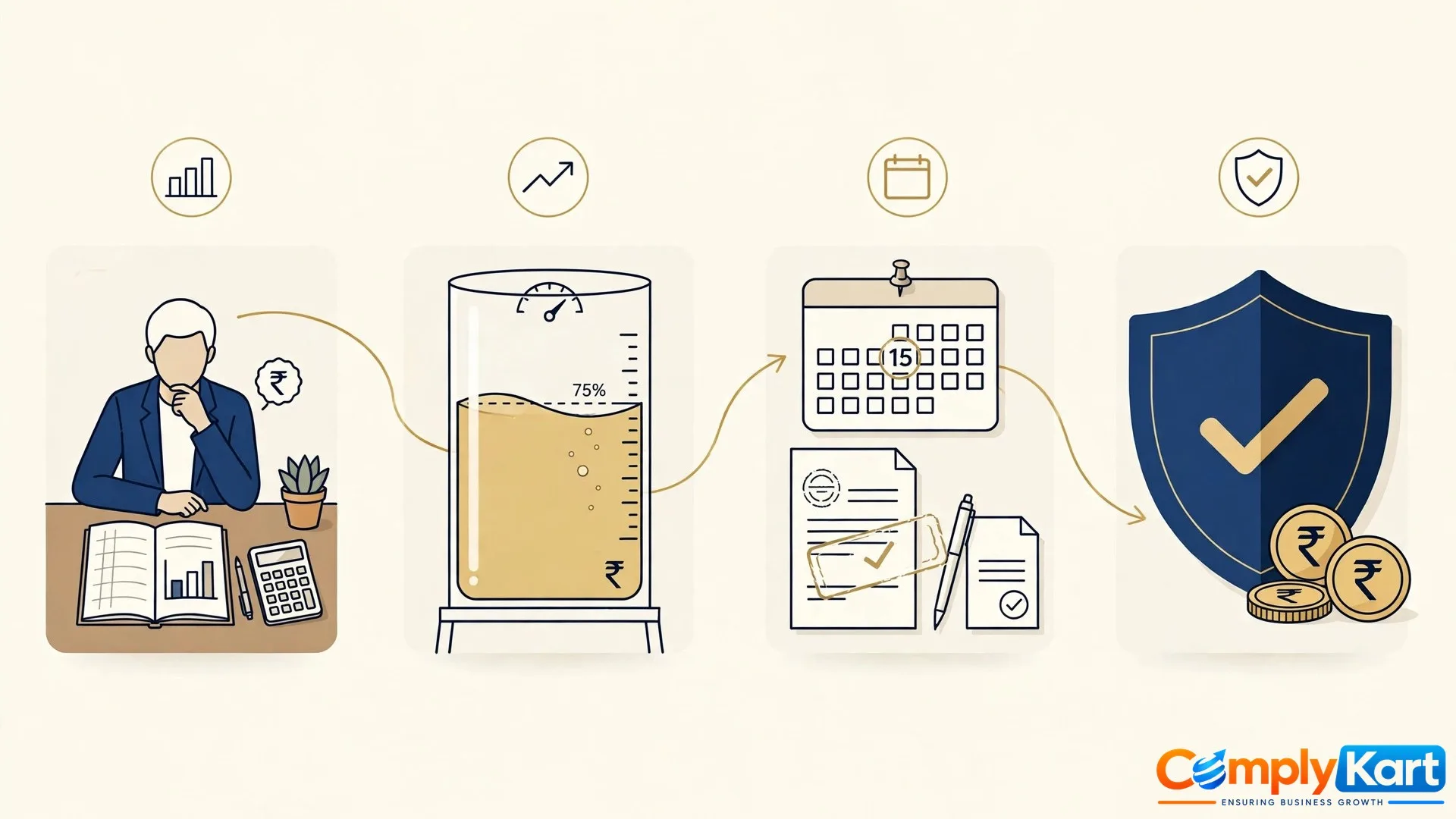
Section 211 (1961 Act) / Section 408 (2025 Act) prescribes four instalments for most taxpayers:
Due date
Cumulative advance tax payable
15 June
At least 15% of estimated annual tax
15 September
At least 45%
15 December
At least 75%
15 March
100%
"At least" matters — you can pay more, earlier. You cannot pay less without interest consequences.
Presumptive taxpayers (44AD / 44ADA) get a simpler deal: no quarterly instalments. Pay 100% by 15 March in a single instalment. Miss that, and 234C applies on the whole amount for one month.
Any payment made on or before 31 March counts as advance tax. Pay on 31 March and it's advance tax; pay on 1 April and it's self-assessment tax. The line is the financial year's end, and it determines which interest provisions apply.
How to estimate — the honest method
Advance tax is paid on an estimate, and the law accepts that estimates are imperfect — that's what the safe harbours are for. But "estimate" doesn't mean "guess." Here's the method that holds up:
Step 1 — Project the full year's income. Take actual income to date from your books, then add a separately estimated figure for the remaining months. Don't just divide nine months by three — in a growing business that underestimates, in a seasonal one it overestimates, and the interest falls on the shortfall either way.
Step 2 — Apply deductions and compute tax. Chapter VI-A deductions, the regime choice (old vs new — and under the 2025 Act, the new regime in Section 202), slab rates, surcharge, health and education cess at 4%.
Step 3 — Subtract TDS and TCS already deducted or expected. Salary TDS, 194J deductions by clients, TCS credits. What remains is the advance-tax base.
Step 4 — Apply the instalment percentages to the base, subtract what's already paid, and pay the difference by each due date.
Re-estimate every quarter. Income changes; estimates should too. The December instalment is the natural checkpoint — nine months of actuals behind you, three months to project. Most 234C interest is born from estimates frozen in June and never revisited.
A worked example
Ritu runs a design studio. By mid-December, her books show:
Less 80C/80D deductions: ₹2,00,000 → taxable income ₹30,00,000
Tax at slab rates (new regime): roughly ₹7,02,000 including 4% cess
Less TDS already deducted (₹2,66,000) and expected on Q4 receipts (₹1,20,000): advance-tax base = ₹3,16,000
December instalment target: 75% of ₹3,16,000 = ₹2,37,000 cumulative; she has paid ₹1,40,000 so far → pay ₹97,000 by 15 December
The divide-by-three shortcut would have taken nine-month profit (₹24,00,000), annualised it to ₹32,00,000 — same answer here by luck. In a seasonal business, where Q4 is either dead or explosive, the shortcut misleads. Work from actuals plus a separately estimated Q4, always.
Advance tax for businesses vs individuals — different pressure points
The law is the same; the pain points differ.
Companies live and die by advance tax — there is no TDS on business profits, so nearly the entire liability moves through instalments. The finance team typically runs the computation monthly and pays quarterly. The December review coincides with Q3 results, so listed companies often align the two. The 90% test under 234B is the number the CFO watches: fall below it and interest runs from 1 April on the whole shortfall.
Firms and LLPs face the same schedule, with one extra wrinkle: partner remuneration and interest on capital are deductible within limits (Section 40(b)), so the firm's taxable income — and therefore its advance tax — depends on partner payouts decided during the year. Firms that fix partner remuneration early get cleaner estimates.
Individuals with business income carry the heaviest estimation burden because income is lumpy and record-keeping is thinner. This is where the quarterly re-estimation discipline matters most — and where most 234C interest is actually paid, by freelancers and small traders who set a June figure and never looked at it again.
Salaried individuals (covered above) mostly encounter advance tax through other income. Their estimation problem is simpler — rent is contractual, interest is predictable — but the awareness problem is worse: many don't know the obligation exists until the return is processed and interest appears.
Capital gains and unexpected income get special treatment. You can't estimate what you couldn't foresee. If capital gains, lottery winnings, or income from a new business arise after an instalment's due date, pay the tax on that income in the remaining instalments — or by 31 March if none remain — and no 234C interest applies to the shortfall. This is the proviso to Section 234C, and it's the most underused relief in the advance-tax system.
The interest provisions — 234B and 234C
These are not penalties. They are interest — 1% per month, simple — computed mechanically when your return is processed. Understanding the difference between the two is the whole game.
Section 234B — default in payment of advance tax
Applies when the total advance tax you paid during the year is less than 90% of your assessed tax (tax on total income as finally assessed, minus TDS/TCS). Interest: 1% per month (or part of a month) on the shortfall, from 1 April following the financial year until the date of assessment.
Example: assessed tax ₹5,00,000, advance tax paid ₹4,00,000. That's 80% — below the 90% line. Interest runs at 1% per month on ₹1,00,000 from 1 April until assessment.
Pay 90% or more and 234B doesn't trigger at all, even if individual instalments were deferred (234C may still apply to the deferrals — the two sections are independent).
A subtle point: 234B interest is charged on the assessed tax, not your estimate. If the assessing officer adds income on assessment, the 90% test is re-run against the higher figure — and interest follows. Conservative estimation is its own insurance.
A 234C worked example
Same Ritu, same year. Her advance-tax base is ₹3,16,000. Here's what she actually paid:
Due date
Required cumulative
She paid (cumulative)
Shortfall
Interest
15 Jun
15% = ₹47,400
₹30,000
₹17,400
1% × 3 months = ₹522
15 Sep
45% = ₹1,42,200
₹1,30,000
₹12,200
1% × 3 months = ₹366
15 Dec
75% = ₹2,37,000
₹2,37,000
Nil
Nil
15 Mar
100% = ₹3,16,000
₹3,16,000
Nil
Nil
But wait — the safe harbours. June's trigger is 12%, not 15%: 12% of ₹3,16,000 = ₹37,920. She paid ₹30,000 — still short, so interest applies on ₹7,920 (the shortfall against 15%)... actually, the interest is computed on the shortfall against the headline percentage (15%), once the safe-harbour floor (12%) is breached. So ₹17,400 × 1% × 3 = ₹522. September: 36% of ₹3,16,000 = ₹1,13,760; she paid ₹1,30,000 — above the floor, no interest at all. The table above overstated September. Corrected: only June attracts 234C (₹522), because the 36% safe harbour saved September.
This is why the floors matter more than they look. A taxpayer who tracks 12%/36% instead of 15%/45% for the first two instalments buys real margin — legally.
Total interest for the year: ₹522. Small — because she caught up. Had she never caught up, 234B would have added its own layer from 1 April on the full-year shortfall against 90% of assessed tax.
Section 234C — deferment of instalments
Applies per-instalment, when what you paid by each due date falls below the safe-harbour floor:
Instalment
Interest triggers if paid less than
Interest period
15 June
12% of advance tax payable
3 months
15 September
36%
3 months
15 December
75%
3 months
15 March
100%
1 month
Rate: 1% per month, simple, on the shortfall amount. The period is fixed — paying late doesn't shorten it, but paying the shortfall before the next instalment reduces the shortfall for that instalment.
Note the safe-harbour floors (12%/36%) sit below the headline percentages (15%/45%) — the law gives you a small margin on the first two instalments. Use it, but don't rely on it as a planning tool.
For 44AD/44ADA taxpayers: single test — if advance tax paid by 15 March is less than 100%, interest at 1% for one month on the shortfall.
What the 2025 Act changes
The provisions continue with new numbers: Section 424 (old 234B) and Section 425 (old 234C). The mechanics — 90% test, instalment floors, 1% rate — are preserved. What changes is vocabulary: "Tax Year" replaces the previous-year/assessment-year pair.
Senior citizens — the full picture
Section 207(2) exempts a resident individual of 60 years or more from advance tax if they have no income chargeable under the head "profits and gains of business or profession." Pension, interest, rent, capital gains — all fine. The exemption survives those.
The practical effect: a retired landlord with ₹8 lakh of rental income pays zero advance tax through the year and settles everything as self-assessment tax with the return. No instalments, no 234B, no 234C.
Two boundaries to respect: the exemption needs resident status (non-resident seniors don't get it) and no business income — even a small consultancy receipt kills it for the whole year.
Salaried employees — when advance tax sneaks up
Your employer deducts TDS on salary under Section 192 each month. For most employees, that's the end of the story. Advance tax enters through the side door:
You didn't disclose other income to your employer. You can give your employer details of other income (and the TDS on it) for them to factor into salary TDS. Most people don't — and then the rental income or capital gain sits untaxed until return time, attracting 234B/234C.
Two employers in one year. Each deducts TDS assuming the basic exemption applies in full. Combined, you're under-deducted. The classic job-changer's surprise.
A mid-year capital gain. Sell shares in November, and the December and March instalments should carry the tax.
The fix is either disclosure to the employer (higher monthly TDS, no advance tax needed) or advance tax on the gap. Pick one; doing neither is what generates interest.
How to pay — the challan process
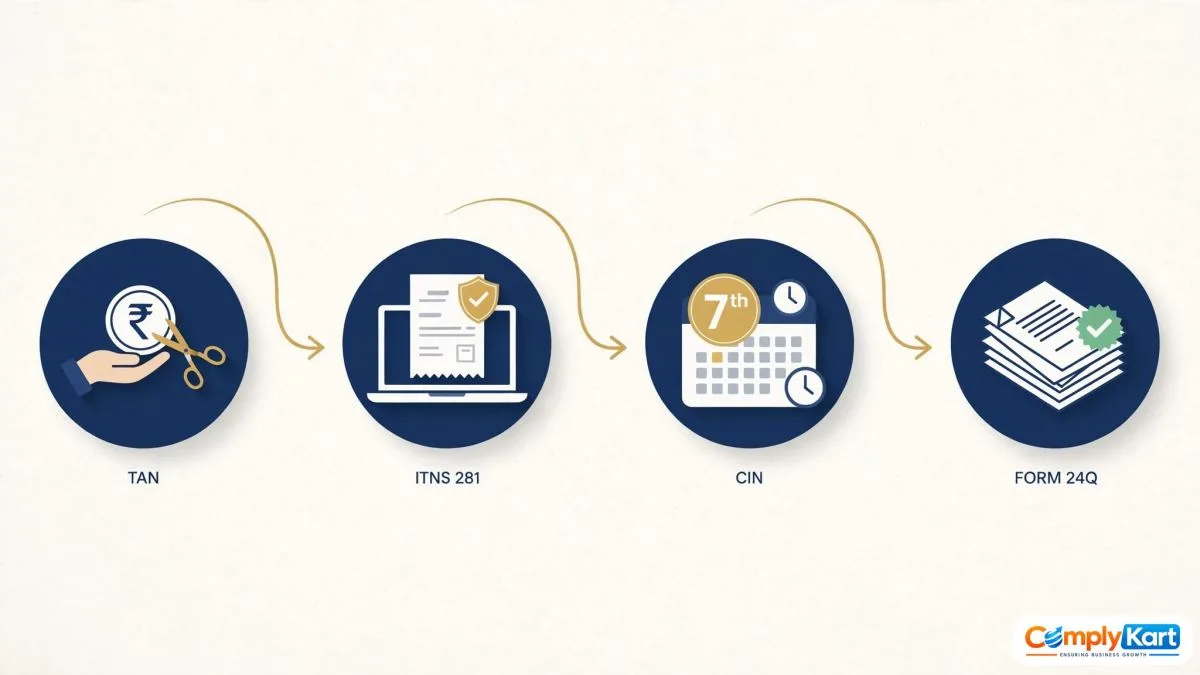
Advance tax is paid on the e-filing portal (incometax.gov.in) via e-Pay Tax:
Log in, select e-Pay Tax → New Payment.
Choose the correct Tax Year (the year the income belongs to — for FY 2025-26 payments, that's Tax Year 2025-26).
Select payment type Advance Tax (100) — not Self-Assessment Tax (300). The minor head determines which interest provisions apply.
Pay via net banking, UPI, or card. Save the challan (Form 280) with the BSR code and serial number.
Wrong minor head is a common, fixable error — but fix it before filing the return, because the CPC matches payments by head.
How long does it take?
A quarterly advance-tax computation for a business with maintained books takes a few hours of professional time: update the income projection, recompute tax, subtract TDS credits, apply the instalment percentage. The payment itself is minutes on the portal.
The December review takes longer — it's a genuine re-estimation, not a rollover — budget half a day. First-time computations (new business, first capital gain) take longer because the baseline has to be built from scratch.
How ComplyKart helps
Quarterly computation. We maintain a running advance-tax worksheet for you — income projected, TDS tracked, instalment computed — refreshed before each of the four due dates. You get a single number to pay and a challan to approve.
The December deep review. Nine months of actuals, three months of projection, regime re-check, capital-gains true-up. This is the instalment where accuracy matters most, and it's where we spend the most time.
Interest diagnosis. Already missed instalments? We compute the exact 234B/234C exposure, identify which shortfalls are covered by the capital-gains proviso, and structure the remaining payments to stop the bleeding.
Salaried clients. We run the other-income check each quarter — rent, interest, gains — and tell you whether to disclose to your employer or pay advance tax directly.
What we don't do. We don't promise zero interest — if the shortfall already happened, the interest is statutory. We don't file advance tax under the wrong minor head to "save time." And we don't let estimates go stale: if your numbers change mid-quarter, we recompute rather than carrying forward a June estimate into December.
Common mistakes and how to avoid them
Treating TDS as the whole liability. TDS is a withholding, not a computation. The 10% your client deducted is rarely your final rate.
Freezing the June estimate. Income moves; the December re-estimation is where most people save (or lose) real money.
Paying under the wrong minor head. Advance Tax (100) vs Self-Assessment Tax (300) — the CPC treats them differently, and a misclassified payment doesn't count toward the instalment.
Ignoring the 90% rule. 234B doesn't care about your instalment discipline — it tests the year's total. Pay 90%+ and one whole interest provision disappears.
Missing the capital-gains proviso. Gains arising late in the year, paid in remaining instalments, attract no 234C. Most taxpayers either panic-pay or ignore it; the law gives you a middle path.
Senior citizens with a side business. One consultancy invoice revokes the 207(2) exemption for the entire year. If you're 60+ and take on any professional work, advance tax applies from that year.
44AD taxpayers forgetting March 15. Single instalment, 100% by 15 March. There's no June/September/December — but there's also no second chance.
FAQ
Frequently asked questions
19 answers from our consultants.
You pay for our expert's time — document checking, filing, follow-ups — not the government. The government fee goes to the government; our fee is for the work we do so you don't have to figure it out yourself.
Depends on your income sources. Salary + one house + other income: ITR-1. Business or profession: ITR-3 or ITR-4 (presumptive). Companies: ITR-6. Filing the wrong form gets your return marked defective — we pick the right one.
Belated returns attract a fee (₹5,000, or ₹1,000 if income is below ₹5 lakh), you lose the right to carry forward most losses, and interest accrues under Sections 234A/B/C. File on time — it's free to be punctual.
In a belated return, most Chapter VI-A deductions (80C, 80D etc.) are not allowed. That's real money left on the table. Another reason the deadline matters.
TDS is not your final tax — it's an advance. You might have paid too much (claim a refund) or too little (pay the balance). Plus, the ITR is your income proof for visas, loans and government tenders.
1% per month (simple) on the shortfall if total advance tax paid during the year is less than 90% of your assessed tax. It runs from 1 April of the following year until assessment. Pay 90%+ and it doesn't apply.
No — if you pay the tax on that gain in the remaining instalment (March) or by 31 March, the proviso to Section 234C protects you. The law recognises you couldn't have estimated a February gain in June.
Resident individuals aged 60+ with no business or profession income — yes, fully exempt under Section 207(2). They pay the whole tax as self-assessment tax with the return. Any business income, however small, removes the exemption.
Only if your total tax for the year exceeds ₹10,000 after your employer's TDS. Usual triggers: rental income, capital gains, a second job, or large interest income. You can disclose other income to your employer for higher TDS instead of paying advance tax separately.
Advance tax is paid during the financial year (before 31 March) in instalments. Self-assessment tax is the balancing amount paid after 31 March when filing the return. Pay on 31 March = advance tax; pay on 1 April = self-assessment tax.
On incometax.gov.in → e-Pay Tax → New Payment, select the correct Tax Year, choose payment type "Advance Tax (100)", and pay via net banking/UPI/card. Save the challan — you'll need the BSR code and serial number at return time.
Once: 100% of advance tax by 15 March. No quarterly instalments. If you pay less than 100% by that date, 234C interest applies at 1% for one month on the shortfall.
The mechanics continue: Sections 403–408 cover liability and instalments, Section 424 replaces 234B, Section 425 replaces 234C, effective from Tax Year 2026-27. "Tax Year" replaces the old previous-year/assessment-year terminology.
Yes — "at least" is the operative phrase. Paying early or in full is always allowed and reduces interest exposure. There's no downside to overpaying an instalment (excess is refunded with interest under Section 244A, subject to conditions).
The excess is refunded when your return is processed, with interest under Section 244A (generally 0.5% per month) if the refund exceeds 10% of tax paid. Overpaying is safe; underpaying is what costs.
Yes — companies follow the same four-instalment schedule (15/45/75/100). For companies, advance tax is typically the primary payment mechanism since there's no TDS on business profits.
Yes, but with the proviso: gains are often unforeseeable, so pay the tax in the instalments remaining after the gain arises (or by 31 March). No 234C on the earlier shortfall if you do.
If advance tax paid during the year is 90% or more of your final assessed tax, no 234B interest — regardless of instalment timing. It's the year's total that matters for 234B; instalment timing is 234C's domain.
Possibly. Each employer applied the basic exemption and lower slabs independently, so combined TDS is usually short. Compute your actual liability on combined salary — if the gap exceeds ₹10,000, pay it as advance tax in the remaining instalments.
What clients say about working with us
Real stories from businesses we've worked with.
Trademark Registration“
Our Trademark was applied in all the classes with a short span of time by Complykart Trademark Experts and I can say the level of expertise and commitment they carry is remarkable. It's an A+ from my side. We are now sticking to ComplyKart only.
Company Registration“
I found the professionalism of the staff at complykart.com, a pleasure to work with. As a foreigner to India, they took the time to explain the documentation and assisted in every question I raised. I was pleased that complykart.com made it easy for my Business.
Merger & Acquisition“
Trust, Commitment, Dedication and responsiveness are the best things with ComplyKart. Thanks for handling our Merger assignment with so much care. After my business disputes, complykart handles all things with own sense of understanding.
Direct Tax Specialist · Income Tax & TDS · 8+ years experience
Ritik Gupta handles ComplyKart’s direct tax practice — income tax returns for companies, LLPs and individuals, TDS filings, advance tax planning and assessment proceedings. He keeps clients penalty-free through every assessment year.
Last reviewed: 16 November 2026
Get a free consultation
Talk to a ComplyKart professional about Advance Tax Payment. The first consultation is free.