Five steps, no guesswork — you always know exactly what comes next. Tap a step to see what it involves.
12345
You pay securely. Payment is confirmed instantly, and your receipt with the written fee breakup lands in your inbox.
Overview
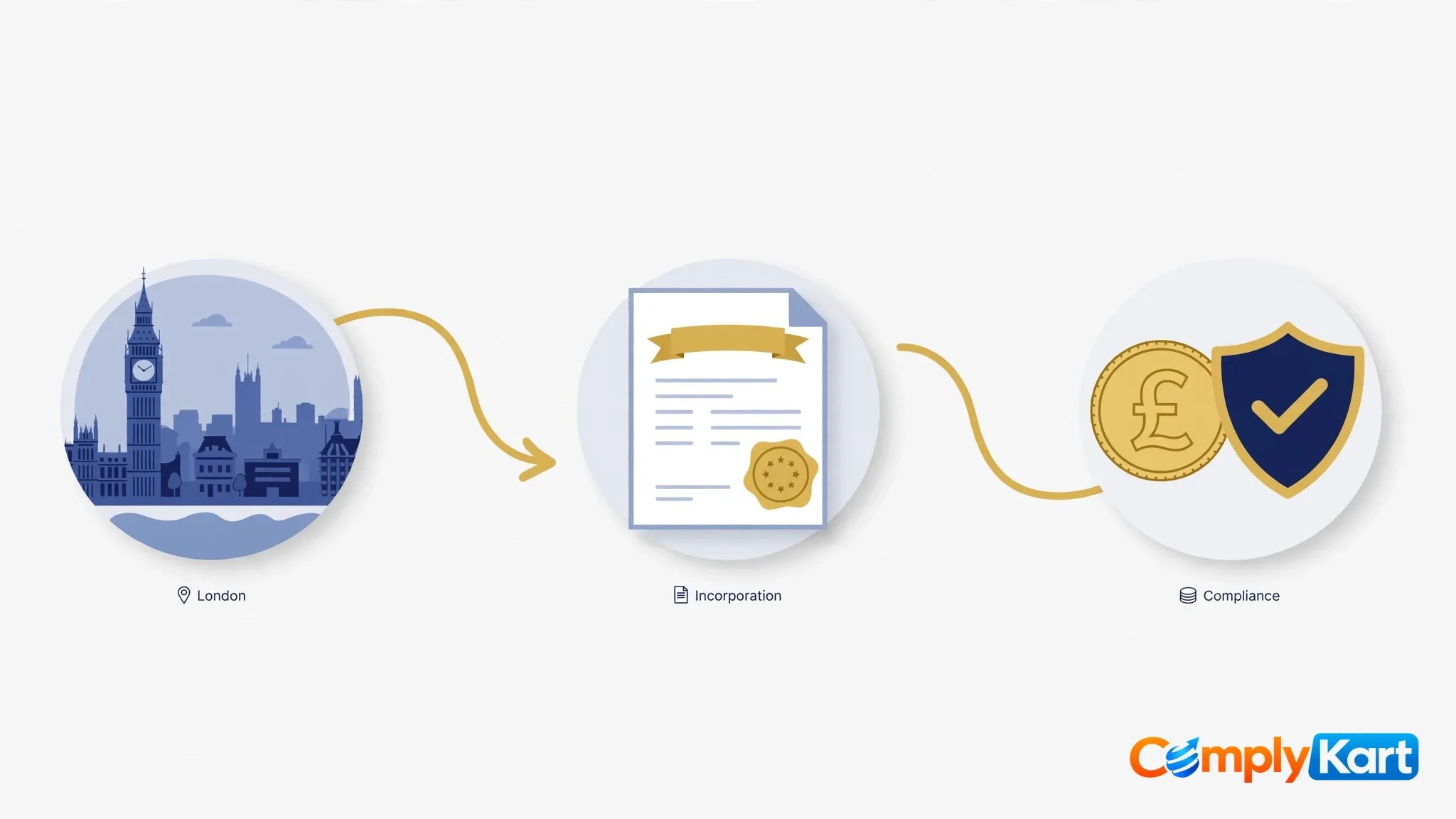
The UK is the fastest major jurisdiction in the world to form a company in — genuinely 24 to 48 hours online, one director, one shareholder, no minimum capital, and no requirement that anyone involved lives in Britain. For Indian founders it is the natural first foreign entity: English-language law you already understand the shape of (the Companies Act 2006 will feel familiar to anyone who knows India's 2013 Act), a respected jurisdiction for contracts and banking, and a sensible base for serving UK, European, and Middle-East customers.
Two things have changed recently that most online guides have not caught up with. First, Companies House fees doubled on 1 February 2026 — digital incorporation is now £100, not the £50 every blog still quotes, and the annual confirmation statement is £50. Second, the Economic Crime and Corporate Transparency Act is turning Companies House from a passive registry into an active gatekeeper: identity verification for directors and PSCs is being phased in, and filings face real scrutiny. Neither change makes the UK hard — it remains one of the easiest places on earth to incorporate — but the era of the £12 anonymous company is over, and that is probably for the best.
This guide covers the formation itself, the real costs in 2026, the PSC and confirmation-statement regime, UK banking for non-residents, corporation tax and VAT, and — the part founders actually get wrong — the India-side FEMA and tax position.
Is a UK company right for you?
A UK Ltd is a good fit if:
Your customers are in the UK or Europe and you want local contracts, GBP billing, and credibility
You want the fastest, cheapest credible foreign entity as a first step abroad
You are testing international markets before committing to a US structure
You need a holding company in a respected common-law jurisdiction
Think twice if:
Your target is US venture capital — form the Delaware C-Corp instead; converting later is messy
Your customers are entirely in India — the compliance overhead buys you nothing
You need US payment rails specifically (Stripe US, US ACH) — a UK entity does not give you those
What you need before filing
The five essentials:
A company name — must be unique at Companies House, must end in "Limited" or "Ltd", and cannot be offensive or imply regulated status (bank, trust, university) without permission. Check the Companies House name-availability search and the UK trademark register — a name that clears the first can still infringe the second.
At least one director — aged 16 or over, any nationality, any residence. Most Indian-founder companies appoint one or two directors; there is no requirement for a UK-resident director.
At least one shareholder — can be the same person as the director. Standard: 100 shares of £1 each.
A UK registered office address — where Companies House and HMRC send official mail. It must be a real UK address (a commercial registered-office service qualifies); it goes on the public record.
Articles of association and a SIC code — model articles are fine for most companies; the SIC code describes your business activity (e.g., 62012 for software).
Identity verification (ECCTA). Directors and PSCs must verify their identity with Companies House — the regime is being phased in through 2025–2026, with mandatory verification for new appointments. Practically, this means a passport-based digital check during or shortly after incorporation; build a few days of slack into your timeline for it.
Advantages of a UK Ltd for an Indian founder
Speed and cost
Nothing else in the credible-jurisdiction set touches it: £100, 24–48 hours, one form. A Delaware filing plus EIN takes 6–8 weeks; a UK Ltd can exist before your US registered agent has replied to your email.
No residency requirements
Directors, shareholders, and PSCs can all be Indian residents. Contrast Singapore (needs a local director) or the UAE mainland (needs local licensing) — the UK asks for an address, not a person.
A legal system you already understand
The Companies Act 2006 and India's Companies Act 2013 share DNA. Directors' duties, shareholder resolutions, share classes, charges — the concepts map across almost one-to-one, which makes dual-jurisdiction advice cheaper and mistakes rarer.
Tax clarity
19% on the first £50,000 of profit, 25% above £250,000, with a single well-understood return. No state-level taxes, no franchise-tax arithmetic, no $25,000-penalty information returns lurking for the unwary.
Credibility and contracts
A UK Ltd on the contract, a UK bank account, GBP invoicing — for UK and European enterprise customers, this removes the "who are these people" friction that an Indian entity sometimes creates in procurement.
The Companies House register itself
Being on the public register with filed accounts is a trust signal. Customers, partners, and banks can verify you in thirty seconds — which is exactly why the ECCTA verification reforms, far from being a burden, actually strengthen the signal.
Documents required
Written for an Indian individual forming a UK Ltd from India — no UK residency is needed for directors or shareholders. Companies House incorporation itself is a data filing, not a document upload, so the documents below split honestly: what you personally get verified with, what gets filed, and what only your Indian bank sees. Nothing in the UK system asks for your Aadhaar. Your company receives a Companies House company number — there is no UK version of a CIN certificate issued by the MCA; the CIN is India's system, and any page that tells you to keep one ready for a UK filing is copying an Indian checklist.
Documents from you, the Indian founder
Passport — every director and every Person with Significant Control (PSC). Since 18 November 2025, identity verification is mandatory for new directors and PSCs before the appointment or filing is accepted. A biometric passport — Indian passports are biometric — lets you verify free through GOV.UK One Login from India, and you receive a personal verification code. If the digital route does not work for you, an Authorised Corporate Service Provider (ACSP) can verify you instead; an ACSP may ask for extra certified ID or address documents, and its list varies by provider — there is no single Companies House address-proof list.
Your current residential address, and the year you moved in. Asked during identity verification, and needed for each director's details. Your residential address is protected information; the service address is what appears on the public record.
Indian address proof — a recent bank statement or utility bill in your name. Companies House does not ask you to upload this for incorporation. Keep it ready anyway: your ACSP (if you use one) and your UK bank or fintech will ask for it.
2–3 company name choices, in order of preference. We check them against the Companies House register and the trademark register before filing — clearing one and infringing the other is a common, avoidable mistake.
Country documents — prepared and filed for you
Memorandum and Articles of Association. The memorandum is generated from the filing; most founders adopt the model articles. We review whether you need bespoke clauses — share classes, transfer restrictions, investor rights — before anything is locked in.
The incorporation filing (IN01 particulars) and the certificate of incorporation. Filed online with Companies House; the digital fee is £100 since 1 February 2026. The certificate and your company number are the company's birth proof — banks, HMRC and counterparties ask for them.
PSC declaration. Anyone holding more than 25% of the shares or voting rights, or otherwise controlling the company, is declared at incorporation, and each PSC completes identity verification and links their personal code. For a typical founder company, that PSC is you.
Registered office address. UK law requires a real UK address for official mail — not a PO box. We provide a registered office service if you do not have one, and the address sits on the public record.
Statutory registers. Registers of members, directors and PSCs are set up at incorporation and kept with the company's records. They are not filed at Companies House, but they must exist from day one.
India-side paperwork — your bank in India, not Companies House
PAN. For your AD bank's FEMA file only. Companies House never asks for it.
Form A2 and the LRS declaration for the remittance. Resident individuals fund a foreign company under the Liberalised Remittance Scheme — up to USD 250,000 per financial year — through an authorised dealer bank.
ODI reporting where you take shares: Form FC through your AD bank, and the Annual Performance Report (APR) each year. Keep the share certificate the UK company issues you as the investment evidence for the bank's file.
TCS check before you remit. Tax collected at source applies on LRS remittances above the threshold in force under section 206C(1G); confirm the current rate and threshold with your bank, because both have changed recently.
The formation process — step by step
Step 1 — Name and structure decisions
Finalise the name (Companies House + trademark check), the share structure (100 × £1 is the default), directors, shareholders, and PSCs. Decide who the PSCs are now — anyone over 25% — because you declare them at incorporation.
Step 2 — Registered office service
Engage a UK registered-office provider (typically £50–150 a year). This address receives your statutory mail; make sure the provider forwards promptly — missed HMRC letters become penalties.
Step 3 — Identity verification
Complete the Companies House identity-verification step for each director and PSC as the current ECCTA timetable requires.
Step 4 — File the incorporation
Submit the IN01 particulars online with the memorandum and articles — £100 digital fee since 1 February 2026. Most applications are processed within 24–48 hours; same-day service (£156, software filing only) exists for urgent cases.
Step 5 — Certificate of incorporation
You receive the certificate with the company number. This is the company's birth certificate — banks, HMRC, and counterparties will ask for it.
Step 6 — HMRC registrations
Register for corporation tax (usually automatic on incorporation, but confirm), set up the HMRC online account, register for PAYE if you will employ anyone in the UK, and consider voluntary VAT registration if reclaiming VAT on UK expenses matters to you.
Step 7 — Bank account
Open the UK business account — the practical bottleneck for non-resident founders. High-street banks usually want UK-resident directors; most Indian founders use fintech business accounts (Wise, Revolut, Airwallex) which onboard non-residents remotely with the certificate, PSC/shareholder IDs, and proof of address.
Step 8 — Statutory registers and first board minutes
Set up the registers of members, directors, PSCs, and charges; minute the first board meeting (bank account authority, share issuance, accounting reference date). These live at the registered office (or the single alternative inspection location) — they are not filed, but they must exist.
Fees and costs (from 1 February 2026)
Item
Cost
Digital incorporation
£100
Paper incorporation
£124
Same-day incorporation (software only)
£156
Confirmation statement (digital, annual)
£50
Confirmation statement (paper)
£110
Voluntary strike-off (digital)
£13
Registered office service
~£50–150 / year
Professional fees for the full setup (formation, registers, HMRC setup, banking support, India-side FEMA paperwork) vary; get a fixed quote that itemises what is included. Note the strike-off fee actually fell (from £33) — closing a company got cheaper while forming one got dearer, which tells you what the policy is trying to encourage.
The PSC register — get this right
Every Ltd must identify its Persons with Significant Control and keep the information on the public register, updating Companies House within the statutory windows when it changes. The five statutory conditions: holding >25% of shares, >25% of voting rights, the right to appoint/remove a majority of directors, significant influence or control, or control through a trust or firm. For a typical Indian-founder company, the founders are the PSCs — declare them accurately at incorporation and update the register the day the cap table changes, not at the next confirmation statement. Failure to maintain PSC information is a criminal offence, not an administrative slap.
Confirmation statement and accounts
The confirmation statement (£50 digital) is due annually — it confirms directors, shareholders, PSCs, SIC code, and registered office are current. Separately, the company files annual accounts with Companies House (deadline: 9 months after the accounting reference date for a private company) and a corporation tax return (CT600) with HMRC (12 months after the accounting period, but the tax itself is due at 9 months and a day — the classic trap). Micro-entity accounts keep the filing light for small companies. Late accounts draw automatic penalties starting at £150 and escalating fast.
UK tax — the honest version
Corporation tax. 25% main rate above £250,000 of profit; 19% small-profits rate up to £50,000; marginal relief smooths the band between. Most early-stage founder companies live in the 19% band. The rate applies to worldwide profits of a UK-resident company, with double-tax relief for foreign tax paid.
VAT. Registration is mandatory once taxable turnover exceeds £90,000 in any rolling 12 months (monitor it — the test is rolling, not per financial year). Standard rate 20%. Below the threshold, voluntary registration lets you reclaim VAT on UK costs, which suits pre-revenue companies spending in the UK.
Dividends to Indian shareholders. The UK levies no withholding tax on dividends — a genuine structural advantage over the US. India taxes the dividend in the shareholder's hands under Indian law.
Employing people. UK employees need PAYE registration, National Insurance, and pension auto-enrolment. Contractors in India are outside this — but misclassifying UK workers as contractors invites HMRC's IR35 scrutiny.
The India side — FEMA, LRS and ODI
Same framework as any foreign investment. Individual founders remit under the LRS — $250,000 per person per financial year through an authorised dealer bank with Form A2. An Indian company investing in the UK Ltd follows the Overseas Investment Rules, 2022 — net-worth-linked limits, AD-bank reporting on the FIRMS portal, and an Annual Performance Report each year. TCS under section 206C(1G) applies on LRS remittances above the threshold — confirm the current rate before remitting.
Residency and control. A UK company managed from India can be Indian tax-resident under the POEM rules — document where strategic decisions are actually taken. And if the Indian company services the UK entity, transfer-pricing documentation for the cross-border charges is non-negotiable.
How ComplyKart helps
Full formation handled: name checks, registered-office coordination, incorporation filing, statutory registers, HMRC setup, PSC registration, banking introductions, and the India-side FEMA/LRS or ODI paperwork. Afterwards, we run the annual calendar — confirmation statement, accounts, CT600, and Indian reporting — so deadlines never surprise you.
What we do not do: we are not UK solicitors. Documents use standard practitioner templates; for funding rounds, share schemes (EMI options have specific UK rules worth using properly), or disputes, we bring in UK counsel and tell you so. We do not guarantee bank approval — we tell you the current onboarding reality first.
What happens after incorporation
Company number and certificate — quote the number on everything; it is the UK equivalent of the CIN.
HMRC online account — activate it; corporation tax, PAYE, and VAT all run through it.
Accounting from day one — UK accounting periods, the 9-month accounts deadline, and the pay-by-9-months-and-a-day rule should be in your calendar before the first invoice.
Registered office mail — check forwarding actually works; a missed confirmation-statement reminder becomes a late-filing penalty.
One decision worth making early is the accounting reference date. The default is the last day of the month of incorporation's anniversary, but you can shorten or extend the first period (within limits) to align with the Indian financial year or your investors' reporting cycle. Changing it later is possible but adds filings. Similarly, issue the share certificates promptly after incorporation — they are the primary evidence of ownership, and banks and future investors will ask for them alongside the certificate of incorporation.
UK Ltd vs US LLC vs Indian Pvt Ltd
UK Ltd
Delaware LLC
Indian Pvt Ltd
Formation time
24–48 hours
1–3 days (+ 4–6 wks EIN)
7–15 working days
Formation cost (govt)
£100
$110 + $300/yr
~₹0 + stamp duty
Minimum directors
1
1 (manager/member)
2
Annual filings
Confirmation statement + accounts + CT600
State tax + 5472/1120
AOC-4 + MGT-7 + ITR
Corporate tax
19%/25%
21% federal (+state) / pass-through
22%/25%/30% options
Dividend withholding
0% (UK)
25%/15% (treaty)
0% (India abolished DDT)
Best for
UK/EU business, speed
US VC fundraising
India operations
FAQ
Frequently asked questions
18 answers from our consultants.
You pay for our expert's time — document checking, filing, follow-ups — not the government. The government fee goes to the government; our fee is for the work we do so you don't have to figure it out yourself.
£100 for standard digital incorporation since 1 February 2026 (up from £50), plus roughly £50–150 a year for a registered-office service and professional fees. The annual confirmation statement is £50.
Most digital applications are processed within 24–48 hours. Same-day incorporation (£156, software filing only) is available when everything is in order.
A Person with Significant Control — anyone with >25% of shares or votes, director-appointment rights, or significant influence. PSC details are on the public register, and failing to maintain them is a criminal offence.
No. Unlike Singapore, the UK imposes no local-director requirement. All directors can be Indian residents.
The annual filing confirming the company's registered details (directors, shareholders, PSCs, SIC code, office) are current — £50 when filed digitally, due every 12 months.
25% main rate on profits above £250,000; 19% small-profits rate up to £50,000; marginal relief between £50,000 and £250,000. Most early-stage companies pay 19%.
When taxable turnover exceeds £90,000 in any rolling 12-month period. Below that, registration is voluntary — useful if you want to reclaim VAT on UK expenses.
As an individual, via the LRS — $250,000 per financial year per person through your bank with Form A2. As an Indian company, via the ODI route under the Overseas Investment Rules, 2022.
Confirmation statement (£50), annual accounts at Companies House (9 months after year-end), corporation tax return CT600 at HMRC (12 months, but pay tax by 9 months and a day), plus PSC updates as they happen.
Automatic penalties from £150, doubling for consecutive late filings and escalating with delay. Persistent failure can lead to the company being struck off and directors disqualified.
No — the registered office must be a UK address. A commercial registered-office service is the standard solution for non-resident founders.
The Standard Industrial Classification code describing your business activity, declared at incorporation (e.g., 62012 for business and domestic software development). You can hold multiple codes; keep them accurate as the business evolves.
Model articles suit most simple founder-owned companies. Take bespoke articles if you have multiple shareholders with different rights, investor protections, or leaver provisions — that is a solicitor's job, not a template download.
It can engage Indian contractors, but employing people in India generally requires an Indian presence (subsidiary or employer-of-record) for PF, ESI, and withholding compliance where the work is performed.
The Economic Crime and Corporate Transparency Act 2023 — the reform giving Companies House identity-verification powers, stronger filing scrutiny, and enforcement teeth, funded by the February 2026 fee increases. It makes the register more trustworthy, which helps legitimate companies.
Voluntary strike-off (DS01) costs £13 digitally since February 2026 — cheaper than before. The company must have ceased trading, settled debts, and distributed assets; HMRC and creditors can object.
US venture funds invest in Delaware C-Corps. If US institutional funding is the plan, form the C-Corp. If the business is UK/Europe-facing or you want the fastest credible entity, the Ltd wins on speed, cost, and simplicity.
What clients say about working with us
Real stories from businesses we've worked with.
Trademark Registration“
Our Trademark was applied in all the classes with a short span of time by Complykart Trademark Experts and I can say the level of expertise and commitment they carry is remarkable. It's an A+ from my side. We are now sticking to ComplyKart only.
Company Registration“
I found the professionalism of the staff at complykart.com, a pleasure to work with. As a foreigner to India, they took the time to explain the documentation and assisted in every question I raised. I was pleased that complykart.com made it easy for my Business.
Merger & Acquisition“
Trust, Commitment, Dedication and responsiveness are the best things with ComplyKart. Thanks for handling our Merger assignment with so much care. After my business disputes, complykart handles all things with own sense of understanding.
Company Law Specialist · Company Law & ROC Compliance · 10+ years experience
Naman Agarwal specialises in company law and ROC compliance. He manages incorporations, annual filings (AOC-4, MGT-7, ADT-1), board processes and statutory registers for private limited companies, LLPs and Section 8 companies.
Last reviewed: 16 November 2026
Get a free consultation
Talk to a ComplyKart professional about Company Formation in the UK. The first consultation is free.