Five steps, no guesswork — you always know exactly what comes next. Tap a step to see what it involves.
12345
You pay securely. Payment is confirmed instantly, and your receipt with the written fee breakup lands in your inbox.
The two-regime reality you must plan around
The Income-tax Act, 2025 (in force from 1 April 2026) kept both tax regimes alive. The new regime under Section 202 is the default: lower slab rates, a generous rebate, almost no deductions. The old regime survives on opt-out, with the full deduction architecture now renumbered into Sections 122 to 154.
For tax year 2026-27 the new-regime slabs run: nil up to ₹4 lakh, 5% to ₹8 lakh, 10% to ₹12 lakh, 15% to ₹16 lakh, 20% to ₹20 lakh, 25% to ₹24 lakh, and 30% above ₹24 lakh. The headline number that matters most: total income up to ₹12,00,000 attracts zero tax because of the Section 156 rebate, and for salaried taxpayers the ₹75,000 standard deduction pushes the effective nil-tax threshold to ₹12,75,000.
The old regime's slabs are steeper (30% above ₹10 lakh) but it allows the deductions the new regime denies: Section 123 (old 80C) up to ₹1.5 lakh, Section 126 (old 80D) health insurance, Section 124 (old 80CCD) NPS, HRA, home-loan interest under Section 24, and the rest.
The crossover maths is unforgiving. At ₹15 lakh income, the old regime wins only if your total deductions cross roughly ₹4,25,000. At ₹20 lakh, the bar rises to about ₹5,00,000. Most salaried taxpayers with only 80C and 80D simply do not clear that bar — which is why the new regime is the default and why most people should stay there.
Salary structuring: what still works under each regime
Salary structuring is not about exotic allowances; it is about matching your pay slip to the regime you will actually file under.
Under the old regime, the classic levers retain their value: HRA (if you pay rent), LTA, the employer's NPS contribution (deductible without the ₹1.5 lakh ceiling that binds your own contribution), and the Section 123 basket — EPF, PPF, ELSS, life insurance premiums, tuition fees, home-loan principal. The employer's NPS contribution deserves special attention: it is one of the few deductions with no practical ceiling tied to the 80C limit, and it works under both regimes.
Under the new regime, the structuring playbook is shorter but real: the ₹75,000 standard deduction applies automatically, and the employer's NPS contribution remains deductible. Everything else — HRA, LTA, 80C — buys you nothing. If your employer offers a flexible benefits menu, pick cash over allowances you cannot exempt.
One analogy helps: choosing a regime is like choosing between two mobile plans. The old plan has a high base rental but cheap add-ons (deductions); the new plan has low rental and no add-ons. You do not pick by loyalty — you pick by your actual usage, recomputed every year.
Business income: deductions, depreciation, and the presumptive choice
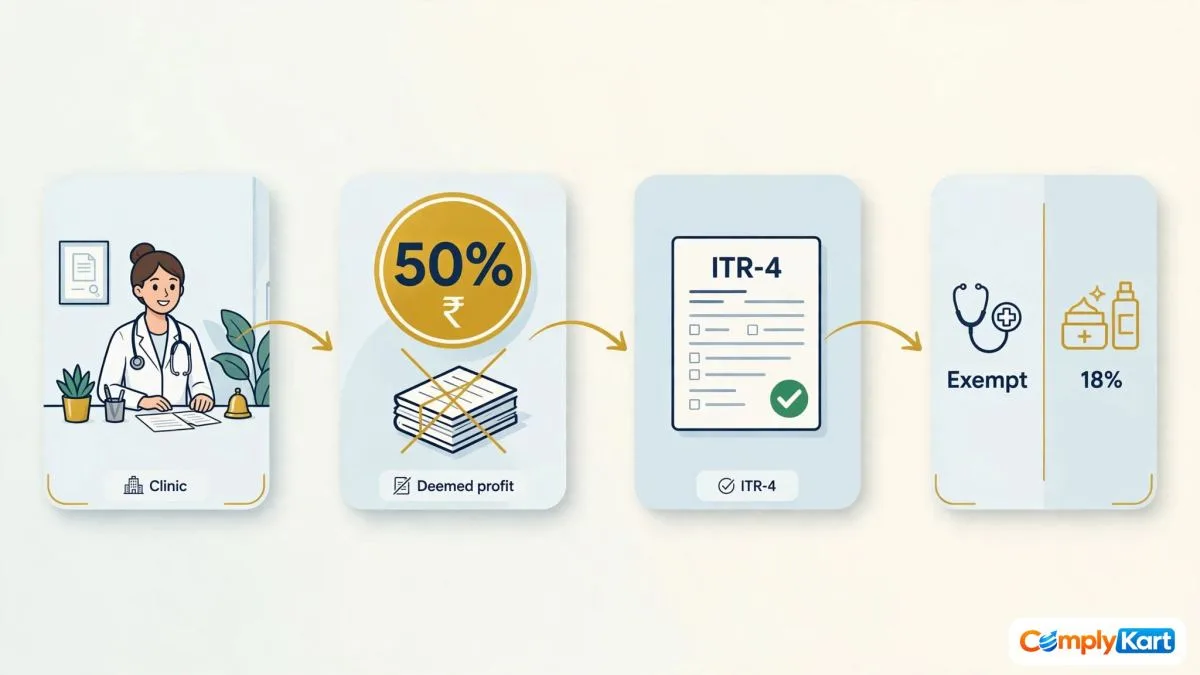
For businesses and professionals, planning starts with a structural choice: books with actual expenses, or the presumptive scheme under Section 58 (old 44AD/44ADA/44AE, now merged). The presumptive route taxes a deemed percentage of turnover — simple, but it forfeits actual-expense deductions and, crucially, locks you out of switching freely year to year.
If you maintain books, the deduction inventory is your planning document: salaries, rent, interest on business borrowings, repairs, insurance, and depreciation on assets. Depreciation deserves its own line in your annual review — the written-down-value method front-loads the benefit, so asset purchases timed before 31 March still earn a full year's depreciation only if put to use for 180 days or more; buy late in the year and you get half the rate.
Losses are an asset too. Business losses carry forward for eight years and set off against future profits — but only if the return is filed on time. A belated return forfeits carry-forward (other than house-property loss). Planning that ignores filing discipline is not planning.
Capital gains timing: the 2024 reset changed the maths
The Budget 2024 reset rewrote capital-gains planning. Long-term capital gains on most assets now face a flat 12.5% rate, indexation benefit was removed for property, holding periods were simplified to 12 months (listed) and 24 months (most other assets), and equity short-term gains rose to 20%.
What this means for planning: the old game of holding property long enough for indexation to erase the gain is over. The new game is timing — realising gains in years when your slab income is lower, harvesting the ₹1.25 lakh annual equity LTCG exemption every year rather than letting it lapse, and using Sections 54, 54F, and 54EC (reinvestment exemptions) deliberately instead of accidentally. A taxpayer who sells ₹1.25 lakh of equity gains each March and rebuys in April banks a permanent exemption the buy-and-hold investor never sees.
Advance tax: the calendar that avoids interest
Advance tax is where planning meets cash flow. If your total tax liability (after TDS) exceeds ₹10,000 in a year, you must pay in instalments: 15% by 15 June, 45% by 15 September, 75% by 15 December, and 100% by 15 March. Miss the schedule and interest under Sections 423 to 425 accrues at 1% per month — not a penalty you can argue away, just arithmetic.
Senior citizens without business income are exempt from advance tax. Everyone else — salaried with large capital gains, freelancers, businesses — should run a December estimate and a March true-up. The March instalment is your last legal chance to correct the year's course.
GAAR: where planning stops and avoidance begins
The General Anti-Avoidance Rule is the boundary fence of tax planning. It allows the tax department to look through arrangements whose main purpose is obtaining a tax benefit — circular transactions, accommodation entries, treaty-shopping structures with no commercial substance.
The test is substance over form. A genuine business decision that also saves tax is planning. A transaction that exists only on paper to manufacture a deduction is avoidance. The practical rule: if you cannot explain the commercial reason for a structure to a sceptical stranger in two sentences, do not build it. Aggressive schemes sold as "tax planning" — backdated agreements, bogus gifts, inflated expenses — fail at the first scrutiny notice, and the interest and penalty that follow dwarf the tax originally saved.
The annual planning cycle we run with clients
Real planning follows the tax year, not the filing deadline:
April–May: Regime choice locked in based on projected income and deductions; salary structure aligned with the chosen regime; advance-tax estimate for the year.
June–September: First two advance-tax instalments; mid-year review if income has moved materially (bonus, new client, property sale).
October–December: Third instalment; investment harvesting — ELSS, PPF, NPS contributions spread rather than bunched; capital-gains harvest review.
January–March: Final instalment by 15 March; last deduction top-ups; regime choice re-validated with actuals; documentation filed and labelled.
July (filing): Return filed under the planned regime; refund or demand reconciled against the plan.
What good planning never does
It never manufactures documents. It never backdates. It never recommends a deduction you cannot evidence. It never treats the March rush as a strategy. And it never confuses a lower tax bill this year with a lower tax bill over five years — sometimes paying tax now (say, by opting out of a dubious exemption) is cheaper than defending an assessment later.
How ComplyKart helps — and what we do not do
We build an annual tax plan around your actual income profile: regime comparison with real numbers, salary-structure review, deduction harvesting calendar, advance-tax computation with reminders, and capital-gains timing advice. We sit with you in December and again in March, because plans made in April drift.
What we do not do: we do not sell "zero-tax" schemes, we do not create artificial transactions, we do not backdate anything, and we do not advise on structures whose only purpose is tax avoidance. If a proposal cannot survive GAAR scrutiny, we will tell you so in writing.
Common mistakes we see every year
Choosing the regime by habit. The regime that won last year may lose this year — a home loan closed, a child finished school, NPS stopped. Recompute annually.
Ignoring the employer's NPS. It is the highest-value deduction most salaried taxpayers leave unclaimed.
Letting the ₹1.25 lakh equity exemption lapse. It does not carry forward. Harvest it or lose it.
Paying advance tax late. The 1%-per-month interest is automatic and non-negotiable.
Mixing regimes across the year. TDS deducted under one regime assumption and filing under another creates mismatches the portal flags.
Step 1 — Map your income for the full tax year
List every income head: salary, business or profession, capital gains (realised and planned), house property, other sources. Planning on salary alone while ignoring a property sale is how demands are born. Put numbers against each, even approximate ones — a plan built on "about ₹18 lakh" beats no plan.
Step 2 — Compute tax under both regimes
Run the full computation twice: new regime with its slabs and rebate, old regime with every deduction you genuinely expect to claim. Do not use last year's deductions as this year's — verify each one. The regime with the lower number wins; sentiment is not a variable.
Step 3 — Align salary structure with the chosen regime
If the old regime won, maximise HRA, LTA, and the 80C basket through payroll where possible. If the new regime won, take cash over exempt allowances and push the employer NPS contribution, which survives in both regimes.
Step 4 — Schedule deduction-linked investments across the year
Spread ELSS, PPF, and NPS contributions monthly. This is not just discipline — it keeps you inside annual limits without a March scramble and gives market-linked investments the benefit of rupee-cost averaging.
Step 5 — Plan capital-gains realisation deliberately
Decide which gains to book this year and which to defer. Harvest the ₹1.25 lakh equity exemption, check 54/54F/54EC reinvestment windows before selling property, and remember the March instalment deadline for advance tax on gains.
Step 6 — Pay advance tax on schedule
Calendar the four instalments — 15 June, 15 September, 15 December, 15 March. Set reminders a week before each. A December review and a March true-up catch the drift that accumulates over the year.
Step 7 — Keep evidence as you go
Every deduction needs a document: premium receipts, investment statements, rent agreements with PAN of landlord, home-loan certificates. File them monthly into one folder. Scrutiny notices arrive two years later; memory does not.
Step 8 — Review in December and lock in March
The December review catches regime drift — a bonus, a job change, a sale. The March lock-in finalises investments, confirms the regime, and sets up a clean filing in July. Planning is a loop, not an event.
FAQ
Frequently asked questions
23 answers from our consultants.
You pay for our expert's time — document checking, filing, follow-ups — not the government. The government fee goes to the government; our fee is for the work we do so you don't have to figure it out yourself.
Depends on your income sources. Salary + one house + other income: ITR-1. Business or profession: ITR-3 or ITR-4 (presumptive). Companies: ITR-6. Filing the wrong form gets your return marked defective — we pick the right one.
Belated returns attract a fee (₹5,000, or ₹1,000 if income is below ₹5 lakh), you lose the right to carry forward most losses, and interest accrues under Sections 234A/B/C. File on time — it's free to be punctual.
In a belated return, most Chapter VI-A deductions (80C, 80D etc.) are not allowed. That's real money left on the table. Another reason the deadline matters.
TDS is not your final tax — it's an advance. You might have paid too much (claim a refund) or too little (pay the balance). Plus, the ITR is your income proof for visas, loans and government tenders.
Compute your tax under both regimes with your actual expected deductions. The new regime is the default and wins for most taxpayers; the old regime wins only when total deductions cross roughly ₹4.25 lakh at ₹15 lakh income (about ₹5 lakh at ₹20 lakh). Recompute every year — the answer changes as your life changes.
Salaried individuals can choose afresh each year. Taxpayers with business or profession income face restrictions on switching — generally a one-time re-entry to the new regime after opting out, with form-filing requirements. Check the current rules before switching with business income.
31 March of the tax year. But genuine planning spreads investments across the year. Anything bought in a March panic — especially insurance mis-sold as investment — usually underperforms a planned monthly SIP.
The employer's NPS contribution (up to 14% of salary for private-sector employees) is deductible over and above the ₹1.5 lakh Section 123 limit, and it is available under both regimes. It is the single most underused salary deduction in India.
Interest accrues at 1% per month under Sections 423 to 425 of the Income-tax Act, 2025 — 423 for filing-related shortfall, 424 for advance-tax default, 425 for instalment deferment. It applies automatically; there is no waiver application for ordinary delays.
Yes, resident senior citizens with no business or profession income need not pay advance tax. Their banks still deduct TDS, which they claim as refund or adjust in the return.
The General Anti-Avoidance Rule lets the tax department ignore the tax benefit of an arrangement entered into mainly to avoid tax. Genuine commercial transactions are unaffected; only artificial, tax-driven structures are targeted. If a deal has real commercial substance, GAAR is not a concern.
Avoidance through artificial arrangements is struck down under GAAR and specific anti-abuse provisions. Lawful tax planning — using deductions, exemptions, and timing the statute itself provides — is entirely legal and expected. The difference is substance: real transactions versus paper ones.
Realise gains in years when your other income is lower, harvest the ₹1.25 lakh annual equity LTCG exemption each year, and use reinvestment exemptions (54/54F/54EC) before selling property. Never let a tax consideration override a sound investment decision — but when the investment decision is made, timing is legitimate planning.
No. The annual ₹1.25 lakh exemption on long-term capital gains from equity is use-it-or-lose-it for each tax year. Systematic annual harvesting — selling and rebuying to book gains within the exemption — is standard practice.
It depends on your actual profit margin versus the deemed rate. If your real expenses are far below the deemed percentage, actual books win. If bookkeeping costs exceed the tax difference, presumptive wins. Also consider: presumptive restricts regime-switching flexibility, and companies cannot use it at all.
Yes, if you genuinely pay rent to them and they declare it as income. You need a rent agreement and payment proof (bank transfer, not cash). The assessing officer can and does verify this in scrutiny.
The standard deduction (₹75,000 for salaried), the employer's NPS contribution, and a small set of specific exemptions. HRA, LTA, 80C, 80D, and home-loan interest do not. The regime trades deductions for lower slab rates and a large rebate.
Business income allows deduction of genuine business expenses and depreciation; salary allows only the standard deduction and specific exemptions. Business losses carry forward for eight years against future business profits — but only if the return is filed within the due date.
Investment proofs, insurance premium receipts, rent agreements with landlord PAN, home-loan interest certificates, NPS statements, capital-gains computation sheets, and advance-tax challans. Keep them for at least eight years — assessments can reopen within statutory time limits.
Yes — residential status determination is the foundation (days of presence, deemed residency rules), followed by DTAA relief on doubly-taxed income, and proper disclosure of foreign assets. NRI planning is a separate discipline from resident planning; the regimes and exemptions differ materially.
Penalty under the under-reporting provisions can reach 50% of the tax on under-reported income, and 200% for misreporting. Interest on the shortfall runs separately. Honest mistakes disclosed voluntarily fare far better than concealed income discovered in scrutiny.
Compare post-tax returns. Prepaying saves interest at your loan rate (tax-free return); investing must beat that rate after tax to win. Under the new regime, where home-loan interest and 80C buy no deduction, prepayment usually wins unless investments clearly outperform.
What clients say about working with us
Real stories from businesses we've worked with.
Trademark Registration“
Our Trademark was applied in all the classes with a short span of time by Complykart Trademark Experts and I can say the level of expertise and commitment they carry is remarkable. It's an A+ from my side. We are now sticking to ComplyKart only.
Company Registration“
I found the professionalism of the staff at complykart.com, a pleasure to work with. As a foreigner to India, they took the time to explain the documentation and assisted in every question I raised. I was pleased that complykart.com made it easy for my Business.
Merger & Acquisition“
Trust, Commitment, Dedication and responsiveness are the best things with ComplyKart. Thanks for handling our Merger assignment with so much care. After my business disputes, complykart handles all things with own sense of understanding.
Direct Tax Specialist · Income Tax & TDS · 8+ years experience
Ritik Gupta handles ComplyKart’s direct tax practice — income tax returns for companies, LLPs and individuals, TDS filings, advance tax planning and assessment proceedings. He keeps clients penalty-free through every assessment year.
Last reviewed: 16 November 2026
Get a free consultation
Talk to a ComplyKart professional about Tax Planning Advisory. The first consultation is free.