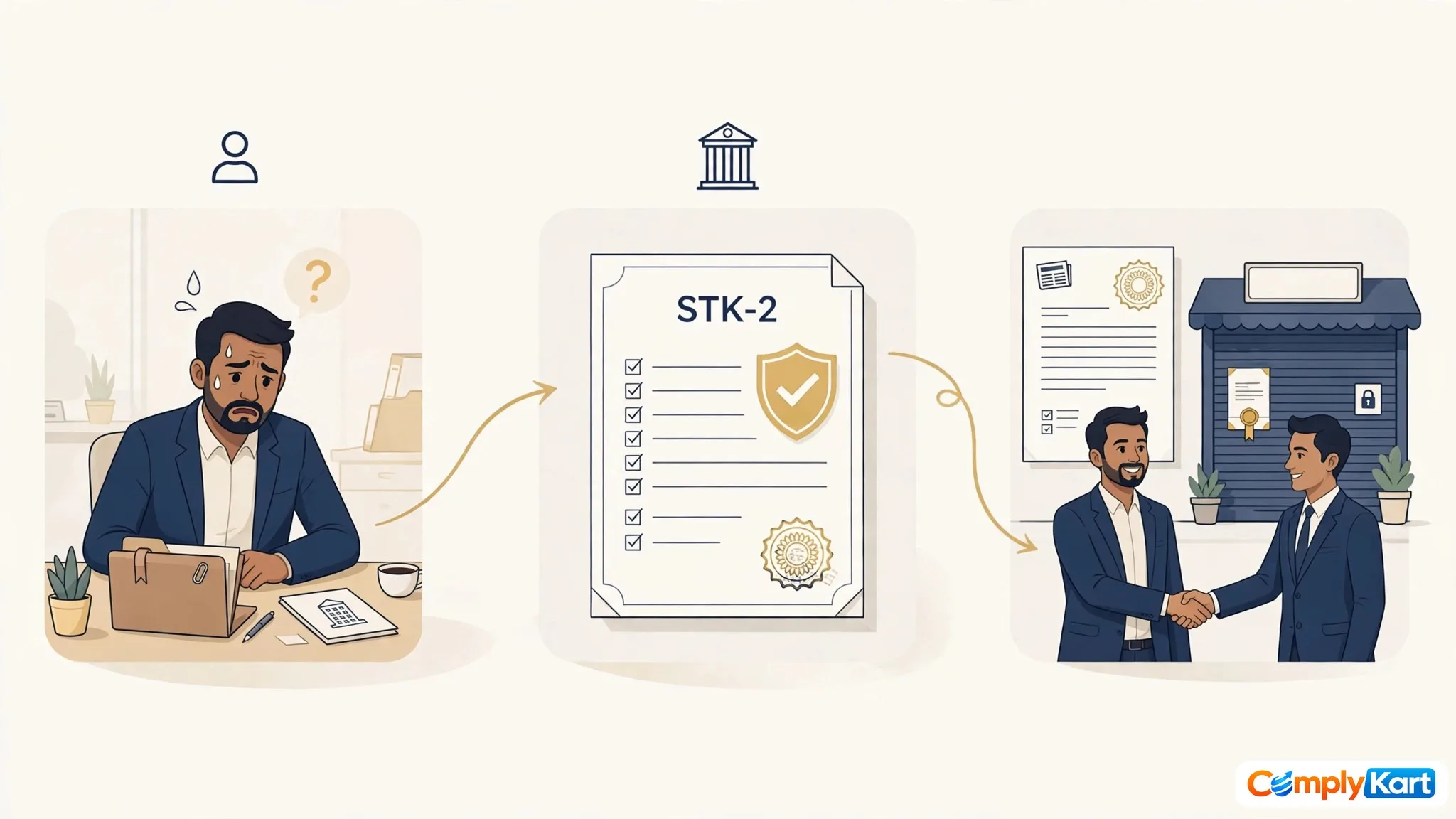
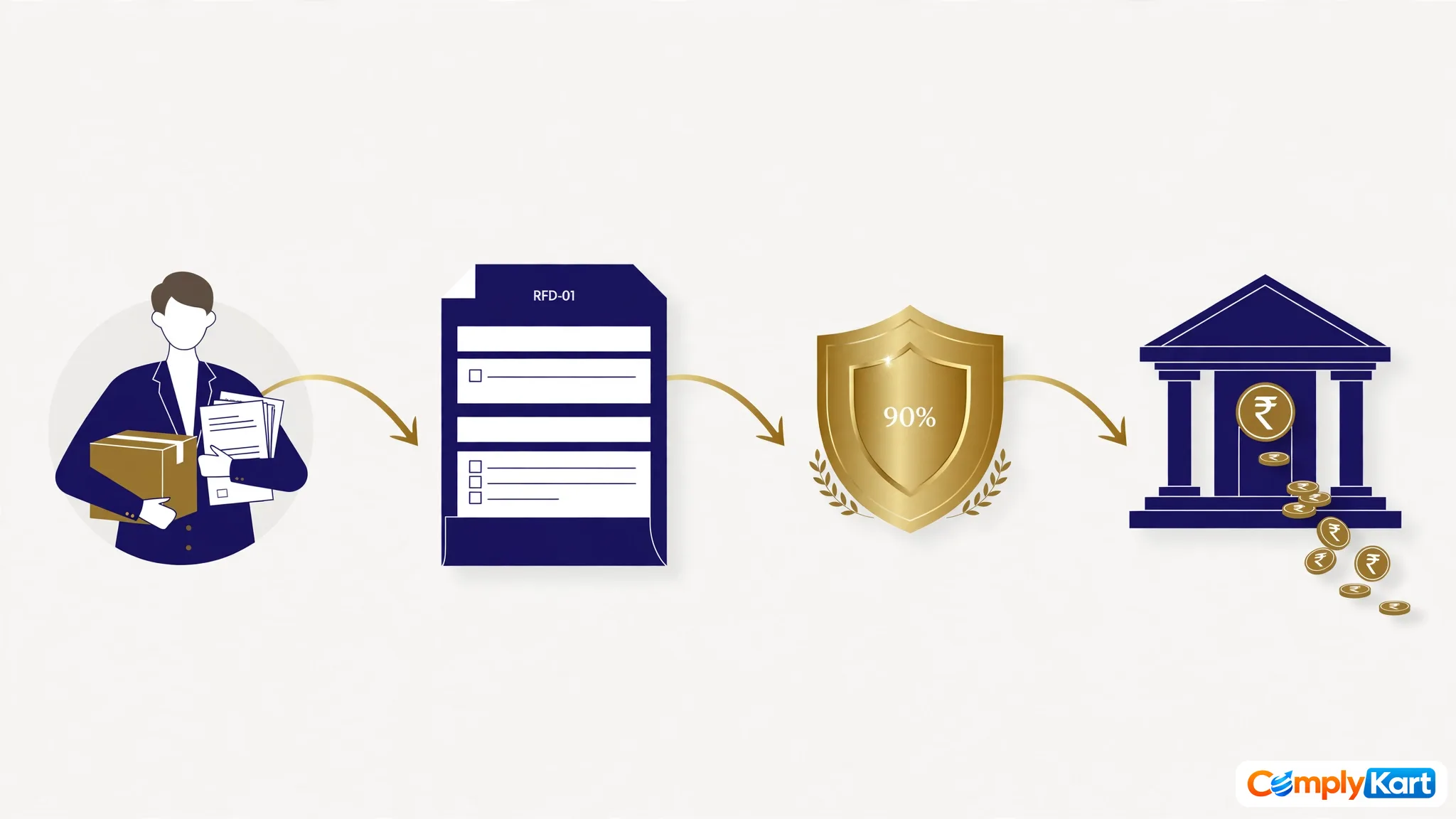
Five steps, no guesswork — you always know exactly what comes next. Tap a step to see what it involves.
12345
You pay securely. Payment is confirmed instantly, and your receipt with the written fee breakup lands in your inbox.
Form 13 Lower / Nil TDS Certificate: the Complete Guide
TDS is a blunt instrument. It deducts tax on your income at flat statutory rates — 10% on professional fees, 10% on rent above the threshold, 20%-plus on NRI payments — without asking whether you actually owe that much tax. If your real liability is lower, the excess sits with the government until you file your return and wait for a refund. For a contractor with thin margins, that gap is working capital frozen for a year.
Form 13 is the release valve. Under Section 197, you apply to your Assessing Officer for a certificate directing your payer to deduct at a lower rate — or nothing at all — matched to your actual expected liability. The mechanism is old, the filing is now fully online on TRACES, and for NRIs selling property or earning Indian income it is often the single most valuable tax form they will ever file.
An analogy: TDS is the toll booth that charges every truck the same fee regardless of load. Form 13 is the pass that tells the booth your truck is half-empty — you still pay, but only for what you carry. The AO's job is to check the truck before issuing the pass.
Who should apply
Anyone whose genuine tax liability for the year will be materially lower than what standard TDS would collect:
Contractors and freelancers with high gross receipts but thin margins or heavy deductions — TDS at 10% on gross fees routinely exceeds their real liability.
NRIs receiving rent, interest on NRO accounts, or sale consideration for Indian property — payer-side TDS under Section 195 runs at 20%–30% plus surcharge, while DTAA or actual capital-gains liability may be far lower.
Companies and firms with carried-forward losses, MAT/AMT credits, or exemptions that wipe out current-year liability.
Investors with large dividend or interest flows but offsetting losses or deductions.
Banks and financial institutions receiving interest where treaty or domestic provisions reduce the effective rate.
The common thread is a mismatch between the TDS rate and the real liability. If there is no mismatch, there is no certificate — the AO's first question is always "why should the government collect less now?"
Section 197 vs 195: which route for NRIs
Residents apply under Section 197. For payments to non-residents, Section 195 governs TDS, and the lower-deduction application for NRI payees is made under that framework — the AO considers DTAA benefits, treaty rates, and the Tax Residency Certificate alongside domestic liability. In practice the TRACES application path is the same, but the AO's analysis for an NRI includes the treaty layer. If you are an NRI seller of Indian property, this certificate is what stands between you and TDS at 20%+ on the entire sale consideration rather than on your actual capital gain.
What the Assessing Officer looks at
The AO does not take your estimate on faith. Rule 28AA requires the officer to consider:
Your estimated total income and tax liability for the current financial year — the computation you attach.
Tax paid or payable on the last four years' income — ITRs filed, assessments completed, demands outstanding. A clean compliance history helps enormously; unpaid demands hurt.
Advance tax paid and TDS/TCS already suffered in the current year.
Whether revenue is at risk — the certificate issues only if the government is satisfied the lower rate still protects collection.
The AO may call for clarification or additional documents before deciding. There is no statutory deadline for the decision that practitioners can bank on, so timing the application is part of the strategy — more below.
Documents to keep ready
Incomplete documentation is the most common reason applications stall. Assemble before you log in:
Estimated income computation for the current financial year, with tax calculation
ITR acknowledgements (or assessment orders) for the last four financial years; where returns were not filed, computation of total income for those years
Form 26AS / AIS summary showing TDS already suffered
PAN and TAN details of each deductor for whom the certificate is sought
Financial statements, where applicable (companies, firms)
Nature-of-business note describing the income source
For exemption-claiming entities: registration/exemption certificate under Sections 11, 12, or 139(4C)
For NRIs: passport, PAN, Tax Residency Certificate, and transaction documents (rent agreement, sale agreement, NRO statements, capital-gains working)
The application process, step by step
Step 1 — Register on TRACES
Open the TRACES portal (contents.tdscpc.gov.in) and register with your PAN if you have not already. Complete the profile and KYC checks the portal requires before the Form 13 request path becomes available.
Step 2 — Open the lower-deduction request
Log in, go to the Statements/Forms area, and select the request path for a lower or nil deduction certificate — historically labelled "Request for Form 13" under Section 197. (Some current guidance refers to this request path as Form 128 under Rule 28AA; the underlying application remains the Section 197 certificate.)
Step 3 — Fill the application
Enter applicant particulars (name as per PAN, PAN, AO details from your latest return), the financial year, and for each deductor: name, PAN/TAN, nature of payment, estimated amount, and the rate you seek. Attach the estimated income computation as the core justification.
Step 4 — Upload documents and authenticate
Upload the document set from the checklist above. Submit using a Digital Signature Certificate (DSC) or Electronic Verification Code (EVC). Note the acknowledgement number — it is your tracking reference for follow-ups with the AO.
Step 5 — AO processing and clarifications
The jurisdictional AO examines the application against your filing history and may seek clarifications. Respond promptly; dormant applications do not decide themselves. If the AO is satisfied, the certificate issues naming each deductor, the income type, and the certified rate.
Step 6 — Deliver the certificate to your deductors
The certificate works only for the deductors named in it. Give each deductor a copy with your invoice or payment request before they deduct — TDS already deducted at the full rate before the certificate arrives cannot be retroactively corrected by the payer; it becomes a refund claim in your return.
Step 7 — Track validity through the year
The certificate is valid from its date of issue until 31 March of that financial year, unless the AO cancels it earlier. Calendar a fresh application for the next financial year — there is no renewal or carry-forward.
Step 8 — Reconcile at return filing
The certificate changes collection, not liability. Your return still computes the real tax; the lower TDS simply means less refund to chase. Keep the certificate with your assessment records.
Timing: when to apply
Apply at the start of the financial year — April or May — for income you will earn through the year. A certificate issued in February covers only February and March; the TDS deducted from April to January is already gone and only a return can recover it. For one-off transactions like an NRI property sale, apply as soon as the deal is probable and before the payment date — and where the deal allows, sequence payments so the bulk falls after the certificate arrives.
Validity, cancellation, and renewal
The certificate is specific to the deductor and the nature of income stated in it. It cannot be used for a different payer or a different income stream. The AO may cancel it during the year — typically where the underlying facts change or the certificate was obtained on incomplete disclosure. There is no renewal mechanism: every financial year needs a fresh Form 13 application, with a fresh estimated computation and updated filing history.
Common rejection reasons
Estimated income that does not reconcile with past filings or bank credits
Outstanding tax demands or chronic non-filing in the last four years
Seeking nil deduction where some liability plainly exists — asking for 2% when the honest answer is 5% reads as overreach and can sink the whole application
Deductor details missing or mismatched (wrong TAN, unnamed payer)
Applying after the income has already been paid and TDS deducted — the AO cannot unwind history
Form 13 vs Form 15G/15H — choosing correctly
This confusion costs people certificates. Forms 15G/15H are self-declarations under Section 197A, given directly to the payer, valid only for interest income (bank deposits, post office, EPF withdrawals), and only where your total income is below the basic exemption limit. No AO is involved. Form 13 is an AO-issued certificate with no income-type restriction and no amount cap — but it requires the application, the documents, and the wait. If your income exceeds the exemption limit, 15G/15H are not available to you at all, and attempting them is a false declaration. For everything else — professional fees, rent, NRI payments, contractor receipts — Form 13 is the route.
We prepare the estimated income computation, compile the document set, file the Form 13 application on TRACES with DSC/EVC, track it with the jurisdictional AO, r
FAQ
Frequently asked questions
21 answers from our consultants.
You pay for our expert's time — document checking, filing, follow-ups — not the government. The government fee goes to the government; our fee is for the work we do so you don't have to figure it out yourself.
Depends on your income sources. Salary + one house + other income: ITR-1. Business or profession: ITR-3 or ITR-4 (presumptive). Companies: ITR-6. Filing the wrong form gets your return marked defective — we pick the right one.
Belated returns attract a fee (₹5,000, or ₹1,000 if income is below ₹5 lakh), you lose the right to carry forward most losses, and interest accrues under Sections 234A/B/C. File on time — it's free to be punctual.
In a belated return, most Chapter VI-A deductions (80C, 80D etc.) are not allowed. That's real money left on the table. Another reason the deadline matters.
TDS is not your final tax — it's an advance. You might have paid too much (claim a refund) or too little (pay the balance). Plus, the ITR is your income proof for visas, loans and government tenders.
It is the application form for a certificate under Section 197 directing lower or nil TDS deduction. You file it online on the TRACES portal; your Assessing Officer verifies your estimated liability against your filing history and, if satisfied, issues a certificate naming your deductors and the reduced rate.
Online, on the TRACES portal (contents.tdscpc.gov.in), authenticated with a digital signature or electronic verification code. The entire lifecycle — application, AO queries, and certificate issuance — is electronic.
The core set: estimated income computation for the current year, ITRs or assessment orders for the last four years, Form 26AS/AIS, PAN/TAN of each deductor, and financial statements where applicable. NRIs add passport, TRC, and transaction documents.
Yes — you name each deductor in the application and the certificate lists them with the certified rate per deductor and income type. A deductor not named in the certificate must deduct at the full statutory rate.
Form 15G is a self-declaration for interest income where your total income is below the taxable limit — no AO involved. Form 13 is an AO-issued certificate with no income-type or amount restriction. They serve different people; above the exemption limit, 15G is not an option.
Without a certificate, the buyer must deduct TDS at 20%+ (plus surcharge and cess) on the entire sale consideration under Section 195. With a Section 197/195 certificate based on your actual capital-gains computation, TDS applies at the certified lower rate on the gain — often a fraction of the headline deduction.
The payer cannot revise it. The excess becomes part of your TDS credit and is recovered as a refund when you file your return. This is why timing the application before payments begin matters more than anything else in the process.
Yes — where the estimated liability does not justify it, where compliance history is poor, or where revenue would be at risk. A rejection is not the end; you can re-apply with a corrected computation, but the clock keeps running on the year's payments.
Yes. The AO may cancel it during the year if the facts change or the application turns out to have been based on incomplete disclosure. The deductor must then revert to full-rate deduction from the cancellation date.
No. It changes only the timing and mode of collection. Your return computes the true liability; the certificate simply stops the government collecting in advance more than you will owe. Under-deduction followed by a large self-assessment payment still attracts interest under Sections 234B/234C if advance tax was short.
Ask for what your computation honestly supports. Seeking nil where some liability exists invites rejection; seeking a modest, well-documented reduction usually succeeds. The AO rewards credible arithmetic, not ambition.
Often yes. A company with carried-forward losses may have zero current-year liability while payers deduct 10% on its service income. The certificate aligns deduction with reality — but the AO will verify the losses are genuine and available for set-off.
No statutory filing fee. Costs, if any, are professional fees for preparing the computation and managing the application.
In practice, no — salary TDS under Section 192 is computed on estimated annual salary by the employer, and Section 197 certificates are not the mechanism for salary. Form 13 targets non-salary payments: professional fees, rent, interest, commissions, and NRI payments.
The certificate does not cap your liability — your return picks up the full income and you pay the balance with interest if advance tax fell short. But if the variance is large, inform the position proactively; a certificate obtained on a wildly understated estimate is cancellation bait.
Yes. Certificates die on 31 March regardless of continuity. File fresh each April with the new year's estimate — repeat applicants with clean histories typically see faster processing.
What clients say about working with us
Real stories from businesses we've worked with.
Trademark Registration“
Our Trademark was applied in all the classes with a short span of time by Complykart Trademark Experts and I can say the level of expertise and commitment they carry is remarkable. It's an A+ from my side. We are now sticking to ComplyKart only.
Company Registration“
I found the professionalism of the staff at complykart.com, a pleasure to work with. As a foreigner to India, they took the time to explain the documentation and assisted in every question I raised. I was pleased that complykart.com made it easy for my Business.
Merger & Acquisition“
Trust, Commitment, Dedication and responsiveness are the best things with ComplyKart. Thanks for handling our Merger assignment with so much care. After my business disputes, complykart handles all things with own sense of understanding.
Direct Tax Specialist · Income Tax & TDS · 8+ years experience
Ritik Gupta handles ComplyKart’s direct tax practice — income tax returns for companies, LLPs and individuals, TDS filings, advance tax planning and assessment proceedings. He keeps clients penalty-free through every assessment year.
Last reviewed: 16 November 2026
Get a free consultation
Talk to a ComplyKart professional about Form 13 Lower TDS Certificate. The first consultation is free.