Five steps, no guesswork — you always know exactly what comes next. Tap a step to see what it involves.
12345
You pay securely. Payment is confirmed instantly, and your receipt with the written fee breakup lands in your inbox.
What e-invoicing actually is (and the two things it isn't)
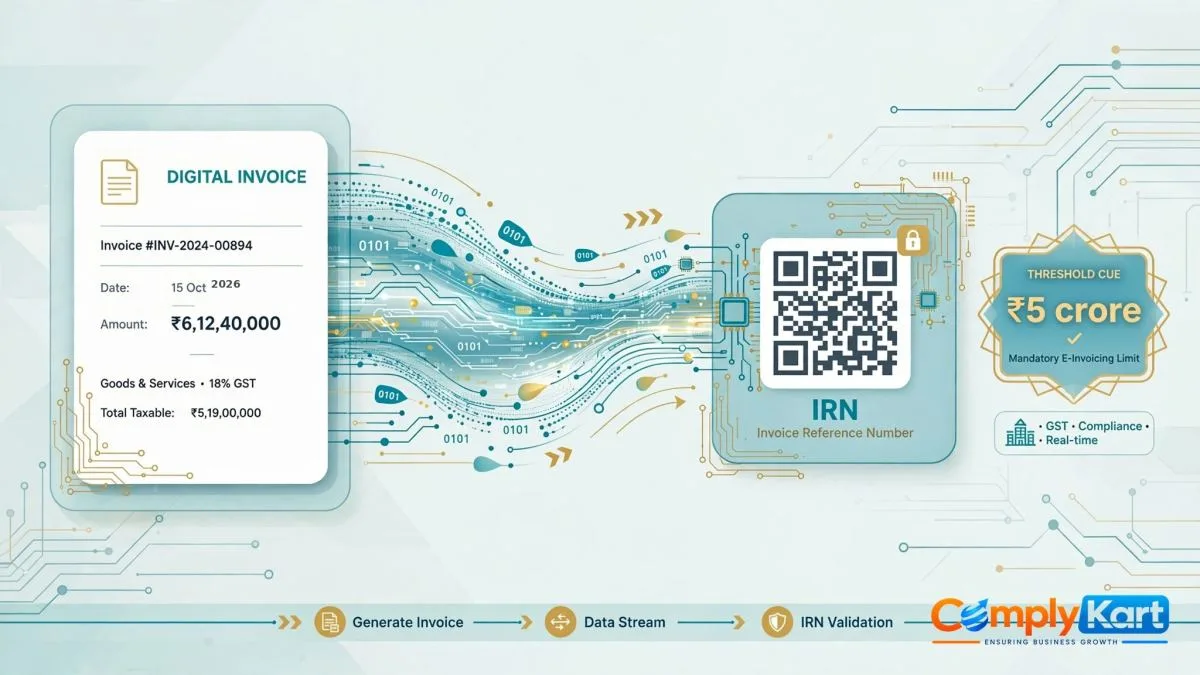
It is: a reporting and validation layer on top of your normal invoicing. Invoice data in a prescribed JSON format (GST INV-01) goes to the IRP; the IRP returns the IRN + signed QR code; you print those on the invoice you give the customer. The IRP also pushes the data to the GST system (auto-populating GSTR-1) and to the e-way bill system.
It isn't invoice generation. The IRP does not create your invoice, does not store your books, and is not your accounting system. It is a registrar: validate, sign, return, forward.
It isn't e-way bills. E-way bills govern the physical movement of goods (consignments above ₹50,000, under Section 68 and Rule 138). E-invoices govern invoice validity for B2B transactions. They are separate compliances — though e-invoice data auto-fills e-way bill Part A, which is the one genuine convenience in the system.
Do you fall under e-invoicing? The threshold test
The rule, in one paragraph: e-invoicing is mandatory for registered persons whose aggregate annual turnover (AATO) exceeded ₹5 crore in any financial year from 2017-18 onwards, for B2B supplies, exports, supplies to SEZ developers, and credit/debit notes. Effective 1 August 2023 (Notification 10/2023-Central Tax).
Three points people get wrong:
1. "Any year since 2017-18" means history counts. The test is not "did I cross ₹5 crore this year." It is "have I ever crossed it." A business that touched ₹5.1 crore in FY 2019-20 and now does ₹3 crore is covered. There is no exit once you enter.
2. Aggregate turnover is PAN-level, not GSTIN-level. If you have three GSTINs under one PAN — say, branches in Maharashtra, Gujarat and Karnataka — their combined turnover is what counts. A single branch doing ₹2 crore does not escape the test if the PAN total crossed ₹5 crore.
3. Aggregate turnover is broad. Under Section 2(6) of the CGST Act, it includes taxable supplies, exempt supplies, nil-rated and non-taxable supplies, exports, and inter-state branch transfers — not just your taxable turnover. Businesses that mentally subtract exempt sales from the test routinely miscalculate.
The phase-in history (why the threshold keeps moving)
Phase
Turnover threshold
Mandatory from
Notification
1
Above ₹500 crore
1 October 2020
61/2020-CT
2
Above ₹100 crore
1 January 2021
88/2020-CT
3
Above ₹50 crore
1 April 2021
5/2021-CT
4
Above ₹20 crore
1 April 2022
1/2022-CT
5
Above ₹10 crore
1 October 2022
17/2022-CT
6
Above ₹5 crore
1 August 2023
10/2023-CT
The direction of travel is obvious: the threshold has only ever moved down. Businesses at ₹3-4 crore turnover should build e-invoicing capability now rather than scramble when the next notification lands.
Who is exempt — even above ₹5 crore
Certain categories are excluded from e-invoicing regardless of turnover:
SEZ units (as issuers; supplies *to* SEZ developers are covered)
Banking companies, financial institutions including NBFCs, and insurance companies
Goods transport agencies (GTA)
Suppliers of passenger transportation services
Suppliers of services by way of admission to cinematograph exhibition in multiplexes
Government departments and local authorities
And by transaction type: B2C invoices are never reported to the IRP, nor are bills of entry (imports), ISD invoices, or supplies from unregistered persons. But note the separate dynamic QR requirement for large B2C sellers, covered below.
The IRP process — step by step
Step 1: Confirm applicability
Run the threshold test honestly: PAN-level aggregate turnover, any FY since 2017-18, inclusive definition. If you are covered, proceed. If you are borderline, document the working — the department's data will do the same arithmetic.
Step 2: Register on the IRP
Log in to einvoice1.gst.gov.in with your GSTIN credentials. Multiple IRPs are now approved (NIC is the primary; others include Clear, IRIS, and Cygnet among the authorised operators) — you may use any approved IRP. Registration is per GSTIN.
Step 3: Connect your billing system
Three routes: direct API integration (your ERP talks to the IRP), via a GST Suvidha Provider (GSP) or Application Service Provider (ASP) (the common route for mid-size businesses), or the offline utility (for low volumes — prepare JSON offline, upload in bulk). Choose based on invoice volume: above a few hundred invoices a month, API or GSP integration pays for itself in weeks — manual uploads at that scale guarantee missed reporting windows.
Step 4: Generate the invoice JSON
Your software creates the invoice and converts it to the GST INV-01 schema — seller details, buyer details, document details, item list with HSN, values, tax breakup, e-way bill details where applicable. Get the HSN right: mismatched HSN is the most common IRP rejection.
Step 5: Upload and receive the IRN
The IRP validates the payload — GSTINs, document number uniqueness for the financial year, tax arithmetic — then generates the Invoice Reference Number (IRN), a unique hash, digitally signs the invoice, and generates the QR code containing key invoice particulars. All of this typically takes seconds via API.
Step 6: Print and issue
Print the IRN and the signed QR code on the invoice you share with the buyer. The invoice is now a valid e-invoice. The IRP simultaneously pushes the data to GSTR-1 (auto-population) and makes it available for e-way bill generation.
Cancellations and corrections
An IRN can be cancelled on the IRP within 24 hours of generation. After that window, corrections go through the normal GST return route — credit/debit notes (which themselves need IRNs) and amendments in GSTR-1. There is no "edit" button on the IRP; plan your invoice discipline accordingly.
Reporting time limits — the deadlines that bite
Generating the IRN eventually is not enough; it must be timely:
AATO above ₹100 crore: invoice must be reported to the IRP within 7 days of the invoice date.
AATO above ₹10 crore: invoice must be reported within 30 days of the invoice date (applicable from 1 April 2025).
AATO up to ₹10 crore: no specific time limit currently prescribed.
After the deadline expires, the IRP permanently rejects IRN generation for that document. A B2B invoice that misses its reporting window cannot be validated later — it stays an invalid invoice for GST purposes, with the ITC consequences that follow. This is the compliance point with the sharpest teeth in the whole framework.
Practical tip: if you are under e-invoicing, generate the e-way bill from the e-invoice data rather than entering everything twice. Duplicate manual entry is where mismatches are born.
The B2C dynamic QR code rule (separate requirement)
B2C invoices don't go to the IRP — but large B2C sellers have their own QR obligation. Under Notification 14/2020-Central Tax, every invoice issued by a registered person with aggregate turnover above ₹500 crore (any FY from 2017-18 onwards) to an unregistered person must carry a dynamic QR code — one that enables digital payment for that invoice.
Key clarifications (CBIC Circular 146/02/2021):
Effective 1 December 2020; penalty for non-compliance was waived for December 2020 to June 2021, enforceable from 1 July 2021.
If you display a dynamic QR code for payment on a digital display with cross-reference on the invoice, that counts as compliance.
Export invoices are B2B in substance — the dynamic QR rule targets domestic B2C.
Implementation checklist: going live without the fire drill
If the threshold test says you're covered — or will be soon — work through this in order:
1. Fix the HSN master first. Every item in your catalogue needs the correct HSN (goods) or SAC (services) code, at the right digit length for your turnover slab. The IRP validates HSN; wrong codes are the number one rejection reason. This cleanup takes longer than the technical integration, so start here.
2. Standardise invoice numbering. The IRP requires document numbers unique within the financial year per GSTIN. If your branches or billing staff run parallel series that could collide, consolidate now. A rejected duplicate on a busy billing day is chaos.
3. Choose your integration route. Under ~200 B2B invoices a month, the offline utility or a basic GSP plan works. Above that, API integration — direct or via GSP — is worth it. Evaluate GSPs on IRP uptime handling (what happens when the IRP is slow), rejection dashboards, and whether they track your 7/30-day reporting windows for you.
4. Test in sandbox. Generate test IRNs for every document type you issue — tax invoices, export invoices, credit notes, debit notes — including edge cases like round-off, discounts, and multi-item invoices with mixed HSN. Confirm the signed QR prints correctly on your invoice format.
5. Train billing staff on the 24-hour rule. IRN cancellation is only possible within 24 hours. After that, the correction path is credit/debit notes. Your billing team must know: a wrong invoice caught on day 2 is not a quick fix anymore.
6. Set up the monthly three-way check. Books vs IRP data vs GSTR-1. Run it every month, not at year-end. The businesses that reconcile monthly never face the GSTR-9C nightmare of twelve months of drift.
7. Monitor the threshold direction. At ₹4 crore turnover with growth, you're one good year from mandatory e-invoicing. Budget the integration this year; it's cheaper planned than rushed.
Common mistakes
Testing only the current year's turnover. The historical test (any FY since 2017-18) is the single biggest source of accidental non-compliance.
Testing per GSTIN instead of per PAN. Multi-state businesses under one PAN must aggregate.
Issuing B2B invoices without IRN "temporarily." Under Rule 48(5) these are not valid invoices. There is no grace concept in the law.
Missing the reporting window. A 31-day-old invoice for a ₹12-crore-turnover business cannot get an IRN. Ever.
Duplicate invoice numbers across the financial year. The IRP rejects them; your numbering series must be unique per FY per GSTIN.
HSN mismatches. Wrong HSN codes are the top IRP rejection reason and also feed GSTR-1 mismatches.
Assuming the GSP handles everything. Your GSP transmits data; the legal responsibility for correct, timely reporting stays with you.
Forgetting credit and debit notes. They need IRNs too. An unreported credit note doesn't reduce your liability cleanly.
9. Not registering all GSTINs on the IRP. E-invoicing registration is per GSTIN. Businesses with branches in multiple states sometimes register the head-office GSTIN and forget the rest — every covered GSTIN needs its own IRP registration.
10. Ignoring the buyer's side of the equation. Your B2B buyers increasingly filter suppliers by e-invoicing compliance, because your IRN is what makes their ITC smooth. Non-compliance doesn't just risk penalties — it quietly costs you customers who'd rather buy from a supplier whose invoices flow cleanly into their GSTR-2B.
What e-invoicing changes in your monthly compliance
GSTR-1 auto-population: B2B invoice data flows from the IRP into GSTR-1. Verify, don't blindly accept — the IRP data is only as good as what you uploaded.
GSTR-2B for your buyers: Your e-invoices appear in your buyers' 2B faster and more reliably, which reduces their follow-up calls to you. Suppliers who e-invoice promptly are measurably easier to do business with — and in competitive B2B markets, that reliability shows up in repeat orders.
E-way bills: Generate from e-invoice data to avoid double entry. Where the e-invoice already carries the transaction details, Part A of the e-way bill fills itself; you only add the transporter and vehicle details.
Reconciliation: Your books, IRP data, GSTR-1 and GSTR-3B should now tell one consistent story. Monthly reconciliation catches the stragglers — the invoice uploaded to the IRP but missed in GSTR-1, or the credit note issued in books but never given an IRN.
How ComplyKart helps with e-invoicing
Applicability assessment: We run the threshold test on your PAN — all GSTINs, all years since 2017-18, correct aggregate turnover definition — and give you a written yes/no with the working. Borderline cases get a documented position you can defend.
IRP registration and setup: Registration on the IRP, API credential configuration, and sandbox testing before you go live. We verify IRN generation end-to-end on test invoices before your first real one.
GSP/ASP selection and integration: We help you choose between direct API, a GSP, or the offline utility based on your invoice volume and ERP, and manage the integration — including HSN master cleanup, which is where most integrations actually fail.
Ongoing compliance: Monthly monitoring of IRN generation vs invoices issued, reporting-window tracking (7-day and 30-day clocks), rejection analysis, and reconciliation of IRP data with GSTR-1.
Remediation: If you have been issuing B2B invoices without IRNs, we assess the exposure — invalid invoices, buyer ITC disputes, GSTR-1 gaps — and build the correction path: credit/debit note strategy, voluntary disclosure, and going-live planning.
What we don't do: We don't sell billing software — we integrate with yours. We don't promise the IRP will never reject your invoices; rejections happen and we fix the data. And we don't advise operating without e-invoicing once you're covered — Rule 48(5) makes that a losing position.
Get a free consultation
Not sure if the ₹5 crore rule catches you, or sitting on un-IRN'd B2B invoices? Get the threshold test done properly before the department does it for you.
Need help choosing the right service?
*Smart service-finder embed — e-invoicing setup vs GST return filing vs audit readiness.*
FAQ
Frequently asked questions
19 answers from our consultants.
You pay for our expert's time — document checking, filing, follow-ups — not the government. The government fee goes to the government; our fee is for the work we do so you don't have to figure it out yourself.
Aggregate turnover above ₹5 crore in any financial year from 2017-18 onwards, mandatory since 1 August 2023 (Notification 10/2023-Central Tax).
On the Invoice Registration Portal at einvoice1.gst.gov.in, using your GSTIN login. Several IRPs are approved; NIC operates the primary one.
Under Rule 48(5), it is not treated as a valid GST invoice. It won't auto-flow to GSTR-1, and your buyer's input tax credit claim on it is compromised.
The IRN can be cancelled on the IRP within 24 hours of generation. After that, corrections happen via credit/debit notes (with their own IRNs) and GSTR-1 amendments.
Yes. Export invoices (with or without payment of tax) and supplies to SEZ developers must be reported to the IRP like domestic B2B invoices.
A GST Suvidha Provider — an authorised intermediary that connects your billing software to the IRP (and other GST systems) via API. Most mid-size businesses e-invoice through a GSP rather than building direct integration.
Businesses above ₹500 crore aggregate turnover must print a dynamic (payment-enabled) QR code on B2C invoices, effective 1 December 2020. It is distinct from IRP e-invoicing.
Supplier and buyer GSTINs, document number uniqueness within the financial year, document type and date, HSN codes, taxable values and tax amounts, and schema conformity to GST INV-01.
The government IRP itself carries no usage fee. GSPs/technology providers charge for their integration and API services — that's a commercial cost, not a government one.
The Invoice Reference Number — a unique hash generated by the Invoice Registration Portal when it validates your invoice data. It is the proof that the invoice has been reported and validated.
No. B2C invoices are not reported to the IRP. But businesses above ₹500 crore turnover must print dynamic QR codes on B2C invoices — a separate requirement under Notification 14/2020.
Above ₹100 crore AATO: 7 days from invoice date. Above ₹10 crore: 30 days (from 1 April 2025). Up to ₹10 crore: no specific limit currently. After the window, the IRP rejects the document permanently.
Yes. B2B credit and debit notes are covered documents under the e-invoicing framework and must be reported to the IRP.
No. Goods transport agencies, banking companies, NBFCs, insurance companies, passenger transport suppliers, multiplexes, SEZ units (as issuers), and government departments are excluded regardless of turnover.
Your B2B invoice data auto-populates GSTR-1 from the IRP. You still review and file GSTR-1 — auto-population is a starting point, not a finished return.
Yes — and you should. E-invoice data auto-populates Part A of the e-way bill, eliminating double entry and the mismatches it causes.
Duplicate invoice numbers for the FY, invalid or inactive buyer GSTIN, HSN code errors, tax arithmetic that doesn't foot, and JSON schema violations. Fix the source data, not the upload.
Seriously consider it. The threshold has fallen from ₹500 crore to ₹5 crore in three years and the direction is clear. Early adoption means integration at your pace, cleaner GSTR-1, and happier B2B buyers — instead of a fire drill when the next notification drops.
What clients say about working with us
Real stories from businesses we've worked with.
Trademark Registration“
Our Trademark was applied in all the classes with a short span of time by Complykart Trademark Experts and I can say the level of expertise and commitment they carry is remarkable. It's an A+ from my side. We are now sticking to ComplyKart only.
Company Registration“
I found the professionalism of the staff at complykart.com, a pleasure to work with. As a foreigner to India, they took the time to explain the documentation and assisted in every question I raised. I was pleased that complykart.com made it easy for my Business.
Merger & Acquisition“
Trust, Commitment, Dedication and responsiveness are the best things with ComplyKart. Thanks for handling our Merger assignment with so much care. After my business disputes, complykart handles all things with own sense of understanding.
Company Law Specialist · Company Law & ROC Compliance · 10+ years experience
Naman Agarwal specialises in company law and ROC compliance. He manages incorporations, annual filings (AOC-4, MGT-7, ADT-1), board processes and statutory registers for private limited companies, LLPs and Section 8 companies.
Last reviewed: 16 November 2026
Get a free consultation
Talk to a ComplyKart professional about E-Invoicing Registration. The first consultation is free.