These are the LLP Act's numbers, not ours. Two forms, two meters — neither has a ceiling.
Form 11 (Annual Return)
30 May · ₹100/day late
Due 60 days from the year-end. Every late day adds ₹100, with no cap.
Form 8 (Accounts & Solvency)
30 Oct · ₹100/day late
Due 30 October. Its own ₹100/day meter, also uncapped.
Both forms late
₹200 per day combined
The meters run independently — a year of delay on both costs about ₹73,000 in additional fees.
Statutory penalties
Up to ₹1 lakh per form
Sections 34(5) and 35(2): ₹100/day capped at ₹1,00,000 for the LLP and ₹50,000 per designated partner, per form.
Put it in perspective: One year of doing nothing costs roughly ₹73,000 in additional fees alone.
After you pay
What happens after you pay
Five steps, no guesswork — you always know exactly what comes next. Tap a step to see what it involves.
12345
You pay securely. Payment is confirmed instantly, and your receipt with the written fee breakup lands in your inbox.
The two dates that decide your LLP's standing
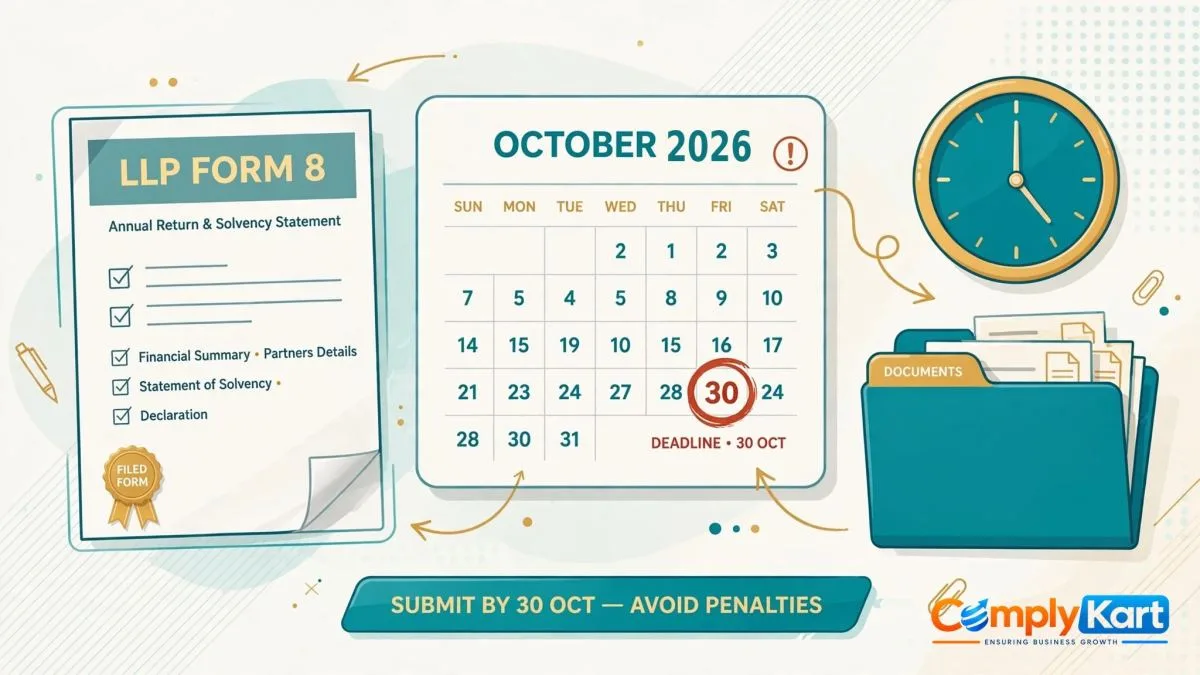
Every LLP in India lives or dies by two calendar dates: 30 May and 30 October. On 30 May, Form 11 — the annual return — falls due. On 30 October, Form 8 — the statement of account and solvency — falls due. These are not targets or suggestions. They are statutory deadlines under the LLP Act, 2008, and the price of missing them is an additional fee that climbs steeply the longer you leave them.
I have seen partners treat LLP compliance as lighter than company compliance. It is not. A private limited company that misses its AOC-4 and MGT-7 faces additional fees too — but an LLP in default is late on two forms at once, and the additional fee on each one is a multiple of its normal filing fee that grows with the delay. Leave both forms unfiled and the additional fees alone run into thousands before any formal penalty proceeding even begins. That figure surprises almost every partner I explain it to.
The other surprise: dormant LLPs file too. An LLP that did no business, raised no invoices, and moved no money still files Form 11 and Form 8 as NIL returns. The MCA does not have a concept of "we were inactive, so we skipped." Inactivity without a formal strike-off is just non-compliance wearing a quiet disguise.
Form 11 — the annual return (Section 35)
Form 11 is the LLP's annual return. It tells the Registrar who the partners are, what each partner has contributed, and what changed during the year — partner admissions, resignations, contribution changes, and changes to the LLP agreement that affect the disclosed particulars.
The due date is within 60 days of the close of the financial year. For the standard 31 March year-end, that is 30 May. The date does not move with turnover, activity, or size. A two-partner consultancy and a fifty-partner firm share the same deadline.
Form 11 is digitally signed by one designated partner. In practice, the filing needs the LLP's master data to be clean: partner details, DPINs, and contribution figures must match the LLP agreement and the Forms 3 and 4 filed during the year. Mismatches here are the most common reason Form 11 gets flagged — a partner who resigned in November but was never reported in Form 4 will still show up, and the annual return will then contradict the event filings.
One practical rule: file Form 11 before you even think about Form 8. The MCA portal will not accept Form 8 for a financial year until Form 11 for that same year is on record. Partners who start both in October routinely discover this the hard way.
Form 8 — statement of account and solvency (Section 34)
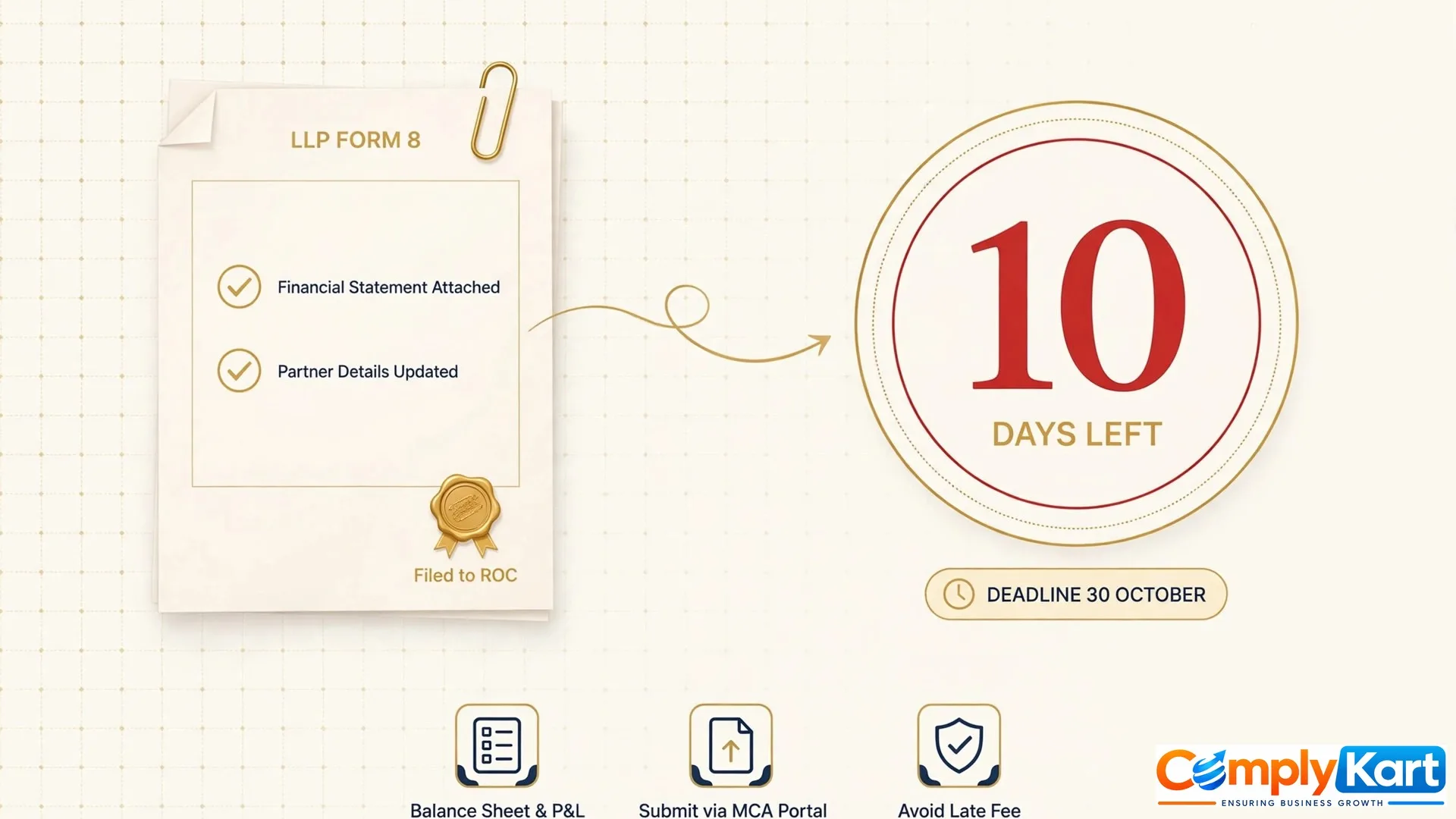
Form 8 is the financial half of the cycle: the statement of account and solvency. It carries the LLP's financial statements and a formal declaration by the designated partners that the LLP is able to pay its debts as they fall due.
The due date is 30 October — technically, within 30 days from the end of six months of the financial year. Form 8 is signed by two designated partners, not one, so both need valid DSCs in October. Every year, filings stall because one partner's DSC expired in August and nobody checked.
If the LLP crossed the audit threshold — turnover above ₹40 lakh or partner contribution above ₹25 lakh — the accounts must be audited, and Form 8 carries the auditor's certification with a valid UDIN. Below both thresholds, the designated partners self-certify. The threshold test applies per financial year, so an LLP that was below the line last year can cross it this year without warning. Check the numbers in April, not in October.
The solvency declaration deserves respect. It is a signed statement that the LLP can meet its obligations. Signing it when the LLP is balance-sheet insolvent is not a paperwork shortcut — it is a false declaration with real consequences for the signing partners.
The audit threshold, plainly stated
Rule 24 of the LLP Rules, 2009 sets the statutory audit trigger: an LLP must have its accounts audited when its turnover exceeds ₹40 lakh, or when the partners' obligation of contribution exceeds ₹25 lakh, in the financial year. Either condition alone triggers the audit.
Do not confuse this with the income-tax audit threshold under Section 44AB (₹1 crore turnover for business, higher with digital receipts). These are two different laws with two different triggers. An LLP can need an MCA audit but not a tax audit, or vice versa. Check both, every year.
DIR-3 KYC — the triennial cycle
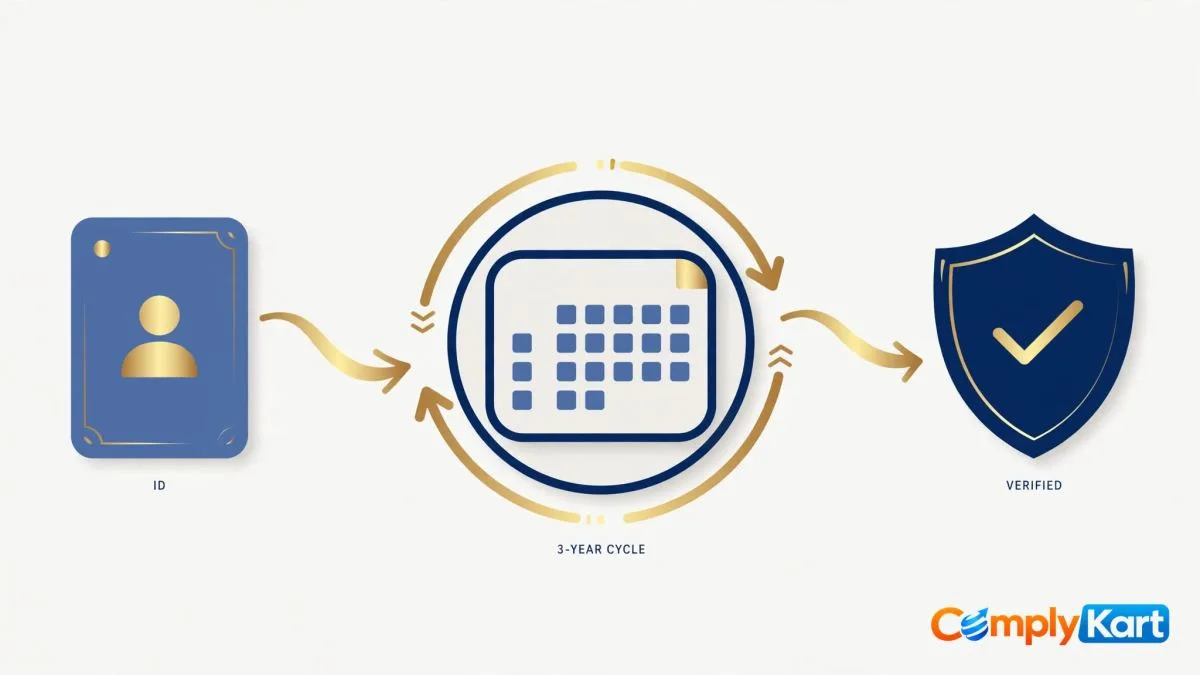
Every designated partner holds a DPIN, and every DPIN needs KYC. Since 31 March 2026, DIR-3 KYC runs on a three-year cycle under G.S.R. 943(E) — it is no longer an annual September filing. The next due date is 30 June 2028.
This change catches people out in both directions. Partners who remember the old annual-September routine file unnecessarily; partners who assume KYC is a one-time event let their DPINs go stale. A deactivated DPIN blocks every MCA filing that needs that partner's signature — including Form 11 and Form 8. Verify DPIN status before the filing season, not during it.
ITR-5 — the tax half of the year
The MCA forms are only half the story. Every LLP files its income-tax return in ITR-5: by 31 July if no audit applies, by 31 October if a tax audit applies. The LLP pays tax at 30% (plus surcharge and cess) on its profits, and partners are not taxed again on their share of profit — but remuneration and interest paid to partners is taxable in the partners' hands within the statutory limits.
The common failure mode is treating the MCA and tax calendars as one calendar. They are not. An LLP can be fully compliant on Form 11 and Form 8 and still be a defaulter on ITR-5, or the reverse. Run both checklists.
Event-based filings — the ones that ambush you
Annual filings are the headline, but LLPs also file event-based forms, each with its own additional fee that rises the longer it sits unfiled:
Form 3 — LLP agreement and changes to it, within 30 days of the change.
Form 4 — appointment, resignation, or change in a partner or designated partner, within 30 days.
Form 15 — notice of change of name or registered office details, within the prescribed time.
A partner exit that never gets reported in Form 4 is the classic ambush. The exiting partner stays on the public register, stays exposed to the LLP's liabilities in the eyes of third parties, and the annual return then contradicts reality. Thirty days. That is all you get.
What late filing actually costs
Since 1 April 2022, the additional fee is not a flat daily charge. Under Annexure A to the LLP Rules, 2009 — substituted by the LLP (Amendment) Rules, 2022 — it is a multiple of the form's normal filing fee, and the multiple rises with the delay: smaller for a small LLP, steeper for every other LLP. The MCA portal computes it automatically — you cannot negotiate it down at the counter.
Work through the arithmetic once and it stays with you:
Delay
Small LLP
Other LLP
Up to 15 days
1× the normal fee
1× the normal fee
16–30 days
2× the normal fee
4× the normal fee
31–60 days
4× the normal fee
8× the normal fee
61–90 days
6× the normal fee
12× the normal fee
91–180 days
10× the normal fee
20× the normal fee
181–360 days
15× the normal fee
30× the normal fee
Beyond 360 days
15×, plus ₹10 for every day beyond 360
30×, plus ₹20 for every day beyond 360
Put a number on it. Take an LLP that is not a small LLP, with contribution up to ₹1 lakh: the normal fee on Form 11 is ₹50. File that form a full year late and the additional fee is 30 × ₹50 plus ₹20 for each of the five days past day 360 — ₹1,600 on that one form, over and above the normal fee. It is the multiples, not a daily meter, that do the damage.
Beyond the additional fee, Sections 34(5) and 35(2) of the LLP Act provide for separate penalties — up to ₹1 lakh per form for the LLP and ₹50,000 per form for each designated partner. Prolonged default can also trigger restrictions on the MCA portal that spill over to the designated partners personally, blocking their other filings and fresh incorporations.
MCA has, in past years, issued circulars waiving additional fees for belated filings within a window. Treat these as occasional relief, never as a plan. An extension waives the fee only if the circular says so explicitly, and it never waives the normal filing fee.
The catch-up playbook
If your LLP is behind — one year, three years, five — the fix is methodical, not heroic:
Step 1 — Pull the LLP's filing history
Download the master data and check which financial years have Form 11 and Form 8 on record. List every missing year, both forms.
Step 2 — Reconcile partners and contributions
Match the current partner list and contribution figures against the LLP agreement and all Forms 3 and 4. File any missing event forms first — the annual returns must reflect reality.
Step 3 — Close the books for each missing year
Prepare financial statements for every defaulting year. If any year crossed the audit threshold, get the audit done — you cannot file a clean Form 8 for an audit year without one.
Step 4 — Check DSC and DPIN validity
Ensure at least two designated partners hold valid DSCs and active DPINs. Renew or revalidate before filing, not mid-filing.
Step 5 — File Form 11 for the oldest year first
Work forward chronologically. Each year's Form 11 must be on record before that year's Form 8.
Step 6 — File Form 8 for each year in turn
Attach audited financials where the threshold applied. Keep UDINs and auditor details ready.
Step 7 — Pay the additional fees as computed
The portal calculates the additional fee as a multiple of each form's normal fee — the longer the delay, the steeper the multiple. Budget for it upfront, and remember statutory penalties sit on top of the additional fee.
Step 8 — File ITR-5 for the missing years
Close the tax loop too. MCA compliance without tax compliance is half a job.
Common mistakes I see every filing season
Starting Form 8 before Form 11. The portal rejects it. Always Form 11 first.
One DSC short. Form 8 needs two designated partners' signatures. Check both DSCs in March.
Filing with mismatched partner data. If Form 4 was never filed for last year's partner change, Form 11 will contradict the register. Fix events first.
Assuming NIL means exempt. Dormant LLPs file NIL returns. The late fee on a missed NIL filing is identical to an active one.
Forgetting the MSME disclosure. Dues to micro and small enterprises must be disclosed in Form 8 — state the amount or confirm nil. An absent disclosure is a frequent scrutiny flag.
Treating MCA extensions as fee waivers. An extension circular waives additional fees only when it says so. Read the clause.
Reading Form 8 the way a lender does
Partners usually treat Form 8 as a filing obligation. Lenders treat it as a character reference. When a bank appraises an LLP for a cash-credit limit or a term loan, the first documents it pulls from the MCA portal are the last three years of Form 8 filings. Clean, on-time filings with consistent numbers signal a managed business. Gaps, belated filings, and restated figures signal the opposite — and the interest rate reflects it.
This is the hidden cost of late filing that no penalty table captures. The additional fee is visible on the challan; the loan that gets priced 150 basis points higher because your MCA record looks disorderly is not. I have watched credit committees ask about a two-year filing gap more sharply than about a bad quarter. A bad quarter is business. A gap is governance.
The same logic applies to enterprise customers running vendor due diligence, and to investors evaluating an LLP for conversion or funding. Your Form 8 history is your public financial biography. Write it on time.
The designated partner's personal exposure
Limited liability protects partners from the LLP's debts. It does not protect designated partners from compliance failures. Sections 34(5) and 35(2) of the LLP Act impose penalties separately on the LLP (up to ₹1 lakh per form) and on each designated partner (up to ₹50,000 per form). The additional fee meter, meanwhile, is a filing charge — but prolonged default invites the Registrar's attention, and the Registrar's attention lands on named individuals.
There is a second, quieter exposure. Designated partners of a defaulting LLP find their DPINs flagged across the MCA system. That flag does not respect entity boundaries — it follows the person into every other LLP and company they are associated with, blocking filings and fresh appointments there too. One neglected LLP can jam the compliance of three healthy companies sharing a common designated partner. I have seen exactly this happen, and untangling it took months.
The lesson is structural: never accept a designated-partner appointment in an LLP whose filings you do not control or at least monitor. The title carries real, personal, statutory liability.
LLP vs company: the annual compliance comparison
Founders choosing between an LLP and a private limited company often ask which is "lighter" on compliance. The honest answer is that they are different, not that one is trivial:
Obligation
LLP
Private limited company
Annual return
Form 11 (30 May)
MGT-7/7A (60 days from AGM)
Financial filing
Form 8 (30 Oct)
AOC-4 (30 days from AGM)
Board/partner meetings
No statutory minimum
4 board meetings a year
Audit trigger
₹40L turnover / ₹25L contribution
₹1 cr turnover (tax audit); company audit mandatory regardless
Late fee character
Additional fee as a multiple of the normal fee, rising with delay
Per-day additional fees on MCA forms too
Minutes & registers
Minimal statutory registers
Statutory registers, minutes books
The LLP skips board meetings, statutory registers, and the AGM machinery — that is the real saving. But the filing discipline (two hard MCA dates, daily penalties) is just as strict. Choose the LLP for the structural simplicity, not for permission to be casual.
First-year filings: the edge cases
An LLP incorporated during the financial year still files for that year. There is no "first year exemption." An LLP incorporated on 20 March files Form 11 by 30 May for those eleven days of existence. Partners find this absurd; the Registrar does not.
The one genuine relief: Form 8 for an LLP whose first financial year is short. The LLP Rules provide that where the LLP is incorporated and the first financial year ends within six months, the statement of account and solvency may cover an extended period. Check the exact position for your incorporation date rather than assuming — and when in doubt, file.
Also note the financial-year question itself. An LLP's first financial year runs from incorporation to the following 31 March (it cannot exceed the statutory period), and the LLP agreement may define subsequent years. Keep the agreement's definition aligned with the 31 March standard unless you have a reason not to — non-standard year-ends complicate every deadline computation.
What the Registrar actually looks at
MCA scrutiny of LLP filings is largely system-driven, but certain patterns draw human attention:
Contribution changes without Form 3. Capital moved but the agreement change never filed.
Partner count mismatches. Form 11 shows four partners; only three Forms 4 exist.
Round-figure financials. Three years of suspiciously round turnover figures invite questions.
Solvency declarations beside creditor-heavy balance sheets. The declaration says solvent; the numbers whisper otherwise.
Late filings followed by strike-off applications. The Registrar reads this as an attempt to outrun dues.
None of these is exotic. They are all just inconsistency between what the LLP told the Registrar in one form and what it told the Registrar in another. The MCA's systems are increasingly good at cross-referencing. File one consistent story.
Timelines and fees
Item
Timeline
Government fee
Professional fee (typical)
Form 11 (annual return)
Due 30 May; filing takes 2–4 days once books are ready
₹50–₹200 (slab on contribution)
₹2,000–₹6,000
Form 8 (statement of account & solvency)
Due 30 Oct; 3–5 days with audit
₹50–₹200 (slab on contribution)
₹3,000–₹10,000
Statutory audit (if triggered)
2–4 weeks
—
₹15,000–₹50,000+
DIR-3 KYC (triennial)
Next due 30 June 2028
Nil (within due date)
₹1,000–₹2,500
ITR-5
31 July / 31 October
Nil
₹5,000–₹15,000
Multi-year catch-up
4–10 weeks depending on years
Multiple of the normal fee, rising with delay
Case-based
How ComplyKart helps — and what we do not do
We run the full LLP annual cycle: reconciling partner and contribution data, preparing and filing Form 11 and Form 8, coordinating the statutory audit where thresholds are crossed, tracking DIR-3 KYC for every designated partner on the triennial cycle, and filing ITR-5. For defaulting LLPs, we scope the catch-up year by year, compute the additional-fee exposure before you commit, and file chronologically so nothing gets rejected.
What we do not do: we do not backdate filings or fabricate signing dates. We do not advise signing a solvency declaration for an LLP that cannot pay its debts. We do not promise MCA fee waivers that do not exist in a notified circular. And we do not file a clean Form 8 for an audit year without the audit — the UDIN trail makes that a short-lived fiction.
FAQ
Frequently asked questions
27 answers from our consultants.
You pay for our expert's time — document checking, filing, follow-ups — not the government. The government fee goes to the government; our fee is for the work we do so you don't have to figure it out yourself.
₹100 per day, per form, with no maximum cap. A one-year delay on AOC-4 and MGT-7 together can cross ₹70,000 in late fees alone. File on time — it's the cheapest compliance you'll ever do.
Yes. Dormant or not, a private limited company must file AOC-4, MGT-7, hold board meetings and conduct a statutory audit every year. Zero turnover doesn't mean zero compliance.
AOC-4 is your financial statements (balance sheet, profit & loss) filed with the ROC. MGT-7 is your annual return (shareholding, directors, meetings). Both are due after your AGM — AOC-4 within 30 days, MGT-7 within 60 days.
Yes, with late fees. There's no amnesty scheme running right now, so every day of delay adds ₹100 per form. We regularly clear 3-4 years of backlog for companies — it's routine work for us.
Every director with a DIN must complete KYC. Since March 2026, it's once every 3 years (not annual anymore). Miss it and your DIN gets deactivated — you can't sign any MCA filing until it's restored.
Private limited companies: yes, within 6 months of financial year-end (by 30 September). OPCs are exempt. The AGM approves your financials — without it, you can't file AOC-4.
Statutory registers (members, directors, charges), minutes of board and general meetings, and accounting books for 8 years. The ROC can ask for these during inspection — most small companies don't maintain them properly.
File ADT-3 for the resignation and appoint a new auditor with ADT-1 within the statutory timeline. Don't leave the position vacant — an auditor-less company can't file AOC-4.
Form 11 is due within 60 days of the close of the financial year. For the standard 31 March year-end, the due date is 30 May. The date does not change with turnover, profit, or activity level.
The additional fee is a multiple of the form's normal filing fee under Annexure A to the LLP Rules, 2009, and the multiple rises with the delay — one extra normal fee for up to 15 days, rising to 15 times for a small LLP and 30 times for any other LLP beyond 180 days, plus ₹10 or ₹20 for every day beyond 360 days on Form 8 and Form 11. If both forms are overdue, both multiples apply.
Yes. Every LLP registered under the LLP Act, 2008 must file Form 11 and Form 8 each year, even with zero transactions. File them as NIL returns. The late fee on a missed NIL filing is the same as for an active LLP.
No. The MCA portal does not accept Form 8 for a financial year until Form 11 for that same year is on record. Always complete Form 11 first.
When its turnover exceeds ₹40 lakh or the partners' obligation of contribution exceeds ₹25 lakh in the financial year, under Rule 24 of the LLP Rules, 2009. Either condition alone triggers the audit.
Two. Form 8 requires the digital signatures of two designated partners, plus the auditor's certification with a valid UDIN if the audit threshold was crossed. Form 11 needs only one designated partner's signature.
DIR-3 KYC keeps a designated partner's DPIN active. Since 31 March 2026 it runs on a three-year cycle under G.S.R. 943(E) — it is not an annual filing anymore. The next due date is 30 June 2028.
The DPIN can be deactivated, which blocks every MCA filing requiring that partner's signature — including Form 11 and Form 8. Check DPIN status before the filing season begins.
Yes. Every LLP files ITR-5: by 31 July if no tax audit applies, by 31 October if a tax audit under Section 44AB applies. MCA compliance and tax compliance are separate obligations with separate deadlines.
An LLP pays tax at 30% on its profits (plus applicable surcharge and health and education cess). Partners are not taxed again on their share of the LLP's profit, though remuneration and interest paid to partners are taxable within statutory limits.
Form 3 reports the LLP agreement and changes to it; Form 4 reports appointment, resignation, or change of partners and designated partners; Form 15 reports changes such as the registered office. Each is due within 30 days of the event and carries the same slab-based additional fee if filed late.
File Form 4 now, with the additional fee computed from day 31 after the event. Until it is filed, the resigned partner remains on the public register and exposed. Then ensure Form 11 reflects the corrected position.
Only if a notified MCA circular expressly waives them for your filing and period. Past circulars have waived additional fees within a window but never the normal filing fee, and never retrospectively for fees already paid. Do not plan around a hoped-for waiver.
File a chronological catch-up: oldest year's Form 11, then its Form 8, moving forward. Reconcile event filings first, complete audits for threshold years, and budget for the accumulated additional fees — multi-year defaults routinely cross ₹1 lakh.
Prolonged default exposes the LLP to strike-off proceedings, and the Registrar can act against LLPs that have not carried on business or filed for extended periods. If the LLP is genuinely defunct, a voluntary strike-off via Form 24 is cleaner than indefinite default.
Yes, indirectly — Form 11 disclosures on partners and contributions must match the LLP agreement, and any change in the agreement must first be reported in Form 3. Keep the agreement, Forms 3 and 4, and the annual returns telling one consistent story.
Where the audit threshold is crossed, the auditor's certification on Form 8 must carry a valid UDIN generated on the ICAI portal. A Form 8 with an invalid or missing UDIN is a defect waiting to be noticed.
The MCA forms are the same, but foreign partners' KYC and documentation need extra care, and profit repatriation has FEMA implications handled outside the annual filing cycle. Factor longer document turnaround into your May and October timelines.
What clients say about working with us
Real stories from businesses we've worked with.
Trademark Registration“
Our Trademark was applied in all the classes with a short span of time by Complykart Trademark Experts and I can say the level of expertise and commitment they carry is remarkable. It's an A+ from my side. We are now sticking to ComplyKart only.
Company Registration“
I found the professionalism of the staff at complykart.com, a pleasure to work with. As a foreigner to India, they took the time to explain the documentation and assisted in every question I raised. I was pleased that complykart.com made it easy for my Business.
Merger & Acquisition“
Trust, Commitment, Dedication and responsiveness are the best things with ComplyKart. Thanks for handling our Merger assignment with so much care. After my business disputes, complykart handles all things with own sense of understanding.
Company Law Specialist · Company Law & ROC Compliance · 10+ years experience
Naman Agarwal specialises in company law and ROC compliance. He manages incorporations, annual filings (AOC-4, MGT-7, ADT-1), board processes and statutory registers for private limited companies, LLPs and Section 8 companies.
Last reviewed: 16 November 2026
Get a free consultation
Talk to a ComplyKart professional about Annual Compliance of LLP. The first consultation is free.