
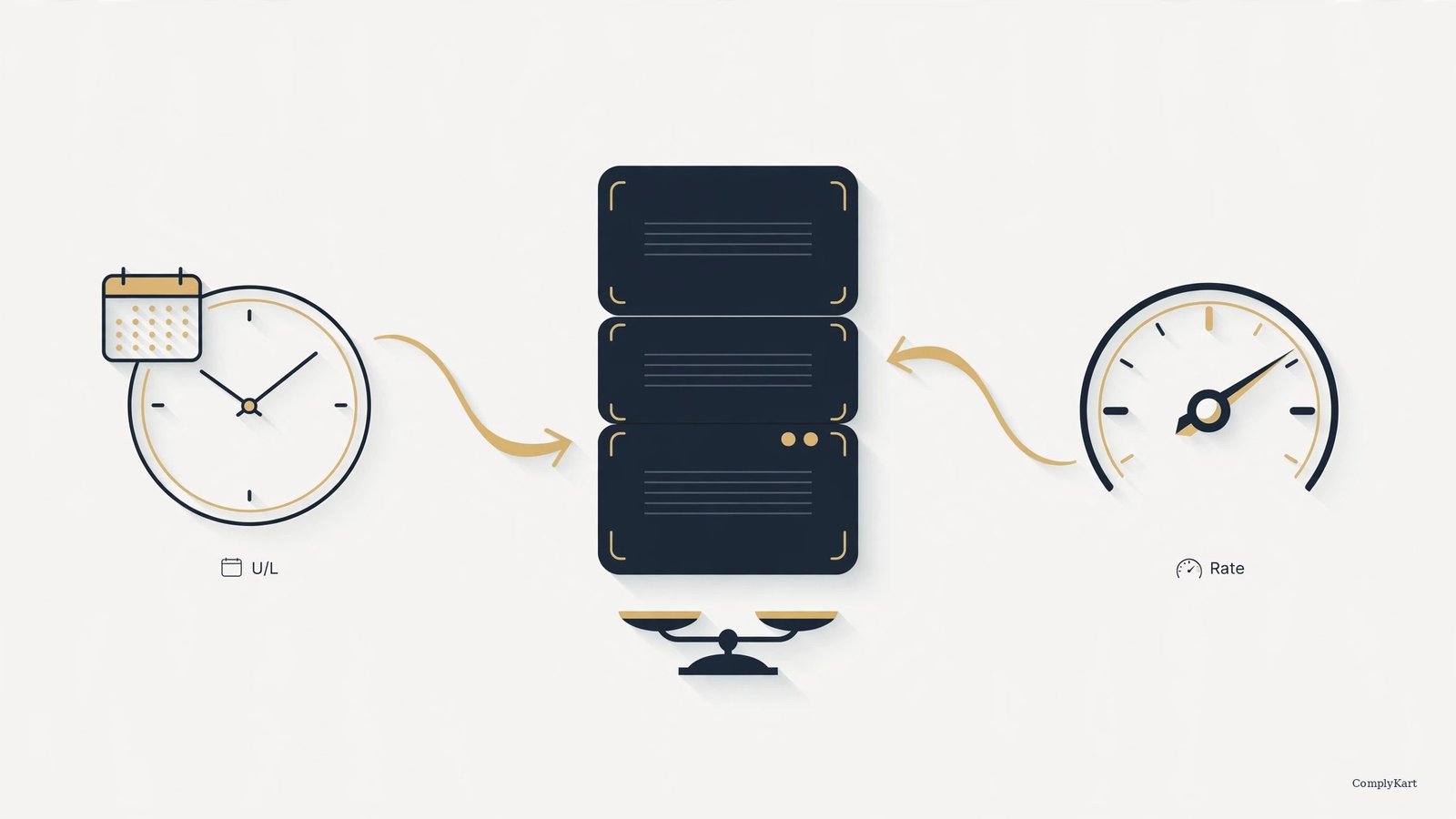
Your company bought a server for ₹10 lakh. Your accountant depreciates it one way. Your tax consultant depreciates it another. Both are right. That sentence confuses every first-time founder, and it should not.
Depreciation in India runs on two clocks. The Companies Act clock ticks with the asset's useful life. The Income-tax clock ticks with the government's prescribed rates. Both tell time. Neither is wrong. You just have to know which clock you are reading.
Clock one: the Companies Act
Schedule II of the Companies Act, 2013 assigns every asset a useful life. Computers and data-processing units: 3 years. Plant and machinery (general): 15 years. Motor vehicles: 8 to 10 years depending on the type. Buildings: 30 to 60 years depending on construction. You may use the straight-line method or the written-down-value method, and you normally assume a residual value of up to 5% of the asset's original cost.
The logic is economic: the asset loses value as it is used up, and the accounts should show that wear and tear honestly. A server really is near-worthless after three years. The Companies Act clock is trying to describe reality.
And it has a hard edge. Section 123 of the Act says dividends can only be declared out of profits after providing depreciation as per Schedule II. Skip or understate depreciation, and your dividend — and the directors who declared it — are on thin ice. This is where the accounts clock bites.
Clock two: the Income-tax Act
The Income-tax Act does not care about your server's useful life. It works on blocks of assets and prescribed rates under the written-down-value method: plant and machinery generally 15%, motor cars 30%, computers 40%, buildings 10%, furniture 10%. You claim whatever the rate allows, regardless of how the asset is actually wearing out.
There is also additional depreciation under Section 32(1)(iia): an extra 20% in the first year on new plant and machinery used in manufacture or production, rising to 35% in notified backward areas of Andhra Pradesh, Bihar, Telangana, and West Bengal. This is a deliberate incentive — the tax clock sometimes runs faster on purpose, to push investment where the government wants it.
Why the two numbers never match
The accounts clock follows the asset. The tax clock follows policy. A computer gets 3 years in your books (roughly 31.67% a year on straight-line) but 40% WDV for tax. A building gets 60 years in your books and 10% for tax. The gap is structural, not an error, and it produces timing differences — you claim more tax depreciation early, less later, or the reverse.
Those timing differences create deferred tax. Accounting Standard 22 (and Ind AS 12 for companies on Ind AS) requires you to recognise the tax effect of the gap between book depreciation and tax depreciation. This is the part where founders glaze over, but it is simple in substance: if your tax depreciation this year is higher than your book depreciation, you will pay more tax later, and the accounts should show that future liability now.
What to get right in practice
Maintain two registers, or one register with two columns. Every fixed-asset register should track both book depreciation and tax depreciation. Auditors and tax officers each want their own number. Give each of them the right one.
Apply Schedule II correctly from day one. Component accounting — depreciating significant parts of an asset separately when they have different useful lives — is required under Schedule II. A building's lift and its structure do not live the same life. Treating them as one asset is technically wrong, and first-year audits flag it routinely.
Do not confuse the 5% residual value. Schedule II's residual value is a ceiling for the accounts calculation, not a tax concept. Mixing the two frameworks is the most common error in first audits.
Check additional depreciation eligibility before buying. If you are setting up manufacturing, the 20% (or 35%) first-year additional depreciation is real money. It has conditions — new machinery, used in manufacture, put to use in the year. Confirm them before the purchase, not after.
Watch assets that straddle personal and business use. A car used partly for personal purposes, a laptop that travels home — the tax law restricts or disallows depreciation on the personal-use portion, while the accounts may still depreciate the full asset. Document usage honestly; this is where assessments get uncomfortable.
The one-sentence version
Book depreciation tells your shareholders how the asset aged. Tax depreciation tells the government how much of it you may deduct. Keep both, reconcile both, and never let one masquerade as the other.
Depreciation policy is set once a year but affects every return you file — map it alongside your other statutory deadlines on our compliance calendar so neither clock ever runs out on you.





Comments
No comments yet — ask the first question below.
Join the discussion
Questions go straight to our expert desk. Comments appear after a quick review — no spam, no noise.