
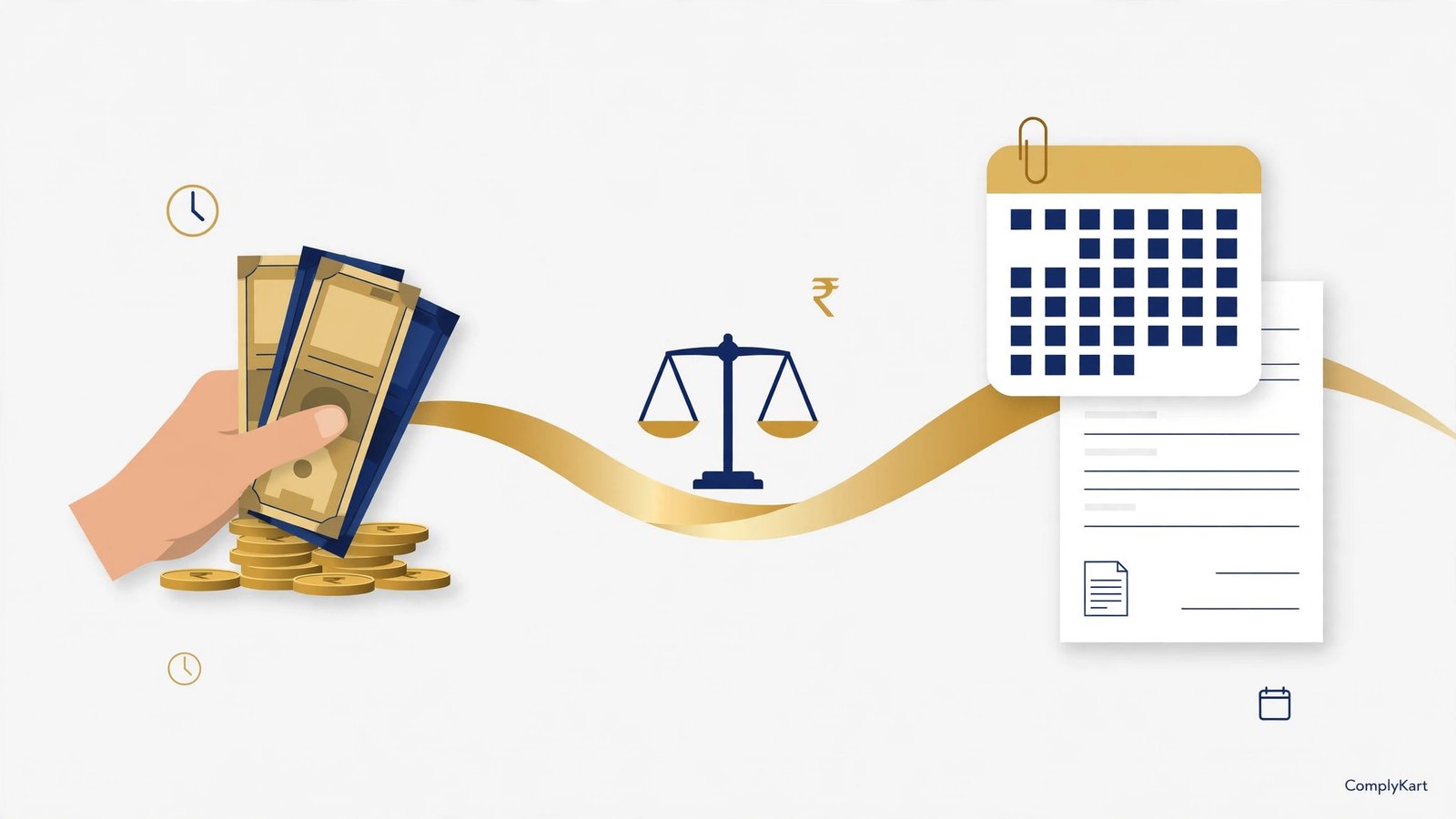
Two businesses. Same sales, same expenses, same year. One reports a profit. The other reports a loss.
Neither is cooking the books. They are simply keeping them differently. One records income when the money arrives; the other records it when the work is done. This is the difference between cash and accrual accounting — and it quietly decides what your profit means.
Cash basis: money in, money out
Cash accounting is exactly what it sounds like. You record income when cash hits your account, and expenses when cash leaves it. Simple. Intuitive. Matches your bank statement.
A freelance designer finishes a project in March and gets paid in May. On cash basis, that income belongs to May — because May is when the money arrived. Office rent paid in advance for six months? That is an expense in the month you paid it, all of it, at once.
For very small businesses, this simplicity is the whole appeal. The books answer one question — “where did the money go?” — and answer it honestly. The trouble starts when timing matters, because cash accounting has a blind spot: it cannot see money that is owed but not yet moved.
Accrual basis: earned versus received
Accrual accounting records income when you earn it and expenses when you incur them — regardless of when the cash moves. The invoice sent is income. The bill received is an expense. The bank balance is a separate question.
That same designer, on accrual basis, books the March project as March income the moment the invoice goes out. The May payment is just collection — the income was already counted. The six months of prepaid rent is not a one-month expense; it is spread across the six months it covers, because that is when the benefit is consumed.
Accrual is harder. It needs receivables, payables, and adjustments. But it answers the question owners actually need answered: “how did the business perform this period?” — not “what did the bank say this period?”
The photographer who got paid too early
Here is the analogy that makes the whole thing click. A wedding photographer charges ₹60,000 and takes the full advance in March for a December wedding.
On cash basis, March looks wonderful — ₹60,000 of income, no costs yet. The books say: great month. On accrual basis, March shows no income at all. The ₹60,000 sits on the balance sheet as a liability — money received for work not yet done, politely called “unearned revenue.” The income appears in December, when the photographer actually shoots the wedding.
Now ask which picture is truer. In March, the photographer owes a wedding. The cash is in hand, but so is the obligation. Accrual accounting sees both. Cash accounting sees only the cash — and flatters March while robbing December of the income it earned.
Every business that takes advances, gives credit, or prepays expenses lives inside this analogy. The bigger the gap between doing the work and moving the money, the more the two methods disagree — and the more the choice matters.
Who must use which
Here the law removes the choice for some of you. Every company in India must maintain its books on the accrual basis, under the double-entry system — Section 128(1) of the Companies Act, 2013 says so directly. If you run a private limited company, this debate is already settled. You are on accrual.
For sole proprietors, partnerships, and LLPs, income-tax law recognises both systems. You choose one and apply it consistently, year after year. Many small professionals start on cash for its simplicity and move to accrual as credit dealings grow. What you cannot do is hop between the two to suit the year’s tax bill — consistency is the rule, and switching methods needs proper disclosure.
There is also a GST wrinkle worth knowing: the time-of-supply rules decide when your GST liability arises, and they operate independently of your accounting method. Your books and your GST returns can legitimately recognise the same transaction in different periods. That is normal. It is also why reconciling the two is a real year-end exercise, not a formality.
The practical takeaway
If you are a company, use accrual and use it well — match income to the period it was earned and expenses to the period they were incurred. If you are small enough to choose, choose with your growth in mind: cash is fine while every deal is pay-as-you-go; the moment you invoice on credit or take advances, accrual starts telling the truth and cash starts telling stories.
And whichever you use, use it the same way every year. Comparability is the quiet virtue of accounting. A profit figure means nothing if last year’s profit was measured with a different ruler.
Ask your accountant which basis your books actually follow. You might be surprised. Plenty of businesses think they are on one system while their books drift toward the other — income booked on invoices, expenses booked on payments, a hybrid nobody chose. Name the method. Then make the books obey it.



Comments
No comments yet — ask the first question below.
Join the discussion
Questions go straight to our expert desk. Comments appear after a quick review — no spam, no noise.