
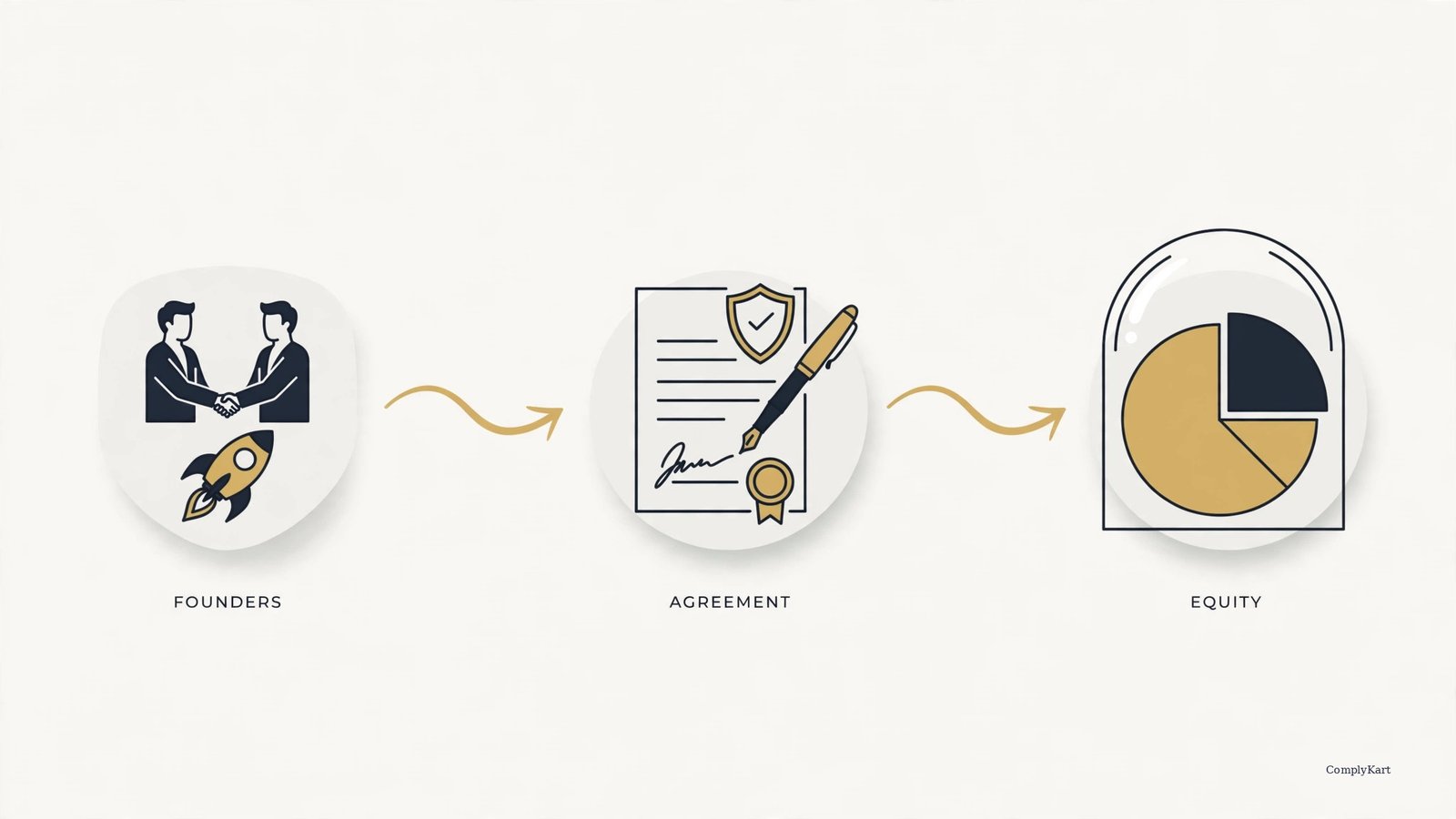
Three friends start a company. They split equity 33-33-33 over coffee, shake hands, and get to work. Eighteen months later, one of them stops showing up. The company is now worth something. The handshake is worth nothing.
This is the most expensive missing document in Indian startups. Not the term sheet — investors bring lawyers for that. The founder's agreement. Written among founders, at formation, before anyone has leverage.
Think of it as a prenup written while everyone is still in love. Nobody plans to use it. Everyone is grateful it exists when they need it.
Not the same as a shareholders' agreement
A shareholders' agreement arrives with investors and governs the investor-founder relationship. A founder's agreement comes first and governs the founders among themselves: who does what, who owns what, and what happens when someone leaves. When the SHA is eventually signed, it can overlap or override parts of the founder's agreement — which is exactly why the founder's agreement should be drafted to survive it, or at least to be reconciled with it deliberately.
The clauses that actually matter
Equity split, with reasons. Equal splits feel fair on day one and unfair on day four hundred. Document not just the percentages but the logic — who brought the idea, who quit a job, who put in cash. A split with a written rationale survives a disagreement. A split with no rationale survives nothing.
Vesting. Founders should vest like employees: typically over four years with a one-year cliff. If a co-founder walks out in month nine, unvested shares return to the company instead of becoming a permanent deadweight on the cap table. Investors will insist on vesting anyway. Doing it yourself, before the term sheet, means you set the terms instead of accepting theirs.
Roles and commitment. Full-time or part-time? Who is CEO, who builds, who sells? Write it down. The most common founder dispute I have seen is not about equity percentages — it is about one founder working weekends while the other "advises."
IP assignment. Everything the founders create — code, designs, content, brand — must belong to the company, not to the individuals. Without a written assignment, a departing founder can claim the core IP was theirs. This single clause has killed acquisitions. Get it signed at formation, not during due diligence.
The clauses people skip, then regret
Leaver provisions. What happens to a founder's shares if they resign, are removed, or die? Good-leaver versus bad-leaver treatment — whether shares are bought back at fair value or at cost — sounds morbid. It is also the clause that decides whether a departure is a clean break or a two-year war.
Decision-making and deadlock. Who decides on hiring, spending above a threshold, fundraising? What happens when two founders disagree 50-50 and neither blinks? A deadlock mechanism — mediation, a casting vote, a buy-sell trigger — feels unnecessary until the day it is the only thing that works.
Acceleration on exit. If the company is acquired, do unvested founder shares vest immediately? Full acceleration, partial acceleration, or none — investors have strong views, but founders should arrive with their own position.
Restrictive covenants. Confidentiality, non-compete, and non-solicitation for a reasonable period after exit. Keep them reasonable — Indian courts enforce what is fair and strike down what is excessive.
Dispute resolution. Seat of arbitration, governing law, the process before anyone files anything. Agreeing on this while you are friends is the whole point.
Make it real, not decorative
An agreement in a drawer is a ritual, not protection. Get it signed on stamp paper of adequate value, keep executed copies with the company's records, and revisit it at every funding round — the SHA may need conforming amendments. The Indian Contract Act, 1872 gives the agreement its teeth; proper execution and stamping give it its bite in practice.
Also watch the equity table as the company evolves. ESOP pools dilute everyone, bridge rounds add convertible instruments, and a founder's "33%" quietly becomes 24% without anyone signing anything malicious. Your agreement should say how new issuances are handled — pro-rata rights, anti-dilution if you negotiated it, and whose approval a new issue needs. Dilution surprises end more founder relationships than outright fights do.
The best time to write a founder's agreement is the week you incorporate, when splitting equity still feels like dividing a pizza. The second-best time is today. The worst time is the week someone stops showing up — because by then, every clause is negotiated through lawyers, and every lawyer is billing by the hour.
Forming the company is step one — and the agreement should reference the actual shareholding your incorporation created. If you are still at the structuring stage, our company registration service pages map the full formation checklist. And if your startup already has investors on the cap table, align the founder's agreement with the shareholders' agreement now, while everyone is still in the same room.





Comments
No comments yet — ask the first question below.
Join the discussion
Questions go straight to our expert desk. Comments appear after a quick review — no spam, no noise.