
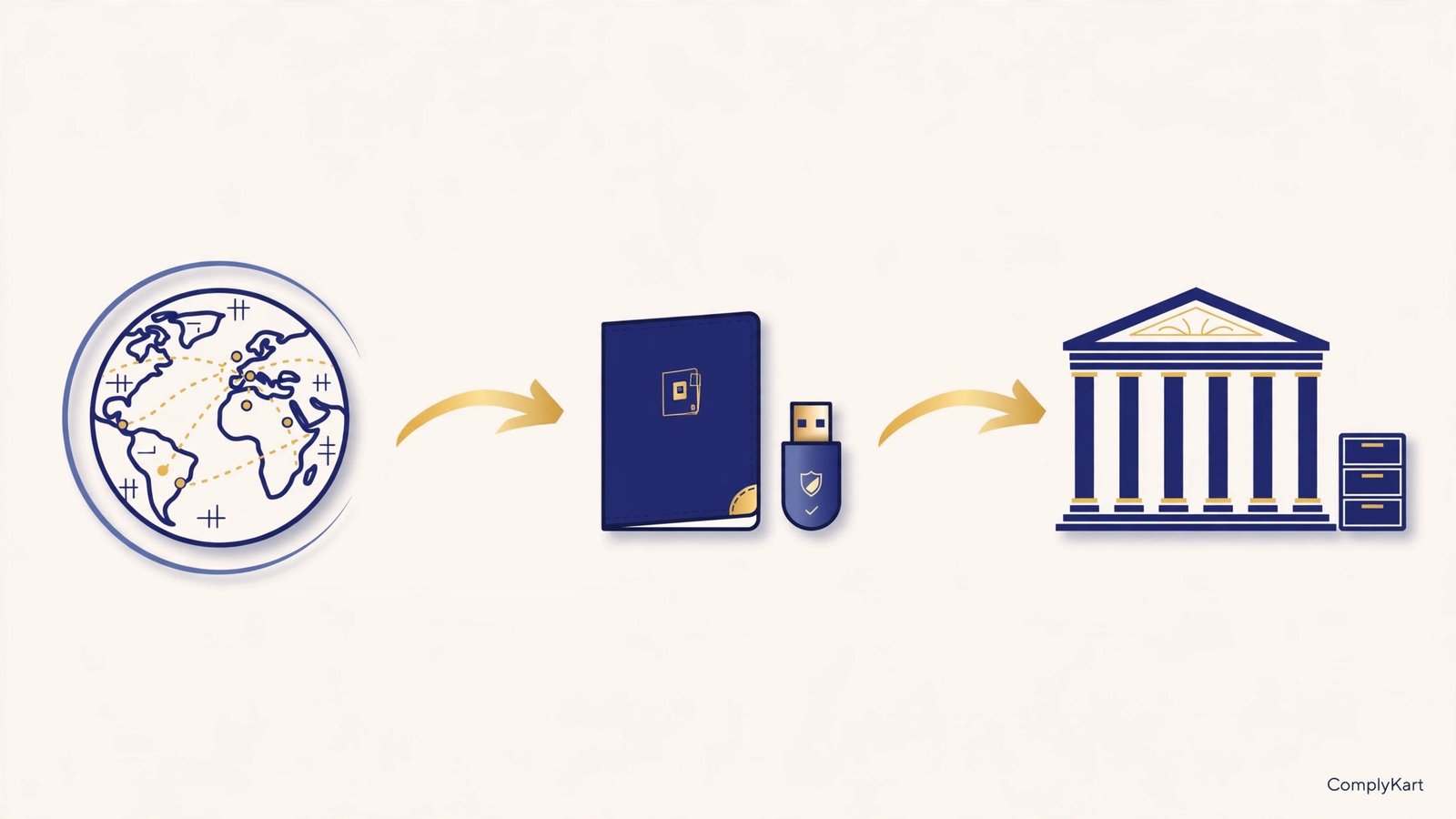
The short answer: a company with foreign directors files the same AOC-4 (around 29 October 2026) and MGT-7 (around 29 November 2026) as any company — but foreign directors need passport-based, notarised or apostilled documents for their DIN and Class 3 DSC, arranged weeks in advance. Separately, foreign investment is reported to the RBI through FIRMS — FC-GPR within 30 days of allotment, FLA by 15 July, FC-TRS within 60 days of transfer — and ROC filings satisfy none of these.
A company with foreign directors — or an Indian subsidiary of a foreign parent — files the same AOC-4 and MGT-7 as everyone else. The forms don't change. What changes is everything around them: the documents, the disclosures, and the parallel filings that belong to a different regulator entirely.
Get the ROC part right and the RBI part confused, or the other way round, and you end up compliant in one place and exposed in another. Let's keep the two cleanly separate.
Key takeaways
- Same ROC forms, same calendar: AOC-4 around 29 October 2026, MGT-7 around 29 November 2026, ADT-1 within 15 days of the AGM.
- Foreign directors need apostilled or notarised passport documents for DIN and Class 3 DSC — start in August, not October.
- Foreign directors may attend board meetings, including the financials approval, by video conference.
- FC-GPR (30 days from allotment), FLA (15 July), FC-TRS (60 days from transfer) go to the RBI via FIRMS — never to the ROC, and never satisfied by ROC filings.
- The MGT-7 shareholding must mirror the actual cap table, including mid-year allotments to the parent.
Do foreign directors change the ROC filing?
The calendar is unchanged: AGM within six months of year-end, AOC-4 within 30 days of the AGM (around 29 October 2026 for a 30 September AGM), MGT-7 within 60 days (around 29 November), ADT-1 for the auditor within 15 days of the AGM.
What differs is director documentation. A foreign director needs a Class 3 DSC like everyone else — but the identity and address proof behind the DSC and the DIN must be a passport, properly notarised or apostilled. These take weeks to arrange across borders. The single most common cause of delayed filings here is starting this paperwork in October. Start in August and the season feels entirely different.
Two details worth checking: if a director's passport was renewed after the DIN was issued, update the DIN to match. And foreign directors can attend board meetings — including the one approving the financials — by video conference. Time zones are a scheduling problem, not a legal one.
What subsidiary disclosures go in the MGT-7?
If the Indian company is a subsidiary of a foreign body corporate, the MGT-7 must reflect the holding-subsidiary relationship precisely: the parent's details, the percentage holding, and every change during the year.
This is where I see the most errors: the MGT-7 shareholding doesn't match the cap table because a mid-year allotment went through PAS-3 but never flowed downstream, or a transfer sits in the registers while the return shows the old holder. Reconcile before you file — the return is a snapshot the whole world can pull. Make it the true one.
Where the parent has infused capital during the year, confirm the share application money was allotted within the permitted time and the PAS-3 filed. Unallotted application money sitting past its deadline is a separate compliance problem that tends to surface exactly when you're trying to close the annual filing.
ROC vs RBI: which filings belong where?
Now the part that causes the most confusion, so I'll state it as plainly as I can: foreign investment into India is reported to the Reserve Bank of India through the FIRMS portal. Not to the ROC. These are separate obligations, on separate portals, on separate clocks — and satisfying one satisfies nothing of the other.
FC-GPR — when shares are allotted to a foreign investor, RBI reporting is due within 30 days of the allotment — not thirty days after the AGM. This is the deadline foreign-invested companies miss most often, because the whole team watches the ROC calendar and nobody watches the FEMA one.
FLA return — the Annual Return on Foreign Liabilities and Assets, due 15 July every year, filed by Indian companies that have received foreign direct investment or made overseas investment. Even if nothing changed during the year. For this cycle, 15 July 2026 has already passed — so the first thing to do is confirm it was actually filed, rather than assuming it was.
FC-TRS — for transfers of shares between a resident and a non-resident, reported within 60 days of the transfer or the receipt of funds.
None of these is filed on the MCA portal. None is satisfied by filing your AOC-4. I state this bluntly because "we filed everything with the ROC" is the sentence I hear right before discovering three years of missed FC-GPRs — and unlike ROC additional fees, FEMA contraventions carry a different order of consequences.
Your season sequence: the two-track plan
Start earliest on whatever crosses a border: director documents, apostilles, parent-company confirmations of the shareholding. These have the longest lead times and the least flexibility, and they are the items most likely to be sitting in someone's inbox in another time zone.
Then run the two tracks in parallel. Track one, ROC: AGM, audit, AOC-4, MGT-7, ADT-1. Track two, RBI: FC-GPR for allotments, FLA confirmation, FC-TRS for transfers. Assign an owner to each track, by name — cross-border compliance fails on ownership, not knowledge. Everyone assumed the other track was covered, until a bank or auditor asked.
Keep a single FEMA file next to your statutory registers: allotments, FC-GPR acknowledgements, FLA filings, valuation reports. When the authorised dealer bank asks — and it will, usually mid-remittance — you'll answer in an afternoon instead of a month.
Frequently asked questions
Can a foreign director get a DIN and DSC without visiting India?
Yes, but the paperwork crosses borders instead: identity and address proof must be the passport, duly notarised or apostilled as the issuing country requires, and the DSC is Class 3 like any director's. Allow weeks — this is the step that most often delays foreign-director filings.
Must a foreign director be physically present for board meetings?
No. Foreign directors can attend by video conference, including the meeting that approves the financials — the law is explicit on this. Time zones are a scheduling problem, not a legal one, so don't let logistics become the excuse for a delayed AGM. If approvals are slipping, the cause is coordination, not compliance.
We filed everything with the ROC. Does that cover our foreign investment reporting?
No — and this is the costliest confusion in cross-border compliance. FDI reporting goes to the RBI through the FIRMS portal: FC-GPR within 30 days of allotment, the FLA return by 15 July, FC-TRS within 60 days of a resident–non-resident transfer. Satisfying the ROC satisfies nothing of the RBI.
What is the FLA return, and who has to file it?
The Annual Return on Foreign Liabilities and Assets, due 15 July every year, filed by Indian companies that have received foreign direct investment or made overseas investment — even if nothing changed during the year. For this cycle, 15 July 2026 has passed: confirm it was actually filed.
Our MGT-7 shareholding doesn't match the cap table. Does it matter?
Yes. The annual return is a public snapshot that lenders, counterparties, and the parent's auditors all read — it is often the first document anyone pulls on your company. Reconcile every mid-year allotment and transfer, confirm the PAS-3s were filed and the registers updated, and only then file. Make the return the true picture, not an approximate one.
Cross-border structures reward precision and punish assumptions. If your company has foreign directors or a foreign parent and you'd rather have a team running both the ROC and the FEMA-adjacent calendars without mixing them up, ComplyKart handles exactly this combination, every season.



Comments
No comments yet — ask the first question below.
Join the discussion
Questions go straight to our expert desk. Comments appear after a quick review — no spam, no noise.