
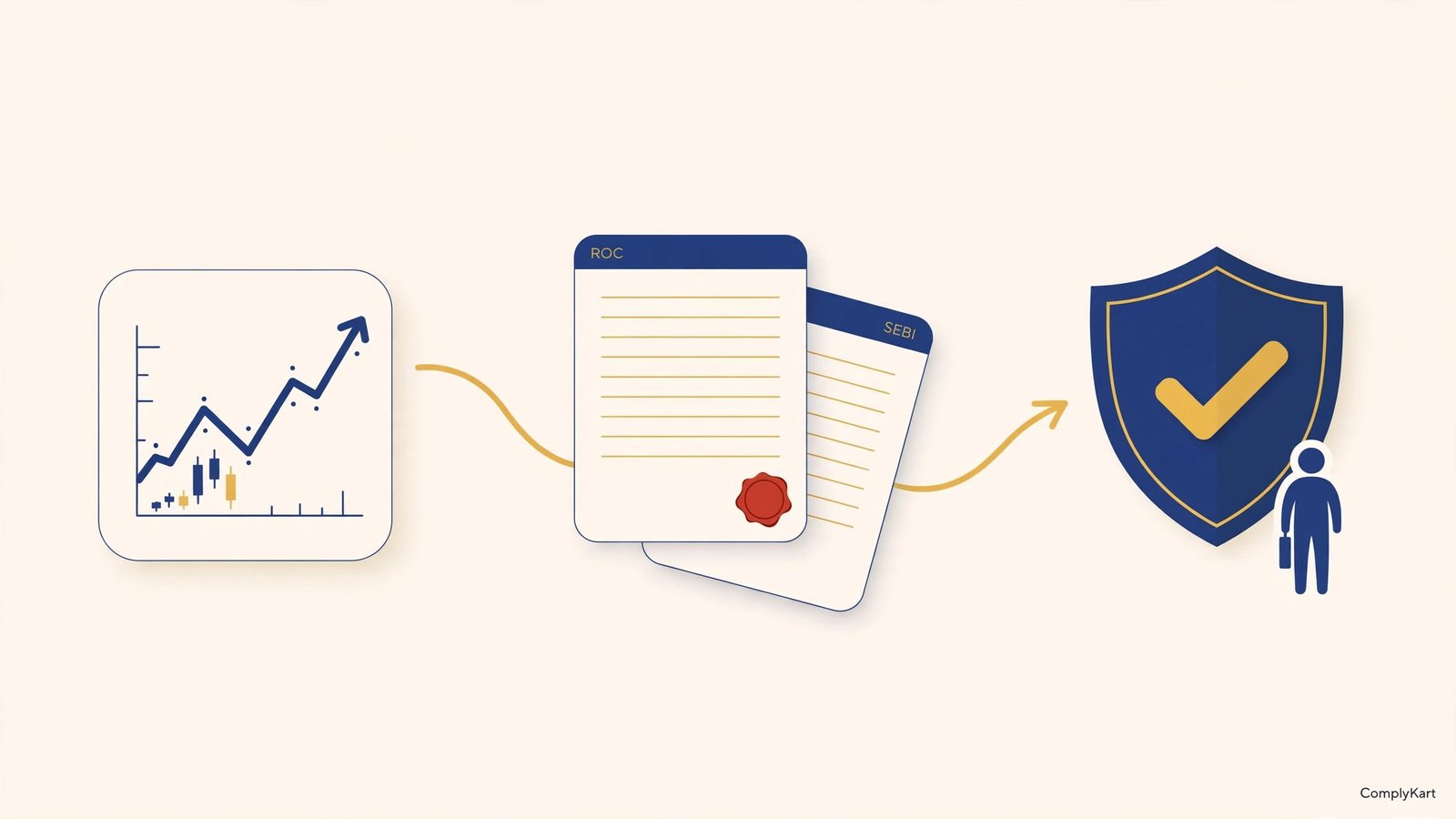
A listed company must file AOC-4 (financial statements) within 30 days of its AGM and MGT-7 (annual return) within 60 days — the same ROC deadlines as any company — plus SEBI LODR filings: the annual report, quarterly shareholding pattern, and corporate governance reports. For a 30 September 2026 AGM, that means AOC-4 by 29 October 2026 and MGT-7 by 29 November 2026.
A listed company answers to two masters at filing time. The Registrar of Companies wants the statutory picture. The stock exchanges, through SEBI's LODR Regulations, want the investor picture. Most compliance teams handle one track well and treat the other as an afterthought. That is where the trouble starts.
Key takeaways
- A listed company files on two tracks — ROC under the Companies Act and SEBI LODR — and neither replaces the other.
- FY 2025-26 (30 September 2026 AGM): AOC-4 by 29 October 2026, MGT-7 by 29 November 2026, with consolidated financials via AOC-4 CFS.
- ROC delays cost ₹100 per day per form with no cap; SEBI delays draw per-day exchange fines and can become public under Regulation 30.
- The secretarial audit (Form MR-3) carries filing delays into the published annual report, where every investor can read them.
For FY 2025-26, assuming your AGM was held on 30 September 2026, here is how the calendar stacks up — and what each filing actually demands of you.
What must a listed company file with the ROC?
These are non-negotiable, whatever your listing status.
AOC-4 — financial statements, within 30 days of the AGM. That puts the deadline at 29 October 2026 for a 30 September AGM. Listed companies almost always have subsidiaries, which means you are filing twice: standalone financials and consolidated financials (AOC-4 CFS). The consolidated set cannot be finalised until every subsidiary's audit is done. Start chasing subsidiary auditors in August, not October. I have seen holding companies miss the deadline because one overseas subsidiary's numbers arrived late — and the additional fee does not care whose fault it was.
MGT-7 — annual return, within 60 days of the AGM. Deadline: 29 November 2026. For listed companies this is the full MGT-7 (the shorter MGT-7A is only for one-person and small companies). The annual return now pulls heavily from data already filed elsewhere — shareholding, directors, meetings — so inconsistencies between MGT-7 and your BEN-2 or past PAS-3 filings get noticed.
The filings people forget: DPT-3 (return of deposits and exempted borrowings) was due 30 June 2026 — if you missed it, file it now with additional fees rather than letting it compound. BEN-2 (declaration of significant beneficial ownership) is event-based; every change in the SBO chain needs a fresh filing within 30 days. MSME Form I is half-yearly — April and October — for companies with outstanding payments to micro and small enterprises beyond 45 days.
What does SEBI LODR add on top?
LODR does not replace ROC filings. It runs alongside them, with its own deadlines and its own penalties.
Regulation 34 — the annual report. The full annual report goes to the exchanges and must be sent to shareholders before the AGM notice period closes. If your ROC financials and your LODR annual report tell different stories — different numbers, different segment disclosures — analysts will find the gap before the regulator does.
Regulation 31 — shareholding pattern. Filed quarterly, within 21 days of quarter end. The Q2 filing (quarter ending 30 September) lands right in the middle of your ROC filing season. Coordinate the two: the promoter holding in your MGT-7 should reconcile with the Q2 shareholding pattern.
Regulation 27(2) — corporate governance. Quarterly compliance report, within 21 days of quarter end. Board composition, committee meetings, related-party transactions. The secretarial auditor cross-references this against your board minutes at year end.
What delays actually cost
On the ROC side, the arithmetic is blunt: additional fee of ₹100 per day per form, with no upper cap written into the rule. A three-month delay on AOC-4 alone runs to roughly ₹9,000 — and that is before you count the compounding problem. Delayed AOC-4 pushes back everything downstream: the next year's auditor appointment disclosures, charge satisfaction timelines, and the secretarial audit report, which must comment on filing delays.
On the SEBI side, the exchanges levy fines per day of delay for LODR filings, and persistent non-compliance invites the kind of regulatory correspondence that ends up disclosed under Regulation 30 — which is to say, your delay becomes public news.
What the secretarial auditor will ask
Listed companies also face the secretarial audit under Section 204 — Form MR-3, annexed to the board's report and published in the annual report for every shareholder to read. The secretarial auditor examines compliance with the Companies Act, SCRA, the Depositories Act, FEMA where applicable, and the SEBI regulations relevant to the company. Filing delays, however minor they felt in October, appear here as qualifications or observations.
A qualification in MR-3 does not stay between you and the auditor. It travels into the annual report, onto the exchange website, and into the notes of every analyst covering the stock. The ROC filings are therefore not just statutory chores — they are the raw material of a public document. File them as if the market is watching, because it is.
The discipline that works
The companies that file on time do one thing differently: they run a single consolidated calendar, not two separate ones. One spreadsheet, both tracks, one owner — usually the company secretary — with the subsidiary audit milestones built in from August. The ROC and SEBI deadlines are close enough together that treating them as one season, rather than two projects, is the only sane approach.
Investors read your filing record the way lenders read a credit report. A clean history of on-time filings is a quiet governance signal. A patchy one raises questions no investor-relations call can fully answer.
If your team is stretched thin this filing season, get a second pair of professional eyes on the calendar before the October deadline hits — a missed AOC-4 is far cheaper to prevent than to fix.
Frequently asked questions
Do listed companies file MGT-7 or MGT-7A?
MGT-7, the full form. MGT-7A is only for one-person and small companies — a listed company never qualifies. The return pulls shareholding, director and meeting data from your other filings, so reconcile it against BEN-2 and past PAS-3 forms before submitting.
What if a subsidiary's audit runs late?
Your consolidated financials — and therefore AOC-4 CFS — cannot be finalised until every subsidiary's audit is signed. Start chasing subsidiary auditors in August. Put each subsidiary's audit timetable into the main calendar from day one — the holding company's deadline does not move for anyone.
Are SEBI fines separate from ROC additional fees?
Entirely separate, and they stack. The ROC charges ₹100 per day per form; the exchanges levy their own per-day fines for delayed LODR filings. Persistent default can also trigger a Regulation 30 disclosure — your delay becomes a market announcement.
Does the secretarial auditor really report filing delays?
Yes. Form MR-3 examines compliance across the Companies Act, SCRA, Depositories Act, FEMA and applicable SEBI regulations, and filing delays appear as qualifications or observations. The report is annexed to the board's report and published — it does not stay private.
Can one compliance calendar cover both ROC and SEBI?
It should. The companies that file on time run a single consolidated calendar — one owner, usually the company secretary — with subsidiary audit milestones built in from August. Treating ROC and SEBI as one season instead of two projects is the only sane approach.



Comments
No comments yet — ask the first question below.
Join the discussion
Questions go straight to our expert desk. Comments appear after a quick review — no spam, no noise.