
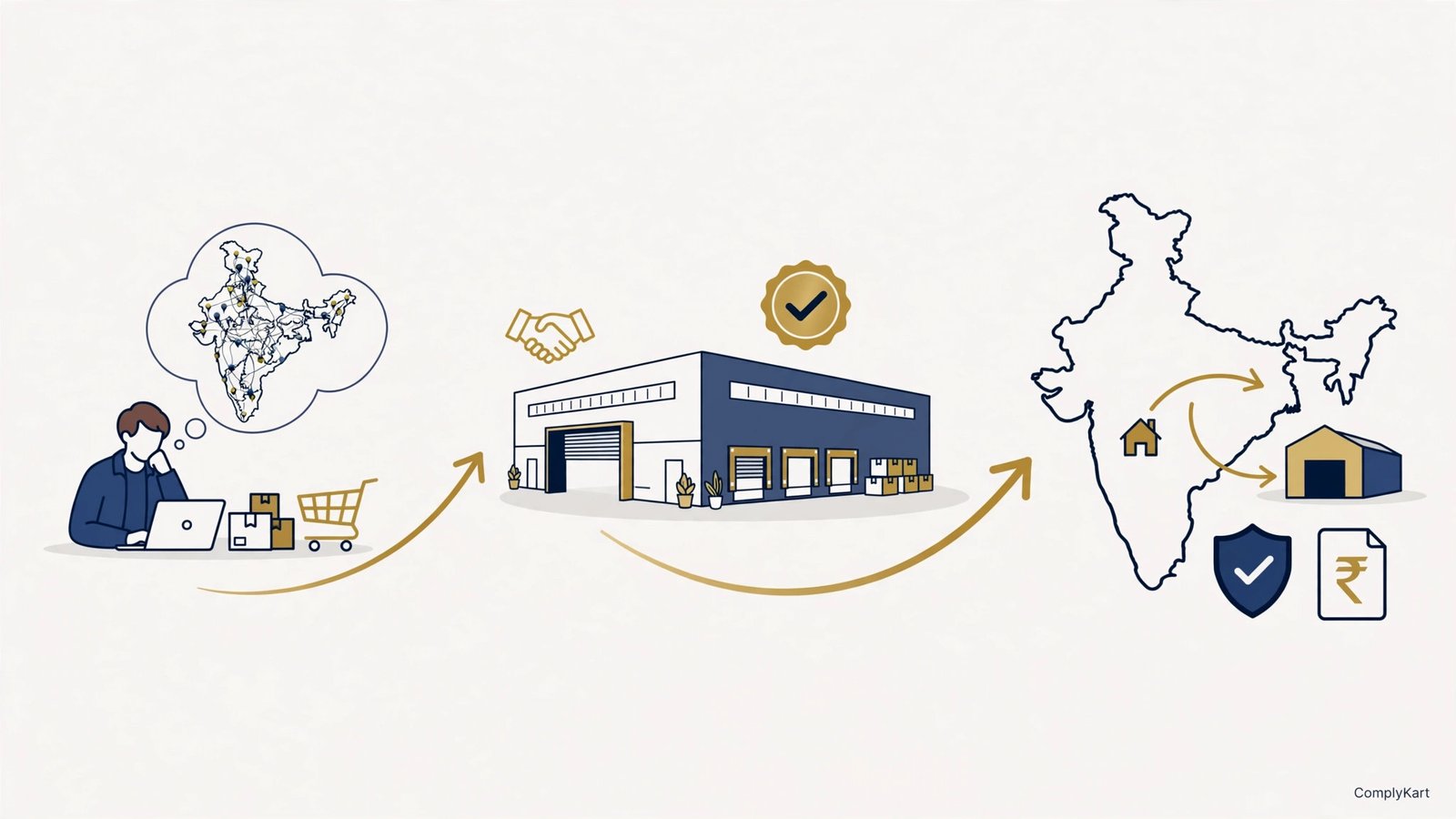
If you sell on Amazon or Flipkart from a single warehouse in your home state, you know the quiet tax problem that comes with growth. The moment your goods sit in a fulfilment centre in another state, the old GST logic kicked in: a place of business there meant a registration there. And another registration. And another — one for every state you touched.
For large sellers, that was paperwork. For small ones, it was a wall.
On 8 October 2026, the 57th GST Council approved a way through that wall. The Finance Ministry shared the details on 9 October: an optional, simplified GST registration route for small sellers who sell exclusively through e-commerce platforms. Here is what it changes, who it is for, and the catches you should know before you use it.
What the new route does
Under the scheme, a qualifying seller can declare the e-commerce operator's warehouse as their principal place of business — their PPoB — in states where they have no physical presence of their own. Read that again. Your stock sits in the platform's warehouse in, say, Maharashtra or Tamil Nadu, but you do not need to register separately in that state on the strength of that warehouse alone. The ECO's warehouse becomes your declared address for GST purposes in that state.
This is the entire trick of the scheme, and it deserves an analogy. Think of PPoB as the address printed on your shop's signboard. Earlier, the tax law's position was roughly: every godown you store goods in needs its own signboard, its own registration, its own filings. Now, for small online sellers, the Council is saying something sensible — you can hang a shared signboard at the marketplace's warehouse. Your business hasn't moved. The law has simply stopped insisting it has.
Who qualifies
Two conditions, both non-negotiable.
First, size. Your monthly input tax credit claims must be below ₹2.5 lakh, excluding stock transfers. This is the Council's proxy for "small." If you are claiming more ITC than that in a month, you are out of this scheme — the regular registration route remains yours.
Second, exclusivity. You must supply goods only through the specified e-commerce operators. Not through your own website. Not through a shop counter on the side. Only through the platform. The simplified route is a bargain: easier registration in exchange for staying inside the marketplace's four walls.
How the application actually moves
The process has a gatekeeper, and the gatekeeper is the e-commerce operator itself. Before anything else, the ECO must give prior consent to you declaring its warehouse as your PPoB in the relevant state or Union Territory. No consent, no registration — the application is rejected outright.
Once you apply, the ministry's timeline is this: your application is forwarded to the concerned ECO — the one whose warehouse you have declared as PPoB or additional place of business — for consent within seven working days. That is a working-days clock, not a calendar-days one, and it runs against the platform, not against you.
After consent comes the identity work. The application goes to the jurisdictional officer in your home state for biometric-based Aadhaar authentication, your photograph, and verification of your original documents — plus a physical verification of your principal place of business in your home state. So the "simplified" route does not skip verification. It skips the need to replicate yourself in every state. One more guardrail: only one registration against a PAN is permitted in a particular state.
The catches, stated plainly
I like this reform. But let me tell you where it can bite, because nobody else will.
The consent step is the whole game. Your registration depends on the platform agreeing, in writing, to let you use its warehouse address. If the ECO is slow, or declines, your application dies at step one. Get the consent conversation started with your account manager before you file — do not assume the seven-day clock protects you if the platform never says yes.
The home-state verification is real. Biometric Aadhaar authentication and a physical visit to your home-state PPoB are mandatory. If your home-state address is a residential flat with no business footprint, sort that out first. Simplified in other states does not mean casual at home.
The ₹2.5 lakh ITC cap is monthly, and it excludes stock transfers. If your business is growing fast — and that is the point of selling online — you can age out of this scheme. Plan for what registration looks like when you cross the line, so you are not scrambling mid-season.
And the exclusivity condition cuts both ways. The day you start selling through your own website or offline, this registration's premise breaks. Build your sales-channel strategy with that boundary in mind.
How this differs from the multistate registration you may have heard about
Earlier this month, GSTN enabled a separate multistate registration facility — one application covering every state you operate in, built around a Master TRN. That is the general route: any normal taxpayer, broader eligibility, a different mechanism. The new ECO-warehouse scheme is narrower and simpler: only small sellers, only platform sales, and instead of registering everywhere, you borrow the platform's address. They solve adjacent problems. Do not confuse them when you apply.
What to do now
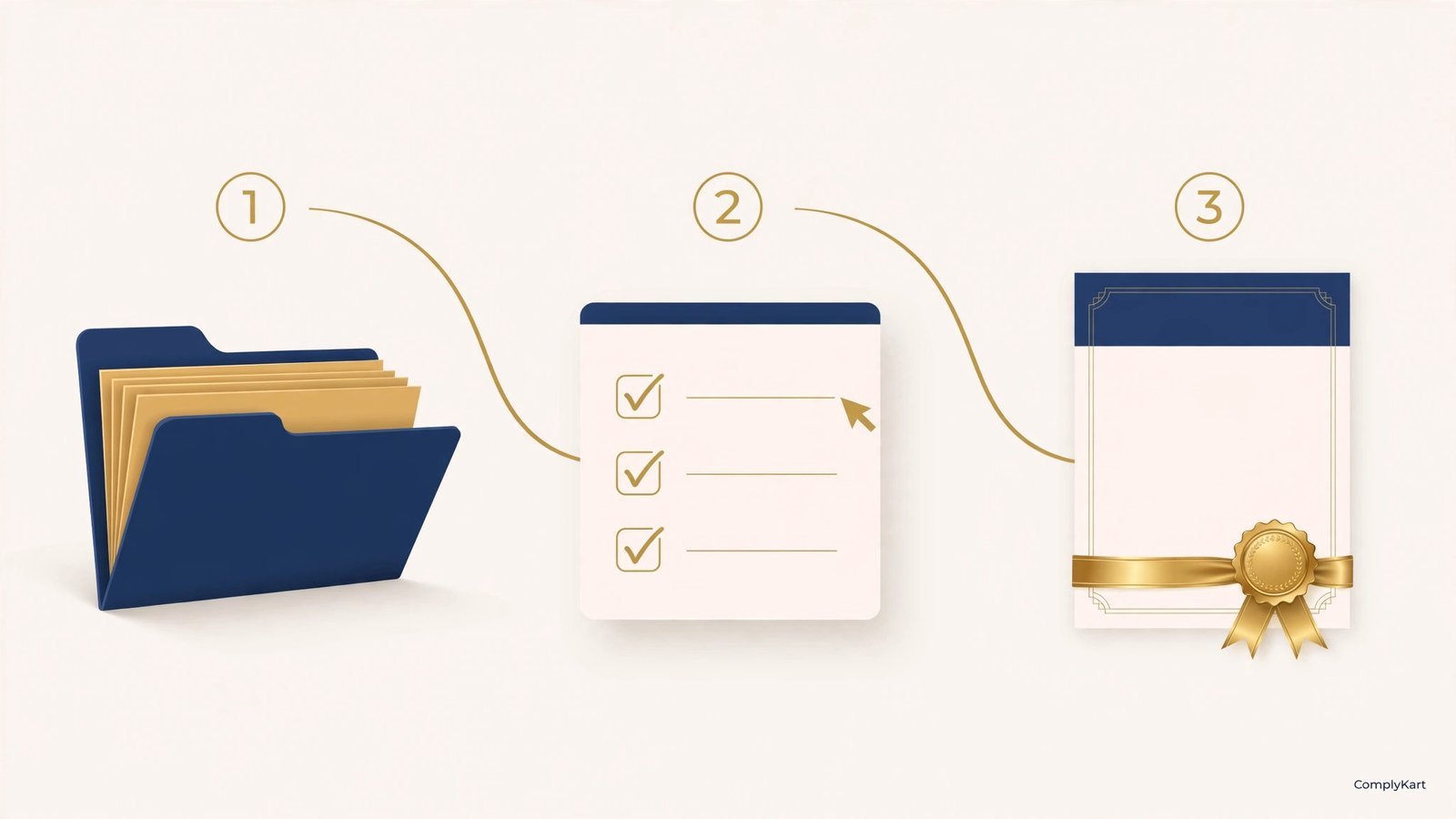
If you sell only through e-commerce platforms and your monthly ITC stays under ₹2.5 lakh, this scheme was designed for you. Three practical steps:
- Talk to your e-commerce operator first. Confirm it will give consent for you to declare its warehouse as your PPoB, and in which states. Get the process — and the timeline — in writing.
- Get your home-state house in order. Aadhaar authentication, documents, and a verifiable principal place of business at home. The physical verification will happen.
- Check the ITC math monthly. The cap is a bright line. The moment you cross it consistently, you need the regular route — and a transition plan.
The Council's direction this year is unmistakable: fewer registrations, fewer notices, less friction for the small end of the market. This scheme is one more step down that road. Use it — but use it with your eyes open.



Comments
No comments yet — ask the first question below.
Join the discussion
Questions go straight to our expert desk. Comments appear after a quick review — no spam, no noise.