
You want to run a nonprofit. Your options in India are a trust, a society, or a Section 8 company. Most people default to a trust because their neighbour did. That is not a strategy. Here is the case for the company route, in plain words.
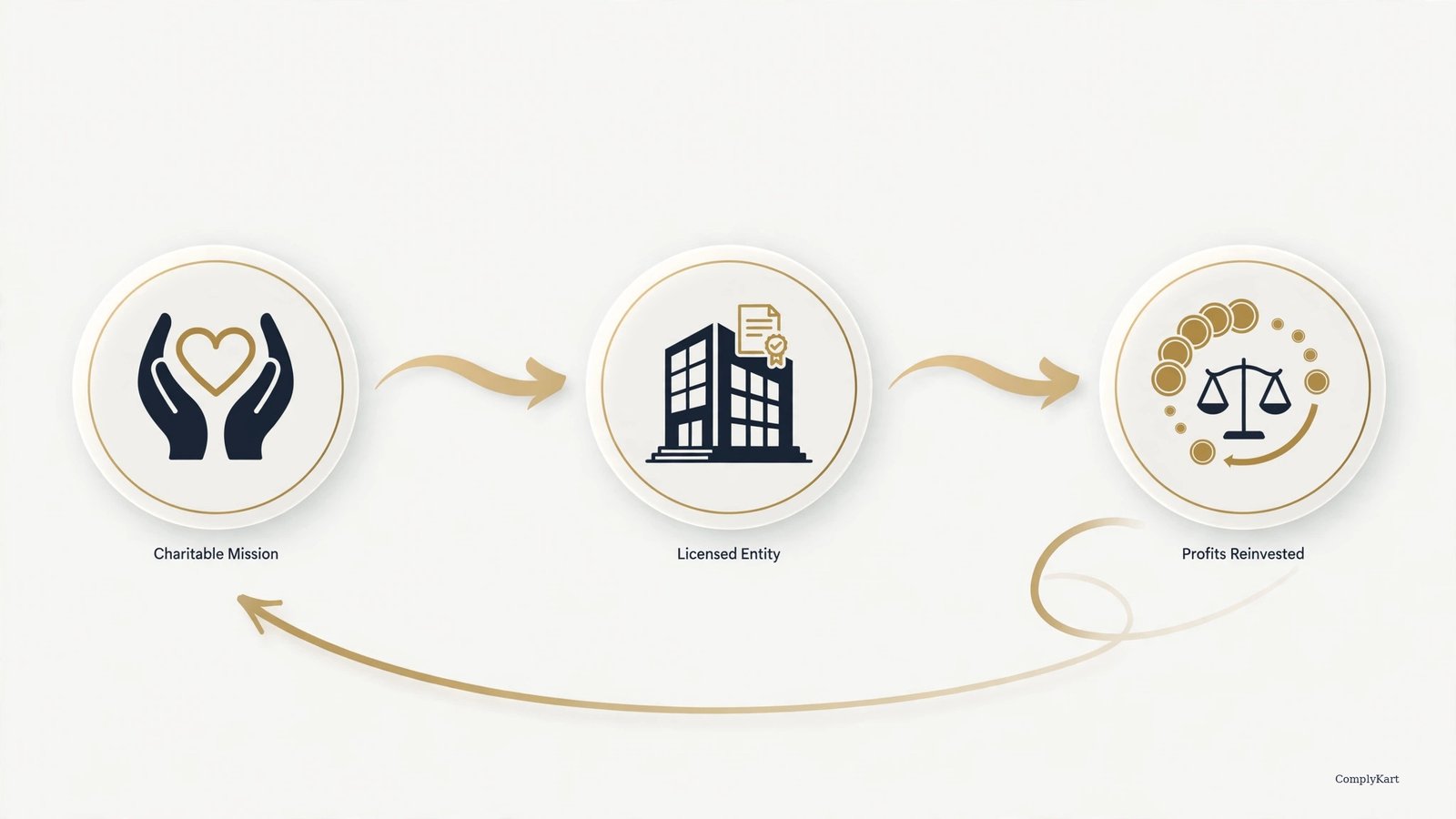
A Section 8 company is a company registered under Section 8 of the Companies Act, 2013 whose objects are nonprofit in nature: promotion of commerce, art, science, sports, education, research, social welfare, religion, charity, or protection of the environment. It has shareholders and directors like any company, but it cannot pay dividends. Every rupee of profit must be applied to its objects.
Think of it like a fountain. Water flows in — donations, grants, fees — and circulates through the mission. It just never leaves the basin. The profits exist. They simply cannot be taken home.
Why founders choose Section 8 over a trust or society
One regulator, national scope. A trust is registered under state law; a society under state societies Acts. A Section 8 company answers to the Registrar of Companies and operates across India without fresh state-level registrations.
Credibility with donors and CSR committees. Companies keep audited books, hold board meetings, and file annual returns with MCA. Corporate donors evaluating CSR partners read that discipline as reliability. It is not the only factor, but it is a real one.
Cleaner governance. Directors, board meetings, minutes, statutory audit — the machinery forces the kind of record-keeping that keeps an organisation honest as it grows beyond its founders.
The trade-off is real too. A Section 8 company carries more compliance than a trust: mandatory statutory audit every year, annual filings, board meetings, an AGM. If your work is small and local, that machinery is overhead. Choose the structure that fits your scale.
How registration actually works
You need at least two people — two shareholders who become the first directors. The Central Government, through the Regional Director, grants a licence under Section 8 allowing the company to drop "Limited" or "Private Limited" from its name.
The process runs through SPICe+, the same incorporation form used for regular companies, with two additional pieces: an application for the Section 8 licence in Form INC-12, and the draft memorandum and articles in Form INC-13, which must state the nonprofit objects clearly. Your objects clause is the soul of the application — vague objects get rejected, precise ones pass.
MCA fees and stamp duty are concessional for Section 8 companies. Name approval follows the usual rules, minus the "Limited" suffix — the licence is what lets you skip it.
The licence is conditional, not decorative
This is the part founders underestimate. The Section 8 licence is granted on the condition that the company applies its profits and income only to its objects. Section 8(11) of the Act carries penalties for violations — for the company and for officers in default — and the Central Government can revoke the licence if the company contravenes its objects or the licence conditions.
Practical translation: no side businesses, no quiet dividends, no "management fees" that are really distributions. Keep the objects clause accurate as your work evolves, and amend it properly if the mission expands.
After incorporation: the compliance rhythm
A Section 8 company follows the same annual cycle as any company. Statutory audit is mandatory every year, whatever the turnover. Financial statements go to the Registrar in Form AOC-4. The annual return goes in Form MGT-7 (or MGT-7A for eligible small companies). Board meetings and an annual general meeting must happen with proper notice and minutes.
Converting out of Section 8 into a regular company later needs Central Government approval — the law does not let you flip a nonprofit into a for-profit vehicle on a whim. Plan for permanence when you choose this structure.
One thing Section 8 does not give you
Tax benefits do not come with the licence. Exemptions and deductions for donors — the registrations everyone actually asks about, like 12A and 80G — are granted separately under the Income-tax Act, on separate applications to the tax department. Section 8 gives you the legal vehicle; the tax department separately decides the tax treatment. Apply for both tracks in parallel instead of assuming one unlocks the other.
Choose with your eyes open
Choose Section 8 when your nonprofit plans to scale nationally, take institutional funding, and be audited like it means it. For a small community initiative — a neighbourhood school, a local temple trust — a trust may honestly be the better fit, because the compliance load is lighter and the structure is simpler to run.
Also consider who will run it after you. A trust deed can be hard to change; a Section 8 company's board can be reconstituted with a board resolution and filings. If you want the organisation to outlive its founders — most serious nonprofits do — the company form handles succession more cleanly than any alternative.
The structure should serve the mission — never the other way around.
Track your new company's first-year filings — AOC-4, annual return, board meetings — on our compliance calendar so the discipline that attracted your donors never slips.





Comments
No comments yet — ask the first question below.
Join the discussion
Questions go straight to our expert desk. Comments appear after a quick review — no spam, no noise.