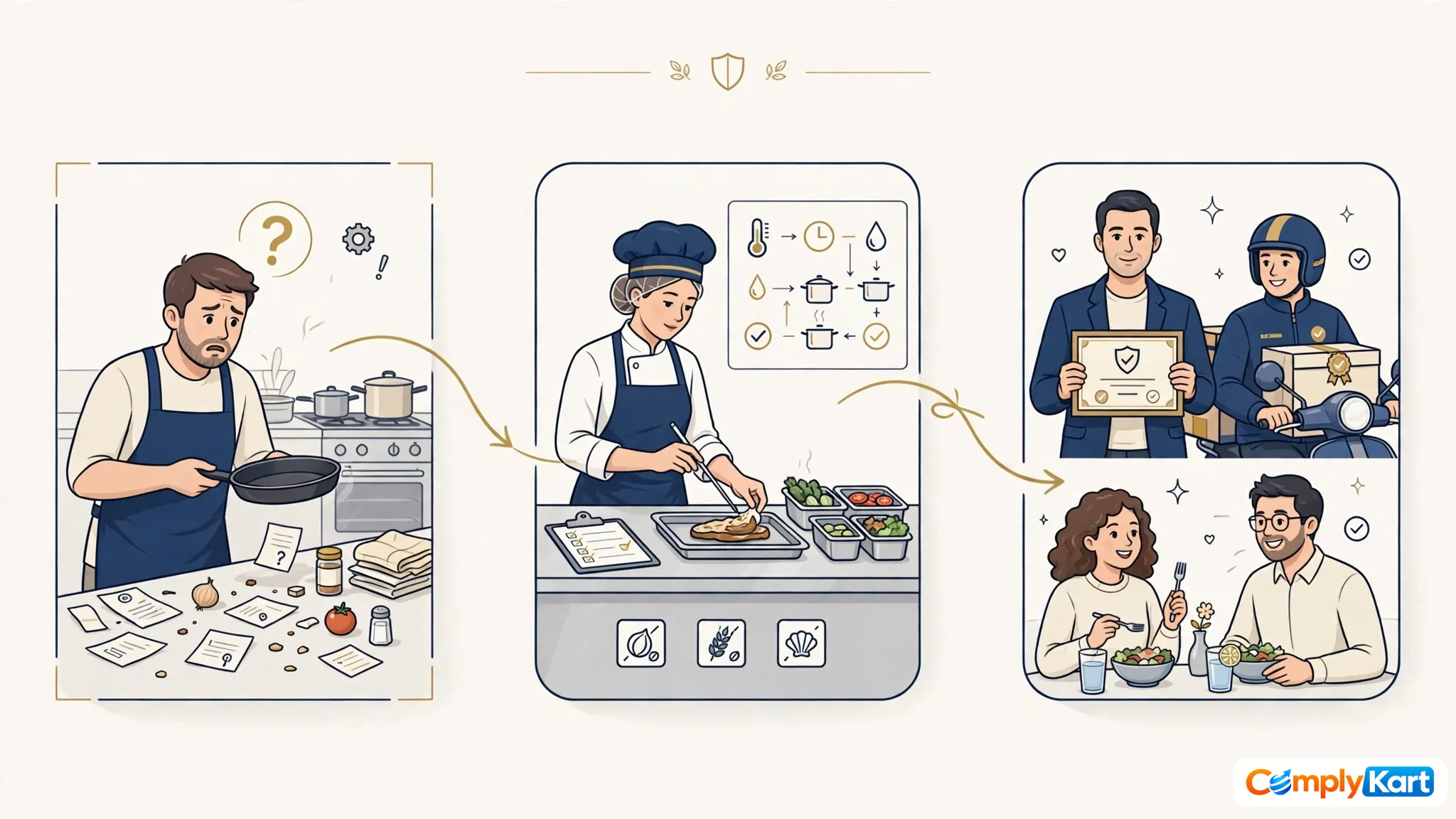
Five steps, no guesswork — you always know exactly what comes next. Tap a step to see what it involves.
12345
You pay securely. Payment is confirmed instantly, and your receipt with the written fee breakup lands in your inbox.
Is a Central License what you need?
Two tests decide this. You need a Central License if you pass either of them.
Test 1 — the turnover test. Your annual food turnover exceeds ₹50 crore. That is the general trigger from 1 April 2026. Note that this is food turnover — if you run a diversified company, the figure that matters is the turnover from food business activities, supported by documentary proof.
Test 2 — the category test. Your Kind of Business (KoB) mandates a Central License regardless of turnover. This is the test most applicants miss, and it catches businesses far below ₹50 crore. The mandatory-Central categories include:
Importers and exporters of food. Every food importer needs a Central License tied to the address on the Import Export Code. Exporters — including 100% export-oriented units — need one too. This applies from the first consignment, not from any turnover figure.
E-commerce food businesses. If you operate the marketplace or platform through which food is sold (not merely sell on one), the Central License applies.
Businesses operating in more than one state. A restaurant chain with outlets in Delhi and Mumbai, a manufacturer with plants in two states, a distributor with warehouses across state lines — multi-state operations trigger the Central License. The practical structure many businesses use: a Central License for the head office plus State Licenses for individual units.
Five-star hotels and above. The star classification, certified by the Ministry of Tourism's HRACC, decides this — not your turnover.
Nutraceuticals, health supplements, proprietary food and non-specified foods. These need prior product approval and sit under Central licensing because the product risk is assessed centrally.
Food units at airports, seaports, railway stations and defence establishments. Location on central-government premises pulls you into the Central authority.
Large-capacity manufacturing. The KoB matrix sets capacity triggers — for example, daily production above 2 MT for most food products, milk handling above 50,000 litres per day or 2,500 MT of milk solids per year, meat processing above 500 kg per day, and slaughtering above specified animal counts.
Food vending agencies with more than 100 vending machines.
You probably do not need a Central License if: your food turnover is under ₹50 crore, you operate within a single state, and your KoB is not on the mandatory list. Most restaurants, caterers, cloud kitchens, single-state manufacturers and distributors belong under the State License. Applying for a Central License you do not need wastes the higher fee and invites a rejection or a downgrade that costs weeks.
The costly error: a business that operates in two states files for a State License because its turnover is under ₹50 crore. It is non-compliant from day one — the category test, not the turnover test, caught it. Check both tests before you file.
What must be decided before filing
Central License applications fail more often on strategy than on documents. Settle these five decisions first.
1. Your exact Kind of Business. FoSCoS asks you to pick a KoB from its eligibility matrix, and the KoB drives the document checklist, the fee logic and whether an inspection is triggered. "Manufacturer" is not one KoB — dairy processing, bakery, nutraceuticals and repacking are different KoBs with different requirements. Pick the wrong one and the officer reverts the application.
2. Premises strategy for multi-state operations. The license is premises-linked. Map every premises — head office, plants, warehouses, dark stores — and decide which need the Central License and which need State Licenses. Importers: the Central License address must match the IEC address.
3. The product and food-category list. Form B requires the list of food categories you will manufacture, import or handle. This list appears on the license, and operating outside it is a violation. Be complete but honest — adding categories "just in case" can trigger product-approval questions for regulated categories.
4. Who the authorised signatory is. One person must be nominated with authority to act for the FBO — the authority letter names them, and their identity documents go on file. For companies, this is typically a director or the food safety officer.
5. Annual fee planning. Under perpetual validity there is no renewal, but the ₹7,500 annual fee continues. Decide who in your organisation owns the FoSCoS payment calendar — this is the single most common post-license failure point.
Advantages of holding a Central License
Nationwide operational coverage. One licensing authority for operations across states. No need to satisfy a different state department's quirks for each unit — the Central License is recognised everywhere in India.
Import and export eligibility. Only a Central License lets you legally import or export food. Customs clearance through ICEGATE cross-references your FSSAI license; without it, consignments stall at the port.
E-commerce and marketplace access. Major platforms verify FSSAI licensing before onboarding food sellers, and institutional buyers — hotel chains, airlines, retailers — treat the Central License as the baseline credential for national suppliers.
Government and institutional tenders. Defence catering, railway catering, mid-day meal supply chains and public procurement of food routinely require a Central License. It is often a pass/fail eligibility criterion, not a scoring factor.
Brand and investor credibility. The 14-digit FSSAI number on packaging, backed by the Central authority, carries weight with consumers, distributors and investors. During due diligence, a clean Central License with inspection history is a tangible asset.
Single regulatory relationship. Dealing with one Central Licensing Authority instead of several state departments simplifies modifications, product additions and compliance correspondence as the business scales.
Future-proofing under perpetual validity. Since April 2026, the license never expires. The compliance burden shifted from periodic renewals to continuous standards — annual fee, hygiene upkeep, returns. For a growing business, that is a lighter long-term load than the old renewal cycle.
Documents required for a Central License
Form B's checklist varies by KoB. These are the groups — your specific list is generated by FoSCoS once you select your KoB.
Core documents (every applicant):
Form B, duly completed and signed by the authorised person
Photo ID and address proof of the proprietor / partners / directors / authorised signatory
Proof of possession of premises — rent or lease agreement, ownership deed, or allotment letter
Partnership deed, affidavit of proprietorship, or MOA / AOA and certificate of incorporation
Authority letter nominating the authorised person
List of food categories to be manufactured, imported or handled
Declaration in the prescribed format
Manufacturing and processing units additionally need:
Blueprint or layout plan of the processing unit, showing the process flow
List of machinery and equipment with installed capacity
Water analysis report from a recognised laboratory (for the water used in food manufacturing)
Food Safety Management System (FSMS) plan and product recall plan
Source details for milk and meat, where applicable
NOC from the municipality or local body
Importers and exporters additionally need:
Import Export Code (IEC) issued by DGFT — the Central License address must match the IEC address
For relabellers and repackers: NOC and a copy of the manufacturer's license
Hotels additionally need:
Certificate from the Ministry of Tourism (HRACC star classification) — mandatory for hotel KoBs
Supporting documents often requested:
Documentary proof of turnover (for the turnover test)
Ministry of Commerce certificate for 100% EOUs
NOC / prior approval document issued by FSSAI, where applicable
Names, addresses and constitution details must match across the IEC, the company records and the application. Mismatches between the IEC address and the license premises are the most common importer-application failure.
The Central License process — step by step
Step 1 — Confirm the tier and KoB. Run both tests (turnover and category). Select the KoB on the FoSCoS eligibility checker. If you are on the borderline of ₹50 crore, assemble turnover proof now — the officer will ask.
Step 2 — Create the FoSCoS account. Register on foscos.fssai.gov.in with a working mobile number and email. These become the application's official contact points for all department communication.
Step 3 — Fill Form B. Enter business constitution, premises details, the KoB, food categories and the authorised person's details. Upload documents in the specified formats — FoSCoS is strict about file types and sizes, and illegible scans are a top revert reason.
Step 4 — Pay the fee. ₹7,500 for the Central License, paid online through the portal. Save the payment receipt and the application reference number.
Step 5 — Department scrutiny. The Central Licensing Authority scrutinises the application. Straightforward cases can be decided within about 7 days of a complete application; the department may revert with queries, which you must answer within 30 days to avoid rejection.
Step 6 — Inspection. For manufacturing units, importers' premises and high-risk KoBs, a food safety officer inspects the premises against Schedule 4 hygiene requirements — water, pest control, storage temperatures, process hygiene, documentation. Low-risk trading offices may be licensed without a physical visit. Prepare the premises before you file, not after the inspection is scheduled.
Step 7 — Grant and download. On approval, the 14-digit license is issued on FoSCoS. Download it, display the number at the premises, and print it on packaged-food labels as required.
How long does it take?
Realistic planning figures, not portal promises:
Days 1–5: Document assembly and Form B filing. Most delays live here — incomplete product lists and mismatched address proofs.
Days 5–15: Scrutiny. Clean applications in low-risk KoBs can clear within about a week; queries add a round trip of up to 30 days for your response.
Days 15–45: Inspection scheduling and visit for manufacturing and high-risk units, plus the officer's report.
Days 45–60: Final decision and issuance.
Plan for 30 to 60 working days end to end. Importers racing a shipment should file at least two months before the consignment's expected arrival — customs will not clear food without the license in place.
How ComplyKart helps
Eligibility and KoB mapping. We run both tests on your business — turnover, premises, activities — and pin down the exact KoB before anything is filed. This is where most DIY applications go wrong, and it is the cheapest stage to get right.
Document engineering. We assemble the Form B dossier to the KoB's checklist: authority letters drafted correctly, product lists scoped to what you actually do, manufacturer documents (layout, FSMS, water report) reviewed for the gaps inspectors flag.
End-to-end filing and follow-up. FoSCoS filing, fee payment, reference tracking, query responses within the 30-day window, and inspection preparation — what the officer checks, in what order, and what "good" looks like.
Multi-premises strategy. For chains and multi-state businesses, we map which premises need the Central License and which need State Licenses, so you neither over-license nor leave a unit exposed.
Post-license calendar. Annual fee reminders, Form D1/D2 return filings, modification filings when you add products or premises.
What we will not do: we will not file you in a lower tier to save the fee difference, we will not guarantee a timeline the department controls, and we will not put product categories on your license that you do not actually handle. A license that does not match your operations is a liability, not an asset.
What happens after the license arrives
In the first 30 days: display the 14-digit FSSAI number prominently at the premises — it is mandatory. Update packaged-food labels to carry the FSSAI logo and license number per the Labelling and Display Regulations, 2020. Brief the team on the hygiene standards the premises were approved against.
For importers: link the license to your ICEGATE profile so customs clearance references it. Each consignment's food safety clearance depends on this linkage working.
In the first 6 months: expect the possibility of a surveillance inspection — the 2026 framework moved toward risk-based inspections driven by product risk and compliance history. Keep the FSMS documentation live, not filed away: temperature logs, pest control records, batch traceability, supplier approvals.
The recurring compliance you are signing up for
Annual fee — ₹7,500, every year, on time. Perpetual validity ended renewals, not payments. Calendar the fee like a tax deadline; non-payment risks deemed suspension, and operating during suspension is unlicensed operation under Section 63.
Annual and half-yearly returns. Form D1 (annual, by 31 May) for manufacturers and importers, and Form D2 (half-yearly) for specified categories. File them even in a quiet year — nil returns beat missing returns.
Modifications. Adding a product category, changing premises, or changing the authorised signatory needs a modification filing on FoSCoS. Do it before the change takes effect, not after an inspection finds it.
Inspections. Risk-based and unannounced. Maintain Schedule 4 standards continuously — the inspection tests the everyday state of the premises, not a prepared one.
Common mistakes and how to avoid them
Applying in the wrong tier. A multi-state operator files for a State License on turnover grounds. Rejected or, worse, granted and then found non-compliant. Run the category test first.
IEC address mismatch. The importer's Central License premises must match the IEC address. A registered-office IEC with a warehouse license application gets reverted.
Product list gaps. Manufacturing a category not on the license. Expand the list through a modification before production, not after.
Treating perpetual validity as "no further action." The annual fee, the returns and the hygiene standards all continue. The businesses that get penalised under the new system will be the ones that filed and forgot.
Weak inspection readiness. The FSMS plan submitted with Form B must match the actual factory floor. Officers compare the two.
FSS (Licensing and Registration of Food Businesses) Regulations, 2011, as amended by the Amendment Regulations, 2026 (notified 10 March 2026).
FSSAI implementation order dated 13 March 2026 (perpetual validity, migration).
PIB press release on the April 2026 licensing overhaul (thresholds).
FSS (Labelling and Display) Regulations, 2020 (license number on labels).
FoSCoS Kind of Business eligibility matrix (foscos.fssai.gov.in).
Bar & Bench, "Navigating FSSAI: 24 FAQs on licensing, labelling, claims, inspections and enforcement" (September 2026) — cross-check on thresholds and mandatory-Central categories.
We re-verify thresholds, fees and KoB lists against FSSAI notifications each quarter. The page carries a last-reviewed date; it is not a promise that the law will not change.
Get a free callback
[CTA card — name, phone, preferred time. A food regulatory specialist calls back, not a salesperson.]
Need help choosing the right service?
[Smart engine embed — "Tell us what you're dealing with."]
FAQ
Frequently asked questions
11 answers from our consultants.
You pay for our expert's time — document checking, filing, follow-ups — not the government. The government fee goes to the government; our fee is for the work we do so you don't have to figure it out yourself.
The main triggers for central are: annual turnover above ₹20 crore, importing or exporting food, operating in more than one state, or selling on major e-commerce platforms. We confirm your tier before you pay anything.
Typically 30–60 days from filing, including the inspection. Department processing varies by region and workload — we track it and chase it for you.
The fee depends on your business type and the validity period (1–5 years) you choose. Request a quote and we will give you the exact current fee for your category.
For central licenses, inspection is the norm rather than the exception. We prepare you so the visit is a formality, not a fire drill.
No — operating a food business without the license is an offence with heavy penalties. Plan the application ahead of your launch or expansion date.
Each manufacturing or operating unit needs its own license, but we coordinate multi-unit filings under one managed process.
You must upgrade from state to central license when you cross the threshold. We handle upgrades as well as fresh applications.
Tell us your situation in plain words — what you're trying to do, not which form you think you need. Half our job is stopping clients from buying the wrong service. The first consultation is free and honest.
Yes. We quote professional fee + government charges + taxes separately, in writing, before you pay. The number doesn't change midway. If the government fee changes, we show you the notification.
Every engagement gets a tracker — you see what's filed, what's pending and what's next. No chasing on WhatsApp for status updates.
What clients say about working with us
Real stories from businesses we've worked with.
Trademark Registration“
Our Trademark was applied in all the classes with a short span of time by Complykart Trademark Experts and I can say the level of expertise and commitment they carry is remarkable. It's an A+ from my side. We are now sticking to ComplyKart only.
Company Registration“
I found the professionalism of the staff at complykart.com, a pleasure to work with. As a foreigner to India, they took the time to explain the documentation and assisted in every question I raised. I was pleased that complykart.com made it easy for my Business.
Merger & Acquisition“
Trust, Commitment, Dedication and responsiveness are the best things with ComplyKart. Thanks for handling our Merger assignment with so much care. After my business disputes, complykart handles all things with own sense of understanding.
Company Law Specialist · Company Law & ROC Compliance · 10+ years experience
Naman Agarwal specialises in company law and ROC compliance. He manages incorporations, annual filings (AOC-4, MGT-7, ADT-1), board processes and statutory registers for private limited companies, LLPs and Section 8 companies.
Last reviewed: 16 November 2026
Get a free consultation
Talk to a ComplyKart professional about FSSAI Central License. The first consultation is free.