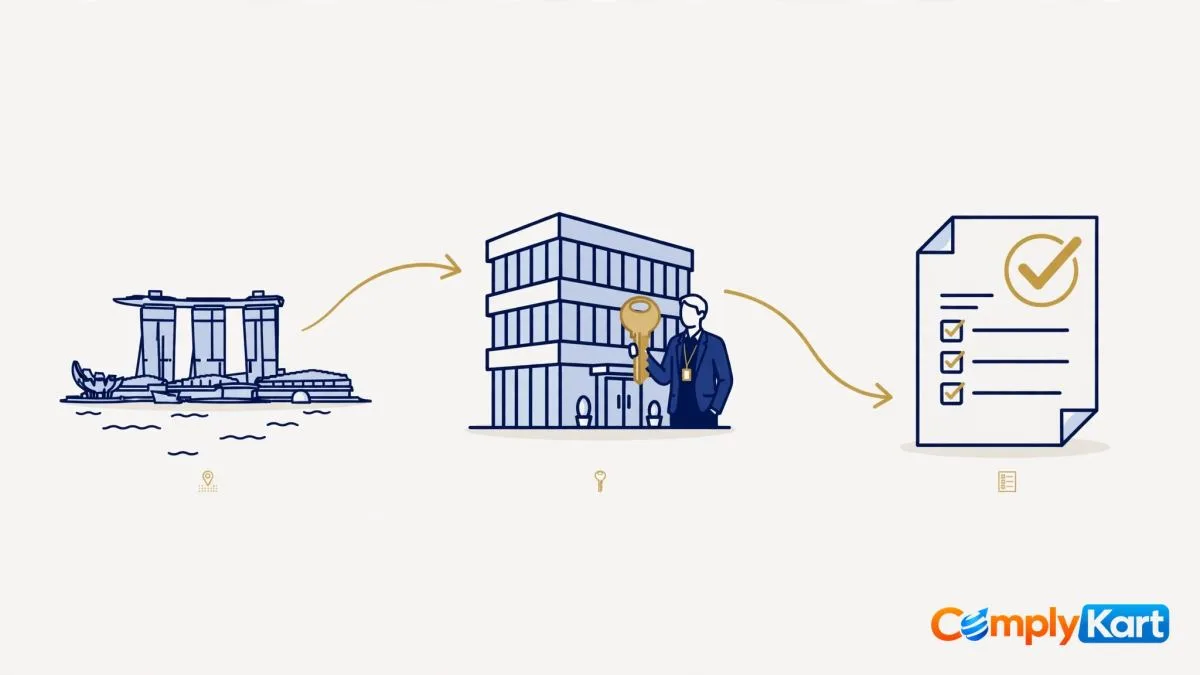
Five steps, no guesswork — you always know exactly what comes next. Tap a step to see what it involves.
12345
You pay securely. Payment is confirmed instantly, and your receipt with the written fee breakup lands in your inbox.
Overview — what "incorporating in the US" actually means
Incorporating in the US means creating a legal entity under the laws of one US state — there is no federal incorporation. For an Indian founder, the whole process runs remotely: choose a state and entity type, appoint a registered agent, file with the state, get an IRS tax ID, open a bank account. No SSN, no visa, no flight required.
The analogy that keeps founders out of trouble: a US entity is a vehicle, not a destination. A taxi gets you across town; it does not decide where you live or pay tax. In the same way, the LLC or C-Corp is the vehicle for US contracts, US customers, and US banking — but your Indian tax residency, FEMA obligations, and Indian operations continue exactly as before. Most incorporation mistakes come from treating the vehicle as the whole journey.
The first decision: LLC vs C-Corp
This choice matters more than the state, and it is expensive to reverse — converting later can trigger tax events.
Choose the LLC if: you are a freelancer, consultant, agency, or bootstrapped SaaS founder who wants US credibility, US banking, and Stripe/PayPal access with minimal compliance. A single-member LLC owned by a non-US person is a disregarded entity: the IRS ignores it, and you report the income in India. State compliance is one annual report. The trade-off: US venture investors will not invest in an LLC (pass-through taxation does not fit fund structures), and equity instruments like SAFEs and proper ESOPs do not work cleanly.
Choose the C-Corp if: you plan to raise venture capital, especially from US investors. The Delaware C-Corp is the global standard for priced rounds — preferred shares, option pools, and SAFEs all assume it. The trade-off: 21% US federal corporate tax on profits, heavier compliance (board minutes, annual reports, franchise tax), and double taxation if you distribute dividends.
The honest middle: founders who start with an LLC for early revenue and later raise a round usually do a conversion or form a fresh C-Corp above the LLC. Both paths cost money and create paperwork. If there is any real chance of institutional funding within 18–24 months, starting as a C-Corp is usually cheaper than converting.
The second decision: Delaware vs Wyoming (vs the rest)
Delaware is the investor standard. The Court of Chancery — a dedicated business court with centuries of case law — is why lawyers and VCs trust it. Costs: ~$90 to file an LLC, $300/year franchise tax for LLCs; C-Corps pay franchise tax on an authorised-shares basis. Formation takes two to four weeks standard, 24 hours expedited.
Wyoming is the bootstrap standard. ~$100 to file, $60/year annual report, no state corporate income tax, strong privacy (member names not in public records), and one-to-two-day formation. For an LLC that will never raise VC, Wyoming is simply cheaper and faster.
What about Nevada, Texas, Florida? They appear in marketing because of tax headlines, but for a remote Indian founder they add nothing Delaware or Wyoming do not already give — and investor familiarity drops sharply outside Delaware.
Rule of thumb: raising venture money → Delaware C-Corp. Everything else → Wyoming LLC. Do not overthink the state; underthink it and you will pay the difference in annual fees for a decade.
The incorporation process — step by step
Step 1 — Choose entity type and state
Decide LLC vs C-Corp and Delaware vs Wyoming using the framework above. Write the decision down — your future tax filings depend on it.
Step 2 — Pick and reserve a name
The name must be distinguishable in the state's records and include the entity designator (LLC / Inc. / Corp.). Run the state's name search before paying anyone.
Step 3 — Appoint a registered agent
US law requires a registered agent with a physical address in the formation state to receive legal and tax documents. Formation services bundle this at roughly $100–300/year. This is not optional and not a mailbox trick — it is a legal requirement.
Step 4 — File the formation documents
Articles of Organization (LLC) or Certificate/Articles of Incorporation (corporation), filed with the Secretary of State. Online filing is standard; approval times range from a day (Wyoming) to weeks (Delaware standard).
Step 5 — Get the EIN from the IRS
The Employer Identification Number is the company's US tax ID — needed for banking, tax filings, and payment processors. Foreign founders apply without an SSN (the IRS has a specific process for applicants without one). Do not pay a middleman hundreds of dollars for what is a free IRS application, though assisted filing is reasonable if you want it handled.
Step 6 — Draft the internal documents
Operating agreement (LLC) or bylaws plus founder stock issuance (C-Corp). For a C-Corp, issue founder shares with vesting and file the 83(b) election within 30 days — missing that deadline is a classic, expensive founder error.
Step 7 — Open the US bank account
With formation documents and EIN, digital-first banks built for startups open accounts remotely for non-resident founders. You will need proof of identity, proof of address, and a documented source-of-funds trail — the application that gets rejected is almost always the one with a thin KYC story.
Step 8 — Set up payments and accounting
Stripe, PayPal, or equivalents attach to the EIN and bank account. Put bookkeeping in place from day one — reconstructing a year's transactions at tax time costs multiples of monthly bookkeeping.
The compliance calendar nobody warns you about
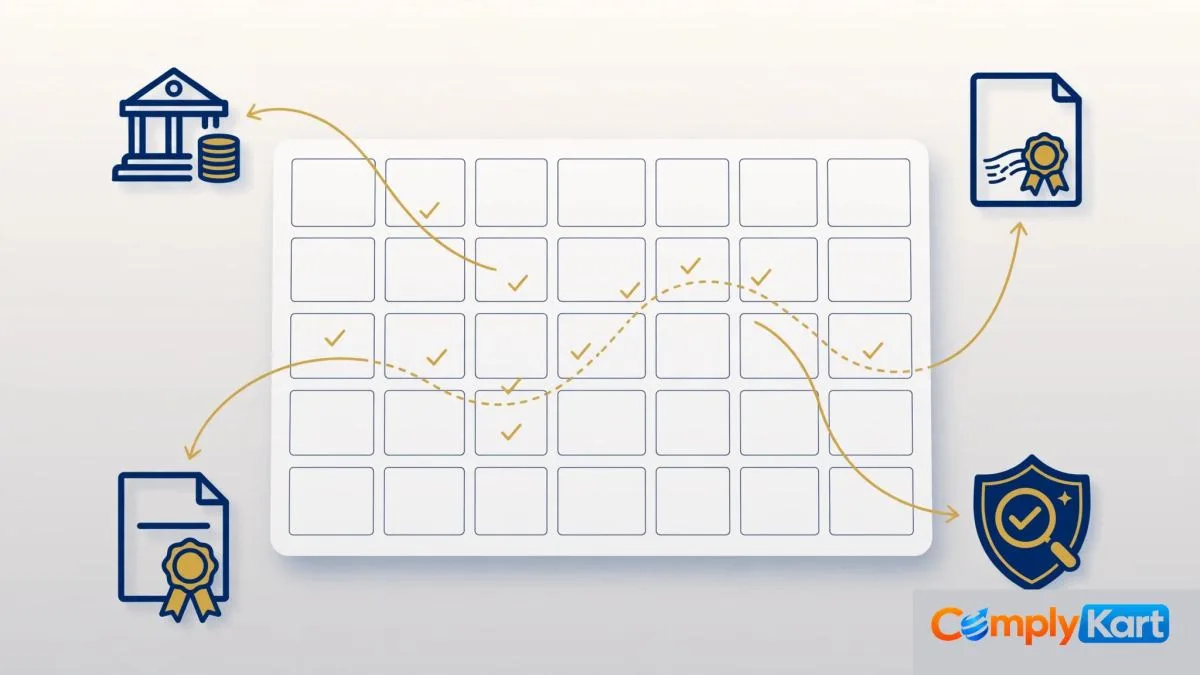
Form 5472 + pro forma Form 1120 (every year, April 15). A foreign-owned single-member LLC reports its transactions with its foreign owner to the IRS annually. The LLC itself owes no tax, but the *information return* is mandatory — even for a dormant LLC, even with zero revenue. The penalty is $25,000 per form per year, plus $25,000 more for each 90-day period the failure continues after IRS notice, with no cap. Extendable to October 15 via Form 7004. This is the single most-missed obligation among Indian founders, and the most expensive.
State annual report / franchise tax. Wyoming: $60 annual report on the anniversary month. Delaware LLC: $300 franchise tax yearly. Delaware C-Corp: franchise tax under the authorised-shares or assumed-par method, plus annual report.
BOI reporting. Under FinCEN's final rule of August 11, 2026, US companies currently have no beneficial-ownership reporting obligation.
C-Corp extras. Federal corporate return (Form 1120), state returns where applicable, payroll filings if you hire, and 1099s for US contractors.
Banking, payments, and the KYC reality
Remote account opening works, but banks are not charities — they underwrite risk. What gets approved: a clean formation packet, an EIN letter, a government ID, a real business description, and a coherent explanation of where money comes from and where it goes. What gets rejected or frozen: vague "consulting" descriptions, mismatched names across documents, and large first deposits with no invoice trail. Keep every client contract and invoice; the bank may ask for them months later.
The India side: FEMA, tax, and the structure most founders need
Incorporating abroad does not move your tax residency. As an Indian resident, you report worldwide income in India, and the US LLC's profits land on your Indian return (with foreign tax credit mechanics where US tax was actually paid, e.g., a C-Corp's dividends).
FEMA/ODI. Setting up a company abroad is an overseas investment. The framework depends on whether you invest as an individual (LRS route, currently $250,000/year with TCS implications) or through an Indian company (ODI route with Form FC filings and annual performance reports). Getting this wrong — funding the US company from India without the right window — is a FEMA contravention, not a paperwork delay.
POEM and substance. If the US company's effective management sits entirely in India, Indian tax law may treat it as resident here. Real substance — or honest single-entity planning — beats elaborate structures.
The dual-entity strategy most scale-ups use: an Indian Pvt. Ltd. for Indian operations, team, and GST, plus the US entity for US revenue and fundraising — with transfer pricing documented from the first intercompany transaction, not the fifth year. The "Delaware flip" (moving the holding company to a Delaware C-Corp above the Indian operating company) is the standard pre-Series-A manoeuvre for startups raising US capital.
Common mistakes Indian founders make
Skipping Form 5472 because "the LLC had no income." The filing is about existence and related-party transactions, not profit.
Choosing an LLC, then raising a priced round. Investors require a C-Corp; conversion mid-round delays closing.
Funding the US company from India without FEMA cover. Personal transfers and company ODI are different doors — walk through the right one.
No 83(b) election on founder stock in a C-Corp. Thirty days, no extensions, no excuses.
Treating the US entity as replacing Indian compliance. GST, Indian income tax, and ROC filings continue for your Indian presence.
Stale registered agent. If the agent lapses, the state dissolves the company administratively — and you find out when the bank freezes the account.
How ComplyKart helps — and what we do not do
We run the full setup: entity-and-state selection against your funding plans, registered agent arrangement, state filing, EIN procurement, bank-account documentation pack, and the first-year compliance calendar (Form 5472, state reports, franchise tax). On the India side, we structure the funding under the correct FEMA window — LRS or ODI — with the filings and the transfer-pricing documentation your auditor will ask for next March.
What we do not do: we do not advise you to skip Form 5472, we do not create nominee or sham structures to hide ownership, and we do not promise "zero tax" outcomes — the LLC's pass-through is a tax fact, not a planning trick, and your Indian tax bill is real.
FAQ
Frequently asked questions
21 answers from our consultants.
You pay for our expert's time — document checking, filing, follow-ups — not the government. The government fee goes to the government; our fee is for the work we do so you don't have to figure it out yourself.
If you plan to raise investment, go private limited — investors won't touch an LLP. If it's a professional services firm with partners who want simplicity, LLP works. Tax-wise they're different too. Tell us your plans and we'll recommend honestly, not just sell you the costlier option.
Two directors and two shareholders for a private limited company (the same two people can fill both roles). For an LLP, two designated partners. One Person Company needs just you.
Yes. There's no bar on salaried employees being directors, unless your employment contract says otherwise. Check your appointment letter for moonlighting clauses — that's the real question, not the Companies Act.
PAN, Aadhaar, a recent bank statement or utility bill as address proof, and a passport-size photograph. For foreign directors, a passport and apostilled address proof. That's it — we handle the rest.
An LLC suits founders who want pass-through income reported in India with minimal compliance. A C-Corp suits founders raising US venture capital, issuing SAFEs, or building an ESOP — investors require it. The LLC cannot cleanly do priced equity rounds; the C-Corp pays 21% federal tax. Decide on funding plans, not on formation cost.
Yes. A foreign-owned single-member US LLC must file Form 5472 with a pro forma Form 1120 every year by April 15 (extendable to October 15), reporting transactions with its foreign owner — even if the LLC earned nothing. The penalty is $25,000 per form per year, uncapped, plus more if the failure continues after IRS notice.
The IRS allows foreign applicants without a Social Security Number to apply for an Employer Identification Number through its international process. The EIN is free from the IRS. You need it before opening a bank account, filing taxes, or activating Stripe/PayPal.
It depends on the entity. A foreign-owned single-member LLC is disregarded for US federal tax — no US income tax, and you pay tax in India on worldwide income as a resident. A C-Corp pays 21% US federal tax on its profits, and dividends to you face US withholding (reduced under the India-US treaty) plus Indian tax with foreign tax credit.
Roughly: Wyoming LLC — $60 state report + $100–300 registered agent + Form 5472 preparation. Delaware LLC — $300 franchise tax + agent + 5472. Delaware C-Corp — franchise tax (varies by method) + agent + corporate tax return + state filings. Budget a few hundred to a couple of thousand dollars annually depending on structure.
A registered agent is the legally designated recipient of lawsuits and official documents for your company, with a physical address in the formation state. Every state requires one, continuously. If it lapses, the state can administratively dissolve your company. Budget providers charge around $100–300/year.
Almost certainly yes, if you live and work in India. The US LLC covers US contracts and banking; your Indian operations — employees, office, domestic clients, GST registration — need an Indian entity. Many founders run both, with documented transfer pricing between them from day one.
Restructuring so a new Delaware C-Corp becomes the holding company above your Indian operating company, typically before a US-led funding round. It gives US investors the entity they require while Indian operations continue below. It involves share swaps, FEMA filings, and tax analysis — not a weekend DIY project.
Sending money abroad to capitalise your US company is an overseas investment. As an individual you generally use the Liberalised Remittance Scheme window; an Indian company uses the ODI route with its own filings and annual reporting. Using the wrong window — or none — is a FEMA contravention. Structure the funding before the first transfer, not after.
When founders receive stock in a US C-Corp subject to vesting, the 83(b) election lets them pay tax on the (usually tiny) value at grant rather than the (hopefully large) value at vesting. It must be filed within 30 days of the stock issuance — no extensions. Missing it is one of the most expensive avoidable founder mistakes in US startups.
A US LLC with no Indian presence cannot directly run Indian payroll compliantly — PF, ESI, professional tax, and TDS obligations attach to an Indian employer. Founders typically employ through their Indian entity or use an employer-of-record, with the US LLC contracting for services. Get local advice before putting anyone on payroll.
The IRS can assess $25,000 per missed year — $75,000 for three years — before interest and continuation penalties, and the open statute of limitations lets them reach back indefinitely for those years. Penalty abatement for reasonable cause exists but is discretionary. Filing late is always cheaper than not filing.
For a Delaware C-Corp, yes for most first-time founders: about $500 gets incorporation, EIN procurement, a bank account pathway, and Stripe activation in one to two weeks, with the standard documents done correctly. If you are forming a Wyoming LLC, direct state filing plus a registered agent is cheaper and equally straightforward.
You still file the information return — Form 5472 with pro forma 1120 — even at zero revenue. That filing is not an income-tax return; it is a disclosure return. A C-Corp files an actual corporate tax return (Form 1120) regardless. "No income" never means "no filing" for a foreign-owned US entity.
Yes, through statutory conversion or by forming a new C-Corp and contributing the LLC's assets — but the tax and legal consequences need modelling first, especially if the LLC has appreciated assets, IP, or revenue history. If funding is likely within two years, incorporating as a C-Corp now is usually cheaper than converting later.
Formation documents, EIN letter, operating agreement or bylaws, cap table, all bank statements, every client contract and invoice, intercompany agreements with your Indian entity, and board or member resolutions for major decisions. US banks and the IRS both ask for these months or years later — reconstruction is expensive.
What clients say about working with us
Real stories from businesses we've worked with.
Trademark Registration“
Our Trademark was applied in all the classes with a short span of time by Complykart Trademark Experts and I can say the level of expertise and commitment they carry is remarkable. It's an A+ from my side. We are now sticking to ComplyKart only.
Company Registration“
I found the professionalism of the staff at complykart.com, a pleasure to work with. As a foreigner to India, they took the time to explain the documentation and assisted in every question I raised. I was pleased that complykart.com made it easy for my Business.
Merger & Acquisition“
Trust, Commitment, Dedication and responsiveness are the best things with ComplyKart. Thanks for handling our Merger assignment with so much care. After my business disputes, complykart handles all things with own sense of understanding.
Company Law Specialist · Company Law & ROC Compliance · 10+ years experience
Naman Agarwal specialises in company law and ROC compliance. He manages incorporations, annual filings (AOC-4, MGT-7, ADT-1), board processes and statutory registers for private limited companies, LLPs and Section 8 companies.
Last reviewed: 16 November 2026
Get a free consultation
Talk to a ComplyKart professional about US Company Incorporation. The first consultation is free.