
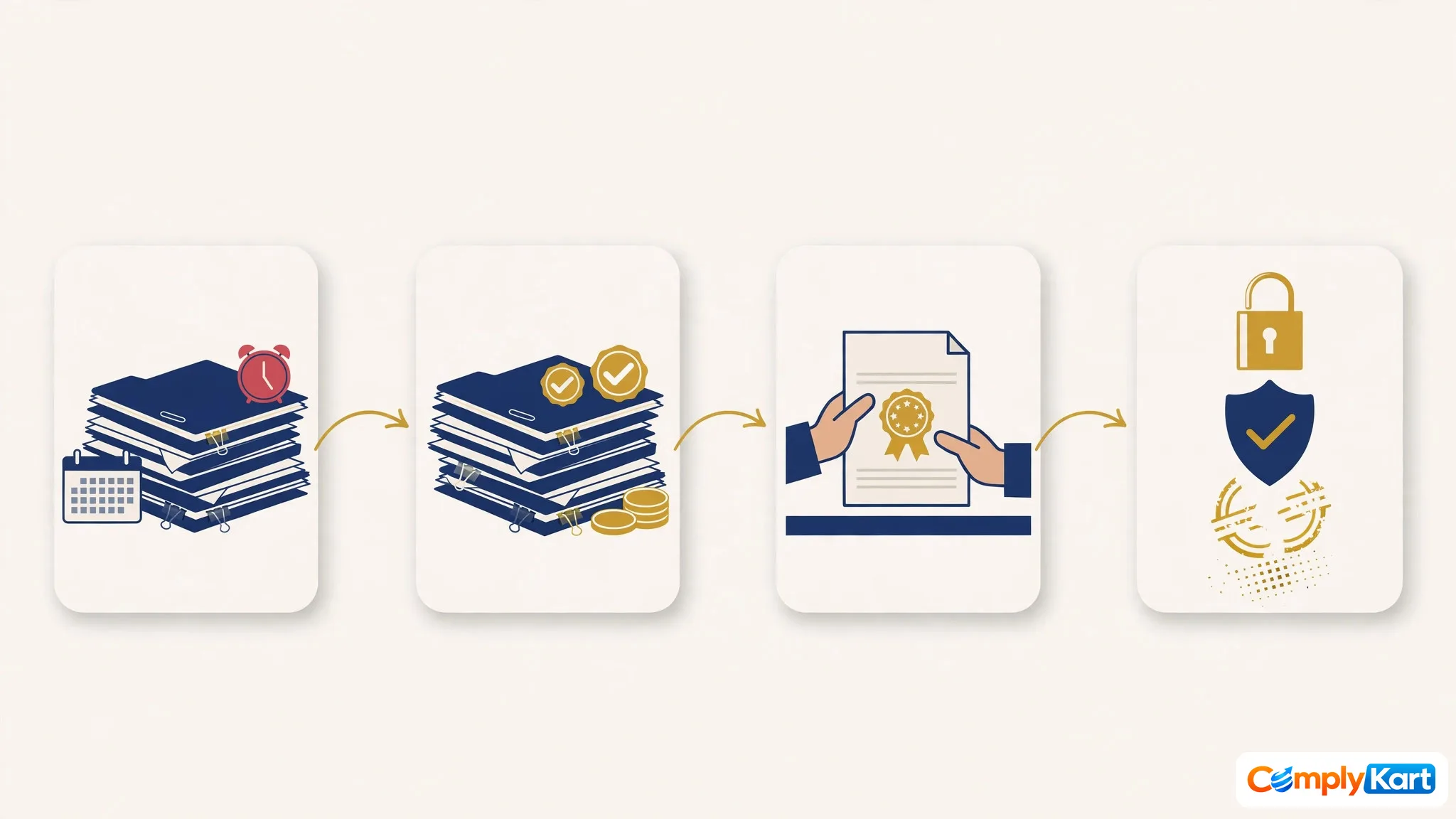
IN BRIEF
Closing an LLP with pending compliances means filing its overdue Form 8 and Form 11 returns up to the financial year it stopped business, then applying for strike-off in Form 24 under Section 75 of the LLP Act, 2008 and Rule 37 of the LLP Rules, 2009. The LLP must have no business for at least a year, no liabilities, and every partner's consent.
No. Not directly. Rule 37(1A) of the LLP Rules, 2009 says an LLP must file its overdue Form 8 and Form 11 returns — up to the financial year in which it stopped doing business — before applying for strike-off in Form 24. The order is fixed: regularise first, then strike off.
File Form 24 with a backlog still sitting on the register and the application comes back. That one rule shapes everything in this guide.
That one rule shapes everything in this guide. Partners usually arrive at the closure question backwards. They stopped trading two years ago, filed nothing since, and now want the LLP gone. The clean exit exists. It just runs through the backlog, not around it. The good news: the backlog is smaller than most partners fear, once you stop pricing it with the wrong fee rule. Half the internet still says a late Form 8 or Form 11 costs ₹100 a day with no cap. That was the position until 31 March 2022. It is not the position now, and the difference runs into tens of thousands of rupees.
Can you file Form 24 with pending compliances?
Short version: the portal will not let you. Longer version: Section 75 of the LLP Act, 2008 gives the Registrar the power to strike a defunct LLP off the register, and Rule 37 sets out how. For a voluntary strike-off — the route you apply for yourself — Rule 37(1)(b) needs two things: the LLP must not have carried on business for at least a year, and every partner must consent. Then Rule 37(1A) adds the condition partners miss most often. Before Form 24, the LLP must file its overdue returns in Form 8 and Form 11 up to the end of the financial year in which it ceased business. Not up to today. Up to the year it stopped. That distinction matters, because it caps the backlog. An LLP that stopped in December 2024 does not owe returns for 2025-26 and 2026-27. It owes them up to 2024-25.
There is a second route worth knowing about, because it is the one you want to avoid. Under Rule 37(1)(a), the Registrar can strike an LLP off on his own motion when it has not carried on business for two years or more. You get a notice and one month to make representations. After that, the name goes into the Official Gazette and the LLP stands dissolved. That sounds like a free exit. It is not: the penalties for the default years do not dissolve with the LLP, the record stays dirty, and there is no way back if the strike-off was a mistake. Voluntary strike-off is the controlled version — you choose the timing and leave a paper trail that says the closure was deliberate.
Who can use Form 24?
Rule 37(1) gives two doors in. The first covers an LLP that has not carried on any business or operation for a year or more. The second covers an LLP that never started business at all since incorporation. Either way, three conditions must hold on the day you file: no business for the required period, no outstanding liabilities, and the consent of all partners — not just the designated partners. A silent partner who drifted away years ago still has to sign. Track that person down early. A missing signature is the most avoidable reason a closure stalls.
There are hard bars too. A pending prosecution or unresolved regulatory proceeding blocks the application, and a regulated LLP needs its regulator's approval attached. Check these before spending money on anything else.
What do the late fees actually cost now?
This is where most closure guides go wrong, so let me be precise. Since 1 April 2022, under the LLP (Amendment) Rules, 2022, the MCA portal charges an additional fee that is a multiple of the form's normal filing fee, and the multiple grows with the delay. The normal fee is small — ₹50 where the LLP's contribution is up to ₹1 lakh, rising to ₹600 above ₹1 crore.
| Delay | Small LLP | Other LLPs |
|---|---|---|
| Up to 15 days | 1 × normal fee | 1 × normal fee |
| 16–30 days | 2 × | 4 × |
| 31–60 days | 4 × | 8 × |
| 61–90 days | 6 × | 12 × |
| 91–180 days | 10 × | 20 × |
| 181–360 days | 15 × | 30 × |
| Beyond 360 days (Forms 8 and 11) | 15 × plus ₹10 per day beyond day 360 | 30 × plus ₹20 per day beyond day 360 |
A small LLP means contribution up to ₹25 lakh and turnover up to ₹40 lakh, under Section 2(1)(ta) of the LLP Act. If your LLP fits, your slabs are the kinder left-hand column.
So where does ₹100 a day live now? It survives as a statutory penalty under Sections 34(5) and 35(2) — ₹100 for every day of default, capped at ₹1 lakh for the LLP and ₹50,000 for each designated partner, per form. It is not charged at the filing counter; it arises if the Registrar adjudicates the default. Filing voluntarily, before any notice reaches you, is the strongest protection: under Section 76A, no penalty is imposed where the filing is made before, or within 30 days of, the adjudicating officer's notice.
Here is a worked example you can check. Take a non-small LLP with contribution up to ₹1 lakh, so the normal fee is ₹50 per form. It stopped doing business on 31 December 2024, in FY 2024-25, and the partners sit down to close it on 9 November 2026. Rule 37(1A) means four forms are owed:
| Form | Due date | Days late | Additional fee |
|---|---|---|---|
| Form 11, FY 2023-24 | 30 May 2024 | 893 | ₹1,500 + ₹20 × 533 = ₹12,160 |
| Form 8, FY 2023-24 | 30 Oct 2024 | 740 | ₹1,500 + ₹20 × 380 = ₹9,100 |
| Form 11, FY 2024-25 | 30 May 2025 | 528 | ₹1,500 + ₹20 × 168 = ₹4,860 |
| Form 8, FY 2024-25 | 30 Oct 2025 | 375 | ₹1,500 + ₹20 × 15 = ₹1,800 |
| Total | ₹27,920 |
The same backlog for a small LLP on identical facts costs ₹13,960 — the 15 × slabs with ₹10 a day beyond day 360. Treat both figures as planning numbers, not quotes: the portal's computation on the day you file is the final one. The capped statutory penalty sits over and above these amounts if the Registrar chooses to adjudicate, which is one more reason to file before a notice forces the conversation. And do not wait for a waiver. The LLP Settlement Scheme of 2020 closed in December 2020, and in July 2025 the MCA told the Lok Sabha that no company or LLP settlement scheme is under consideration. When the MCA gave companies fee relief for FY 2025-26 filings in October 2026, LLPs were left outside it.
One more cost, the small one: Form 24 itself carries a government fee of ₹500 for a small LLP and ₹1,000 for other LLPs, under Annexure A Item 5 of the LLP Rules. A few secondary sources quote a flat ₹500 for everyone; the MCA fee schedule splits it by size, and the portal computes the final fee. Professional fees sit on top and vary by firm.
The regularise-first sequence, step by step
Closing an LLP with pending filings is like selling a house with unpaid property tax. The buyer will not take the keys until the dues are cleared, and the tax bill does not vanish when the house changes hands. The order below is not preference. The portal and the law enforce most of it.
Step 1 — Pull the filing history. Download the LLP's master data from the MCA portal and list exactly which years are missing Form 11 (the annual return, due 30 May under Section 35) and Form 8 (the statement of account and solvency, due 30 October under Section 34). No guessing. The register is the truth. Our catch-up playbook for LLPs that have not filed for years walks through the same backlog in full, with the fee maths for longer gaps.
Step 2 — Fix the event filings first. If a partner joined or left and Form 4 was never filed, or the agreement changed and Form 3 never caught up, clear those before the annual returns. An annual return that contradicts the register gets flagged, and a missed Form 4 from three years ago will block a clean Form 11 today.
Step 3 — Close the books for every missing year. Prepare financial statements year by year, even for years with no business. A dormant LLP files nil returns; inactivity is not an exemption. If any single year crossed the audit threshold — turnover above ₹40 lakh or contribution above ₹25 lakh under Rule 24 — that year's accounts must be audited before its Form 8 can carry them.
Step 4 — Check DSCs and DPINs. Form 8 is signed by two designated partners, so you need two valid Class 3 DSCs. Confirm each designated partner's DPIN is active. DIR-3 KYC now runs on a three-year cycle — for most existing holders the next due date is 30 June 2028, though a DIN first allotted in FY 2025-26 does not fall due until 30 June 2029 — but a DPIN already deactivated for an older default blocks every filing until it is restored.
Step 5 — File Form 11 for the oldest year first, then work forward. The sequence inside each year matters too: the portal expects that year's Form 11 on record before it accepts the year's Form 8. Our Form 11 annual return guide covers what the form itself asks for. If you would rather hand the whole backlog to a team, our LLP annual filing service files the years in the order the portal demands. Wait until the MCA confirms each SRN as approved before moving on; filing Form 24 while a return still shows as pending is the most common cause of a rejected application.
Step 6 — File Form 8 for each year in turn. Attach the year's financial statements, audited ones where Step 3 said an audit applied, and keep the auditor's details and UDIN ready for those years.
Step 7 — Close the tax loop. MCA compliance is half the record. File the LLP's final income-tax return in ITR-5 for the last year of business, after checking the Annual Information Statement and Tax Information Summary — a dormant LLP can carry unreported bank interest or unclaimed TDS credits that will flag the return later. File any pending TDS returns and issue pending Form 16A certificates. Then cancel the GST registration: file every outstanding GSTR-1 and GSTR-3B first, apply for cancellation in Form GST REG-16 within 30 days of discontinuing the business, and file the final return, GSTR-10, within three months of the cancellation date. Reverse any Input Tax Credit balance left on the cancellation date — unreversed credit becomes a demand. Close Professional Tax and Shops and Establishments registrations and any trade licence the same way.
Step 8 — Settle every liability and close the bank accounts. Pay off creditors, repay partners' capital, close inter-partner loans, and collect no-dues letters from lenders. Then close every bank account in the LLP's name and get a written closure certificate from each branch. A nil-balance account is still an active account in the bank's records, and it will invalidate your affidavit.
Step 9 — Commission the CA-certified statement of accounts last. This is the document the Registrar scrutinises most, and the 30-day clock starts from the certification date. Get the accounts certified in January and file Form 24 in March, and the statement is stale. Schedule this step last, deliberately.
Every document Form 24 needs
Rule 37(1A) is unusually specific about attachments. Assemble these before filing:
- Statement of accounts — disclosing nil assets and nil liabilities, certified by a Chartered Accountant in whole-time practice, made up to a date not earlier than 30 days before the Form 24 filing date.
- Affidavit — signed by the designated partners, jointly or severally, declaring that the LLP has not commenced business, or ceased carrying it on from a stated date, and that it has no liabilities.
- Authority to apply — signed by all partners, authorising the designated partners to file the application.
- Latest income-tax return acknowledgement — the most recent ITR-5 acknowledgement, if the LLP has ever filed returns. If it never had income and filed none, say so explicitly in the affidavit.
- Bank closure certificates — one per closed account. If the LLP never opened a bank account, attach a declaration from all partners saying so.
- Indemnity bond — executed separately by each designated partner, duly notarised, undertaking that any liability discovered later will be met by them jointly and severally even after strike-off.
- Regulator approval — only where the LLP is regulated under a special law.
- GST cancellation order — a copy of the GSTN portal's approval of Form GST REG-16.
Form 24 is filed on the MCA V3 portal, digitally signed by a designated partner's DSC and certified by a practising professional — a CA, CS or CMA in practice. Keep the SRN safe. It is the only proof the application exists while C-PACE works through it.
Filing Form 24 — what happens after you submit
Since 27 August 2024, LLP strike-off applications are processed centrally by C-PACE, the Centre for Processing Accelerated Corporate Exit in Manesar — not by the jurisdictional Registrar. The change came through MCA notification G.S.R. 475(E) of 5 August 2024, and it standardised the process. C-PACE publishes a notice of the proposed strike-off on the MCA website and in the Official Gazette, inviting objections for one month. If no objection arrives and the Registrar is satisfied, the name is struck off the register and the strike-off notice is published in the Gazette. On that publication, the LLP stands dissolved.
How long does it take? Practitioner guides put the C-PACE process at roughly three to six months end to end, and that is a fair planning range — not a statutory timeline. The Registrar can raise queries, typically with about 30 days to respond. Answer them inside the window. A lapsed query is the slowest way to close an LLP.
What strike-off does NOT end
This is the part partners skip, and it is the part that matters most. Strike-off removes the name from the register. It does not erase what the LLP owed, and it does not end the partners' exposure.
Rule 37(5) preserves the liability of the designated partners after dissolution. Section 167C of the Income-tax Act, 1961 makes every person who was a partner during the relevant previous year jointly and severally liable for tax the LLP cannot pay, unless that partner proves the non-recovery cannot be attributed to any gross neglect, misfeasance or breach of duty on their part. Section 90 of the CGST Act, 2017 does the same for GST: the firm and each partner are jointly and severally liable for tax, interest or penalty, and the Act treats an LLP as a firm for this purpose. Tax authorities can complete assessments and enforce demands against partners personally after the LLP is struck off. Criminal prosecutions survive too. The only real defence is a clean, documented exit: settled liabilities, closed accounts, reconciled tax records, and the Form 24 approval on file.
And there is no way back if the strike-off itself was wrong. Unlike a company, which can be restored by the NCLT under Section 252 of the Companies Act, 2013, the LLP Act contains no restoration route at all — Section 75 and Rule 37 give no NCLT revival window, and Rule 37(6) preserves only the Tribunal's power to wind up a struck-off LLP. A partner who says the strike-off was unjustified is generally left to a writ petition before the High Court. Do not count on getting the name back.
Strike-off or winding up — which fits your LLP?
Not every closure belongs in Form 24. The choice turns on one question: is there anything left to wind up?
| Situation | Route |
|---|---|
| No business for a year or more, no assets, no liabilities, all partners agree | Form 24 strike-off |
| Never started business since incorporation, nothing to distribute | Form 24 strike-off |
| Assets to sell or distribute, contracts to close, creditors to pay | Winding up under Sections 63–65 of the LLP Act, ending in a Tribunal dissolution order |
| More liabilities than assets — the LLP cannot pay its way out | Winding up / insolvency route, with professional advice before anything is filed |
| Partners disagree about closing at all | Neither — resolve the disagreement first; Form 24 needs every partner's consent |
Winding up is slower and costlier than strike-off, and it only makes sense when there is something to wind up. If the LLP is genuinely empty — no money, no property, no creditors — strike-off is the route the law designed for exactly that situation. If you are unsure which side of the line you sit on, the statement of accounts answers it: if it cannot honestly show nil assets and nil liabilities, Form 24 is not your form.
Five mistakes that get Form 24 rejected
1. Filing Form 24 before the backlog is clear. Rule 37(1A) is explicit, and the V3 portal checks it. File the overdue Forms 8 and 11 first, wait for the SRNs to show approved, then file Form 24.
2. Certifying the statement of accounts too early. The 30-day clock runs from the certification date. Certify it, then file within the month. A stale statement is a rejected application.
3. Leaving a bank account open with a small balance. A nil balance is not a closed account. Get the written closure certificate from the branch, for every account.
4. Missing one partner's consent. Every partner signs — including the partner who left the business years ago and never looked back. Find them before you start, not after C-PACE asks.
5. Cancelling GST after strike-off, or not at all. File GSTR-10 within three months of the REG-16 cancellation, and reverse the remaining Input Tax Credit. Once the LLP is dissolved, filing a final return becomes far harder, and the demand lands on the partners anyway under Section 90.
Frequently asked questions
Can I close an LLP that has not filed Form 8 and Form 11 for years?
Yes — but only after filing them. Rule 37(1A) requires overdue Form 8 and Form 11 returns up to the end of the financial year in which the LLP stopped business, with the additional fees the portal computes. There is no shortcut around the backlog, and no settlement scheme is currently open.
How much does it cost to close an LLP with pending compliances?
The government fee for Form 24 is ₹500 for a small LLP and ₹1,000 for others. The real cost is the backlog: additional fees on overdue Forms 8 and 11 run on the post-2022 slab table, and a two-year, two-form backlog for a non-small LLP with contribution up to ₹1 lakh costs about ₹27,920 in additional fees alone. Professional fees are separate.
How long does LLP strike-off take?
Practitioner guides put the C-PACE process at roughly three to six months from filing Form 24 to Gazette publication, assuming no queries. The one-month public objection period is part of that window. Queries from the Registrar, or a filing made before the backlog is clear, stretch it.
Can a struck-off LLP be restored?
There is no restoration route in the LLP Act comparable to Section 252 of the Companies Act, which lets companies apply to the NCLT. A partner who says the strike-off was unjustified is generally left to a writ petition before the High Court. Treat strike-off as final.
Do I still need to file income tax returns for a dormant LLP?
Yes, up to the year the LLP carried on business — the latest ITR-5 acknowledgement is a Form 24 attachment. Check the Annual Information Statement and Tax Information Summary before filing the final return, so unreported bank interest or TDS credits do not surface after the LLP is gone.
Pull the master data this week. Count the missing years honestly, price the backlog on the slab table, and file — oldest Form 11 first, Form 8 behind it, year after year until the register is clean. Then close the tax loop, close the bank accounts, certify the nil statement last, and file Form 24. Every week of it stops the meter on another slice of the backlog. If the gap is more than a year or two, or an audit year is hiding inside it, this is the point where most partners hand the sequence to a professional team. Close your LLP with ComplyKart and we will map your exact backlog, compute the fees before you commit, and file the closure in the order the law demands. If you are still deciding whether closure is right at all, our LLP registration and compliance team can talk through the alternatives first — including whether the LLP is worth keeping alive. You can also run the numbers yourself on our compliance fee calculator before you call.





Comments
No comments yet — ask the first question below.
Join the discussion
Questions go straight to our expert desk. Comments appear after a quick review — no spam, no noise.