
IN BRIEF
Converting a private limited company into an LLP is the change of a company's form under section 56 and the Third Schedule of the Limited Liability Partnership Act, 2008. Its assets, contracts and liabilities vest in the LLP by law, the company is deemed dissolved, and the LLP must file Form 14 within 15 days and the agreement in Form 3 within 30 days.
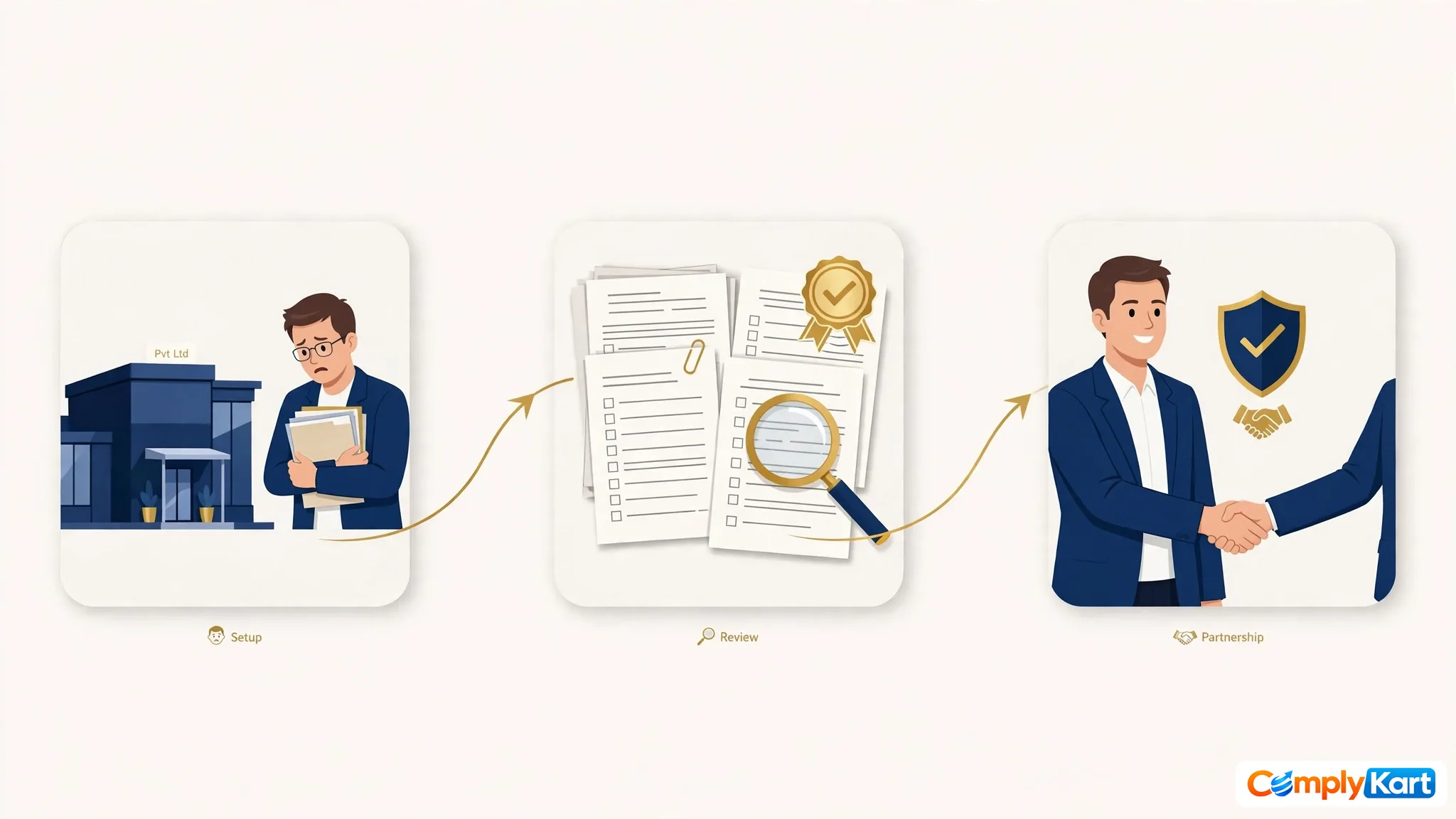
Your private limited company did its job — limited liability, a clean structure, credibility with banks. Then the compliance piled up: four board meetings a year, an AGM, AOC-4, MGT-7, an auditor whether you needed one or not — and the investors never came. Now you are wondering whether the business would be simpler as an LLP. It can be. But the route everyone quotes is often the wrong section number, and the tax answer is not "free" — it is "free if".
Yes — a private limited company can become an LLP without winding up, under section 56 and the Third Schedule of the LLP Act, 2008. Its assets, contracts and liabilities move to the LLP by law. The conversion is tax-free only if seven conditions are met, including turnover of ₹60 lakh or less in each of the last three years.
Which law actually governs the conversion — section 56 or section 366?
Section 56 of the LLP Act, 2008, read with the Third Schedule to that Act and Rule 39 of the LLP Rules, 2009. That is the route. Section 366 of the Companies Act, 2013 is the opposite direction: it lets an LLP — or another entity — register itself as a company, through Form URC-1. I am spelling this out first because the two get mixed up constantly, including in professional write-ups. Search "section 366 conversion" and you will find pages that use it for both directions. If your adviser quotes section 366 for turning your company into an LLP, they have the arrow backwards.
The distinction is not academic. The two routes have different procedures. The section 366 route needs a newspaper advertisement and a 21-day window for objections. The section 56 route needs neither — no advertisement, no objection window. You file, the Registrar checks, and the certificate issues. Knowing which Act you are under also tells you which forms to open: Form 18 and FiLLiP for section 56, URC-1 for section 366.
One scope point. The Third Schedule is titled "Conversion from Private Company into Limited Liability Partnership" — it is framed for a private company. Form 18's description on the MCA portal covers a private company or an unlisted public company. If your company is listed, this route is not for you. An unlisted public company should confirm the route with its adviser before filing rather than assuming the Schedule covers it.
Can your company convert? Five tests to pass first
Not every company can convert. The Third Schedule sets two hard conditions, and the practical checklist adds three more.
First, no security interest. There must be no charge, mortgage or lien subsisting on the company's assets when you apply. A term loan secured against the company's assets blocks the conversion until the loan is repaid or the lender releases the charge — and the satisfaction has to be on record in Form CHG-4. This is the most common reason conversions stall.
Second, every shareholder becomes a partner — and no one else. All the shareholders of the company must become partners of the LLP, in the same proportion as their shareholding. You cannot use the conversion to bring in a new partner, drop an awkward shareholder, or rebalance the ownership. A new partner joins after the conversion, through a Form 4 amendment to the LLP agreement. If a shareholder refuses, the conversion cannot proceed.
Third, at least two partners. An LLP needs a minimum of two partners, so a One Person Company cannot convert directly. An OPC has to become a private limited company with at least two members first. The LLP also needs at least two designated partners, both individuals, with at least one resident in India for 120 days or more in the financial year. Designated partners need a DIN or DPIN — if yours do not have one yet, read our guide on what a DPIN is and how to get one before you start.
Fourth, filings up to date. The Registrar expects pending annual returns and financial statements to be filed before approving Form 18. At least one AOC-4 and one MGT-7 or MGT-7A should be on record. Clear the backlog first; a company with two years of unfiled returns will not get a clean conversion.
Fifth, foreign shareholders. If the company has foreign shareholders, its sector must allow 100% foreign investment under the automatic route, without FDI-linked performance conditions. An LLP cannot take foreign investment in a restricted sector. This one kills more conversions than founders expect — check the sector before you spend anything.
Will the conversion cost you capital gains tax?
This is the question that decides most conversions, and the answer has a cliff edge in it.
Under section 70(1)(ze) of the Income-tax Act, 2025 — the provision that used to be section 47(xiiib) of the 1961 Act — the transfer of the company's assets to the LLP, and the shareholders' transfer of their shares, is exempt from capital gains tax if seven conditions are all met:
- All the assets and liabilities of the company transfer to the LLP.
- All the shareholders become partners in the LLP in the same proportion as their shareholding.
- The shareholders receive no consideration other than their share in the profit and capital contribution in the LLP.
- The former shareholders keep at least 50% of the LLP's profit share for five years from the conversion date.
- The company's turnover did not exceed ₹60 lakh in any of the three preceding years.
- The company's total assets did not exceed ₹5 crore in any of the three preceding years.
- No amount is paid to any partner out of the company's accumulated profits for three years from the conversion.
Here is the cliff. A consultancy with turnover of ₹55 lakh, ₹48 lakh and ₹52 lakh over the last three years, and assets of ₹3.2 crore, passes every test — the conversion is tax-free. Give the same firm one year at ₹65 lakh and it fails. The whole exemption falls away, not just the excess over ₹60 lakh, and the transfer is taxed as a capital gain — broadly, the value of the assets moved, less their cost. One good year can cost you the exemption. Check all three years, not just the last one.
Three more tax consequences, because founders only ever ask about the first one. If a condition is breached after conversion — say the former shareholders' combined profit share drops below 50% within five years because a new partner is admitted — section 71(3) makes the previously exempt gain taxable in the year of the breach. The company's unabsorbed business losses and depreciation can carry forward to the LLP under section 116(10), but only for eight tax years from the year the loss was first computed, and a breach pulls the set-off losses back as income under section 116(11). And the company's unused MAT credit does not transfer at all. It is lost on conversion. If you are sitting on a large MAT credit, that alone may be reason to stay a company.
Then there is the ongoing tax rate, which many founders forget to compare. A company can pay 22% under the optional regime — 25.168% effective with surcharge and cess. An LLP pays 30% plus surcharge and cess. The partners do not pay tax again on their share — a partner's share is exempt under section 10(2A) — but the LLP itself pays more on the same profit. On ₹20 lakh of annual profit, that gap is roughly ₹1 lakh a year in extra tax, every year. Lighter compliance has a price.
How the conversion actually happens, step by step
Step 1: board resolution and shareholder consent. The board resolves to convert, approves the proposed LLP name, the designated partners, the statement of assets and liabilities certified by the company's auditor, and the capital contribution and profit-sharing ratios. Separately, all shareholders sign a statement consenting to the conversion, giving the company's name, registration number and date of incorporation. It is this shareholder statement, not the board resolution, that the Third Schedule requires to be filed with Form 18.
Step 2: reserve the name through RUN-LLP. You can apply for up to two proposed names and pay ₹200. An approved name stays reserved for three months. Most companies keep their brand name and swap "Private Limited" for "LLP". Get Class 3 digital signatures for all proposed designated partners at this stage — about one to two working days — and draft the LLP agreement so it is ready to file after registration.
Step 3: file FiLLiP with Form 18. The conversion application goes through FiLLiP, with Form 18 as the linked form — select the option for conversion from a private company. Attach the shareholders' consent statement, the auditor-certified statement of assets and liabilities, the latest income-tax return acknowledgement, and the other documents the instruction kit asks for, including a list of creditors and their consent, a CA certificate that the company is not an NBFC, and proof of the registered office. A practising CA, CS or CMA must certify the filing before submission. Approval takes about 7 to 15 working days.
Step 4: receive the certificate. The Registrar issues the Certificate of Registration in Form 19, along with the LLP Identification Number. The same filing provides for the allotment of the LLP's PAN and TAN. From the registration date on the certificate, the private limited company is deemed dissolved and removed from the Registrar's records. This is not a winding up — no liquidator, no creditor meeting, no court process. The company simply ceases to exist, and the LLP stands in its place. A recent example: C.G.Ispat Private Limited, a subsidiary of Vaswani Industries, was converted into C.G.Ispat LLP with its certificate issued on 12 November 2026 and LLPIN ADE-0328.
Step 5: tell the Registrar — Form 14, within 15 days. The Third Schedule requires the LLP to inform the Registrar of Companies of the conversion within 15 days of registration, attaching the certificate and a copy of the FiLLiP filing.
Step 6: file the LLP agreement — Form 3, within 30 days. The partners' agreement goes on record in Form 3 within 30 days of registration. If you want the capital-gains exemption, the agreement must show the capital contribution and profit-sharing ratios in proportion to the old shareholding — this is where the 50%-for-five-years condition lives in practice. Get the ratios wrong here and the exemption is at risk even though the conversion itself succeeded. Our guide to what an LLP agreement must say covers the clauses; our post on LLP partners, their rights and duties explains who owes what once the agreement is signed.
Step 7: new tax registrations. The LLP gets a new PAN and TAN through FiLLiP, and it must take a fresh GST registration — the company's GSTIN does not carry over. Unused input tax credit moves to the LLP through Form GST ITC-02 under section 18(3) of the CGST Act, with a certificate from a practising chartered accountant or cost accountant confirming the transfer of liabilities. Do this promptly; a GST registration with physical verification can take up to 30 days, and you cannot issue tax invoices from the LLP until it is in place.
What does it cost, and how long does it take?
The whole process usually takes three to five weeks once charges are cleared and filings are up to date. The slow parts are never the MCA filings — they are clearing a charge, chasing a shareholder's consent, or a pending annual return.
| Stage | Estimated time |
|---|---|
| Clearing charges and pending filings | Varies with the company's filing history |
| DSCs for designated partners | 1 to 2 working days |
| RUN-LLP name approval | 2 to 3 working days |
| FiLLiP and Form 18 approval | 7 to 15 working days |
| Form 14 | Within 15 days of registration |
| Form 3 (LLP agreement) | Within 30 days of registration |
| New GST registration | Up to 7 working days (up to 30 days with physical verification) |
On cost, the honest answer is that the government fees are small and the variable part is stamp duty and professional fees. The MCA fees run on the contribution slab: DSCs about ₹2,500 each, RUN-LLP ₹200, FiLLiP ₹500 to ₹5,000 depending on contribution, Form 18 ₹50 to ₹600, Form 14 ₹50 to ₹600, Form 3 ₹50 to ₹600. Stamp duty on the LLP agreement is state law, charged on the capital contribution — in Maharashtra it is 1% of capital, with a minimum of ₹500 and a cap of ₹15,000. You can work out the cost of staying a company before you decide — the saving is the point of the exercise, so measure it. So a small company with ₹1 lakh of contribution, two designated partners, in Maharashtra, pays roughly ₹6,850 in government fees, DSCs and stamp duty: ₹5,000 for two DSCs, ₹200 for the name, ₹500 for FiLLiP, ₹50 each for Forms 18, 14 and 3, and ₹1,000 of stamp duty. Professional fees sit on top and depend on the company's size and filing history.
One stamp-duty trap deserves its own sentence. If a partner's contribution comes in as property rather than cash, Maharashtra charges conveyance duty on the market value of that property — not 1% of a cash figure. A ₹6,000 stamp-duty bill can become a six-figure one. Contribute cash where you can, and get the duty worked out before you sign the agreement.
What changes the day the certificate arrives?
Think of conversion as a change of title deed, not a house move. The family, the furniture and the address stay where they are — only the name on the deed changes, and the law moves everything across in one stroke. That is what "vesting by law" means. Under the Third Schedule, all the company's property, rights and liabilities vest in the LLP on the registration date. Contracts continue with the LLP as the party, employees continue with the LLP as their employer, and pending cases continue by or against the LLP. No separate transfer deeds, no fresh agreements, no novation of every contract.
Three things still need your attention. First, licences carry over subject to the laws that govern them — notify each issuing authority, and update the records for registered assets like land, vehicles and trademarks. Second, for twelve months starting within fourteen days of registration, every official letter, invoice and document must state that the LLP was converted from a company into an LLP, with the former company's name and registration number. Miss this and the Third Schedule imposes a fine of ₹10,000 to ₹1 lakh, plus ₹50 to ₹500 for every day the default continues. Put the line on your letterhead the day the certificate arrives. Third, update the bank accounts, invoices, website and vendor records with the LLP's name, PAN and LLPIN.
After that, the LLP lives on the LLP calendar: Form 11 by 30 May and Form 8 by 30 October each year, and a statutory audit only if turnover exceeds ₹40 lakh or contributions exceed ₹25 lakh. No board meetings, no AGM, no auditor unless the thresholds say so. If no agreement is in place, the First Schedule defaults decide how the LLP runs, including equal profit shares regardless of capital contributed — which is why the agreement in Form 3 matters more than the certificate.
When converting is the wrong move
Conversion suits an owner-managed business that will not raise equity and wants lighter compliance. Weigh it properly:
- Convert if the business is owner-run, profits are modest, no outside investor is expected, there are no secured loans, and the turnover and asset tests are comfortably met.
- Stay a company if you plan to raise equity, offer ESOPs, or take foreign investment in a restricted sector. An LLP cannot issue shares, and there is no way back without converting again — the reverse route, LLP into company, is a separate section 366 exercise. Also stay if you hold unused MAT credit, or if the 22% company tax rate beats the LLP's 30% on your profit level.
- Wind up instead if the business is really ending. Conversion keeps the entity alive with its history, contracts and liabilities. If what you want is a clean exit, a strike-off or winding up is cheaper than converting and then closing an LLP.
The most expensive version of this decision is converting, then discovering a year later that you need equity and converting back. Two conversions, two sets of fees, and the tax exemption only works once.
Five mistakes that stall a conversion
Leaving a charge on record. The loan is repaid but the CHG-4 was never filed. The Registrar sees a live charge and the application stops. File the satisfaction before you file Form 18.
Forgetting a shareholder. Every shareholder must become a partner. A dormant shareholder with 1% who lives abroad and does not answer emails can block the whole conversion. Get every consent in hand before you pay for anything.
Changing the profit-share ratio at conversion. The agreement must mirror the old shareholding. Founders sometimes use the conversion to "fix" an unfair split. That breaks the tax exemption and invites a dispute with the shareholder who lost out. Fix the split before or after — never during.
Filing Form 3 late. The agreement is due within 30 days of registration, and the additional fee after that runs on a slab. Worse, the agreement is the document that protects the tax exemption. File it in the first week, not the fourth.
Forgetting the GST and bank updates. The LLP has a new PAN and a new GSTIN. Invoices raised under the old GSTIN after conversion are wrong, and the ITC-02 transfer has its own conditions. Update the bank mandate the same week — a payment stuck because the account name does not match is an avoidable embarrassment.
If your company passes the five eligibility tests and the seven tax conditions, conversion is a tidy piece of work — three to five weeks, a few thousand rupees of government fees, and a much lighter compliance calendar at the end of it. If it fails any of them, stay a company and revisit the question when the numbers change. Decide on the arithmetic, not on the romance of a simpler structure. If you want a second pair of eyes on the eligibility and tax tests before you commit, talk to us about the LLP conversion — the check takes less time than fixing a conversion that should never have been filed. And if you are still choosing between the two structures in the first place, our private limited company registration page sets out what the company form gives you that an LLP cannot.
Frequently asked questions
Can a private limited company convert into an LLP?
Yes. A private limited company can convert into an LLP under section 56 and the Third Schedule of the LLP Act, 2008, without winding up. It must have no subsisting charge on its assets, and all its shareholders — and no one else — must become partners in the LLP.
Is a private company to LLP conversion done under section 366?
No. Section 366 of the Companies Act, 2013 covers the reverse process — registering an LLP or another entity as a company, through Form URC-1. A private company becomes an LLP under section 56 of the LLP Act, 2008.
How long does it take to convert a private limited company into an LLP?
Usually three to five weeks, once outstanding charges are cleared and pending ROC filings are complete. Approval of FiLLiP and Form 18 takes about 7 to 15 working days. The LLP must then file Form 14 within 15 days and its agreement in Form 3 within 30 days of registration.
Does the LLP get a new PAN and GSTIN after conversion?
Yes. The LLP receives a new PAN and TAN through FiLLiP and must obtain a fresh GST registration. It can transfer the company's unused input tax credit by filing Form GST ITC-02.
Can a One Person Company convert directly into an LLP?
No. An LLP needs at least two partners, so an OPC must first convert into a private limited company with at least two members, and only then convert into an LLP.
What happens if the company's turnover exceeds ₹60 lakh in one of the three preceding years?
The conversion is still possible — the turnover test only decides the tax treatment. But the capital-gains exemption under section 70(1)(ze) is lost, and the transfer of assets to the LLP is taxed as a capital gain in the company's hands.



Comments
No comments yet — ask the first question below.
Join the discussion
Questions go straight to our expert desk. Comments appear after a quick review — no spam, no noise.