
IN BRIEF
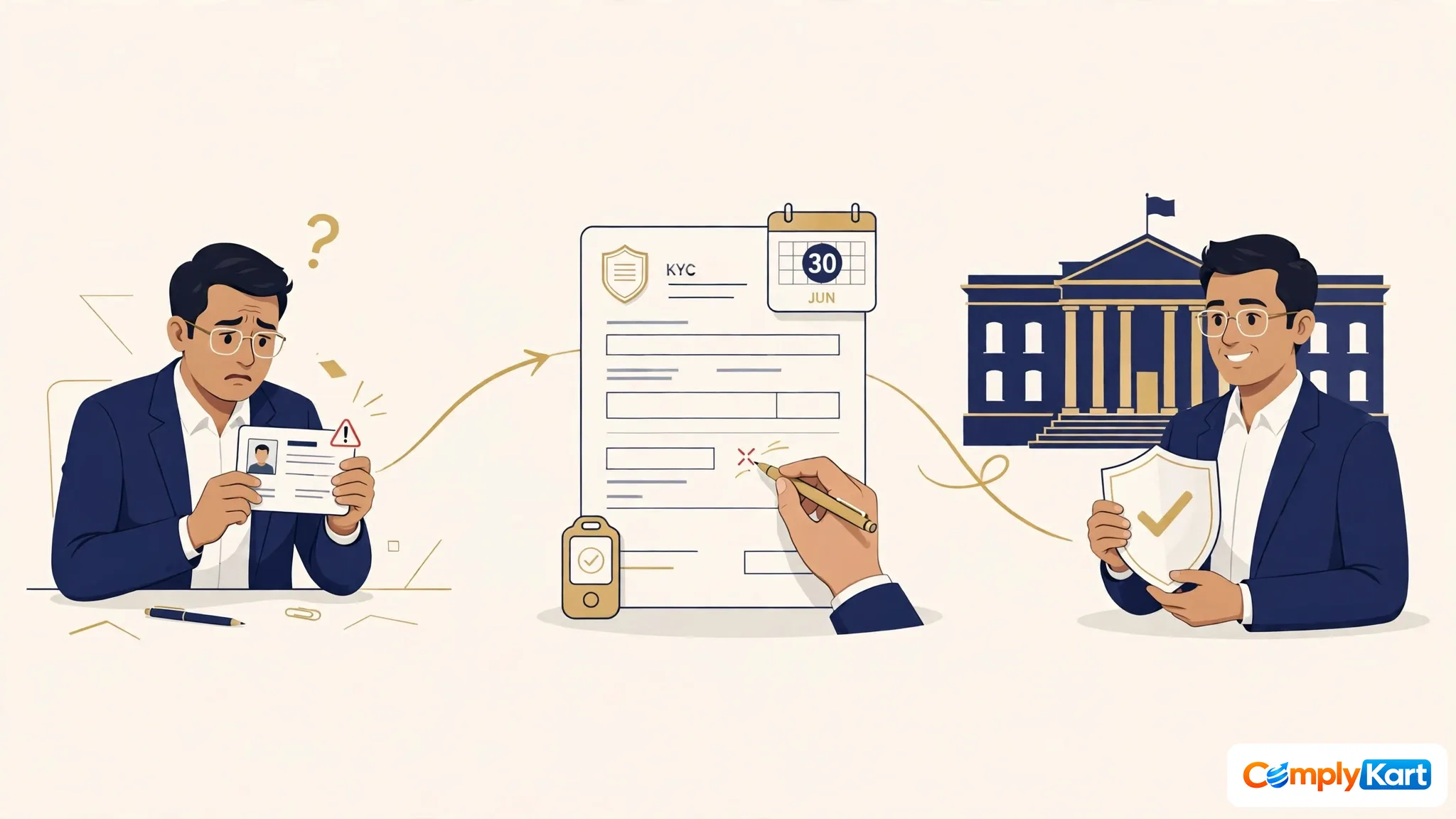
DIR-3 KYC is the KYC filing every person holding a Director Identification Number must make under Rule 12A of the Companies (Appointment and Qualification of Directors) Rules, 2014. Since 31 March 2026 it is due once every three financial years, by 30 June, on a single unified DIR-3 KYC Web form. Missing it deactivates the DIN, and reactivation needs the overdue filing plus a ₹5,000 fee.
A DIN that worked fine last year can stop working without warning. You open the MCA portal to sign a filing, and the portal says your DIN is deactivated. No hearing, no notice in the post. Just a status flag — and every filing that needs your DIN is stuck until you fix it.
Most deactivated DINs are not fraud cases. They are ordinary directors who tripped over a small error in DIR-3 KYC, the KYC filing every DIN holder owes under Rule 12A of the Companies (Appointment and Qualification of Directors) Rules, 2014. Here is the short version first.
The short answer: DIR-3 KYC is now due once every three financial years, by 30 June — not every year by 30 September. The next filing falls between April and June 2028. Miss the date and the MCA marks your DIN "Deactivated due to non-filing of DIR-3 KYC". You get it back by filing the overdue form and paying a ₹5,000 fee. The errors below are how directors end up there.
First, the rule changed — and half the internet hasn't caught up
The Companies (Appointment and Qualification of Directors) Amendment Rules, 2025, notified as G.S.R. 943(E) on 31 December 2025 and in force from 31 March 2026, replaced the annual DIR-3 KYC with a filing once every three consecutive financial years. The two old forms — the DIR-3 KYC e-form and the DIR-3 KYC Web service — merged into one unified DIR-3 KYC Web form.
| Before 31 March 2026 | From 31 March 2026 | |
|---|---|---|
| How often | Every financial year | Once every three financial years |
| Due date | 30 September | 30 June of the year after the third financial year |
| Form | DIR-3 KYC e-form or KYC-Web | One unified DIR-3 KYC Web form |
| Next routine filing | — | 1 April – 30 June 2028 (for DINs held on 31 March 2025) |
I wrote about the change itself when it landed — see No DIR-3 KYC This September: the New Once-in-3-Years Rule. This post is the other half: the mistakes directors still make under the new cycle, and the fix for each one. One warning before we start: several guides online still show the old annual dates. If the page you are reading says 30 September, it is stale. Check the date on the page before you trust it.
Error 1: Still diarising 30 September every year
This is the most common error in 2026, and it is also the most forgivable — the old rhythm ran for seven years. Directors who filed every September now either file a routine KYC in a year when none is due, or — worse — sit relaxed in June 2028 because their diary says September.
No routine KYC is due in 2026 or 2027 for a director who filed for FY 2025-26. The next window opens 1 April 2028 and closes 30 June 2028. A DIN allotted during FY 2025-26 first falls due between April and June 2029. Filing early in a non-due year does no harm, but it also buys nothing: it does not move your next due date. Set the reminder for 1 June 2028, not September.
Error 2: Your name doesn't match your PAN
The MCA cross-checks your KYC details against PAN and Aadhaar the moment you enter them. A single character of difference stops the form. "Meena Agarwal" on the PAN and "Meena Agarwal Sharma" on Aadhaar is enough. Middle names, initials, a surname added after marriage — the portal treats them all as mismatches.
This is the single most common reason DIR-3 KYC filings get stuck, and the fix is not in the form. Correct the record at the source first: the name on your PAN, or the name on the DIN record itself. For a permanent change to the DIN record — a name or date-of-birth correction — the route is Form DIR-6. Only when the PAN, the Aadhaar and the DIN record all spell your name the same way should you open the KYC form. Check the spelling on the NSDL PAN portal and the UIDAI self-service portal before you start, not after the form bounces.
Error 3: The OTP goes to a phone you no longer own
DIR-3 KYC verifies you by OTP — one to your registered mobile, one to your registered email, both during the filing itself. If you changed your number two years ago and never told the MCA, the OTP goes to a stranger's phone and the filing stops dead. The same applies to an email account you stopped checking, or a company domain that lapsed.
The rule here is a 30-day one: any change to your mobile number, email or residential address must be filed within 30 days of the change. Do not wait for the next KYC cycle to update your contact details — the cycle is three years long, and a dead number in year two means you cannot file in year three. Log in to the MCA portal now and confirm the registered mobile and email are ones you control today. If they are not, update them through the KYC Web form within the 30 days — the same unified form carries the update. Keep a personal DSC ready as well: where details have changed, the portal asks for one, and an expired DSC discovered on the due date is a delay you do not need.
Error 4: Sharing one mobile number or email across directors
Small companies do this all the time — one office mobile and one accounts email registered against two or three directors. The portal does not accept it. Each DIN holder needs their own mobile number and email on record, because the OTP that verifies you has to reach you, not your co-director.
The fix is boring and cheap: give every director a personal mobile and a personal email on the MCA record before the filing window opens. Do it in a quiet month, not in June 2028 when three directors are all trying to fix the same shared number at once.
Error 5: "I resigned, so I don't file"
The duty follows the DIN, not the directorship. Every individual holding a DIN as on 31 March of a financial year owes the filing — whether they sit on any board or not, whether they resigned years ago, and even if the DIN is disqualified or inactive for other reasons. Resigning from the company ends your directorship. It does not end your DIN.
This catches founders who left a startup, sold a company, or wound one up and assumed the compliance ended with it. It did not. Until the DIN itself is surrendered, the KYC cycle keeps running, and a missed cycle deactivates the DIN — which matters the day you join another board or sign another filing. If you truly never want the DIN again, surrender it properly. Otherwise, keep the KYC current.
Error 6: Thinking a mid-cycle update resets the clock
You changed your address in February 2027 and filed the update within 30 days, as the rule asks. Good. But that filing does not restart your three-year cycle. Your next full KYC stays anchored to the original cycle — still April to June 2028 if you filed for FY 2025-26.
This trap works both ways. Some directors file an update and then assume they are covered until 2030. Others file an update and then file a full routine KYC again, twice in one cycle, out of caution. Neither is needed. An update keeps the DIN active and the record current; it does not move the due date. Note your due year on a calendar and leave it alone.
Error 7: Foreign directors — passport, notarisation and the OTP trap
The filing applies equally to foreign nationals holding a DIN. The document set differs: a passport instead of PAN and Aadhaar, an overseas address proof, and the same OTP-verified contact details and DSC requirements. The passport copy must be notarised in the director's home country — with an apostille if the country is a Hague Convention signatory, or attestation by the Indian Embassy or High Commission if it is not.
Two things trip foreign directors up. First, the OTP problem is worse abroad: a foreign mobile number that changed, or an inbox that filters MCA mail as spam, stalls the whole filing. Check both channels well before the due window. Second, documents take longer — notarisation and apostille are not same-day jobs. Start the paperwork a month before you plan to file, not the week of 30 June.
Error 8: Ignoring a deactivated DIN — or fixing the wrong one
A deactivated DIN is not a status you can work around. It cannot be quoted in any MCA filing: no DIR-12 for appointments or cessations, no annual return signatures, no charge filings, no incorporation forms. A company whose only director has a deactivated DIN can find its AOC-4 and MGT-7 stuck as well, because there is nobody with a live DIN to sign them. And the flag is visible — anyone checking the DIN on the MCA portal sees it, including lenders, investors and acquirers doing diligence.
Before you fix it, check what deactivated it. DIR-3 KYC is the common cause, but it is not the only one: duplicate DINs, for instance, deactivate a DIN for a different reason. Filing DIR-3 KYC fixes a KYC deactivation. It fixes nothing else. Check the DIN status and its reason code on the MCA portal first, so you file the right cure.
What deactivation actually blocks — and the ₹5,000 way back
Think of a DIN like a driving licence. KYC is the renewal. A deactivated DIN is an expired licence — the car does not move until it is renewed, however urgent the journey. The renewal here is simple, and there is no hearing, no condonation petition and no compounding. The steps:
- Log in to the MCA V3 portal and open DIR-3 KYC Web.
- Confirm or update your details — PAN, Aadhaar or passport, current address proof, photograph, and a mobile number and email you control right now.
- Verify both OTPs during the filing.
- Pay the fee online — and, because the filing is late, the ₹5,000 additional fee that reactivates the DIN.
- Check the DIN status shows active before you use it in another filing. A filing made while the DIN still shows deactivated will bounce.
On-time filing is free. The ₹5,000 is the price of the delay, and it is charged per DIN, per missed cycle. The figure is the one currently reported on the MCA fee schedule — confirm it on the portal before you pay, because fee schedules do change. The real cost, though, is the gap: between deactivation and reactivation your DIN was unusable, and filings stuck in that window may have picked up late fees of their own. If your company needs to appoint a director, that appointment runs through Form DIR-12 — which needs an active DIN first. Fix the DIN, then file the appointment.
Worked example: the phone change in February 2027
Take a director, Ananya, who filed her DIR-3 KYC for FY 2025-26 and holds her DIN on 31 March 2025. Her next routine filing is due between 1 April and 30 June 2028. In February 2027 she changes her mobile number.
What she must do: file the update on DIR-3 KYC Web within 30 days of the change — by early March 2027. The new number becomes her registered contact. What she must not assume: that this filing moves her next due date. It does not. Her routine KYC is still due April–June 2028, and the OTPs for that filing will go to the new number she registered in March 2027. One update, filed on time, keeps the whole chain working. One update missed, and the June 2028 OTPs go to a dead number — which is exactly Error 3, arriving two years late.
The pre-filing checklist
- Name match: the name on your PAN, Aadhaar and DIN record is spelled identically. If not, correct it at the source (DIR-6 for the DIN record) before opening the form.
- Channels live: the registered mobile and email are yours, reachable today, and not shared with another director.
- Documents ready: PAN, Aadhaar or passport, current address proof, a photograph — and a valid personal DSC if any detail has changed.
- Due year known: you know which June your next routine filing falls due, and the reminder is set for 1 June of that year.
- Status checked: the DIN shows active on the MCA portal, and if it shows deactivated, you know the reason code before you file anything.
Frequently asked questions
What is the DIR-3 KYC due date now?
Once every three financial years, by 30 June. Directors who filed for FY 2025-26 next file between 1 April and 30 June 2028. A DIN allotted in FY 2025-26 first falls due between April and June 2029. Changes to your mobile, email or address must still be filed within 30 days, in any year.
What is the DIR-3 KYC late fee?
₹5,000, paid with the overdue DIR-3 KYC Web form to reactivate a DIN deactivated for non-filing. On-time filing carries no fee. Confirm the figure on the MCA portal before paying, as fee schedules change.
How do I reactivate a deactivated DIN?
File the overdue DIR-3 KYC Web form with your current details and pay the ₹5,000 fee. There is no separate reactivation form and no hearing. The DIN returns to active once the MCA processes the filing — check the status shows active before using the DIN in another filing.
Do I need DIR-3 KYC after resigning as a director?
Yes, if you still hold the DIN. The duty follows the DIN, not the directorship. It applies even if you sit on no board, and even to disqualified or inactive DIN holders. Only surrendering the DIN ends it.
Do I need a DSC for DIR-3 KYC?
When nothing has changed, the unified DIR-3 KYC Web form verifies you by OTP to your registered mobile and email — no DSC, no professional certification. Where a detail has changed, keep a valid personal DSC ready, because the portal asks for one on the change route. Either way, the form must be completed by the DIN holder personally.
A deactivated DIN rarely means a director did something wrong. It usually means a small thing went stale — a name spelled two ways, a phone number from two jobs ago, a diary entry from the old annual cycle. Fix the small thing now, while the next due date is still eighteen months away, and June 2028 becomes a ten-minute form instead of a blocked filing season. If you want the filing handled for you, our Director KYC service covers the check, the OTP steps and the filing — and if a deactivated DIN is already holding up your annual filing, sort the DIN first, then the returns. The compliance fee calculator will give you the cost of the filings waiting behind it.





Comments
No comments yet — ask the first question below.
Join the discussion
Questions go straight to our expert desk. Comments appear after a quick review — no spam, no noise.