
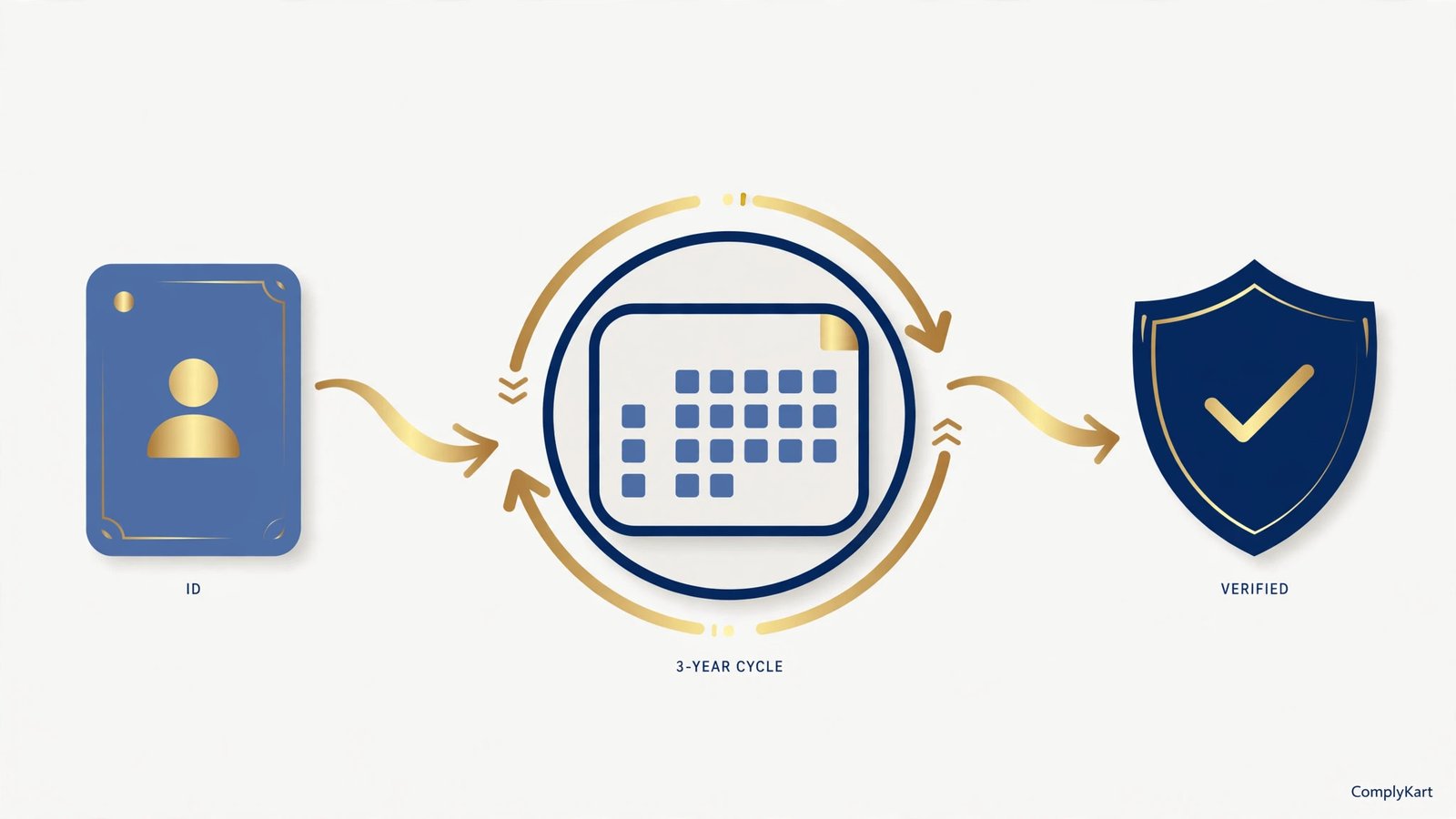
For years, September meant one thing for company directors: DIR-3 KYC. Every person holding a Director Identification Number filed it, every year, by 30 September. Miss it and the DIN risked deactivation, plus a ₹5,000 fee to bring it back to life.
That annual ritual is over. And yet, this October, I am still seeing compliance calendars, checklists, and reminder emails telling directors to file DIR-3 KYC “before 30 September.” The rule changed on 31 March 2026. The calendars did not get the memo.
Here is the new math, plainly stated.
What actually changed
The Ministry of Corporate Affairs amended the Companies (Appointment and Qualification of Directors) Rules through G.S.R. 943(E), dated 31 December 2025. The amendment took effect on 31 March 2026. Its core move: Rule 12A, which governed director KYC, was substituted.
Under the new Rule 12A, director KYC is no longer annual. It is triennial — once every three years. Every individual holding a DIN as on 31 March of a financial year must file KYC intimation in Form DIR-3 KYC Web, on or before 30 June of the year immediately following every third consecutive financial year.
Read that slowly. Once every three financial years. By 30 June. Not 30 September, and not every year.
The new timeline, worked out
Directors who completed their KYC through FY 2025-26 — which is nearly everyone who was compliant under the old system — have their next routine filing due by 30 June 2028. There is no DIR-3 KYC item for you in 2026. There is none in 2027 either.
Think of it like a driving licence renewal that moved from yearly to once in three years. You do not queue up this year. You do not queue up next year. You mark the new date and get on with business. But — and this is the part people miss — you still have to report a new address the moment you move. The renewal got rarer; the duty to keep details current did not.
The two triggers that still force a filing
The triennial cycle covers routine KYC. Two events still demand a filing in between, and both catch people out.
First, a change in your details. If your mobile number, email address, or residential address changes, you must file DIR-3 KYC Web within 30 days of the change, along with the prescribed fee. This is not optional and not triennial — it is immediate. I have seen directors change phone numbers, ignore this, and discover the problem years later when a filing bounces.
Second, a deactivated DIN. If your DIN was deactivated under the old regime for missed KYC, you reactivate it through the web form. The amendment kept that door open: reactivation happens via DIR-3 KYC Web, not the old e-form.
One more carve-out worth knowing: if your DIN was allotted during a financial year — say through SPICe+ at incorporation — your KYC details were already captured at allotment. You do not file DIR-3 KYC again that same year. Your three-year cycle starts from the year of allotment.
Web only, now
The amendment discontinued the old e-Form DIR-3-KYC. There is now a single, unified Form DIR-3 KYC Web, and it is the only permitted mode — for the triennial filing, for updating changed details, and for DIN reactivation. If someone sends you the old downloadable form, it is outdated. Do not use it.
This is part of the MCA’s steady push to web-based filings. Fewer forms, one portal, one workflow. In this case, the simplification is genuine.
What you should actually do this October
For most directors: nothing. That is the honest answer, and it feels strange after years of September filings. But “nothing” has two footnotes.
Footnote one: verify. Log in to the MCA portal and confirm your DIN status shows active. If it does, and your mobile, email, and address are current, close the tab. You are done until the 2028 window.
Footnote two: fix your calendar. Delete the recurring “DIR-3 KYC by 30 September” reminder and replace it with “DIR-3 KYC Web by 30 June 2028.” Then add a standing habit that matters more than the triennial date: whenever a director changes a phone number, email, or address, someone files the update within 30 days. Make it part of your onboarding and exit checklists, not a year-end scramble.
The old system trained directors to think of KYC as a September chore. The new system asks something smaller and smarter: file once in three years, and keep your details honest in between. The directors who will get into trouble under the new rules are not the ones who forget 2028. They are the ones who change their email in 2027 and tell nobody.
So no, there is no DIR-3 KYC deadline this September. There never will be again. Update the calendar, update the checklist, and spend the compliance energy you just saved on something that actually needs it.




Comments
No comments yet — ask the first question below.
Join the discussion
Questions go straight to our expert desk. Comments appear after a quick review — no spam, no noise.