
IN BRIEF
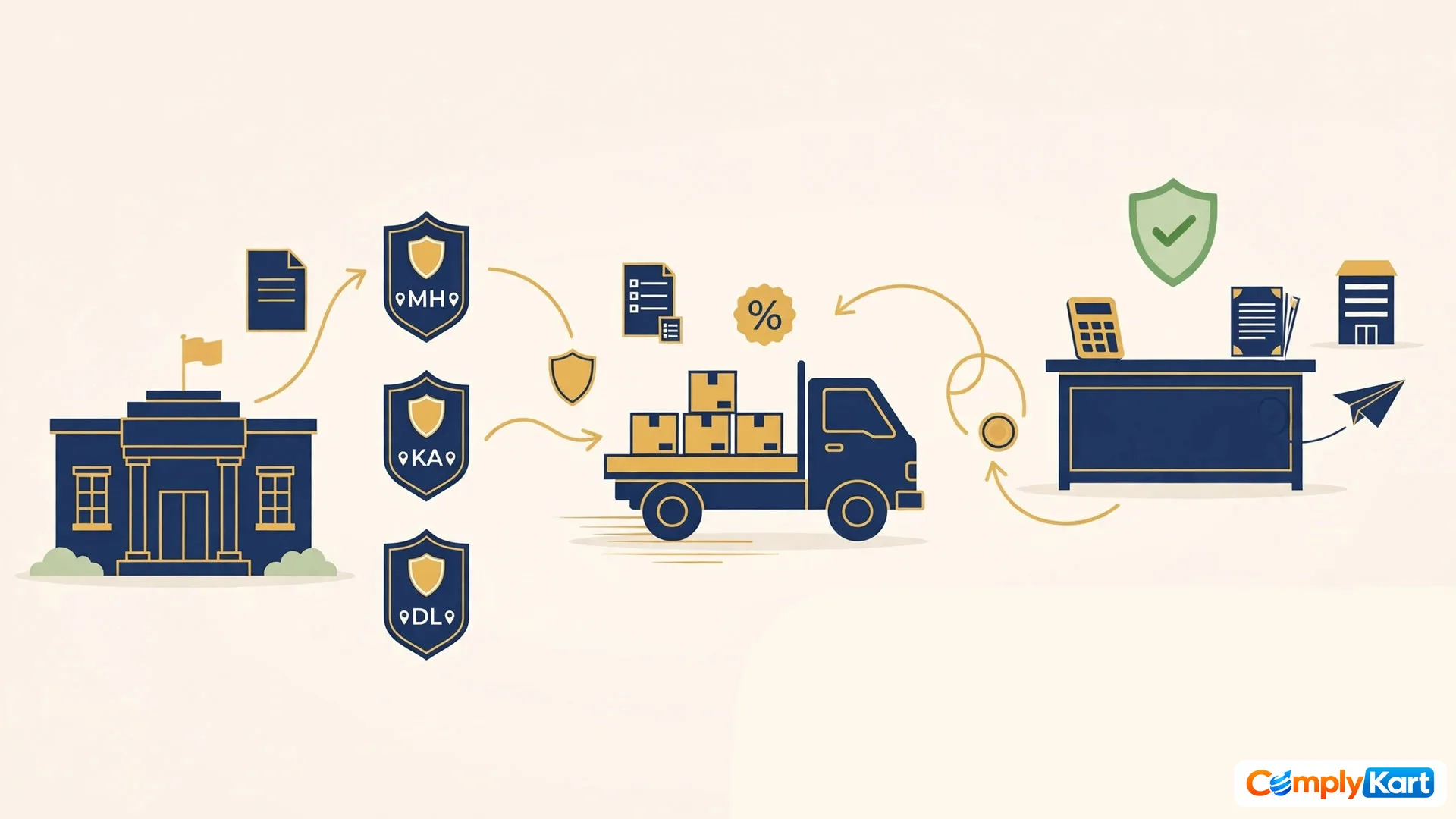
A distinct person under GST is a separate GST registration of the same legal entity, treated as a separate taxpayer under section 25(4) and (5) of the CGST Act, 2017. Each registration is a distinct person, so goods or services moving between two registrations of the same company are a taxable supply under Schedule I, even when no money changes hands.
Your company has one PAN and one balance sheet. But under GST it can be several taxpayers at once: every GST registration you hold is a separate person, called a distinct person. Goods or services moving between two of your own registrations are a taxable supply, even when no money changes hands.
What "distinct person" actually means
Section 25(4) of the CGST Act says it plainly: a person who has obtained more than one registration, whether in one State or in more than one State, is treated as a distinct person for each registration. Section 25(5) adds the other half — an establishment in one State and an establishment in another State are distinct persons too.
Think of it as one family with separate wallets. You are the same family. But each GSTIN is its own wallet, with its own returns, its own credit ledger, its own tax bill. Move stock from the Delhi wallet to the Karnataka wallet and GST treats it as a sale between two people — because, for GST, that is what it is.
This surprises founders because income tax does not work this way. Under income tax, your branches are one assessee. Under GST, they are not. The day you take a second registration, you stop being one taxpayer and become as many taxpayers as you have GSTINs. That is the whole idea, and everything else in this guide follows from it.
If you operate in several States, you already know the multistate registration routine. This guide is about what happens after the registrations exist.
When your own transfer becomes a supply
Schedule I of the CGST Act, paragraph 2, is the provision that does the damage. It says a supply of goods or services between related persons or distinct persons, made in the course or furtherance of business, is treated as a supply even if made without consideration. No payment, no problem — the law still calls it a supply.
Four situations cover almost everything a multi-branch business does:
| Movement | Supply? | What you do |
|---|---|---|
| Two places under the same GSTIN, same State | No | Internal stock movement. Delivery challan; no tax invoice. |
| Two places under the same GSTIN, different States | No | Still one registration, still internal. Delivery challan; e-way bill if the consignment tops ₹50,000. |
| Two different GSTINs, same State | Yes | Taxable supply. Tax invoice with CGST + SGST; e-way bill if the consignment tops ₹50,000. |
| Two different GSTINs, different States | Yes | Taxable supply. Tax invoice with IGST; e-way bill if the consignment tops ₹50,000. |
The test is the GSTIN, not the distance. A warehouse ten kilometres away under a second registration is a taxable supply. A branch a thousand kilometres away under the same registration is not. People get this wrong in both directions — they pay tax on internal movements they did not need to, and they skip tax on transfers they should have invoiced.
Branch transfers of goods: the invoice, the IGST, the e-way bill
Take a real example. Your Maharashtra unit sends finished goods worth ₹24,00,000 to your Karnataka branch. Different GSTINs, different States. This is an inter-State supply between distinct persons, so the Maharashtra unit raises a tax invoice and charges IGST at 18% — ₹4,32,000. The Karnataka branch pays ₹28,32,000 in total and claims ₹4,32,000 as input tax credit, subject to the usual conditions in section 16.
Notice what happened to your cash. ₹4,32,000 went out and ₹4,32,000 came back as credit. The tax is a pass-through, not a cost — as long as the receiving branch can actually use the credit. That "as long as" is where the money is lost, and I come back to it in the valuation section below.
Two documents ride with the goods. First, the tax invoice — section 31 requires one for every supply between distinct persons, and the time of supply follows section 12. Second, the e-way bill: under section 68 read with Rule 138, every movement of goods worth more than ₹50,000 needs an e-way bill generated before the vehicle moves. A stock transfer between distinct persons is a supply, so the rule applies like any other movement. Even a movement under the same GSTIN needs one above ₹50,000, because Rule 138 covers movements for reasons other than supply as well.
One recent ruling is worth knowing. In August 2026 the GST Appellate Tribunal at Thiruvananthapuram, in M.S. Steels v. Commissioner of Kerala State GST, held that the heavy detention penalty under section 129 cannot apply to a same-GSTIN stock movement, because there is no supply and therefore no tax payable to anchor the penalty to. The tribunal was clear, though, that the e-way bill requirement itself survives — the department's recourse for a missing bill is the documentation penalty under section 122(1)(xiv). So the lesson is narrow: a missing e-way bill on your own stock still costs you, just under a different section.
Cross-charge: when the head office bills its own branch
Goods are the easy half. Services are where finance teams come unstuck. Your head office runs accounting, HR, IT support, legal and treasury for every branch. Those are services, and when the branch sits under a different GSTIN, the head office is supplying services to a distinct person. That supply needs a tax invoice. The trade calls it a cross-charge.
Cross-charge is not defined anywhere in the Act. It is the industry's word for invoicing a supply between two registrations of the same legal entity. The legal basis is the same pair — section 25(4)/(5) plus Schedule I paragraph 2 — and the invoice carries IGST when the branch is in another State.
Here the CBIC has given real relief. Circular No. 199/11/2023-GST, dated 17 July 2023, clarified two things that matter every month. First, where the receiving branch is eligible for full input tax credit, the value declared in the head office's invoice is deemed to be the open market value — even if the head office left salary costs out of the calculation. Second, where the head office issues no invoice at all for internally generated services, and the recipient is eligible for full credit, the value may be deemed nil.
The Delhi High Court confirmed the second point in 2025 in KEI Industries v. Union of India: no cross-charge raised, full credit available to the recipient, value deemed nil, no IGST payable. Read that carefully, though. The relief is conditional on full credit. If the branch cannot claim full credit, the nil-value position does not exist, and the department can value the service properly. Which brings us to valuation.
How to value it: Rule 28 in plain words
Rule 28 of the CGST Rules sets the pecking order for valuing a supply between distinct persons. First, the open market value — what an unrelated buyer would pay for the same thing at the same time. If that is not available, the value of goods or services of like kind and quality. If neither works, Rule 30 (cost plus 10%) or Rule 31 (reasonable means). There is also a practical shortcut: where the goods are meant for further supply as such by the recipient, the supplier may value them at 90% of the price the recipient charges its own customer.
Then comes the proviso that does most of the real work: where the recipient is eligible for full input tax credit, the value declared in the invoice is deemed to be the open market value. In plain terms, if the branch can claim every rupee of credit, the department accepts your invoice value. Your valuation workings still need to exist — an officer can ask how you got there — but the number on the invoice stands.
The trap is the branch that cannot claim full credit. A bank branch reverses half its credit under section 17(4). A unit making exempt supplies cannot claim credit on the exempt side at all. For those recipients the proviso does not apply, and the value must be worked out at open market value or cost plus 10% — and cost plus 10% includes apportioned salary costs, which the head office would rather not compute.
Work it through. Your head office's internal finance, HR and IT team costs ₹12,00,000 a year. Your Karnataka branch takes 40% of the shared service, so ₹4,80,000. Cross-charge it at 18% IGST: ₹86,400. If the Karnataka branch makes only taxable supplies, it claims ₹86,400 back and the whole exercise nets to zero. But suppose the branch is a bank branch that reverses 50% of its credit. It keeps ₹43,200 of credit and ₹43,200 becomes a real cost — and the ₹4,80,000 base itself must be defensible at open market value or cost plus 10%, salaries included. Same invoice, same company, very different outcome. The difference is never the rate. It is the recipient's credit position.
ISD or cross-charge? Stop mixing them up
This is the confusion I see most often, and since 1 April 2025 it has consequences. Input Service Distributor (ISD) and cross-charge are not two names for one thing. They do opposite jobs.
| ISD | Cross-charge | |
|---|---|---|
| What moves | Input tax credit on a service a third party supplied | A service the head office itself supplied |
| Example | Statutory audit fee, ERP licence, national advertising — billed to HO, used by all branches | HO's own accounting, HR, IT and management support to branches |
| Supply involved? | No — only credit is distributed | Yes — a taxable supply between distinct persons |
| Document | ISD invoice | Tax invoice |
| Output tax paid? | No | Yes — IGST, claimed back by the branch |
The rule that decides which one you use is simple: who supplied the service? If a vendor billed your head office for a service several branches use, the credit travels by ISD. If your head office's own people did the work, the service travels by cross-charge invoice.
And the ISD half is no longer optional. The Finance (No. 2) Act, 2024 substituted section 20 of the CGST Act, and Notification No. 12/2024-Central Tax brought the change into force on 1 April 2025. From that date, distributing credit on common input services received for or on behalf of distinct persons through ISD is mandatory. Before April 2025, Circular 199/2023 had let the head office choose between ISD and a cross-charge invoice for those credits. That choice is gone. If you are still routing vendor-billed common services through cross-charge invoices in FY 2026-27, you are distributing credit through the wrong mechanism — and the credit may not survive an audit.
Two registrations in the same State: worth it?
Sometimes the question runs the other way. You have two places of business in one State and you are wondering whether to take a second registration there at all. The proviso to section 25(2), read with Rule 11, allows it — a separate registration for each place of business, applied for in Form REG-01. Once you do, the two registrations are distinct persons, and every movement between them becomes a taxable supply with invoices and valuation, exactly as above.
There are two strings attached that people miss. First, when you take the second registration, unutilised input tax credit has to move with the business: Rule 41A requires the transfer through Form ITC-02A within 30 days, apportioned on the book value of assets. Second, the composition scheme is all-or-nothing per State — the proviso to section 10(2) says that if one registration under the same PAN in a State opts for composition, every other registration under that PAN in that State must follow.
So the decision is a trade-off, and it is worth making deliberately. One registration keeps internal movements out of GST entirely, but it also keeps one credit ledger, one return and one place of business on record — which gets awkward when the two units do very different things or sit far apart. Two registrations give you clean unit-wise books and credit, at the price of invoicing, valuing and reconciling every internal movement between them. My rule of thumb: take the second registration when the units need separate books for a business reason — different product lines, separate P&L accountability, a buyer or lender who wants unit-wise numbers. Do not take it just because the portal allows it. The compliance you buy with it is permanent.
And if a registration has outlived its use, close it properly — a cancelled registration revived late costs more than a clean cancellation done on time.
Five mistakes that cost real money
- Treating every internal movement as tax-free. Same GSTIN, no tax. Different GSTIN, tax — even with no payment. Check the GSTIN first, every time.
- Moving goods without an e-way bill. Above ₹50,000 a consignment, the bill comes before the vehicle moves — stock transfer or sale, it makes no difference.
- Routing vendor-billed common services through cross-charge after 1 April 2025. Those credits must travel by ISD now. Cross-charge is only for services your own people provided.
- Using the nil-value position for a branch that cannot claim full credit. Circular 199's relief and the KEI Industries decision both depend on full credit. An exempt or partially blocked recipient needs a real valuation — open market value or cost plus 10%, salaries included.
- No workings behind the invoice value. The second proviso to Rule 28 accepts your invoice value when the recipient has full credit, but "accepted" is not "never asked about". Keep the allocation workings — turnover shares, headcount shares, cost sheets — on file. Unexplained branch transfers are exactly what a scrutiny notice picks up first.
Frequently asked questions
Is GST charged when I send stock to my own branch in another State?
Yes. The two branches hold different GSTINs, so they are distinct persons under section 25, and the transfer is a supply under Schedule I even without payment. Your unit raises a tax invoice with IGST, and the receiving branch claims the IGST as credit.
What is the difference between a distinct person and a related person?
A distinct person is the same legal entity holding a different GST registration. A related person is a different legal entity connected to you — a subsidiary, a holding company, a partner's firm. Both are covered by Schedule I and Rule 28, but only distinct persons share your PAN.
Do I need to cross-charge my head office's salary costs to branches?
Only if the branch cannot claim full input tax credit. Where the branch has full credit, Circular 199/2023 says the invoice value is deemed the open market value even if salary costs were left out — and if no invoice is raised at all, the value may be deemed nil. Where credit is restricted, the value must be worked out at open market value or cost plus 10%, which includes apportioned salaries.
Can I still use cross-charge for audit fees billed to my head office?
No — not since 1 April 2025. Audit fees are a third-party service, so the credit must be distributed through ISD. Cross-charge is for services your head office's own people provide, like internal accounting or HR support.
What happens if I take a second GST registration in the same State?
The two registrations become distinct persons. Every movement between them needs a tax invoice and valuation, unutilised credit moves through Form ITC-02A within 30 days, and if one registration opts for the composition scheme, the other must too.
One company, many GSTINs, many taxpayers. The distinct-person rule is not a trap the department set for you — it is the price of having a separate tax identity in every State you operate in. Invoice the transfers, value them honestly, route vendor credits through ISD and your own services through cross-charge, and the tax washes out. Skip any of those steps and the same rule quietly turns into a demand. If your branches span three or more States, get the workings checked once — a GST registration review costs far less than a scrutiny notice, and our compliance fee calculator will tell you what the fix is worth before you commit to it.





Comments
No comments yet — ask the first question below.
Join the discussion
Questions go straight to our expert desk. Comments appear after a quick review — no spam, no noise.