
IN BRIEF
An energy audit is a one-time structured examination of how a facility uses energy, producing a report of findings and costed saving measures, while ISO 50001:2018 is the international standard for an energy management system that keeps improving energy performance through targets, baselines and indicators, with a three-year certificate and annual surveillance audits.
Short answer: An energy audit is a one-time diagnosis — a report that tells you where your energy goes and what fixing it is worth. ISO 50001 is the management system that keeps acting on that diagnosis, year after year, with targets, measurements and an annual surveillance audit.
A plant head in an energy-heavy unit usually meets these two in the wrong order. Someone quotes an audit, someone else quotes a certificate, and both sound like the same purchase. They are not. I have seen the audit report land on a shelf, untouched, twelve months after it was paid for. I have also seen a certified system quietly hold a plant's energy cost per unit steady while production doubled. The difference was never the quality of the first report. It was whether anything kept happening after it.
What an energy audit actually gives you
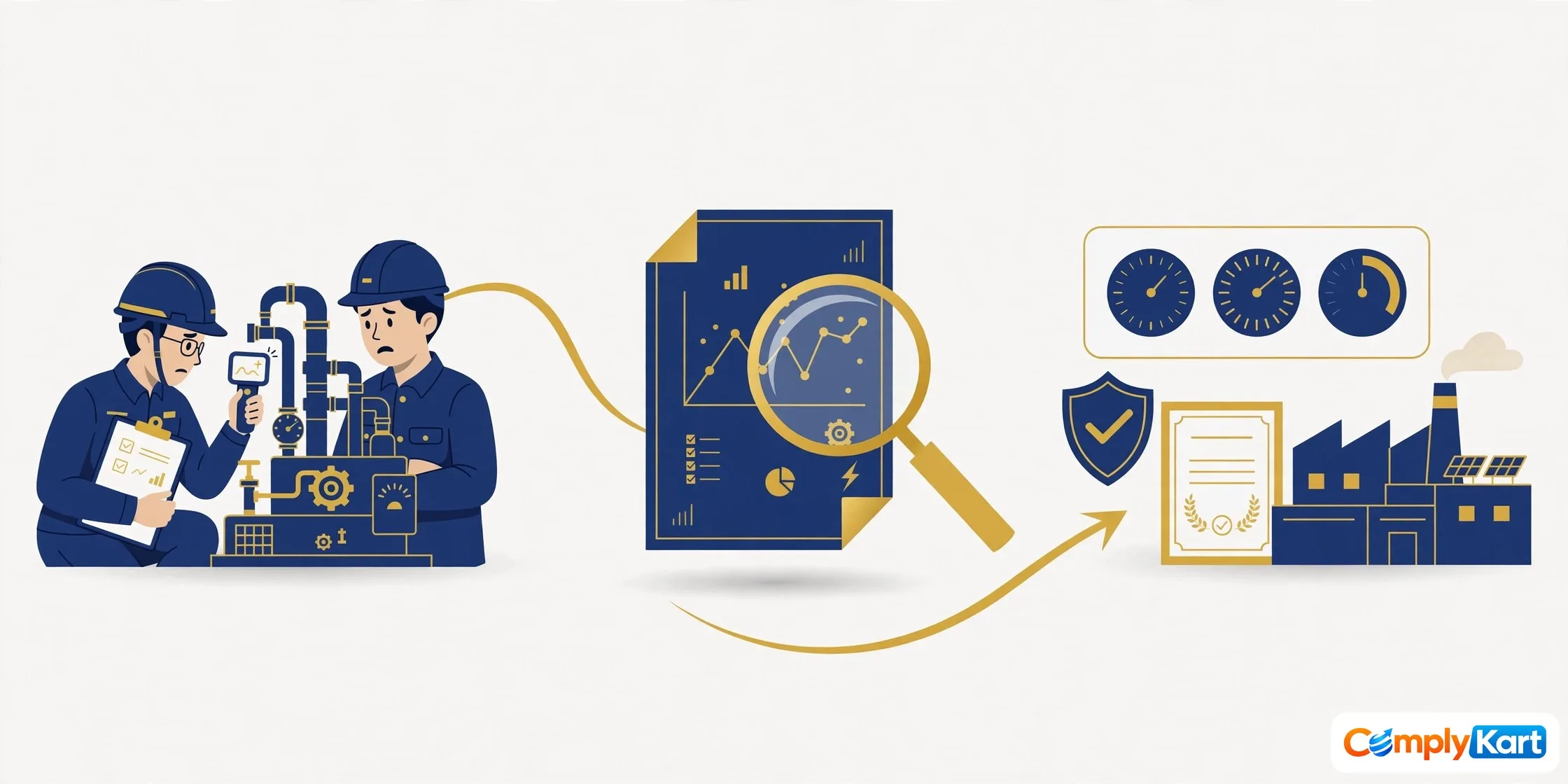
An energy audit is a structured examination of how a facility uses energy. An auditor walks the plant, studies bills and production data, measures equipment — motors, compressors, boilers, HVAC — and works out where energy is wasted and what each fix would cost and save. What you receive is a report: findings, measures ranked by payback, and a baseline picture of consumption.
Two things about that report matter. First, it has a date on it. The day it is written, it starts ageing. Production mix changes, a new line comes in, a compressor gets replaced, and the numbers drift. Second, the report itself changes nothing. It recommends. Somebody still has to approve the spending, change the operating routine, and check whether the saving actually showed up on the bill.
There are two depths. A walk-through audit gives a quick picture and the obvious wins. A detailed audit measures properly and prices the bigger projects. Either way, the output is the same kind of thing: a document. And one confusion is worth clearing up now. ISO 50002 is the standard for how to conduct an energy audit. It is a method, not a certificate you hang on a wall. Anyone selling you an "ISO 50002 certificate" for your company is selling you a misunderstanding.
What ISO 50001 actually is
ISO 50001:2018 is the international standard for an energy management system — an EnMS. Think of it less as a document and more as a routine your company agrees to keep. It runs on the Plan-Do-Check-Act cycle, and it asks for a handful of plain things.
First, an energy review: a systematic look at what you use, where, and how much. Second, significant energy uses — the SEUs — the handful of equipment or processes that dominate the bill. Third, an energy baseline, the reference period you compare against. Fourth, energy performance indicators, or EnPIs: metrics like energy per unit of output, so you can tell whether you genuinely improved or merely produced less. Then objectives, action plans, internal audit, and management review. A certification body checks all of it in two stages — Stage 1, a document and readiness review, and Stage 2, an on-site audit — and the certificate runs three years, with surveillance audits after the first and second years.
Here is the analogy I use with plant heads. An energy audit is a full-body health checkup. Useful, thorough, and completely useless if you frame the report and carry on eating the same way. ISO 50001 is the diet, the morning walk and the follow-up tests, written down as a routine the whole household follows. The checkup tells you the truth once. The routine is what moves the numbers.
Energy audit vs ISO 50001, side by side
| Question | Energy audit | ISO 50001 |
|---|---|---|
| What you get | A report with findings and costed measures | A working system plus a certificate |
| How long it lasts | Until conditions change — months, not years | Three-year cycle with annual surveillance |
| Who checks it | The auditor you engaged | An independent certification body |
| What it proves | That you looked, once | That you manage energy continuously |
| What happens next | Nothing, unless you act | Targets, reviews and corrective action are built in |
| Typical first step | Walk-through or detailed audit | Energy review — which usually starts with audit data |
Notice the last row. This is not a contest with one winner. The audit feeds the system. A good energy review leans heavily on audit findings. The mistake is treating them as substitutes, when in practice one is the input and the other is the machine that uses it.
The Indian legal layer: where an audit is not optional
For most companies, both choices are voluntary. For some, the audit is not. Under the Energy Conservation Act, 2001, designated consumers — large energy users in notified energy-intensive sectors — must have energy audits conducted by a BEE-accredited energy auditor. The Bureau of Energy Efficiency's 2010 Regulations on the manner and intervals of energy audits require the first audit within 18 months of notification, and subsequent audits every three years from submission of the previous report.
The same framework runs the PAT scheme — Perform, Achieve and Trade — under which designated consumers carry energy-consumption reduction targets and can trade energy saving certificates for surplus savings. ISO 50001 supports this work. It gives a designated consumer a disciplined way to track consumption and demonstrate improvement. But it does not by itself discharge a statutory audit duty or a PAT target. If your unit is a designated consumer, keep the mandatory audit on its own calendar, whatever else you build around it.
Which one should you buy first?
Work through it in this order, honestly.
Buy the audit alone if you have a single, specific question — a bill that jumped, a line that eats power, a board that wants a costed list before it sanctions anything. A detailed audit answers that question well, and a small unit with a modest bill may need nothing more for a year or two.
Buy the audit, then build the system if the audit finds real money — and most detailed audits do — but nobody in the plant owns energy as a job. This is the commonest case. The audit becomes the energy review, the SEUs fall out of it, and the baseline is already measured. You are halfway into ISO 50001 before you spend a rupee on certification.
Go straight to the system if a buyer, a tender or a lender is asking for it, if you run multiple sites and the same waste repeats at each one, or if you are a designated consumer already living under targets. Here the audit is still done — it just happens inside the project, as the energy review, rather than as a standalone purchase.
One honest caveat. A system only pays if someone senior owns it. I have watched a certified plant slide back because the energy manager left and nobody picked up the monthly review. The certificate survived. The savings did not. If you cannot name the person who will own the EnPIs, buy the audit, fix the top three measures, and come back to the system question in a year.
What each one costs — and what to watch in a quote
An audit is quoted per site, after a walkthrough or at least a look at your bills and equipment list. Treat any fixed audit price given sight-unseen with suspicion — the auditor has not yet learned how big your plant is. Ask what the report will contain: system-wise findings, costed measures with payback, and a baseline you can reuse. A report without payback figures is a survey, not an audit.
For the system, the two bills stay separate, exactly as in our ISO 50001 cost and payback guide. ComplyKart's ISO 50001 consultancy costs ₹12,999 for up to 25 employees and ₹24,999 for 26 to 100 employees, and the certification body's audit fee is extra at actuals — it depends on your site's size, energy consumption and complexity, which is why a written quote from the body governs, not a marketplace listing. If a seller quotes you one all-in number for a certificate with no Stage 1 and Stage 2 audit in it, you are not buying ISO 50001. You are buying paper.
Five mistakes plant heads make here
- Buying an audit and expecting a certificate. The report is not certification, and no buyer or tender desk will treat it as one.
- Filing the report and moving on. An audit's savings exist only in the measures you implement. Put the top three on a dated plan before the auditor leaves.
- Treating ISO 50001 as a licence substitute. It is voluntary, not a government licence, and it never replaces a consent or a statutory obligation your unit already holds.
- Scoping only the office building. If the bill sits in the process hall, scoping the admin block gives you a neat certificate and an untouched bill.
- Chasing the cheapest certificate listing. A certificate without a real Stage 2 audit fails the first serious buyer check — scope line, surveillance status, accreditation — and then you pay twice.
Frequently asked questions
Does an energy audit give me ISO 50001 certification? No. An audit produces a report. Certification requires an energy management system audited in two stages by an independent certification body, with annual surveillance. The audit can serve as your energy review, which is the system's starting point.
Is ISO 50001 mandatory in India? No, the standard itself is voluntary. But designated consumers under the Energy Conservation Act, 2001 do have mandatory energy audit duties through BEE-accredited auditors, on a three-year cycle under the 2010 Regulations. Certification supports those duties; it does not replace them.
How long does an ISO 50001 certificate last? Three years, with surveillance audits after the first and second years and recertification at the end of the cycle. An energy audit report, by contrast, has no validity period — it simply ages as your plant changes.
Can a small single-site factory get ISO 50001? Yes. The standard applies to any organisation, and a single site with one dominant process often has the simplest system of all — a short SEU list, one baseline, two or three indicators. Our ISO 50001 certification page covers the process and the current consultancy prices.
We already had an audit last year. Is it wasted if we now go for ISO 50001? Not at all. If the data is still representative, it feeds straight into the energy review, the SEU list and the baseline. Tell the consultant the audit exists on day one — it shortens the project and avoids paying twice for the same measurements.
So the choice is simpler than the sales pitches make it. The audit tells you the truth about your plant. The system makes sure somebody keeps acting on it. Most plants need the first before the second, and the plants that save year after year are the ones that built the second. If you want the maths on what the system costs and how payback works, start with the cost guide linked above, then run your own numbers through the compliance fee calculator before you talk to a certification body. And if a buyer or a tender is already asking, the ISO 14001 certification route pairs naturally with energy management for factory audits that cover environment as well as power.





Comments
No comments yet — ask the first question below.
Join the discussion
Questions go straight to our expert desk. Comments appear after a quick review — no spam, no noise.