
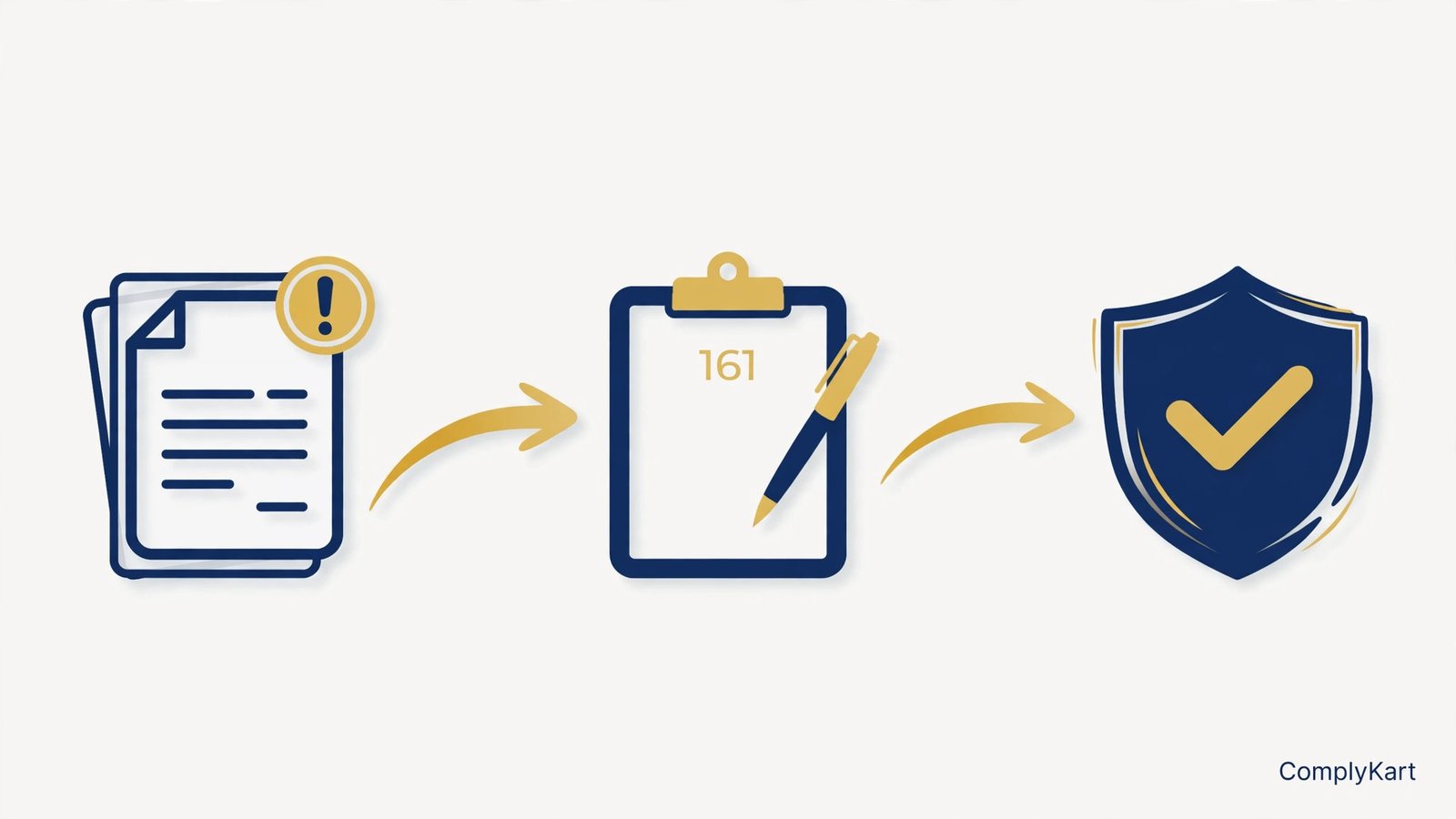
You open the assessment order first. The officer has added back income you missed in the return, or read a deduction differently from how you did. Then the second envelope arrives — a penalty notice under Section 439 of the Income-tax Act, 2025. Under-reporting. Mis-reporting. Two words that sound technical and land like a punch. I have watched that envelope change the mood of many meetings.
On 8 October 2026, that envelope got a proper exit door. CBDT issued Notification No. 134/2026-Income Tax — G.S.R. 871(E) — the Income-tax (Sixth Amendment) Rules, 2026, exercising powers under Section 533 read with Section 440 of the Income-tax Act, 2025. Two things changed, and both matter to you. First, Rule 231 of the Income-tax Rules, 2026 now covers "imposition or waiver" of penalty — earlier it spoke only of imposition. Second, Form No. 161 was replaced entirely. The new form carries a plain title: "Application for seeking waiver of penalty under section 440(2) of the Income-tax Act, 2025." Effective from the date of publication in the Official Gazette — which means it is live now.
Let me explain what the waiver actually buys you. If a penalty has been imposed — or is on its way — under Section 439 for under-reporting or mis-reporting of income, you can apply to the Assessing Officer to have it waived under Section 440(2). That is the penalty part. The form also shields you from prosecution being initiated under Sections 478 or 479 of the Act for that same under-reporting. That shield matters more than people realise. A penalty is money. Prosecution is a criminal proceeding.
Nothing this useful comes free. In exchange for the waiver, you pay additional income-tax in lieu of the penalty. The notification prescribes this additional tax at 100% and 120% of the relevant tax, depending on the category your under-reported income falls into. Which brings us to the trickiest part of the new form — the sorting exercise it forces on you.
The revised Form 161 makes you split your under-reported income into three separate boxes before it will compute anything. Box one: under-reported income arising from mis-reporting of the kinds listed in Section 439(11)(a) to (f). Box two: mis-reporting of the kind in Section 439(11)(g). Box three: plain under-reporting, where no mis-reporting is involved. The additional tax rate you pay depends on which box the income sits in.
Think of it like a Lok Adalat settlement. You walk in, pay the agreed amount, and the dispute ends that day. Nobody treats it as an admission of guilt — but you do sign a paper saying you will not take the matter to a higher court. Form 161 works the same way. The additional tax is your settlement amount. The waiver plus the prosecution shield is your closure. And the no-appeal undertaking, which I will come to, is the paper you sign. Certainty has a price. The new form asks you to name it, box by box.
Now the conditions. Miss one, and the door stays shut. The framework the form operationalises lays down a short checklist:
- Pay the demand first. The tax and interest demanded in the assessment or reassessment order must be paid within the time the demand notice allows.
- Pay the additional tax. The additional income-tax in lieu of penalty — computed per the three-box classification — must be paid. The form asks for challan details.
- Give up the appeal. You must not have filed any appeal against the assessment order, and you must undertake not to file one. Read that again. Filing Form 161 closes the appeal route for good.
- No prosecution already started. If a criminal case under Chapter XXII of the Act has already been initiated, this relief is not available to you.
The form also demands the unglamorous details: your PAN, the assessment or reassessment order particulars, the Document Identification Number, the relevant tax year, assessed income, the under-reported income split across the three boxes, and the payment particulars. The accompanying notes even allow for pre-filling of some of this information. It is a long form. Fill it like the officer will read every line — because he will.
Then the clock starts. File the application within one month from the end of the month in which you received the assessment or reassessment order. The Assessing Officer must pass his order within three months from the end of the month in which your application reaches him. And the application cannot be rejected without giving you an opportunity of being heard. That last line is not decoration. It means a summary rejection, without hearing you, will not survive.
My honest take, practitioner to reader. This waiver suits the case where the addition itself is indefensible — the income was genuinely missed, the books cannot support the deduction, and fighting the assessment would only burn fees while the penalty and prosecution risk sit on the table. In that situation, trading an uncertain penalty plus a prosecution shadow for a fixed additional tax is usually the smarter arithmetic.
It does not suit the case where you believe the officer got it wrong. If the addition is genuinely contestable and the stakes justify an appeal, do not let a penalty notice panic you into Form 161. The undertaking is permanent. You cannot file the waiver application and keep the appeal option warm. Pick your battle before you pick your form.
One more thing. This is fresh law — notified days ago, with forms and portal behaviour still settling in. If a penalty notice from a recent assessment is sitting on your desk, show it to your tax adviser this week, not next month. The one-month filing window does not wait for anyone to get comfortable with the new form.



Comments
No comments yet — ask the first question below.
Join the discussion
Questions go straight to our expert desk. Comments appear after a quick review — no spam, no noise.