
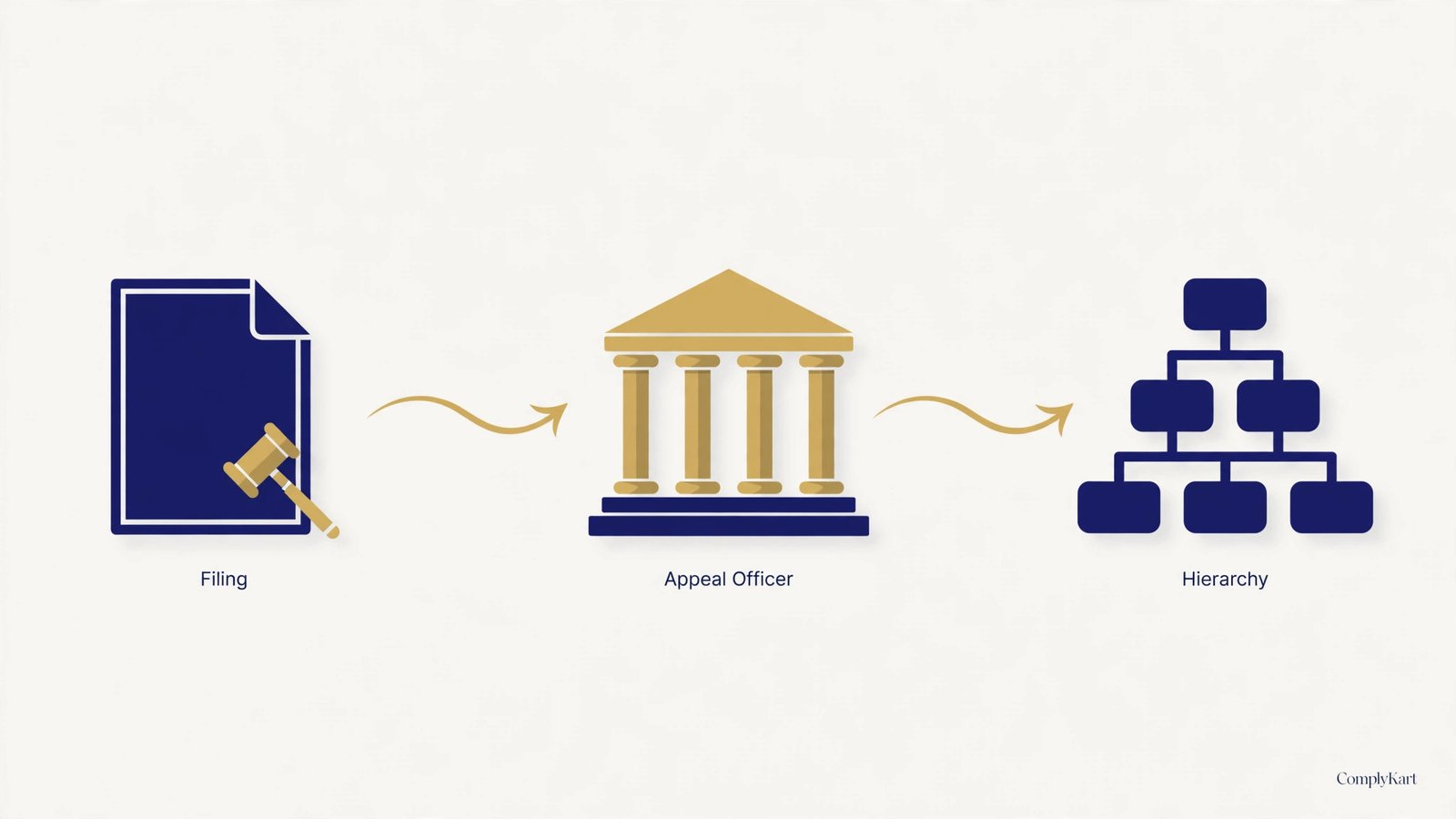
On 30 September 2026, the Central Board of Direct Taxes issued a notification most taxpayers will never read. CBDT Notification No. 133/2026 runs barely a page. It names no new tax, changes no rate, and extends no deadline. It does something quieter: it writes down, in law, exactly who your tax appeal officer reports to.
If you have ever appealed an income-tax assessment — or think you might one day — that one page matters to you. Here is what it says, and why the CBDT bothered.
First, the appeal itself
When the assessing officer passes an order you disagree with, you do not go straight to court. You file a first appeal. This is the department’s own review mechanism: a senior officer re-examines the assessment, the additions, the disallowances.
The appeal is filed electronically in Form 35, generally within thirty days of the demand notice. Miss that window and you are asking for condonation — possible, but never comfortable. The officer who hears it sits at the Commissioner (Appeals) level. For most cases that means a Commissioner of Income-tax (Appeals). For specified categories of smaller or routine cases, the appeal goes to a Joint Commissioner (Appeals) or an Additional Commissioner (Appeals).
These are real appellate authorities. They can confirm, reduce, enhance, or annul an assessment. Their orders carry weight. And until last month, the law describing whom the Joint and Additional Commissioners (Appeals) administratively answer to was an old patchwork — a 1988 notification, amended last in 2023, written for a different statute.
What Notification 133/2026 actually says
The notification is issued under Section 238 of the Income-tax Act, 2025 — the new Act that is replacing the 1961 law. It substitutes clause (ba) of the old 1988 notification (S.O. 359, dated 30 March 1988). The substituted clause says, in plain terms:
Joint Commissioners of Income-tax (Appeals) and Additional Commissioners of Income-tax (Appeals) are subordinate to the Principal Chief Commissioner or the Chief Commissioner of Income-tax within whose jurisdiction they function.
That is the whole change. One sentence of hierarchy, published as S.O. 5368(E), effective from its publication in the Official Gazette. The file number, for the curious, is F. No. 300187/1/2026-ITA-I.
Think of it like a cricket match where the third umpire’s supervisor was never named in the rulebook. Everyone in the stadium knew someone was in charge of the umpires. No written rule said who. This notification writes the name in. Nothing about how the match is played changes — but the chain of responsibility is now printed, citable, and beyond argument.
Why the CBDT bothered with this at all
India is mid-transition from the Income-tax Act, 1961 to the Income-tax Act, 2025. When a statute is replaced, every notification, rule, and delegation issued under the old law needs to be re-anchored in the new one — or it sits on shaky legal ground.
This notification is that re-anchoring. The 1988 notification governing who reports to whom was last amended by Notification 41/2023 in June 2023. The present amendment lifts the appellate hierarchy into the new Act’s framework, under Section 238, so there is no gap a litigant can exploit later.
I read this as housekeeping with a purpose. Appellate orders get challenged on procedure all the time. If the authority that decided your appeal had a cloudy reporting line, that cloud becomes someone’s writ petition. The CBDT just removed the cloud.
What changes for you in practice
Almost nothing — and that is the point. Your right to appeal is untouched. The form, the thirty-day clock, the grounds you can raise: all unchanged. No new compliance falls on you because of this notification.
What you gain is clarity. If your first appeal is before a Joint or Additional Commissioner (Appeals), you now know exactly which Principal Chief Commissioner or Chief Commissioner administratively oversees that office. Escalations, grievances about delay, and administrative complaints have a printed address. Before this, you would have had to piece that together.
One caution, because I see this confusion often: administrative subordination is not the same as deciding your case. The notification tells you who the appeal officer reports to. It does not tell the officer how to decide. Your appeal still succeeds or fails on its merits — the law, the evidence, the computation. A clearer org chart does not make a weak ground strong.
The habit this notification rewards
The department has now published its own chain of command. Publish yours. If an assessment order lands on your desk, the thirty-day appeal clock starts whether you are ready or not. The businesses that handle appeals well do one unglamorous thing: they diary the date the same day the order arrives, and they brief their counsel within the week.
Most appeal disasters I see are not about bad law. They are about good grounds filed late, or strong facts argued by someone who met the file for the first time the night before. The notification changed the department’s paperwork. Your paperwork — the dates you track, the records you keep — is still the part that decides outcomes.
A one-page notification, a one-sentence hierarchy, and a reminder that in tax litigation, the boring disciplines win. File on time. Know who decides. Know who they answer to. Now, at least, the last of those is written down.



Comments
No comments yet — ask the first question below.
Join the discussion
Questions go straight to our expert desk. Comments appear after a quick review — no spam, no noise.