
IN BRIEF
An Input Service Distributor is a separately registered office of a company that receives invoices for input services used by two or more of the company's own GST registrations and distributes the credit to them under section 20 of the CGST Act, 2017. CBIC Circular No. 260/06/2026-GST, dated 26 October 2026, settles how that distribution, its timing and its reversals work.
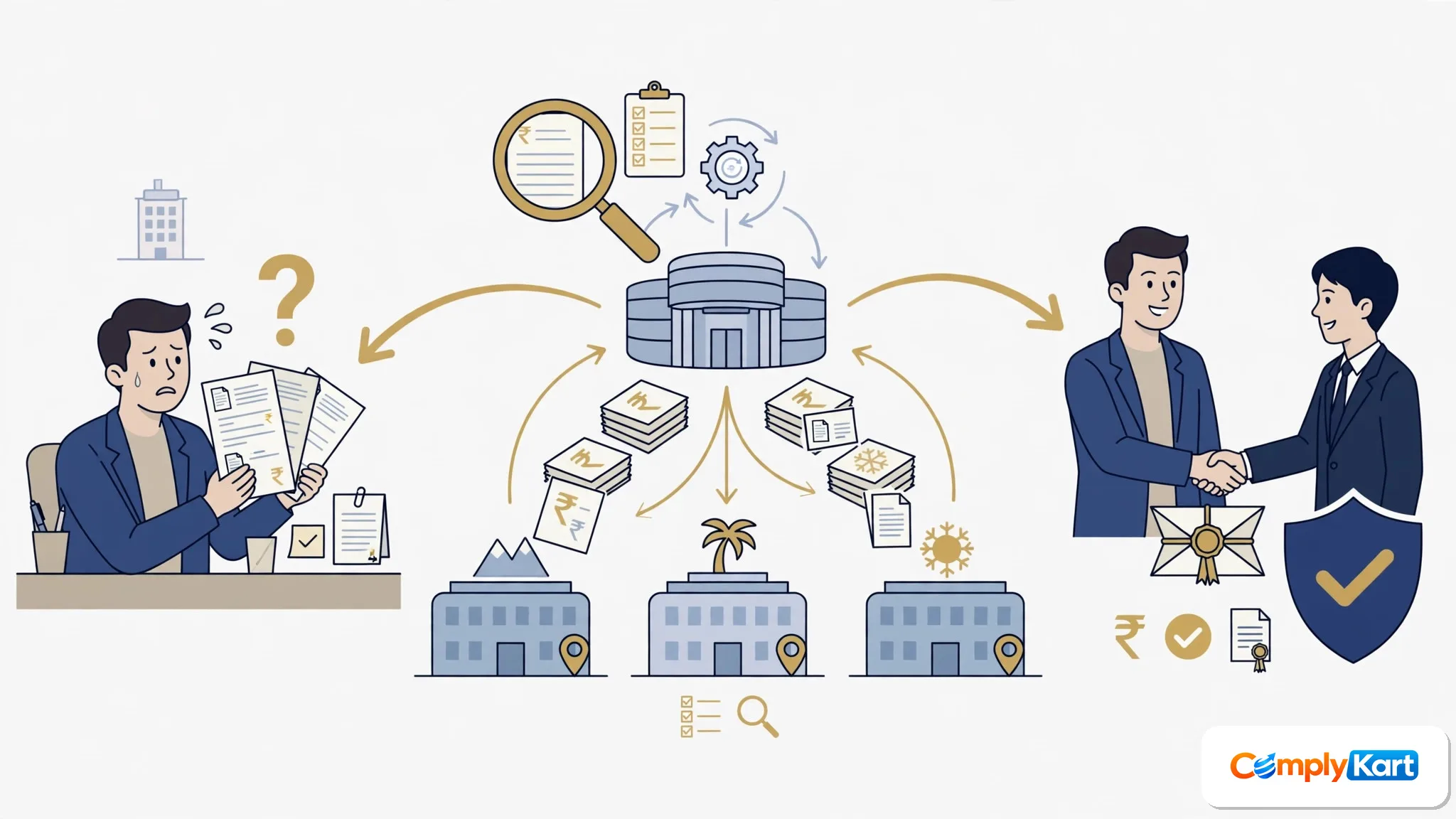
Your head office pays one bill for a service every branch uses — software, audit, a lawyer, a recruitment agency. The branches sit in different states, each with its own GSTIN, and the credit on that one bill has to reach each of them in the right share. That job belongs to the Input Service Distributor, or ISD. CBIC's Circular No. 260/06/2026-GST, dated 26 October 2026, has just settled seven arguments about how the ISD works, and a companion rule change from 1 November 2026 has removed one of its oldest deadlines.
In short: an ISD is a GST registration that passes credit on common input services to a company's registrations in other states. Since 1 April 2025 this route is mandatory. Circular 260 says credit is distributed in the month it is found prima facie eligible, recipients make the reversals, and moving reverse-charge credit to the ISD is not a sale.
What is an Input Service Distributor?
An ISD is an office of a company that receives invoices for input services meant for two or more of the company's own registrations — its distinct persons under section 25 of the CGST Act, 2017. Section 2(61) defines it, and section 20 sets out how it distributes credit. The ISD gets its own GSTIN, separate from the head office's regular registration, even though the PAN is the same. It does not sell goods or services. It only distributes credit, and it reports what it received and what it passed on in Form GSTR-6, due by the 13th of the following month.
Two limits matter from the start. The ISD route covers input services only, not goods or capital goods. And a person registered under the composition scheme cannot register as an ISD. If your head office buys laptops for branches, that is not an ISD matter. If it buys a single software licence used by branches in five states, that is exactly what the ISD exists for.
Who must register as an ISD?
The test is simple, and it has no turnover threshold. If an office receives invoices for input services that have to be distributed to distinct persons under section 20, that office must hold ISD registration. The Finance Act, 2024 made this mandatory from 1 April 2025, through Notification No. 16/2024-Central Tax dated 6 August 2024. Before that date, many companies passed common-service credit around by cross-charging branches. That shortcut is now outside the law for credit that belongs on the ISD route, and it leaves the credit open to disallowance.
Registration follows the ordinary route: Form GST REG-01 on the GST portal, with Input Service Distributor chosen as the reason for registration. The ISD files GSTR-6 every month, including nil months, and keeps working papers tying each supplier invoice to the recipients and their shares.
Can you hold more than one ISD registration in the same state?
Yes, and this is where Circular 260 corrects a lot of older advice. Guides written before October 2026 often said one ISD registration per state, full stop. The circular says there is no bar on more than one ISD registration in the same state or union territory, where different business verticals or places of business are separately registered and each receives input-service invoices for distinct persons. Each such registrant must obtain its own ISD registration, and credit goes only to the distinct person it is attributable to.
Take a company with two separately registered verticals in Maharashtra — a manufacturing division and a trading division, each with its own GSTIN. If each division's office receives common-service invoices for its own branches, each needs its own ISD registration. Map ISD registrations vertical by vertical, and keep attribution records proving which credit belonged to whom.
When must the credit be distributed?
This is the change that helps finance teams most. The old position, written into the GSTR-6 instructions, was that credit had to be distributed in the same month the inward supply was received. Circular 260 replaces that with a practical test: distribute in the month in which the ISD ascertains, from the invoice details in Form GSTR-6A, that the credit is prima facie eligible. Eligible and ineligible credit are distributed separately, as Rule 39(1)(g) requires, and both are reported in GSTR-6.
Notification No. 05/2026-Central Tax, dated 26 October 2026 and effective from 1 November 2026, gives this statutory backing. It deletes the same-month instruction from the GSTR-6 instructions, drops Tables 7 and 11 from the form, and — through amended Rule 60(2) — puts supplier details into GSTR-6A for the ISD. If an invoice lands in GSTR-6A in November but eligibility is only confirmed in December, December is the distribution month.
Who carries out the reversals — the ISD or the branches?
The branches do. The ISD's job is to distribute credit in the manner section 20 prescribes. The recipient distinct persons must satisfy the eligibility conditions in sections 16 and 17 and the rules made under them, and they must make the reversals those provisions require — under section 17(1) or 17(2) read with Rules 42 and 43 for exempt and non-business use, or under section 17(4) read with Rule 38 for banks and financial institutions on the 50% route. The ISD does not make those reversals merely because it distributed the credit.
The split of consequences follows the same line. If the ISD distributes credit in contravention of section 20, it can face a penalty under section 122(1)(ix). If that contravention leaves a recipient holding more credit than it should, the excess is recoverable from the recipient, with interest, under section 21. So a branch that accepts ISD credit without checking eligibility is not protected by the fact that head office sent it. Check before you claim, not after the notice arrives.
How is common credit shared between branches?
Credit that belongs to one recipient goes only to that recipient. Credit for a service used by several recipients is shared in proportion to their turnover in the state or union territory during the relevant period, under section 20 read with Rule 39. Here is a small example you can check.
Say the ISD holds ₹1,00,000 of credit on a common software service, and two recipients used it. Recipient A had turnover of ₹60 lakh in the relevant period and recipient B had ₹40 lakh, a total of ₹1 crore. A receives 60% — ₹60,000 — and B receives 40% — ₹40,000. If, in the same month, the ISD also holds ₹20,000 of credit on a service used only by recipient A, that ₹20,000 goes entirely to A and is never folded into the shared split. Specific credit stays specific; only common credit is shared.
One more point from the 1 November changes: Rule 39(1)(i) now covers distribution of central tax as well as integrated tax. Keep the tax-head split — CGST, SGST, IGST — intact on every ISD invoice.
The reverse-charge transfer: moving credit is not a sale
The trickiest part of Circular 260 concerns reverse-charge credit, and the analogy that clears it up is moving money between your own pockets. Moving a ₹500 note from your left pocket to your right pocket is not income, and it is not a sale. It is the same money, in a different place. Rule 54(1A) works the same way for credit.
Where a registered person with the same PAN and in the same state as the ISD has paid tax under reverse charge on an input service, it issues an invoice, credit note or debit note under Rule 54(1A) to transfer that credit to the ISD for onward distribution. Circular 260 settles three points about those documents. First, they are not outward supplies of the person issuing them. Second, their amounts are excluded from that person's turnover in the state or union territory under section 2(112) — including for the section 20 and Rule 39 allocation, and for adjusted total turnover in a refund claim under section 54(3) read with Rule 89. Third, the transferred credit is not Net ITC of the transferring person for a refund under Rule 89(4) or 89(5).
The transferor also does not reverse the transferred credit. It must pass the entire relevant reverse-charge credit to the ISD without making the proportionate reversals under section 17(1), 17(2) or 17(4). The recipients make those reversals, and that includes the transferor itself where it also receives credit back as a recipient. The 1 November amendments widen this further: the word "common" is dropped from Rule 39(1A) and Rule 54(1A), so the transfer now covers input services attributable to one or more distinct persons, not only services that qualify as common input services.
What this means for a multi-state business
If your head office still pays common-service bills through its regular GSTIN, check three things this month. First, whether you hold ISD registration for every vertical and place of business that receives invoices for distinct persons — including a second ISD in a state with two separately registered verticals. Second, whether your distribution month follows the new prima-facie-eligibility test, with GSTR-6A as evidence. Third, whether any Rule 54(1A) transfer amounts have crept into your turnover or Net ITC figures. A wrong allocation can surface as a scrutiny notice, and a wrong refund figure as a demand — see our guides on replying to a GST scrutiny notice in ASMT-11 and on show cause notices after Circular 258.
For the registration side, the ordinary GST registration route is where an ISD application starts, and businesses with registrations in many states often find the multistate registration guide useful alongside it. If you want a rough sense of what the filings around a registration cost, the compliance fee calculator gives an indicative figure before you speak to a professional.
Five mistakes to avoid
First, routing common-service credit by cross-charge instead of through the ISD, as was done before April 2025. Second, holding one ISD registration for two separately registered verticals in a state and mixing their credit. Third, distributing credit in the month the invoice arrived even though eligibility was confirmed later — or sitting on eligible credit past its month. Fourth, letting the ISD make section 17 reversals, or letting recipients skip them assuming head office handled it. Fifth, counting Rule 54(1A) transfer documents as sales, or transferred credit as your own Net ITC in a refund claim.
Frequently asked questions
Does an ISD file GSTR-1 or GSTR-3B like a normal taxpayer? No. The ISD's return is GSTR-6, due by the 13th of the following month. A regular registration's GSTR-3B is a different return, and the ISD does not make outward supplies to report in GSTR-1.
Can a single-branch company ignore the ISD rules? Yes, in practice. If you have only one registration, there are no distinct persons to distribute credit to, so there is nothing for an ISD to do. The rules bite when one PAN carries two or more registrations and common-service invoices arrive centrally.
What happens if the ISD distributes too much credit to a branch? The ISD faces a penalty under section 122(1)(ix) for distributing in contravention of section 20, and the excess is recovered from the recipient branch with interest under section 21. Correct it with an ISD credit note as soon as you spot it, rather than waiting for the mismatch to surface in a recipient's return.
Do the 1 November 2026 rule changes apply to earlier months? The amendments in Notification No. 05/2026-Central Tax take effect from 1 November 2026. They change how distribution timing, Rule 54(1A) transfers and GSTR-6 reporting work from that date. Circular 260's clarifications of the underlying sections settle how the existing provisions should be read, but do not rewrite history for closed periods — take advice on a specific past month rather than assuming a new rule reopens it.





Comments
No comments yet — ask the first question below.
Join the discussion
Questions go straight to our expert desk. Comments appear after a quick review — no spam, no noise.