
IN BRIEF
ISO 9001 certification is independent confirmation that a business runs a quality management system meeting the ISO 9001 standard, awarded by a certification body after Stage 1 and Stage 2 audits. It applies to any business, from a 5-person firm to a factory, that wants its quality processes verified by a third party. In India, certificates from NABCB-accredited bodies carry recognition under the IAF multilateral arrangement.
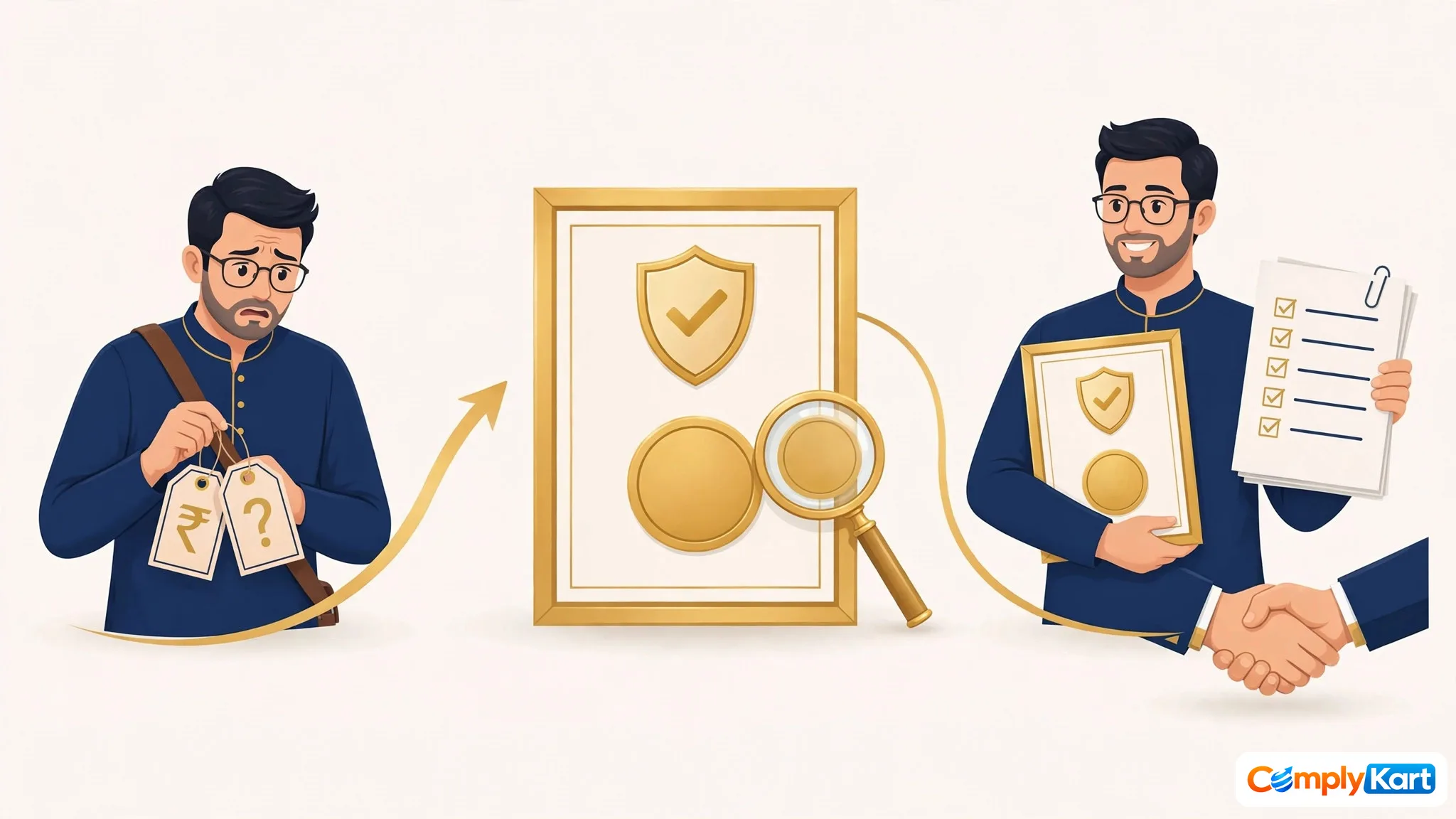
Ask five sellers what ISO 9001 certification costs in India and you will get five different numbers. One says ₹7,999, all-in. Another says ₹2 lakh. Both sound sure of themselves. Only one of them is quoting you the whole bill.
The short answer: ISO 9001 certification in India has two bills, not one. You pay a consultant to build your quality management system, and you pay an independent certification body to audit it. Our consultancy costs ₹9,999 for a business with up to 25 employees and ₹19,999 for 26 to 100 employees, with the certification body's audit fees charged extra at actuals. A genuine accredited certificate for a small company typically lands between ₹75,000 and ₹2,50,000 all-in over the first year. A ₹7,999 all-in quote is almost always a certificate from a body no tender will accept.
Why are there two bills?
ISO itself never issues certificates. It writes the standard. The certificate comes from a certification body, a separate company whose auditors visit your premises, check your system against the standard, and decide whether you pass. In India, the stronger certification bodies are accredited by NABCB, the National Accreditation Board for Certification Bodies. Accreditation is what makes a certificate travel: under the IAF multilateral arrangement, an NABCB-accredited certificate is recognised by buyers and tender authorities in other member countries too.
Your consultant cannot also be your certifier. That separation is the whole point. Your consultant builds the system, trains your people, runs your internal audit, and gets you ready. The certification body then audits it cold. Any seller offering one combined price where the same firm both prepares you and certifies you should make you pause.
So when you compare quotes, split them in your head. Consultancy on one side. Audit fees on the other. Our ISO 9001 certification prices — ₹9,999 for up to 25 employees, ₹19,999 for 26 to 100 — cover the consultancy side only: gap analysis, documentation, implementation help, internal audit, and liaison with the certification body. The audit fee goes to the certification body and depends on your headcount, sites, and scope. It is charged at actuals, and we tell you the figure before you commit.
What makes one business pay more than another?
Four things move the price. Headcount is the first — auditors charge by audit days, and audit days rise with employee numbers. A 12-person office needs fewer audit days than a 90-person factory. Sites are the second. Two factories cost more to audit than one. Scope is the third. "Manufacture of plastic components" is a tighter scope than "design, manufacture, installation and servicing" across three product lines, and a wider scope means a longer audit. Readiness is the fourth, and it is the one you control. A business with written processes already in place needs less consultancy than one starting from memory and habit.
One more driver: whether you bundle standards. If you need ISO 14001 certification for environment alongside 9001, an integrated audit covers both in one visit and costs less than two separate certifications. Ask for that quote explicitly. Sellers rarely volunteer it.
A worked 3-year cost example you can check
Take a 12-person trading company, one office, one straightforward scope. Here is how its three years could look. Treat the certification-body figures as an illustration, not a quote — your certification body sets its own fee — but the shape of the bill is how it works for every small company.
Year one: consultancy ₹9,999, plus the certification body's initial audit, say ₹30,000 for a small single-site audit. Total year one: about ₹40,000. Year two: a surveillance audit, roughly ₹15,000 to ₹20,000. Year three: another surveillance audit, roughly the same. Three-year total: roughly ₹70,000 to ₹80,000, before taxes.
That sits near the bottom of the genuine accredited range you will see quoted elsewhere — guides put a small company's accredited first-year cost at roughly ₹50,000 to ₹2,50,000, with surveillance audits of ₹15,000 to ₹75,000 each. The spread is real. A factory with two sites and a wide scope will land higher. A tidy single-office firm lands lower. What matters is that you compare three-year totals, not first-year headlines. A cheap first year with heavy surveillance fees is the oldest trick in this market.
The certificate itself runs for three years. The certification body visits every year for surveillance, and at the end of year three you go through recertification. Skip a surveillance audit and the certificate gets suspended. That is not a penalty clause in small print. It is how the system works.
What a ₹7,999 certificate really is
Here is the analogy I use with owners. An accredited certificate is like a degree from a recognised university. A non-accredited certificate looks similar on paper, but it is a print-shop degree. Same frame. Different acceptance.
Budget sellers advertising ₹7,999 all-in are usually issuing through bodies that are not accredited by NABCB or any IAF member. Their certificates cost little because no rigorous audit stands behind them — sometimes no audit at all. The certificate arrives fast, often in days, and it works fine until someone checks. Government tenders and large buyers check. They write "accredited certificate" into their eligibility conditions, and a non-accredited certificate fails that condition outright. You lose the tender you bought the certificate for.
Before you pay anyone, run three checks. First, ask for the certification body's name and who accredits it. Second, look that body up on NABCB's list of accredited bodies. Third, ask how the certificate itself can be verified — a genuine certification body lets anyone confirm a certificate's validity with it. If a seller cannot answer all three clearly, walk away. The ₹7,999 you save is the cheapest money you will ever regret spending.
The process, step by step
Seven steps, in order. Gap analysis first: what you already do versus what the standard asks for. Documentation second: a quality manual, procedures, and records that match how you actually work — not a binder copied from another company. Implementation third: your team starts following the written process, not the old habit. Internal audit fourth: someone inside, trained for it, audits your own system and finds the gaps before the outsider does. Management review fifth: you sit down, look at the audit findings, and fix them. Stage 1 audit sixth: the certification body's auditor reviews your documents and readiness. Stage 2 audit seventh: the same body audits your premises and people. Pass both, and the certificate issues.
Most first-timers stumble at step two. They buy a thick manual that describes a company they are not. Auditors spot that in minutes, because your staff cannot explain a procedure they never read. Write short procedures your own team can actually follow. Ten pages you use beat a hundred you do not.
How long does it take?
Honest answer: it depends on readiness, and published timelines disagree for that reason. Consultancies advertising fast delivery quote 15 to 20 days for a small, ready business. Broader guides quote 3 to 6 months. Both can be true. A single-office firm with its processes already written down can move in weeks. A factory that needs its processes built from scratch, staff trained, and an internal audit cycle completed will take months. Plan on 4 to 8 weeks if your paperwork is mostly in order, and longer if it is not. Anyone promising a certificate in three days is not selling you an audit. They are selling you paper.
One more thing: the standard itself just changed
If you are buying now, buy against the right edition. ISO published ISO 9001:2026 on 16 September 2026, replacing the 2015 edition. Under the transition rules, new accredited certifications can only be issued against the 2026 edition from 31 March 2028, and certificates to the 2015 edition stop being valid on 30 September 2029. For a first-time applicant, that means one thing: build your system to the 2026 edition now and skip paying for a transition audit later. If a seller is still quoting you a 2015-only build with no mention of the transition, ask them about it before you sign.
Documents you will be asked for
- Company registration proof — certificate of incorporation, GST registration, or equivalent
- Scope of work — what you actually make, sell, or deliver, in plain words
- Employee list with roles, plus any site addresses beyond the head office
- Existing process notes, formats, and registers, even if they are informal
- Any current licences or registrations your trade already requires
Nothing exotic. The certification body wants to see a real business with real processes, not a paper exercise.
5 mistakes that make the bill bigger
- Buying on the headline price alone. Compare the three-year total, including both surveillance audits, before you choose.
- Choosing a non-accredited body to save money. It saves money once and costs you every tender after.
- Writing a scope that is too narrow. A certificate that does not cover the work you bid for is useless in that bid. Get the scope right first.
- Skipping the internal audit. Findings the certification body discovers cost you a re-audit visit. Findings you discover cost you a correction.
- Letting the consultant write procedures nobody reads. If your team cannot explain the process, the auditor will not pass it.
Frequently asked questions
What is the total cost of ISO 9001 certification in India for a small company?
Our consultancy is ₹9,999 for up to 25 employees and ₹19,999 for 26 to 100 employees, with the certification body's audit fees extra at actuals. A genuine accredited certificate for a small company typically totals ₹75,000 to ₹2,50,000 all-in over the first year, plus surveillance audits in years two and three.
Is a ₹7,999 ISO 9001 certificate valid?
It is a real piece of paper from a real issuer, but if the issuer is not accredited, tenders and large buyers that require an accredited certificate will reject it. Check the certification body's accreditation on NABCB's list before paying.
How long is an ISO 9001 certificate valid?
Three years, with a surveillance audit in each of years two and three and recertification at the end of the cycle. Missing a surveillance audit leads to suspension.
Can I get certified to ISO 9001:2015 now?
Until 31 March 2028, yes, but that certificate must transition to the 2026 edition before 30 September 2029. A new applicant is better off building to ISO 9001:2026 from the start.
Do I need a consultant, or can I go straight to a certification body?
You can go straight to a certification body if your system is already documented and audited internally. Most small businesses are not there yet, and that is what the consultancy covers — gap analysis, documentation, training, and the internal audit.
The cheapest certificate is rarely the cheapest decision. Price the whole three years, check the accreditation, and build to the 2026 edition. If you want a firm figure for your own headcount and scope, our ISO 9001 certification page lists the consultancy tiers, and the compliance fee calculator helps you size up the wider compliance bill your business carries alongside it.



Comments
No comments yet — ask the first question below.
Join the discussion
Questions go straight to our expert desk. Comments appear after a quick review — no spam, no noise.