
IN BRIEF
An LLP for a family business is a Limited Liability Partnership registered under the Limited Liability Partnership Act, 2008. It is a separate legal entity with perpetual succession, so the business continues when partners change, and each partner's liability is limited to their agreed contribution. The LLP agreement sets profit sharing, decision-making and succession, and must be filed in Form 3 within 30 days of incorporation.
A Limited Liability Partnership is usually the right home for a family business that wants a company's protection without its boardroom machinery. It gives the family a separate legal entity, limited liability for every partner, and one written agreement that settles profit sharing, decision-making and succession. It is the wrong choice if the family plans to raise equity funding.
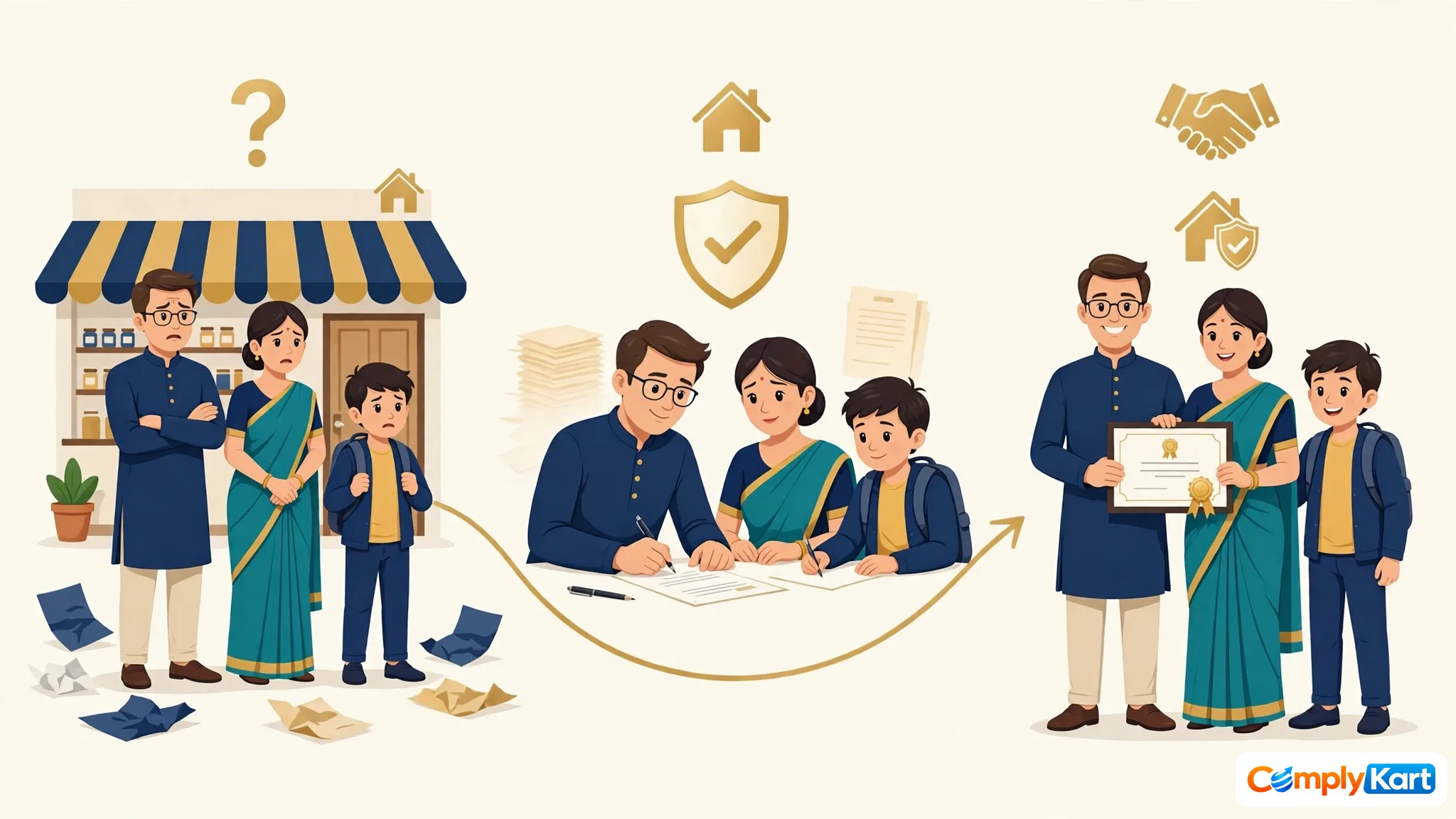
Most family businesses in India start as a handshake. Father runs the shop, the son handles suppliers, the daughter manages accounts — and nothing is written down. That works until it does not: a supplier sues, a brother wants out, or the founder dies and the children discover nobody actually owns anything in the way they assumed. An LLP puts the business on a proper legal footing without turning it into a company. Here is how it works, what it costs, and where the traps sit.
What an LLP actually is for a family business
An LLP is a body corporate registered under the Limited Liability Partnership Act, 2008. It is a legal person separate from the family members who run it. It can own property, sign contracts, hold a bank account and a PAN in its own name, and it can sue and be sued. It keeps going when partners change — that is perpetual succession, written into Section 3 of the Act.
Think of it the way you would think of the family house. The house stands whether or not a particular family member is living in it. The family members live in it, use it and look after it, but the house itself belongs to no one person. An LLP works the same way. The business is the house. The partners are the family living in it. And the LLP agreement is the house rules — written down before anyone argues about who pays for the repairs. That separation is the whole point: in an unregistered partnership firm, the business and the family are the same thing in law, and a business debt can reach the partners personally. In an LLP, the LLP owes it.
Why families choose an LLP: six real benefits
Your home stays yours. Limited liability is the first reason families register. Supplier credit, bank limits and trading exposure run high in family trading and manufacturing businesses. In an LLP, a business debt does not reach the family home, land or savings, apart from what a partner personally guaranteed or did wrong.
The business outlives any one member. A partner can retire, fall ill or pass away and the LLP carries on. Contracts stay live, bank accounts stay open, GST registrations stay unchanged. For a family passing a business between generations, that continuity is worth more than any tax saving.
You write your own rules. The LLP agreement decides who earns what, who decides what, and how someone exits. A working partner and an investing partner can be treated differently. A father can hold a larger profit share while the son who runs the shop draws remuneration. No statute forces a fixed formula on you.
Profit reaches the family once, not twice. The LLP pays tax on its profit, and the partners' share of that profit is exempt in their hands under Section 10(2A) of the Income-tax Act, 1961. A company, by contrast, pays tax and then the dividend is taxed again in the shareholder's hands.
Compliance stays light. No board meetings, no annual general meeting, no resolutions to minute. An LLP files two MCA forms a year — Form 11 and Form 8 — plus its income-tax return. A statutory audit applies only when turnover crosses ₹40 lakh or total partner contribution crosses ₹25 lakh.
Banks and buyers take it seriously. Lenders, large buyers and export customers treat a registered LLP very differently from an unregistered partnership. It has an LLPIN, a PAN and a public record on the MCA portal. That credibility matters when a family firm wants a bigger credit limit or a corporate customer.
The honest limits — read these before you register
An LLP is not the cheapest tax structure. It pays a flat 30% on its profit plus a 4% health and education cess — 31.2% effective on income up to ₹1 crore. A private limited company that opts for Section 115BAA pays 22% plus surcharge and cess, about 25.17% all-in. On rate alone, the company wins. I work the numbers below so you can see the gap in rupees, not adjectives.
An LLP cannot issue shares, so it cannot take equity investment and it cannot offer ESOPs. If the family plans to bring in an angel investor or a venture fund in the next few years, an LLP is the wrong vehicle — investors do not become partners in an LLP. Converting an LLP into a company later is possible but it involves stamp duty and GST complications, so make this call before you register, not after.
Foreign investment into an LLP is restricted in some sectors. If a non-resident family member wants to invest, check the sector rules first — the position is not as open as it is for a company.
Ownership in a family LLP: who can be a partner, and what do they own?
An LLP needs at least two partners, and at least two designated partners. At least one designated partner must be resident in India — someone who stayed in India for 120 days or more during the previous financial year. There is no maximum number of partners and no minimum capital: the family starts with whatever contribution the partners agree on.
Every partner must be a major — 18 years or older — and of sound mind. A minor cannot be a partner in an LLP. What you can do is plan for it: the agreement can set out how a child joins when they turn 18, and the family will should line up with the agreement so the two documents never contradict each other.
A body corporate can also be a partner — for instance, the family's existing company or a family trust's corporate trustee — but it acts through a nominee who is an individual. A body corporate itself cannot be a designated partner; its nominee can.
Designated partners carry the compliance duties. They are the ones responsible for filing documents and returns, maintaining records, and signing the annual forms. In a family LLP, pick the members who will actually do the paperwork — usually two — and make sure they understand the job is real. A missed Form 11 is not the firm's problem alone; the designated partners are personally on the hook for the penalties. The full picture of how many partners an LLP needs and what each one owes is worth reading before you name yours.
Ownership in an LLP is not shares. It is two separate things, and families confuse them constantly. Contribution is what each partner puts in — cash, property or services, valued and recorded. Profit share is what each partner takes out, and the agreement can set it however the family wants. The father who put in ₹20 lakh and works full-time can take 50% of the profit. The son who put in nothing but runs the shop can take 30%. The daughter who put in ₹10 lakh and does not work in the business can take 20%. Contribution and profit share do not have to match. What matters is that the agreement says so in writing. If it does not, Section 23 of the Act applies the First Schedule defaults — and the default is equal sharing, which is rarely what the family intended.
The LLP agreement is the family constitution — write it properly
The LLP agreement is the single most important document in a family LLP. It is filed with the MCA in Form 3 within 30 days of incorporation, and it governs everything the Act leaves to the partners. A good family agreement covers seven things.
Profit and loss sharing. The exact ratio, and whether it changes when a partner's role changes. Write the ratio in numbers, not words like "fair share".
Remuneration. Who draws a salary for working in the business, how much, and within the Section 40(b) limits — more on those in the tax section below. Remuneration must be authorised by the agreement to be deductible.
Decision-making. Which decisions need all partners, which need a majority, and who decides day-to-day spending. Families fight most over money decisions nobody defined.
Admission and exit. How a child, a spouse or an in-law joins, and on what terms — state it now, while everyone is getting along. And how a partner leaves, whether by retirement, a branch wanting out or a dispute, and how their share is valued. Without a valuation method in the agreement, every exit becomes a negotiation, and family negotiations about money are the worst kind.
The death clause. What happens to a deceased partner's share, whether a named heir can be admitted as a partner, and within what time. This is the clause most family agreements skip, and the one they miss most. The next section explains why it matters so much.
Dispute resolution. Arbitration under the Arbitration and Conciliation Act, 1996 is the standard choice. A family that agrees on arbitration in advance keeps its dispute out of court and out of the newspapers.
Stamp duty on the agreement is state-specific — Maharashtra charges 1% of the contribution, Delhi charges 1% capped at ₹5,000. Check your state's Stamp Act before execution. And file Form 3 on time: until the agreement is on MCA record, the Schedule I defaults govern the relationship, and for a family where one member brings the money and another the labour, even a short window under equal sharing creates tax and legal uncertainty.
Succession: what actually happens when a partner dies
This is the part most guides get wrong, so let me say it plainly. When a partner in an LLP dies, the LLP does not die with them. It carries on with the remaining partners. But the family does not automatically step into the dead partner's shoes.
Under Section 24 of the LLP Act, a partner ceases to be a partner the moment they die. The legal heirs receive the money — an amount equal to the deceased partner's capital contribution plus their share of accumulated profits — but they do not become partners, they cannot attend partner meetings, and they have no say in how the business is run. Section 24(6) says so in terms: a person who receives a deceased partner's share has no right to interfere in the management of the LLP.
There are two exceptions. First, the LLP agreement can say otherwise — it can name a successor or set out how an heir is admitted as a partner. That is the death clause I mentioned above, and it is the difference between a smooth handover and a year of arguments. Second, all the surviving partners can agree to admit the heir as a new partner. But agreement after a death is never guaranteed, which is why the clause should be written while everyone is alive and calm.
Two filings follow a death. The LLP must file Form 4 with the MCA within 30 days of the partner ceasing. And if the LLP is left with only one partner, Section 6 gives the survivor six months to find a second partner — after that, the LLP faces winding-up. The family's will must also line up with the agreement. A will that leaves "my share in the business" to a child who the agreement does not admit as a partner creates a fight between the will and the agreement, and the agreement wins on the seat while the will wins on the money. Write them together, with the same adviser, in the same sitting if you can.
Registering a family LLP, step by step
Registration runs entirely online on the MCA V3 portal. The sequence matters — skipping a step is the most common reason forms get rejected.
Step 1 — Class 3 DSC for the designated partners. Every designated partner needs a Class 3 Digital Signature Certificate to sign MCA forms. Class 2 DSCs were discontinued in January 2021. A DSC typically costs ₹1,200–2,500 per person depending on validity.
Step 2 — DPIN for the designated partners. The Designated Partner Identification Number is structurally the same as a director's DIN. If a family member already holds a DIN from a company directorship, that number works as their DPIN. If not, FiLLiP can auto-allot DINs for up to two designated partners as part of incorporation. A third designated partner must get a DIN in advance through Form DIR-3 — missing this is one of the most common causes of FiLLiP rejection.
Step 3 — Reserve the name with RUN-LLP. You can propose up to two name choices in one application. The name must end with "LLP", must not be identical or deceptively similar to an existing company, LLP or registered trademark, and must not use restricted words like bank or national without approval. The reservation lasts 90 days — miss that window and you reapply. Check the MCA name tool and the Trademark Registry before you submit; a name that clears the MCA database can still draw a trademark dispute.
Step 4 — File FiLLiP. This is the single incorporation form — the FiLLiP walkthrough covers each field. It applies for incorporation, allots DINs for up to two designated partners, and requests PAN and TAN at the same time. Attach identity and address proof for each designated partner and registered-office proof — a recent utility bill plus a no-objection certificate from the property owner if the premises are rented. Straightforward applications are typically approved in 2–5 working days.
Step 5 — Collect the documents. On approval the MCA issues the Certificate of Incorporation, the LLPIN, the PAN and the TAN. Keep all four safe; the LLPIN is what you quote on every MCA filing for the life of the entity.
Step 6 — File Form 3 within 30 days. The executed LLP agreement goes on record. Then add GST, Udyam (MSME) and IEC registrations as the business needs them.
What it costs to register a family LLP
Government fees on MCA V3 are linked to the LLP's total agreed contribution. The FiLLiP fee slab is:
| Total contribution | FiLLiP government fee |
|---|---|
| Up to ₹1 lakh | ₹500 |
| ₹1 lakh to ₹5 lakh | ₹2,000 |
| ₹5 lakh to ₹10 lakh | ₹4,000 |
| ₹10 lakh to ₹25 lakh | ₹5,000 |
| ₹25 lakh to ₹1 crore | ₹10,000 |
| Above ₹1 crore | ₹30,000 |
Take a typical small family LLP — two partners, ₹2 lakh total contribution. The arithmetic looks like this: Class 3 DSCs for two partners, ₹2,400–5,000; RUN-LLP, ₹200; FiLLiP, ₹2,000; Form 3, about ₹100; stamp duty on the agreement, ₹500–5,000 depending on the state. Total government outlay roughly ₹5,000–12,000. That is the published estimate for a small LLP, and it is well below the first-year compliance cost of a private limited company. Professional fees for drafting the agreement and handling the filing sit on top — and for a family LLP, the agreement is the one place not to economise.
How a family LLP is taxed — with the numbers
An LLP pays a flat 30% on its profit, plus a 12% surcharge if net income exceeds ₹1 crore, plus a 4% health and education cess. On income up to ₹1 crore the effective rate is 31.2%. Take a family LLP earning ₹20 lakh profit in a year: 30% is ₹6,00,000, plus 4% cess of ₹24,000 — a total of ₹6,24,000. The partners' share of that profit is then exempt in their hands under Section 10(2A). The family pays once, at the LLP level.
Compare that with a private limited company on the same ₹20 lakh profit, opting for the 22% rate under Section 115BAA: 22% is ₹4,40,000, plus a 10% surcharge of ₹44,000, plus 4% cess of ₹19,360 — a total of ₹5,03,360. The company is ₹1,20,640 a year cheaper on tax before any distribution. But the company then taxes the dividend again in the shareholder's hands, while the LLP's profit share arrives tax-free. Which structure wins depends on whether the family withdraws the profit or leaves it in the business — not on the headline rate.
There is one lever that narrows the LLP's gap, and families should know about it. Remuneration paid to working partners is deductible in the LLP's hands under Section 40(b), within limits, and taxable in the partner's hands. The current limits, revised by the Finance (No. 2) Act, 2024 with effect from Assessment Year 2025-26: on the first ₹6 lakh of book profit, ₹3,00,000 or 90% whichever is higher; on the balance, 60%. On a ₹20 lakh book profit the ceiling is ₹13,80,000 — 90% of the first ₹6 lakh plus 60% of the remaining ₹14 lakh.
Say the LLP pays ₹6 lakh as remuneration to the son who runs the shop. Taxable profit falls to ₹14 lakh: 30% is ₹4,20,000, plus cess of ₹16,800 — ₹4,36,800. The son's tax on ₹6 lakh under the new regime is ₹10,000, wiped out entirely by the Section 87A rebate since his total income is under ₹12 lakh. Combined tax: ₹4,36,800, against ₹6,24,000 without the remuneration — a saving of ₹1,87,200. The remuneration must be authorised by the LLP agreement and paid only to working partners, and interest on a partner's capital is deductible only up to 12% a year.
One more tax point: an LLP pays Alternate Minimum Tax at 18.5% under Section 115JC where it applies, but there is no Minimum Alternate Tax exposure of the kind a company faces. And remember the presumptive-tax exclusion — an LLP cannot use Section 44AD, so it keeps books and computes actual profit whatever its turnover.
Annual compliance: two forms, and the dates that matter
Every LLP, active or not, files two MCA forms a year. Form 11, the annual return, is due by 30 May — within 60 days of the financial year ending 31 March. Form 8, the statement of account and solvency, is due by 30 October. Both are filed on MCA V3 and signed by the designated partners using their DSCs. The income-tax return, ITR-5, follows: 31 July for non-audit LLPs, 31 October where an audit applies.
A statutory audit by a practising Chartered Accountant is mandatory only if turnover exceeds ₹40 lakh or total partner contribution exceeds ₹25 lakh. Below both lines, no audit. A small LLP is defined as one where contribution is ₹25 lakh or less and turnover is ₹40 lakh or less. If Form 11's turnover crosses ₹5 crore or contribution crosses ₹50 lakh, it must be certified by a practising Company Secretary.
Two corrections worth knowing, because ranking guides still print the old positions. First, the late fee: since 1 April 2022, the portal's additional fee for a late LLP filing is a slab multiple of the normal fee — 1× to 15× for a small LLP and up to 30× for others — under G.S.R. 109(E) dated 11 February 2022. The ₹100-a-day figure survives only as a statutory penalty under Sections 34(5) and 35(2), capped at ₹1,00,000 for the LLP and ₹50,000 for the designated partners. Second, DIR-3 KYC for designated partners is now a once-in-three-years filing under G.S.R. 943(E), next due 30 June 2028 — not an annual 30 September filing, whatever older guides say.
LLP or private limited company for the family?
| Question | LLP | Private limited company |
|---|---|---|
| Governing law | LLP Act, 2008 | Companies Act, 2013 |
| Tax on profit | Flat 30% + cess (31.2%) | 22% + surcharge + cess (~25.17%) |
| Tax when profit reaches the family | Exempt in partners' hands (s.10(2A)) | Dividend taxed again at slab rates |
| Liability | Limited to agreed contribution | Limited to shareholding |
| Succession | Heirs get money, not the seat (s.24) | Shares pass to heirs; nomination via SH-13 |
| Compliance | Form 11 + Form 8; audit only above ₹40L/₹25L | AOC-4, MGT-7, board meetings, AGM, audit always |
| Raising equity / ESOPs | Not possible | Standard route |
| Suits | Family firms that will stay family-owned | Families planning outside investors or a sale |
The rule of thumb is simple. If the family will own the business for a generation and fund it from its own profits, the LLP's lighter compliance and single-layer tax usually win. If the family wants outside investors, employee stock options, or an eventual sale to a buyer who wants shares, register a company. And if the choice is between an LLP and staying a sole proprietorship rather than a company at all, the comparison is different again — the LLP-versus-proprietorship maths shows why the proprietorship usually pays less tax at the same profit. The succession mechanics for a family-owned company — share transfer, transmission, nomination and buy-back — work differently from an LLP, and I have covered them in detail in the private limited company guide for family businesses.
Five mistakes families make with an LLP
1. Registering with a nominal second partner. An LLP needs two real partners. Adding a relative on paper who has no role, no contribution and no understanding of the business creates a legal relationship with real rights. If that relationship sours, the "sleeping" partner can block decisions and demand a settlement.
2. Filing Form 3 late — or never. The agreement must be on MCA record within 30 days of incorporation. Until it is, the Schedule I defaults apply: equal profit sharing and no guaranteed remuneration. For a family where one member brings the money and another brings the work, that default can misstate both tax and entitlement for months.
3. Skipping the death clause. The agreement that covers profit sharing but not death is unfinished. Without a clause, the heirs get money and no seat, and the family discovers the gap at the worst possible moment.
4. Mixing family money and LLP money. The LLP is a separate legal person with its own PAN and bank account. Personal expenses routed through the LLP, undocumented loans between family members and the LLP, and drawings with no record all create tax and compliance problems that are entirely avoidable.
5. Ignoring the annual filings in a quiet year. An LLP with no business still files Form 11 and Form 8. Dormant does not mean exempt. The late-fee multiplier applies whether the LLP traded or not.
Frequently asked questions
Is an LLP good for a family business?
Yes, when the family wants limited liability with partnership-style flexibility and plans to stay family-owned. The LLP protects personal assets, continues across generations, and lets the family write its own profit-sharing and succession rules. It is the wrong choice if the family plans to raise equity funding, because an LLP cannot issue shares.
How many partners does a family LLP need?
At least two partners and at least two designated partners, with at least one designated partner resident in India. There is no maximum. Every partner must be 18 or older and of sound mind — a minor cannot be a partner, though the agreement can plan for a child to join at 18.
What happens to a family LLP when a partner dies?
The LLP continues, because it has perpetual succession. The deceased partner ceases under Section 24, and the heirs receive the capital contribution plus a share of accumulated profits. They do not become partners and cannot interfere in management unless the LLP agreement provides for it or all surviving partners agree to admit them. The LLP files Form 4 within 30 days of the cessation.
How much does it cost to register an LLP in India?
For a small family LLP with two partners and ₹2 lakh contribution, government outlay is roughly ₹5,000–12,000: DSCs of ₹2,400–5,000, RUN-LLP ₹200, FiLLiP ₹2,000, Form 3 about ₹100, plus state stamp duty on the agreement. Professional fees for drafting the agreement are additional.
How is an LLP taxed, and is the profit share tax-free?
An LLP pays a flat 30% plus 4% cess — 31.2% effective up to ₹1 crore of income. The partners' share of profit is exempt in their hands under Section 10(2A). Remuneration to working partners is deductible within the Section 40(b) limits and taxable in the partner's hands.
Can a family LLP become a private limited company later?
Yes, conversion is possible, but it involves stamp duty and GST complications, and the tax treatment of the conversion needs advice before you start. It is far simpler to choose the right structure at the outset — an LLP if the family will stay in control, a company if outside investors are on the horizon.
If your family is ready to put the business on a proper footing, start with the agreement, not the form. Decide who owns what, who decides what, and what happens when someone leaves or dies — then register the LLP around those answers. Our LLP registration service handles the DSC, name reservation, FiLLiP filing and the agreement drafting in one pass, and the compliance fee calculator will show you the running cost before you commit.




Comments
No comments yet — ask the first question below.
Join the discussion
Questions go straight to our expert desk. Comments appear after a quick review — no spam, no noise.