
On 6 October 2026, Zee Entertainment Enterprises told the stock exchanges something that made headlines: it had received a notice from the Ministry of Corporate Affairs on 5 October, under Section 210(1)(a) and (c) of the Companies Act, 2013. The notice — issued by the Regional Director’s office in Mumbai, Western Region II — sought information as part of an ongoing inspection under Section 206(5). The company said it had already handed over what was asked and would cooperate fully. No violation alleged. No penalty imposed. Just “calling for information.”
And yet the word “investigation” sent a ripple through the market. That is the thing about MCA notices. The language sounds alarming. Most of the time, the reality is far less dramatic.
Let me explain what actually sits behind these section numbers, because one day your company might get such a letter too.
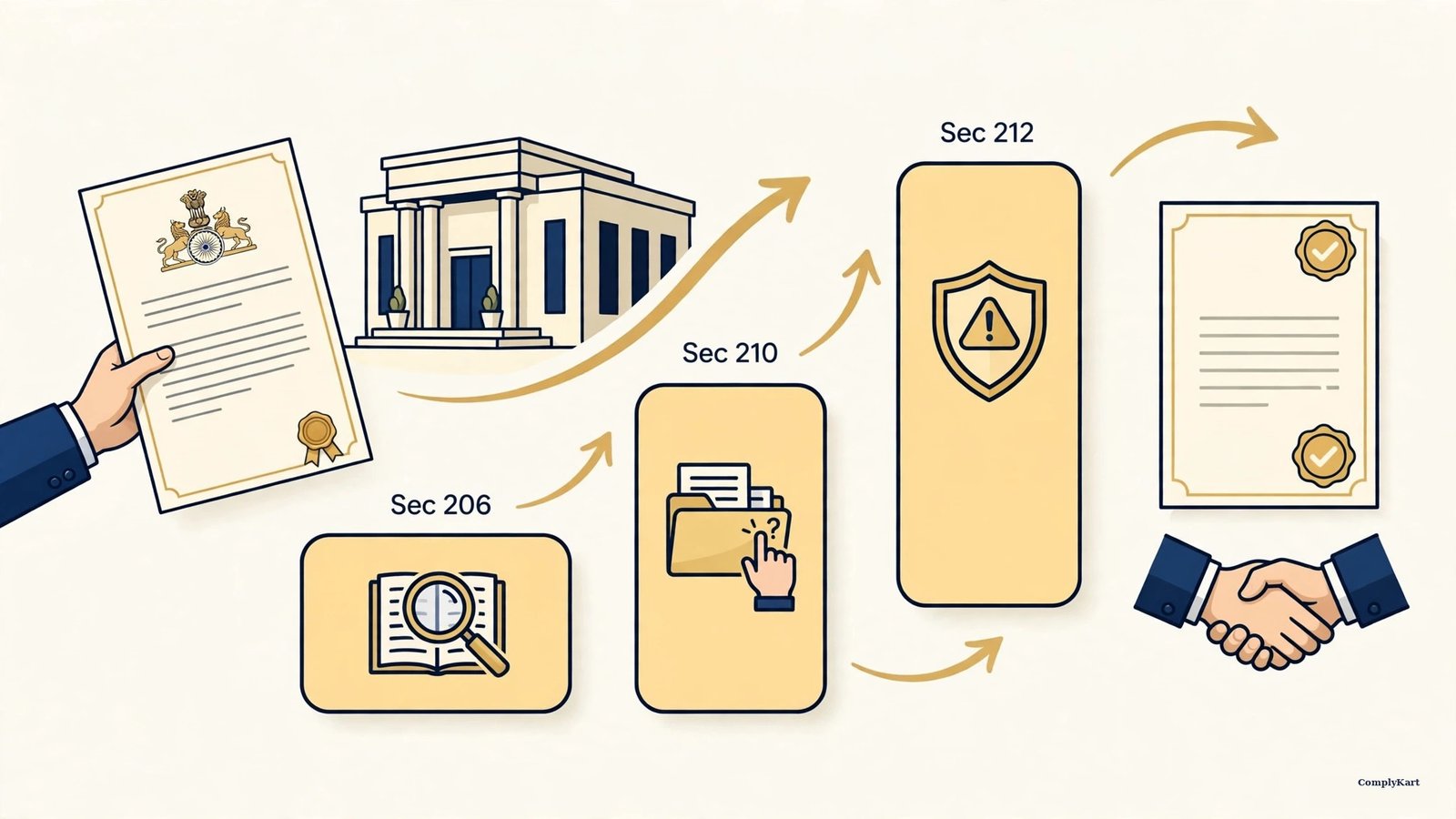
The three levels of MCA scrutiny
The Companies Act gives MCA a ladder. It climbs it rung by rung.
The first rung is Section 206 — inspection, inquiry, and the power to call for information. Under 206(1), the Registrar of Companies can ask your company, in writing, to furnish information or explanations. That is the gentlest tool in the box. It can be a routine query. Often it starts because something in your filings looked odd — a gap in the registers, a delayed filing, a complaint. If the answers do not satisfy the Registrar, the questions get firmer (206(3)), and if they are still inadequate, the Registrar or an inspector can inspect the books directly (206(5)).
The second rung is Section 210 — investigation into the affairs of the company. This is what Zee’s notice invokes. The Central Government can order it on the Registrar’s report (210(1)(a)), on a shareholders’ special resolution (210(1)(b)), or in the public interest (210(1)(c)). Inspectors are appointed. They dig into specific matters, examine people on oath, demand books of account and other papers under Section 207, and file a report under Section 208.
The third rung is Section 212 — the Serious Fraud Investigation Office. This is the big one. SFIO steps in where fraud is suspected. You never want to be here.
Think of it the way a doctor works. Section 206 is the blood test your GP orders at a routine checkup — routine, sometimes triggered by nothing at all. Section 210 is the specialist scan after something on the blood report needs a closer look — serious, but still diagnostic. Section 212 is the emergency admission — something is genuinely wrong. Most companies that get a letter are at stage one, not stage three.
What the Zee notice actually shows
Look at the disclosure Zee filed under Regulation 30 of the SEBI Listing Regulations. It lists the nature of the action as an investigation under Section 210(1)(a) and (c). But the field for “violation or contravention alleged” reads: calling for information. That phrase is doing all the work. The regulator wants answers, not apologies. Nothing has been found yet. Nothing has been decided.
This is also not Zee’s first brush with MCA scrutiny — the ministry ran an inspection back in 2020 after two independent directors resigned over governance concerns. The current notice is described as a continuation of an ongoing inspection. In other words, this is the process working as designed: questions asked, answers given, process continuing.
What you must do if a notice arrives at your company
First, read it properly. Most directors panic at the word “investigation” and stop reading. Don’t. The notice will tell you exactly which section it is under and exactly what is being asked. A “calling for information” letter and an SFIO direction are different planets.
Second, respect the clock. These notices carry deadlines. Missing one turns a routine information request into an adverse inference — the regulator assumes you have something to hide. Respect the clock. You do not want to give anyone that reason.
Third, preserve everything. Section 207(3) places a positive duty on the company and its officers to preserve the books and papers that are the subject of the inspection. Destroying or falsifying records during an inquiry is an offence in its own right — one that can carry imprisonment. Never, ever “tidy up” before the inspectors arrive.
Fourth, get your Company Secretary in the room immediately. A practicing professional who has seen these notices before will spot what the Registrar is really circling. That matters, because the fifth point follows naturally.
Fifth, answer what is asked — precisely and completely. Volunteering a mountain of unrelated documents can open new lines of questioning. Answering with half the facts is worse. Give the exact information sought, in the form sought, with the records that back it up.
A short checklist for the first 72 hours
- Note the date of receipt, the section cited, the authority that issued it, and the reply deadline.
- Forward the notice to your CS and legal counsel the same day. Not tomorrow.
- Pull together the exact records asked for — financial statements, registers, minutes, filings.
- Put an instruction in writing to everyone in the company: nothing related gets deleted, altered, or “archived.”
- Draft the reply with your CS — point by point, against the questions asked.
- If you are a listed company, check your Regulation 30 disclosure obligation immediately.
Listed companies have one extra duty: tell the market
Zee disclosed its notice under Regulation 30 of the SEBI Listing Regulations, 2015 — the rule that forces listed companies to report material events to the exchanges. A regulatory notice against the company qualifies. The company’s disclosure had to say what the action was, what violation was alleged, and what the financial impact was — which Zee stated could not be quantified at this stage. The disclosure was signed by its Company Secretary. That is the process working the way it should.
If you run a listed company, treat this as a same-day job. LODR disclosures have tight timelines, and “we received it last week” is not an explanation the exchanges accept.
The honest truth about MCA scrutiny
Most notices end with a letter back and nothing further. Some escalate — an inspection report under Section 208 can recommend prosecution, compounding, or an SFIO probe. The difference between those two outcomes usually comes down to how the company behaved in the first 72 hours. Cooperate. Be precise. Keep your records clean.
And here is the practitioner’s habit I will leave you with: keep your house in order before anyone knocks. File on time. Maintain your statutory registers. Answer the Registrar’s routine queries promptly instead of letting them pile up. The companies that sail through MCA inspections are not lucky — they are boring. Boring, in compliance, is the highest compliment.




Comments
No comments yet — ask the first question below.
Join the discussion
Questions go straight to our expert desk. Comments appear after a quick review — no spam, no noise.