
Your trademark application is approved, the certificate arrives, and you feel done. Then a competitor starts selling a similar product under a confusingly similar name — and your lawyer tells you your registration covers a completely different class of goods. This happens more often than you'd think. In most cases, nobody picked the wrong class by accident. They just didn't understand what classes do.
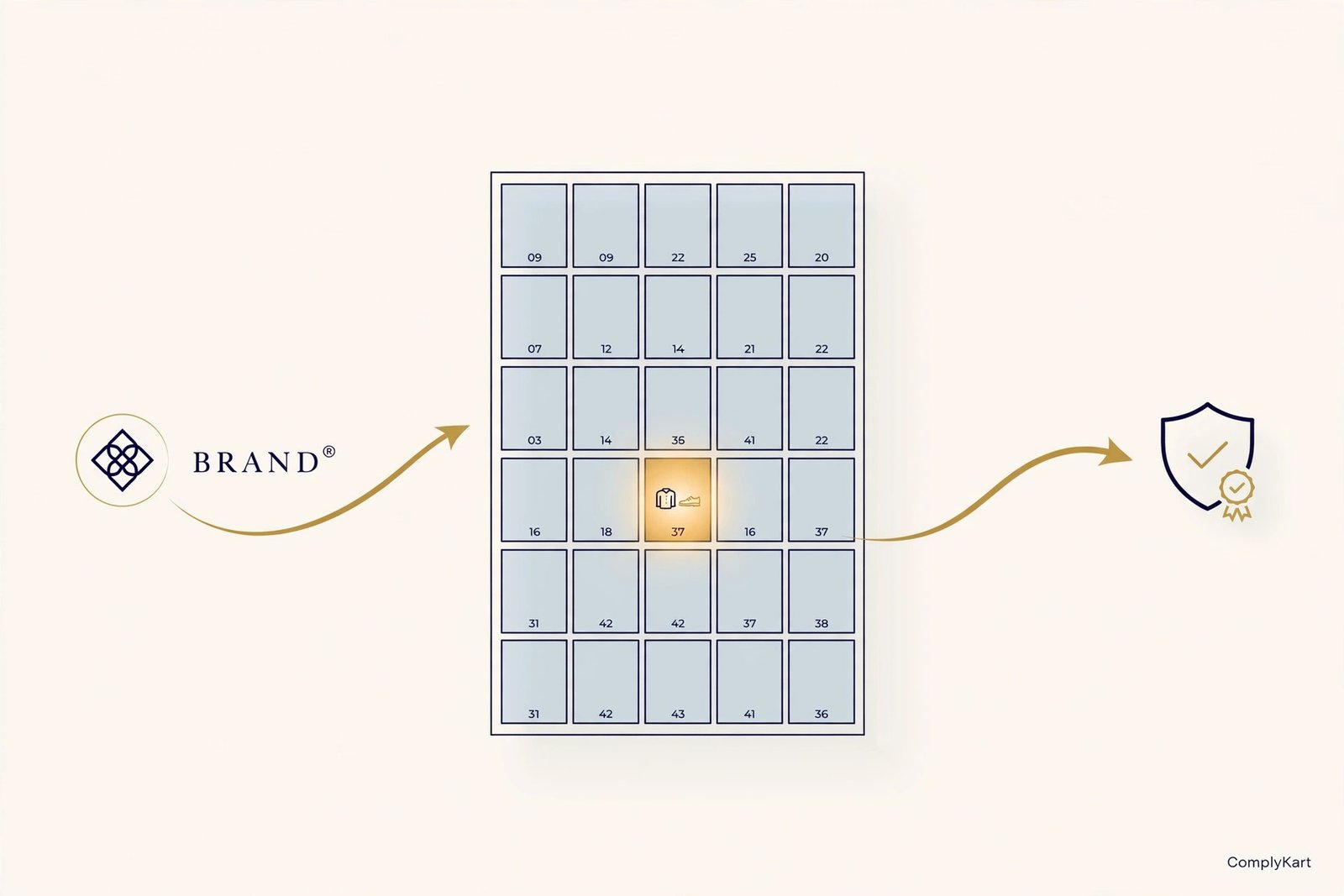
Classes are the sorting system of the trademark world. India follows the NICE Classification — an international system created under the NICE Agreement of 1957 — and it is baked into Indian law through the Fourth Schedule of the Trade Marks Rules, 2017. Every good and every service you can think of is filed into one of 45 numbered classes. Classes 1 to 34 cover goods. Classes 35 to 45 cover services. Your trademark registration protects your mark only within the classes you filed in.
That last line deserves a second read, because it is where money gets lost.
Think of the register as a building with 45 floors
Here is the analogy I use with every founder who asks. Picture the trademark register as a building with 45 floors. Each floor is one class. When you file a trademark, you are not buying the building — you are renting a room on one floor. Your name is protected there. Walk into a different floor, and someone else can legally be using the same name, or something confusingly close, for goods sold on that floor.
A clothing brand registered in Class 25 (clothing, footwear, headgear) has nothing to say about the same word being registered in Class 9 (software, electronics) by a tech company. Different floors. Both owners have every right to be there. Now imagine the reverse: you sell packaged masala mixes but filed your mark under Class 43 — restaurants and cafés — because someone told you "it's a food business." Your competitor files the same-sounding mark in Class 30 (staple foods, spices, condiments) — your actual floor — and gets registered without a fight. Your certificate, meanwhile, is guarding a floor you never traded on.
Three floors that surprise people most: Class 35 is advertising, business management, and retail services — not your product. Class 42 is scientific and technological services including software development — not the software product itself, which sits in Class 9. And Class 41 covers education, training, and entertainment services — including the business of running a coaching institute, but not the books you sell, which are Class 16.
The Class 35 trap
If I had to name the single most common filing mistake, this is it. A founder tells their consultant "we sell online," the consultant files in Class 35, and everyone moves on. But Class 35 does not protect your product or your app. It protects the service of retailing and advertising.
If you manufacture and sell your own brand of skincare, your product belongs in Class 3 (cosmetics and cleaning substances). If you also run an online store that sells other people's brands, Class 35 has a role. Filing only in Class 35 when you needed Class 3 is like buying a shop sign but not locking the shop.
The examination side works the same way. The Registrar's examiner searches for conflicting earlier marks within your class and the ones closely related to it. An identical mark sitting on a distant floor rarely blocks you — and it also won't block your competitor from walking onto your floor later if you never occupied it.
What the wrong class actually costs you
Three things. First, the fee is spent and doesn't come back — the official fee is charged per class, per mark. Under the 2017 Rules, e-filing through Form TM-A costs ₹4,500 per class for individuals, startups, and small enterprises, and ₹9,000 per class for companies that fall outside those categories. File in three wrong classes and you have paid for three empty rooms.
Second, you get zero protection where you actually trade. An infringer in your real class can argue — correctly — that your registration doesn't cover their goods. Your certificate becomes a piece of paper with your name spelled right and your business described wrong.
Third, you can lose time. A competitor who filed in the right class first gets the priority date. You get to oppose, appeal, or rebrand — all slower and more expensive than filing correctly in the first place.
You can cover more than one floor in one application
Since the Trade Marks Rules, 2017, India allows multi-class applications — one Form TM-A can claim several classes at once. That's good news. The fee, remember, multiplies per class. So a startup selling an app (Class 9), running a subscription platform (Class 42), and also selling branded merchandise (Class 25) can file one application for three classes — at three times the single-class fee.
This is where founders usually ask: "Should I just file in all 45?" Don't. I've never seen a business that genuinely trades across all 45 classes, and ₹4,500 × 45 (or ₹9,000 × 45) buys you 45 empty rooms and a very interesting examination report. Examiners notice overclaiming. So do opponents.
There is one exception to the one-floor rule, and it is earned, not bought. A mark that the Registrar declares a well-known trademark under the Trade Marks Act, 1999 gets protection across all classes — even against dissimilar goods. That's a small, hard-won club. For everyone else, the class system is the system.
How to pick the right class without guessing
One: describe what you actually sell or do, in plain words — not your sector, not your ambition. "We sell roasted coffee beans" is Class 30. "We run a café" is Class 43. "We do both" is both.
Two: look at where the money comes from today, not where it might come from in five years. You can add classes later with a fresh application. A speculative class is a fee paid for a room you'll never furnish.
Three: add the adjacent class where expansion is genuinely likely within the next year or two. A clothing brand launching shoes next season files Class 25 once, not twice. A SaaS company planning an education product thinks about Class 41 now, while the name is still clear.
Four: check the TM search in your class and the neighbouring ones before you file. The examiner will. So should you.
Class selection is the least glamorous part of a trademark filing, and it is the part that decides whether your registration works when you actually need it. Get the mark right and the class right, and your certificate means something. Get the class wrong, and you have paid for protection in a room you never entered.


Comments
No comments yet — ask the first question below.
Join the discussion
Questions go straight to our expert desk. Comments appear after a quick review — no spam, no noise.