
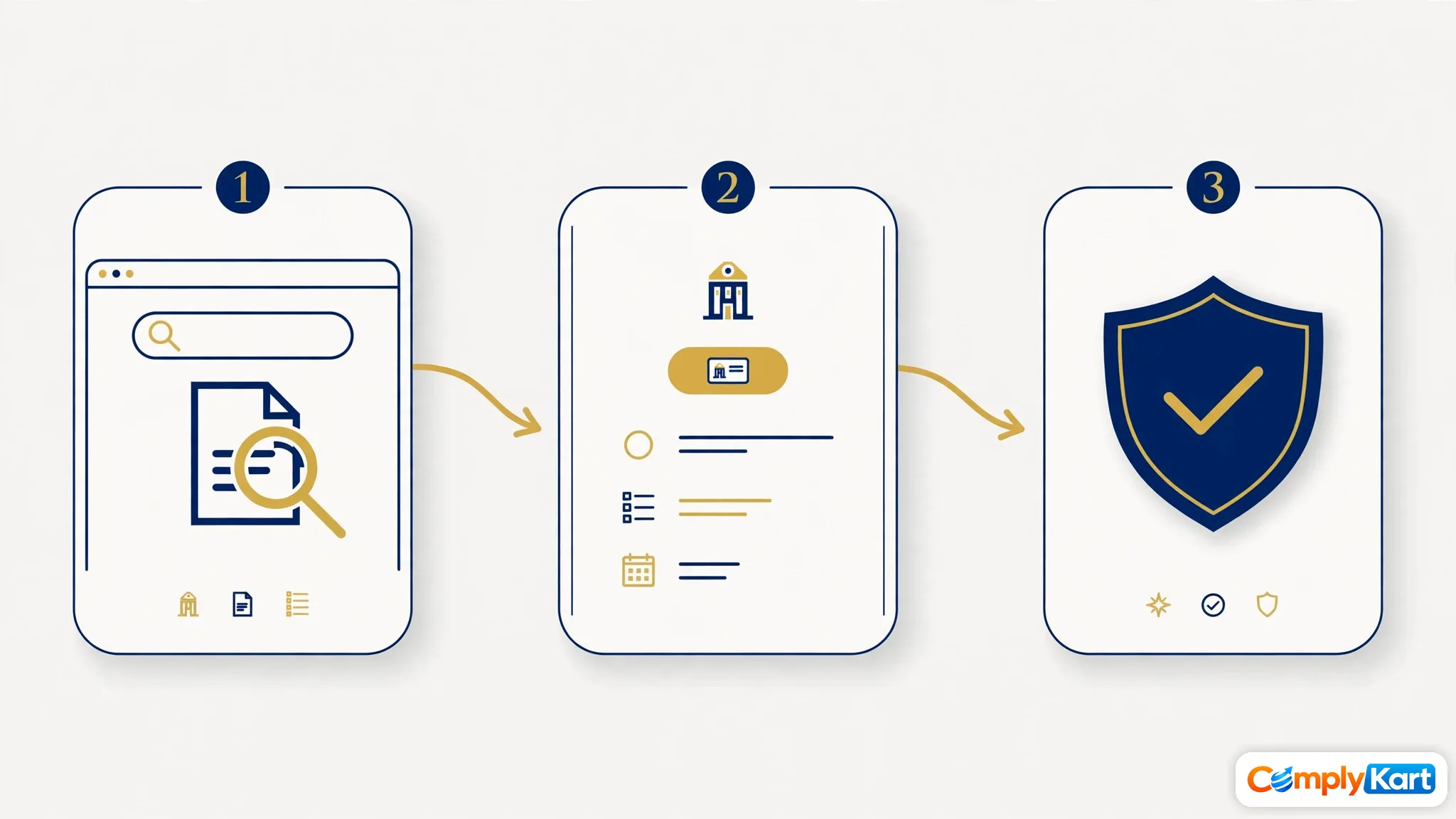
IN BRIEF
MCA master data is the free one-page public summary record the Ministry of Corporate Affairs keeps for every company and LLP on the MCA21 V3 portal, showing the CIN or LLPIN, name, status, capital, registered office, directors or partners, charges and last filing dates. It is searched by CIN, LLPIN or name, usually without logging in, and it is the first check before signing, paying or hiring.
Go to mca.gov.in, open MCA Services, then Master Data, then View Company/LLP Master Data. Type the CIN, LLPIN or company name, solve the captcha and submit. You get the company's CIN, status, capital, registered office, directors and last filing dates — free, in under five minutes, and usually without logging in.
The rest of this guide is about reading what comes back, and knowing what it does not tell you. Before you sign a vendor contract, pay an advance, accept a job offer or put money into a private company, you want one answer: is this business real, and is it in good standing? The fastest free way to get it is the company's MCA master data — the public record the Ministry of Corporate Affairs keeps for every company and LLP registered in India. Probe42's analysis of MCA registry data puts the register at about 21.9 lakh active companies and 5.2 lakh active LLPs as of 31 July 2026. With that many entities around, checking the official record yourself is the cheapest protection you have.
What is MCA master data?
MCA master data is the one-page summary record of a company or a Limited Liability Partnership held on the MCA21 registry. It is built from the incorporation documents and every later filing the Registrar of Companies has approved, under the Companies Act, 2013 or the Limited Liability Partnership Act, 2008. Anyone can view it — you do not need to be a director, a shareholder or a professional.
Think of it as the cover page of a company's file. The cover tells you the name, the number, whether the file is open or closed, and who signed it last. The file itself — the memorandum, the financial statements, the annual returns — is a different service, and it costs money. You check the cover before you pay to read the chapters.
| Record | What it is | Cost |
|---|---|---|
| Master data | One-page summary: CIN, status, capital, address, filing dates, signatories | Free |
| Public documents | The filed forms and attachments themselves: MoA, AoA, financial statements, annual returns, charge documents | ₹100 per company |
| Certified copies | Copies of filed documents certified by the ROC, used in courts, banks and government offices | Fee per document |
The current version of the registry is MCA21 V3. The last batch of company e-forms moved to V3 on 14 July 2025, and V2 is now read-only. A guide that still describes the old V2 screens, or points at a link under mca.gov.in/mcafoportal/, is out of date — that application is gone.
How to check MCA master data on the V3 portal, step by step
For a company, you need either its 21-character CIN or its exact name. For an LLP, the LLPIN or the name.
1. Open the official site, mca.gov.in. Type it yourself rather than clicking a link in a search result when you need the official record. Look-alike sites exist, and some charge for what the portal gives free.
2. From the top menu, go to MCA Services, then Master Data, then View Company/LLP Master Data.
3. Enter the CIN or LLPIN in the identifier box — it also accepts an FCRN or FLLPIN for a foreign company or LLP. If you do not know the number, click the search icon next to the Company/LLP Name field, type the first few words of the name, and pick the entity from the list.
4. If you searched by name, check the state and the date of incorporation before you click. Many companies share similar names. The CIN on the invoice, agreement or offer letter in front of you is the tie-breaker — companies must state their CIN on letters, invoices and notices.
5. Enter the captcha and click Submit. If the captcha fails, refresh only the captcha, not the whole page — reloading means starting over.
6. Read the master record, then open the Signatory Details and Index of Charges sections on the same page. Use the Print option if you need a copy for your file.
That is the whole lookup. The rest of this guide is about what the record means — a page full of fields is only useful if you know which ones to trust and which ones to question.
Do I need to log in to view MCA master data?
Here is the honest answer: usually not — but not always, and the guides disagree with each other about it, so let me tell you what actually happened.
Until late 2025, viewing basic master data on V3 worked without an account, as it had on V2 for over a decade. Around 20 December 2025, practitioners began reporting that the portal sent them to a sign-in page first, and no circular announced the change. The Institute of Company Secretaries of India pushed back in a representation dated 6 May 2026 to the MCA Secretary, asking that basic master data be available "without mandatory login (as was the practice earlier)". Guides published since disagree about whether the wall is still up, and the live state has varied since.
So the practical rule is simple. Try without logging in first — in most cases the search form opens straight away. If you do hit a sign-in page, do not pay anyone for access. Register as a Registered User on the portal. It needs only a PAN and an email, it is free, and it covers the master data services and View Public Documents. You do not need a Business User account, a DIN or a digital signature just to look a company up. A Business User account is for filing on a company's behalf. Viewing is not filing.
Reading the company record, field by field
| Field | What it tells you | What to check |
|---|---|---|
| CIN | The company's unique 21-character identity number | It matches the CIN on the invoice, agreement or offer letter |
| Company name | The exact registered name | The spelling matches the GST certificate and the bank account name |
| ROC code | The Registrar of Companies office holding the file | Some ROC jurisdictions changed in February 2026 — see below |
| Class of company | Private, public, or One Person Company | A private company cannot invite the public to buy its shares |
| Date of incorporation | When the company was registered | A recent date for a "20-year-old business" is a warning sign |
| Authorised and paid-up capital | The maximum capital the company may issue, and the capital actually issued and paid | Ask if paid-up capital is far below the contract value |
| Registered address | The official address for notices | It matches the address on the invoice or agreement |
| Email ID | The official email registered with MCA | Use it to confirm that a communication is genuine |
| ACTIVE compliance | Whether the company filed the ACTIVE form (INC-22A) when required | "ACTIVE Non-Compliant" restricts the company's filings |
| Date of last AGM | When the last annual general meeting was held | More than about 15 to 18 months old suggests missed compliance |
| Date of balance sheet | The year-end of the last financial statements filed | It should normally be the last financial year |
| Company status | Active, strike off, dormant, under liquidation, and so on | See the status table below |
Two fields deserve a second look. The date of last AGM and the date of balance sheet are the fastest compliance-health check the portal offers: a company whose last balance sheet is two years old has not filed its financial statements for two years, whatever its status line says. Read those dates with the fee-free windows in mind — under General Circular 05/2026, AOC-4 for FY 2025-26 can be filed without additional fees till 31 December 2026, and MGT-7/MGT-7A till 31 January 2027. A company that still shows very old dates after those windows has missed a cheap chance to catch up.
The ROC code needs the same care. The MCA re-drew ROC jurisdictions from 16 February 2026 under notification S.O. 4850(E) — the old ROC Mumbai area is now ROC Mumbai-I, ROC Mumbai-II at Navi Mumbai and ROC Nagpur, and Delhi, Haryana, Uttar Pradesh and West Bengal were redrawn too. The ROC on a record may therefore differ from the one on an older certificate; the CIN itself does not change, since it carries a state code, not an ROC code. Our guide to the 2026 ROC jurisdiction restructure maps the new offices district by district.
Worked example: decoding a CIN
Every CIN follows the same structure. Take Infosys Limited: L85110KA1981PLC013115.
| Part | In this CIN | Meaning |
|---|---|---|
| Listing status | L | Listed on a stock exchange (U means unlisted) |
| Industry code | 85110 | The economic activity code recorded at incorporation |
| State | KA | Karnataka, the state of the registered office |
| Year | 1981 | Year of incorporation |
| Company type | PLC | Public limited company |
| Registration number | 013115 | The number given by the ROC |
Common company-type codes are PTC for a private limited company, PLC for a public limited company, OPC for a One Person Company, FTC for a subsidiary of a foreign company, and NPL for a not-for-profit company under Section 8. If you want the full story on the number itself, our guide to what a CIN is explains the format and where to find it.
One trap, and it catches people. A CIN is derived from attributes that can change. Convert from private to public, list on an exchange, or move the registered office to another state, and the company gets a fresh CIN. If a CIN on an old agreement does not match the one on the portal, check whether the company changed its type or its state before assuming the document is fake.
LLP master data: the fields to know
LLP master data looks similar but uses LLP terms. The LLPIN is shorter — three letters, a hyphen and four digits, for example AAA-1234 — and you search it the same way, on the same screen.
| Field | What it tells you |
|---|---|
| LLPIN and LLP name | Unique identity and exact registered name |
| Number of partners and designated partners | How many partners there are, and how many carry compliance responsibility |
| Total obligation of contribution | What the partners have agreed to contribute — the LLP equivalent of capital |
| Main business activity | The declared line of business |
| Date of last Statement of Accounts and Solvency (Form 8) | Whether yearly accounts filings are up to date |
| Date of last Annual Return (Form 11) | Whether the yearly partner return is up to date |
| LLP status | Active, strike off, dissolved, converted, and so on |
The two dates are the LLP equivalent of the company's AGM and balance-sheet dates. Form 8 is due by 30 October each year and Form 11 by 30 May. If both are years behind, the LLP has not been filing, and its late fees run at ₹100 a day per form with no cap. If you are setting one up rather than checking one, our LLP registration service covers the process; for a company, the starting point is private limited company registration.
What each company status means
The status line is the first thing most people read, and the most misread. "Active" does not mean healthy. It means the company exists on the register and is not under a closure process. That is all it means.
| Status | What it means | Should you deal with it? |
|---|---|---|
| Active | Registered and not under any closure process | Yes, subject to the other checks in this guide |
| Dormant | Has obtained dormant status under Section 455, for a future project or to hold an asset | Usually not for active trade — ask why |
| Under process of striking off | The ROC has started removing the company, or the company applied to close under Section 248 | No new contracts until the outcome is clear |
| Strike off | Removed from the register and dissolved | No — it cannot legally do business |
| Amalgamated | Merged into another company | Deal with the company it merged into |
| Under liquidation | Being wound up through insolvency or a court process | Only through the liquidator |
| Liquidated / Dissolved | Winding up is complete and the company no longer exists | No |
| Converted to LLP | Has become an LLP | Check the new LLP's master data |
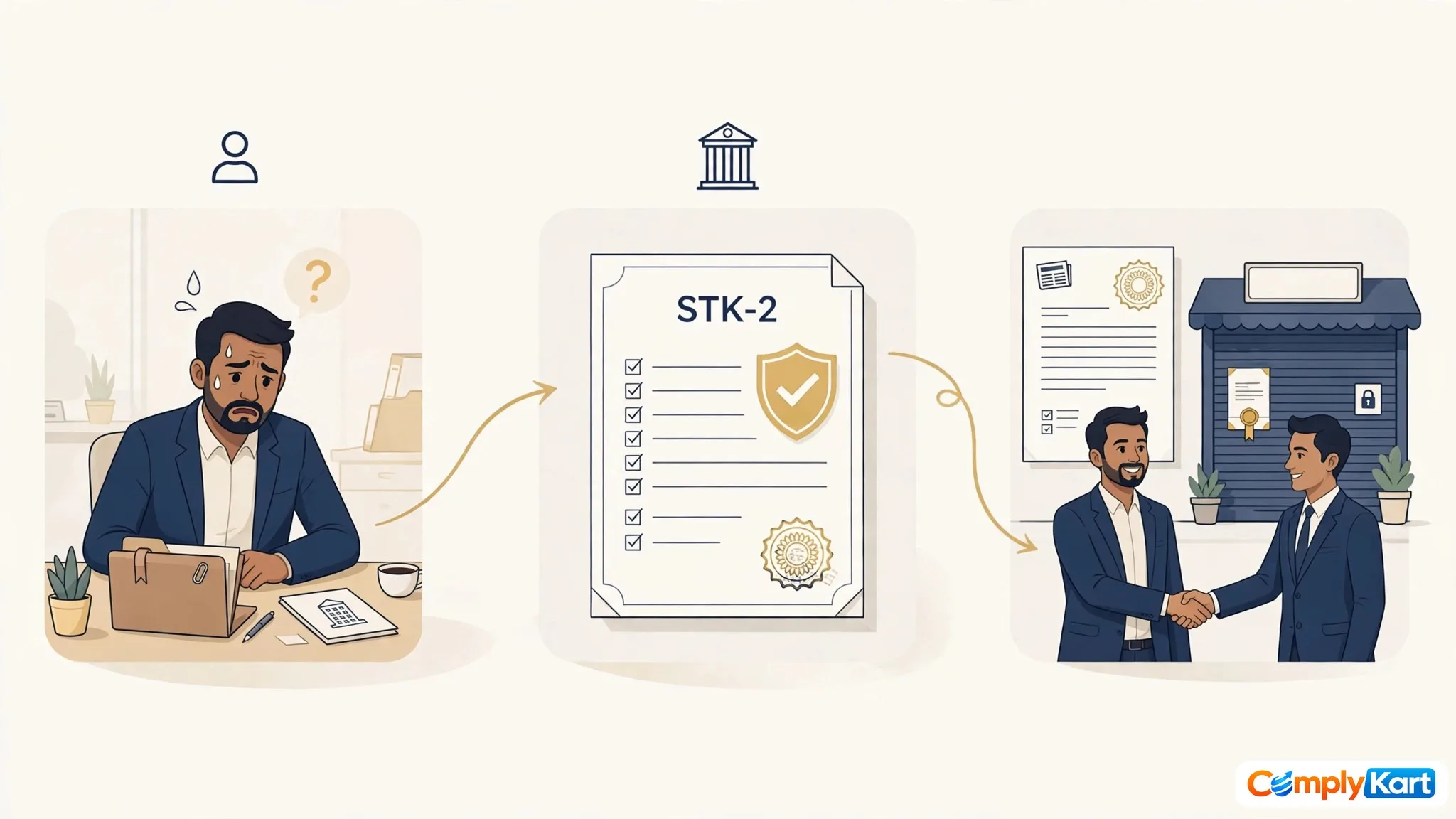
If the status is "Strike off" and the other party still wants you to sign, stop — a struck-off company cannot legally do business. If you are the director of a company that has stopped trading, the legal way out is the strike-off route: our strike-off service and our STK-2 strike-off guide walk through it, including the filings to clear first.
The 7-point check before you sign, pay or join
Master data is a first check, not the only one. Run these seven before you commit to anything.
1. Status is Active — and nothing else. Any other status, including "under process of striking off", means no new contracts until the outcome is clear.
2. ACTIVE compliance is not "Non-Compliant". That flag restricts the company's filings, and a company that cannot file cannot fix its own record either.
3. The last AGM and balance-sheet dates are current. More than a year behind the current financial year means missed filings — read them against the GC 05/2026 fee-free windows first.
4. The name, address and email match the documents you were sent. A mismatch between the GST certificate, the bank account name and the MCA record is the most common sign that something is off — or that you are looking at the wrong company with a similar name.
5. The person you are dealing with is actually a signatory. Check Signatory Details: the name on the offer letter or agreement should appear as a director or designated partner, with a DIN. A job offer signed by someone who is not on the board deserves a question before you resign from your current job.
6. The Index of Charges is clean for the asset in question. If you are buying an asset or lending against one, check whether a lender already holds a charge over it, and whether that charge is open or satisfied.
7. No recent wholesale change of directors. A complete change of directors shortly before a large deal is not proof of anything — but it is a question worth asking, and the signatory section shows you the appointment dates.
None of this shows profitability, solvency or honesty. A company can be Active, current on filings and still be a bad counterparty. Master data tells you what is on record; your judgement, and the documents behind it, do the rest.
What changed on the MCA portal in 2025 and 2026
14 July 2025: the last batch of company e-forms moved to MCA21 V3, and V2 went read-only. Use only V3 screens and guides — the old mcafoportal links are dead.
December 2025: the login gate appeared on master data, with no circular announcing it. ICSI asked for it to go in May 2026. Reports since vary — try without logging in first.
16 February 2026: ROC jurisdictions were redrawn under S.O. 4850(E). The ROC on a Maharashtra, Delhi, Uttar Pradesh, Haryana or West Bengal company's record may now name a different office than its old certificate.
5 June 2026: a fire at the MCA's primary data centre in New Delhi forced an unscheduled switchover to the disaster recovery site in Chennai. The Ministry told Parliament no application data was lost and core filing services were not disrupted, but practitioners reported weeks of login failures, locked accounts and unstable services, and deadlines — including DPT-3, from 30 June to 31 July 2026 — were extended while systems were restored. If the portal feels slow or throws an error on a deadline week, this is the recent history behind it. Retry off-peak before assuming your filing is wrong.
15 April to 15 September 2026: the Companies Compliance Facilitation Scheme, 2026 let companies file overdue annual returns and financial statements at reduced additional fees. It is closed. A company that still shows very old AGM or balance-sheet dates has missed a cheap chance to catch up — overdue AOC-4 and MGT-7 now carry the full ₹100 a day per form in additional fees.
When master data is not enough: View Public Documents
Master data is a summary. When you need the filed documents themselves — the memorandum and articles, the financial statements, the annual return, a charge document — use View Public Documents, under MCA Services, then Document Related Services.
It costs ₹100 per company or LLP, and up to five entities can be covered in one transaction. You need to be logged in, and you pay before you can view anything. After payment, the documents usually appear in your V3 workspace within about a day, and they stay there for seven days. Once you open the first document, a three-hour viewing window starts — download what you need inside it. One caution from practitioner reports: DIR-12 director-change filings do not currently appear in View Public Documents, so for a director change, look at the signatory section of the master data page.
Choose by what you need. Master data answers "is this company real and current?" — free, in minutes. Public documents answer "what did this company actually file?" — ₹100, a login, and a day's wait. Certified copies are a third step, for documents you need in court, at a bank or before a government office. Do not pay for documents when a free summary would have answered your question.
What master data does not show
Four things people expect to find, and will not.
Shareholding. The master record does not list shareholders. Shareholding sits in the annual return (MGT-7) and, for significant beneficial owners, in the BEN-2 filing — our BEN-2 guide explains who counts and the 30-day filing clock.
Financials. You get the date of the last balance sheet, not the balance sheet. The numbers are in the AOC-4 filing, behind the ₹100 document fee.
Beneficial ownership and control. Beyond the directors on the signatory list, the record does not show who really controls the company. That matters most exactly when the directors on paper are not the people making the decisions.
Tax and GST standing. The MCA record says nothing about GST registration, income-tax filings or pending demands. A company can be perfectly current with the ROC and in default with the tax department. Check those registers separately.
Master data is the cover page. Do not mistake it for the book.
Fixing wrong or outdated master data
You cannot edit master data directly on the portal. It changes only when the company files the right form and the ROC approves it. If your own company's record is wrong, here is what fixes each field.
| What needs updating | How it is updated |
|---|---|
| Registered office address | Form INC-22 (with a special resolution and Regional Director approval where the move needs it) |
| Directors joining or leaving | Form DIR-12 |
| Authorised capital | Form SH-7 |
| Company name | Form INC-24, after name approval |
| Last AGM and balance sheet dates | Filing the annual return (MGT-7 or MGT-7A) and financial statements (AOC-4) |
| LLP partners | Form 4 |
| LLP registered office | Form 15 |
| LLP accounts and annual return dates | Form 8 and Form 11 |
If a form has been approved but master data still shows the old details, give it a little time — one professional-firm guide puts the refresh at one to three days after approval — then raise a ticket with the MCA helpdesk on the V3 portal, quoting the SRN of the approved form. If the dates are old because the filings were never made, the fix is the filings themselves. Our compliance fee calculator shows what the overdue filings cost before you start.
Mistakes to avoid
Trusting a screenshot. Always check the record yourself on mca.gov.in rather than relying on an image the other party sends. Screenshots are easy to edit and go stale the day they are taken.
Treating "Active" as a clean chit. It shows registration, not financial health. A company can be Active and still owe money to everyone it deals with.
Ignoring the Index of Charges. Before buying an asset or lending money, check whether a lender already has a charge over it.
Picking the wrong company from a name search. Confirm with the CIN, the state and the date of incorporation. Similar names are common; identical names are not.
FAQs
Can I download the master data record? There is no download button. Use the Print option on the result page, or save it as a PDF from your browser. Filed documents are the separate View Public Documents service — login plus ₹100 per company.
How do I check a director's other companies? Use View Director/Designated Partner Master Data under the same Master Data menu, and search by DIN or name. It shows the DIN status and the companies and LLPs they are associated with. A DIN can be deactivated if DIR-3 KYC is not done.
What if the company name search returns nothing? Check the spelling, then try the CIN. A company that changed its name, converted to an LLP, or was struck off will not appear under its old name. If the name is right and nothing comes back, the company may not exist under that name at all.
Is the MCA record the same as what private company-search sites show? Private sites index the same register and are often faster. The difference is authority and freshness: the MCA portal is the register itself, while a private site shows a copy that may be days old. Use a private site for a quick look; use the MCA portal when the answer matters.
Does master data show whether a company has paid its taxes? No. The MCA record covers company-law compliance only. GST and income-tax standing live on their own portals, and a company can be current with the ROC while in default elsewhere.
The record is free, it takes five minutes, and it is the one check that costs you nothing and saves you from the most avoidable mistake in business — dealing with a company that is not what it claims to be. Check it before you sign, and check the documents behind it if the stakes justify ₹100.




Comments
No comments yet — ask the first question below.
Join the discussion
Questions go straight to our expert desk. Comments appear after a quick review — no spam, no noise.