
IN BRIEF
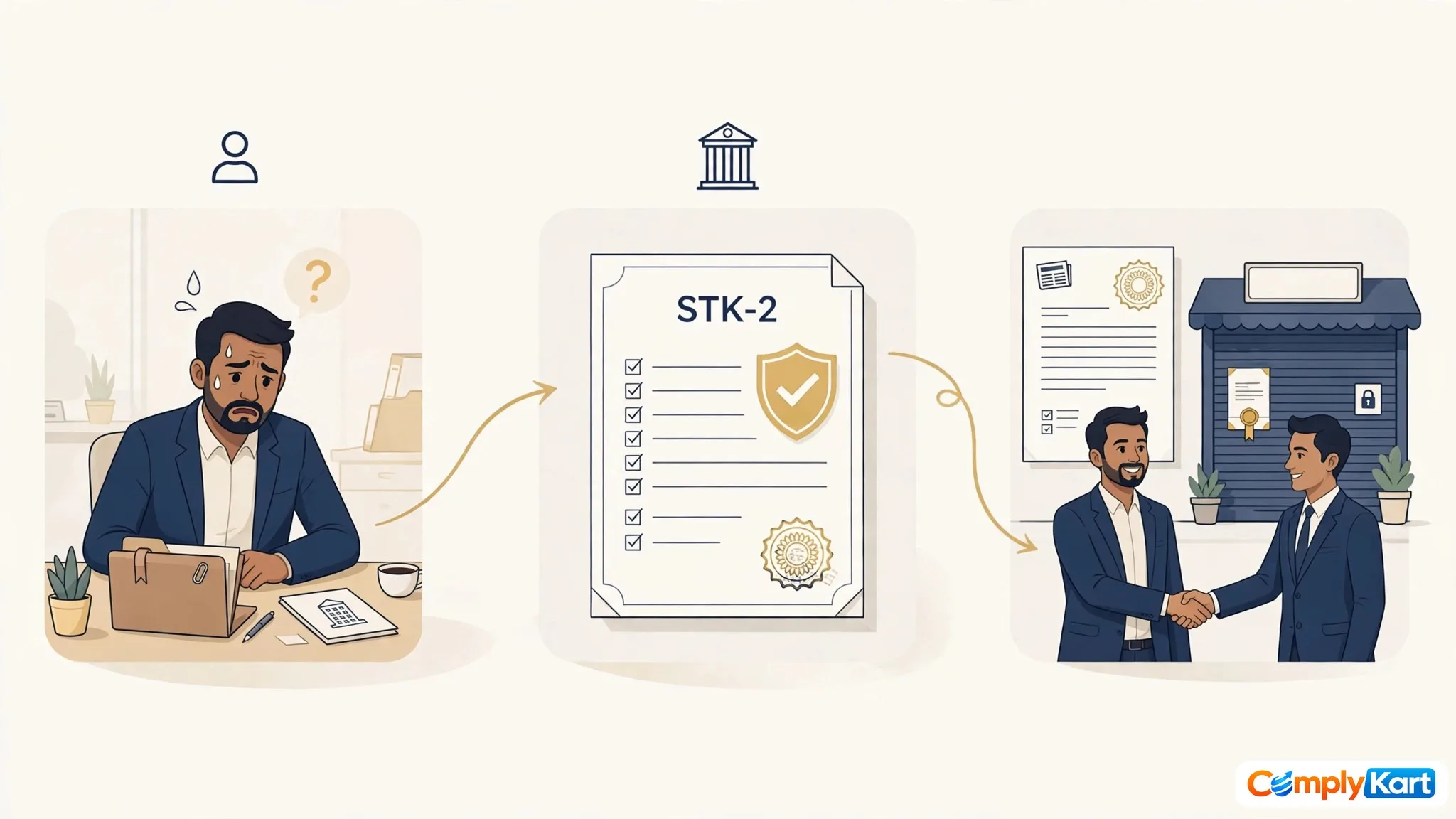
Strike-off is the removal of a company's name from the Register of Companies under section 248 of the Companies Act, 2013, on the company's application in Form STK-2. It applies to a company with no business for two preceding financial years, or that never started within one year of incorporation, which has extinguished all liabilities and cleared its filings. The Registrar then issues Form STK-7, and the company stands dissolved.
Your company stopped trading two years ago. The bank account sits empty, the GST registration is idle, and every year the ROC filings still fall due. You want the company gone — legally, cleanly, and without paying for a full liquidation. That is exactly what strike-off is for. File Form STK-2 under section 248 of the Companies Act, 2013, pay the ₹10,000 government fee, and the Centre for Processing Accelerated Corporate Exit (C-PACE) removes your company's name from the register. The company then stands dissolved. But only if you qualify. Strike-off is the cheapest exit in company law, and it is also the most often refused — usually because the company still owes money, still has filings pending, or applied on the wrong ground.
What is Form STK-2?
Form STK-2 is the application a company files on the MCA V3 portal asking the Registrar to remove its name from the Register of Companies under section 248(2) of the Companies Act, 2013, read with the Companies (Removal of Names of Companies from the Register of Companies) Rules, 2016. One form, one fee of ₹10,000, and a set of attachments. C-PACE — a central Registrar's office in Manesar set up by notification S.O. 1269(E) of 17 March 2023 and working since 1 May 2023 — processes every voluntary strike-off application in India. Your local ROC does not touch it any more.
Think of it like surrendering a driving licence you no longer use. The RTO cancels the licence and you stop being a licence-holder. But any challan you already owe still follows you. Strike-off works the same way. It cancels the company's existence. It does not cancel what the company already owes — and if the company does owe anything, you cannot use this route at all.
Is strike-off right for your company?
Four exits exist for a company that has stopped. Pick the wrong one and you waste months and money.
| Route | Fits when | Who decides | End result |
|---|---|---|---|
| Strike-off (STK-2, s.248) | No business for 2 financial years (or never started), no assets, no liabilities | C-PACE | Name struck off; company dissolved |
| Dormant status (s.455, MSC-1) | You want to pause, not close — the company may restart later | ROC | Company lives, filings pause |
| Winding up (ss.270–365) | Assets or liabilities exist and must be settled properly | NCLT | Company dissolved after debts settled |
| Voluntary liquidation (IBC s.59) | Company is solvent but has affairs to wind down through a liquidator | NCLT / IBBI process | Company dissolved |
If the company has a bank loan outstanding, a tax demand, an unpaid vendor, or even a disputed claim, strike-off is closed to you. Settle first, or wind up. If the company is clean but you might restart it in a year or two, dormant status is cheaper than incorporating again. Strike-off is for the company that is finished — no money in, no money out, nothing left to protect. Our strike-off service handles the whole filing, but the decision in this table is yours to make first. For the full comparison of the two endings, read our guide on winding up vs dissolution.
Who can apply — the section 248 grounds
A voluntary application under section 248(2) must rest on one of the grounds in section 248(1). Two matter in practice. First, the company failed to commence business within one year of incorporation — the incorporated-and-abandoned company. Second, the company has not carried on any business or operation for two immediately preceding financial years and has not applied for dormant status under section 455. Apply in November 2026 and the company should have had no business in FY 2024-25 and FY 2025-26. A company incorporated in 2025 cannot satisfy the two-year ground yet; the one-year ground is its route, if it never started at all.
"No business" means no business. A single invoice, a bank credit that is not a refund, a fresh contract — any of it breaks the ground. And the company must have extinguished all its liabilities before applying. Zero dues to creditors, banks, employees, vendors and government authorities. That is a condition, not a suggestion.
Who cannot apply — the section 249 bars and the Rule 3 exclusions
Section 249 bars an application if, at any time in the previous three months, the company changed its name or shifted its registered office to another State, disposed of property for value, carried on any business other than what the application itself needs, applied to the Tribunal for a compromise or arrangement that is still pending, or is being wound up. Practical meaning: wait three months after any name or inter-State office change, stop all trading, and only then file.
Rule 3 of the 2016 Rules then excludes ten categories outright. A listed company cannot apply. Neither can a company delisted for non-compliance, a vanishing company, a Section 8 company, a company under inspection or investigation, a company facing prosecution, a company with a compounding application pending, a company with outstanding public deposits, or a company with a charge still pending satisfaction. The tenth category covers companies under other regulatory notices. Check the charge register before you file — an old vehicle loan showing as an open charge is one of the most common reasons an application stalls. If you are an LLP partner reading this by mistake, your route is different: winding up an LLP follows its own forms and rules.
Step 0: clear the pending filings first — and count what they cost
This is where most strike-off attempts die. Rule 4(1)(a) of the 2016 Rules is blunt: no STK-2 application unless the overdue financial statements and annual returns are filed up to the end of the financial year in which the company ceased business operations. The Registrar checks all of it before a single notice is published.
Work the numbers before you decide. An overdue AOC-4 or MGT-7 carries an additional fee of ₹100 for each day of delay, with no upper limit, on top of the normal filing fee. Two forms, each 730 days overdue:
2 forms × 730 days × ₹100 = ₹1,46,000 in additional fees alone.
That is before the ₹10,000 STK-2 fee and before professional fees. On top of that, the Registrar can adjudicate penalties for late annual returns and late financial statements — ₹10,000 plus ₹100 a day, up to ₹2 lakh for the company and ₹50,000 for each officer in default, for each form. If your company stopped in FY 2025-26, there is some relief: General Circular 05/2026 lets you file the AOC-4 fee-free till 31 December 2026 and the MGT-7/7A fee-free till 31 January 2027. Use that window. Our compliance fee calculator will total the late fees for your exact position, and our guide on catching up on missed ROC filings walks through the clean-up itself.
Alongside the filings: close every bank account and get a closure confirmation letter from the bank. Cancel the GST registration and file the final returns, including GSTR-10 within three months of cancellation. File the final income tax return for the last year of operation. A company that stopped in FY 2025-26 files for AY 2026-27 by the applicable due date.
What documents does STK-2 need?
Four attachments do the heavy lifting, and all four are prescribed:
- STK-3 — indemnity bond from every director, notarised on stamp paper, indemnifying the Registrar and the government against claims arising from the strike-off.
- STK-4 — affidavit from every director, sworn and notarised, confirming the company has no liabilities and the statements in the application are true.
- STK-8 — statement of accounts certified by a practising chartered accountant, made up to a date not more than 30 days before the application. A statement made 45 days ago is stale. Get it fresh.
- Board resolution and member approval — a special resolution, or the written consent of members holding at least 75% of the paid-up share capital. File the resolution in Form MGT-14 with the ROC within 30 days of passing it (section 117 read with Rule 24).
Depending on the company, add no-objection certificates from the regulators that govern it — RBI, SEBI, IRDAI and others where applicable — plus the bank closure letter, the latest income tax return acknowledgement, and the board resolution authorising a director to sign. STK-2 is signed by an authorised director with a digital signature and certified by a practising chartered accountant, company secretary or cost accountant, as applicable.
How to file STK-2 — the seven steps
1. Board meeting. Directors resolve to strike off, approve the statement of accounts, and authorise a director to sign.
2. Member approval. Pass the special resolution or collect the 75% written consent. File MGT-14 within 30 days.
3. Clean-up. Settle every liability, close the bank accounts, cancel GST, file the final ITR, and bring AOC-4 and MGT-7 current up to the year business stopped.
4. Paperwork. STK-3 bonds and STK-4 affidavits from every director, notarised. STK-8 from your CA, dated within 30 days. NOCs where needed.
5. File STK-2 on MCA V3. Pay the ₹10,000 fee online. The fee is not refunded if the application is rejected, so do steps 1–4 properly first.
6. C-PACE scrutiny. The Registrar examines the application and may ask for clarifications. Per the C-PACE FAQs, STK-2 can be resubmitted twice, with a maximum of 15 days for each resubmission. Answer fast and completely — a second resubmission that still misses the point ends the application.
7. Public notice and dissolution. Once satisfied, C-PACE publishes a notice in Form STK-6 in the Official Gazette and on the MCA website, inviting objections from any person within 30 days. If no valid objection arrives and the Registrar is satisfied, Form STK-7 issues — the order removing the company's name. The company stands dissolved when the STK-7 notice appears in the Gazette.
How much does strike-off cost?
| Item | Amount | Notes |
|---|---|---|
| STK-2 government fee | ₹10,000 | Flat, since 10 May 2019; non-refundable |
| Late fees on overdue filings | ₹100/day per form, no cap | Worked example above: ₹1,46,000 for 2 forms × 730 days |
| Adjudication penalties (if levied) | Up to ₹2 lakh (company) / ₹50,000 (per officer) per form | Sections 92(5) and 137(3); separate from late fees |
| Professional fees, notarisation, CA certification | Varies | Depends on the firm and the clean-up involved |
One figure on the internet will confuse you, so let me clear it up. During the Companies Compliance Facilitation Scheme, 2026 (General Circular 01/2026), the STK-2 fee was cut to 25% — ₹2,500 — and overdue filings could be filed at 10% of the additional fee. The scheme ran from 15 April 2026 and, after two extensions, closed on 15 September 2026. Pages that still quote ₹2,500 are out of date. The full ₹10,000 applies now, and overdue filings carry the full ₹100-a-day additional fee. Check the MCA website for any reopening before you rely on a reduced figure.
How long does strike-off take?
Two clocks run. C-PACE's own processing averaged under two months as on 31 July 2025, according to the Ministry's reply to Lok Sabha Starred Question 314 on 11 August 2025 — down from 499 days in 2021-22, when jurisdictional Registrars handled these applications. That is the filing-to-order clock. The clean-up clock is yours: settling liabilities, closing accounts, filing overdue returns. A clean company with nothing pending can move from board resolution to STK-7 in roughly three to six months. A company with two years of filings to catch up on will take longer, and most of that time is the clean-up, not C-PACE.
Can a struck-off company be brought back?
Yes, under section 252 — and the two windows are different, so keep them separate. A company, member, creditor or workman aggrieved by the Registrar's order can appeal to the NCLT within three years of the order. Separately, the Registrar or any person aggrieved can apply to the Tribunal for restoration within twenty years. The Tribunal restores the name if it is just to do so — typically where the strike-off happened while the company still had business, assets or creditors who were not heard. Restoration brings the company back with its liabilities intact. Strike-off is not a way to erase a debt and then revive a clean company later.
What survives closure
Dissolution ends the company. It does not end what the directors did while it lived. The liability of every director, manager and officer for obligations incurred before dissolution continues as if the company had not been dissolved — creditors and tax authorities can still pursue them. And an application filed on false statements is fraud, punishable as fraud under the Act. That is why the STK-4 affidavit exists, and why it is sworn. If you are unsure whether the company is truly clean, that doubt is itself the answer: do not file until it is resolved.
6 mistakes that get STK-2 rejected
- Filing with liabilities still on the books. A single unpaid vendor invoice is enough. Settle first, then file.
- Skipping the overdue filings. The Registrar checks AOC-4 and MGT-7 up to the year business stopped. File them, pay the late fees, then apply.
- A stale STK-8. The CA-certified statement must be made up to a date within 30 days of the application. Older than that, it is rejected.
- Filing inside the three-month window. A name change or inter-State office shift in the last three months bars the application. Wait it out.
- Leaving a bank account open. Close every account and attach the closure letter. An open account invites questions C-PACE will not answer for you.
- Forgetting the tax tail. Cancel GST, file the final ITR, and keep the acknowledgements. The income tax department is one of the authorities C-PACE writes to.
Strike-off or winding up — which one is yours?
Ask four questions. Does the company owe anyone anything? Does it own anything worth distributing? Has it traded in the last two financial years? Might it trade again? If the answers are no, no, no and no, strike-off is your route — file STK-2 and be done. If any answer is yes, you need dormant status, winding up or liquidation instead, and the winding-up route is where that conversation starts. The cheapest exit is only cheap when it fits. Filed on the wrong facts, it costs more than the route you were avoiding.
FAQs
Can a One Person Company be struck off with STK-2?
Yes. An OPC is a company under the Act and uses the same STK-2 route, the same ₹10,000 fee and the same documents — the sole member's consent replaces the 75% member approval.
Can I use the company name again after strike-off?
Yes. Once the name is struck off and the company dissolved, the name is freed and a new company can apply for it, subject to name availability on the MCA portal.
What happens if someone objects during the 30-day STK-6 notice?
C-PACE considers the objection. A valid objection — an unpaid creditor, a pending tax demand — can hold or defeat the application. Settle the underlying issue and reapply rather than arguing the objection away.
Does strike-off remove a director's disqualification?
No. Strike-off closes the company; it does not cure a disqualification under section 164(2) or any other director-level default. Those are separate matters with separate remedies.
Can a company with a bank loan be struck off?
No. All liabilities must be extinguished first. Repay or settle the loan, get the charge satisfied on the MCA portal, close the account, and only then file STK-2.
What if the Registrar strikes my company off on its own, under section 248(1)?
The Registrar can do that — it first writes to the company and its directors giving 30 days to reply, then publishes a public notice. A suo-moto strike-off usually follows defaults and can cost the directors more than a voluntary application. If your company is inactive, applying yourself is almost always the better route — and if it is already struck off, restoration is through the NCLT under section 252.




Comments
No comments yet — ask the first question below.
Join the discussion
Questions go straight to our expert desk. Comments appear after a quick review — no spam, no noise.