
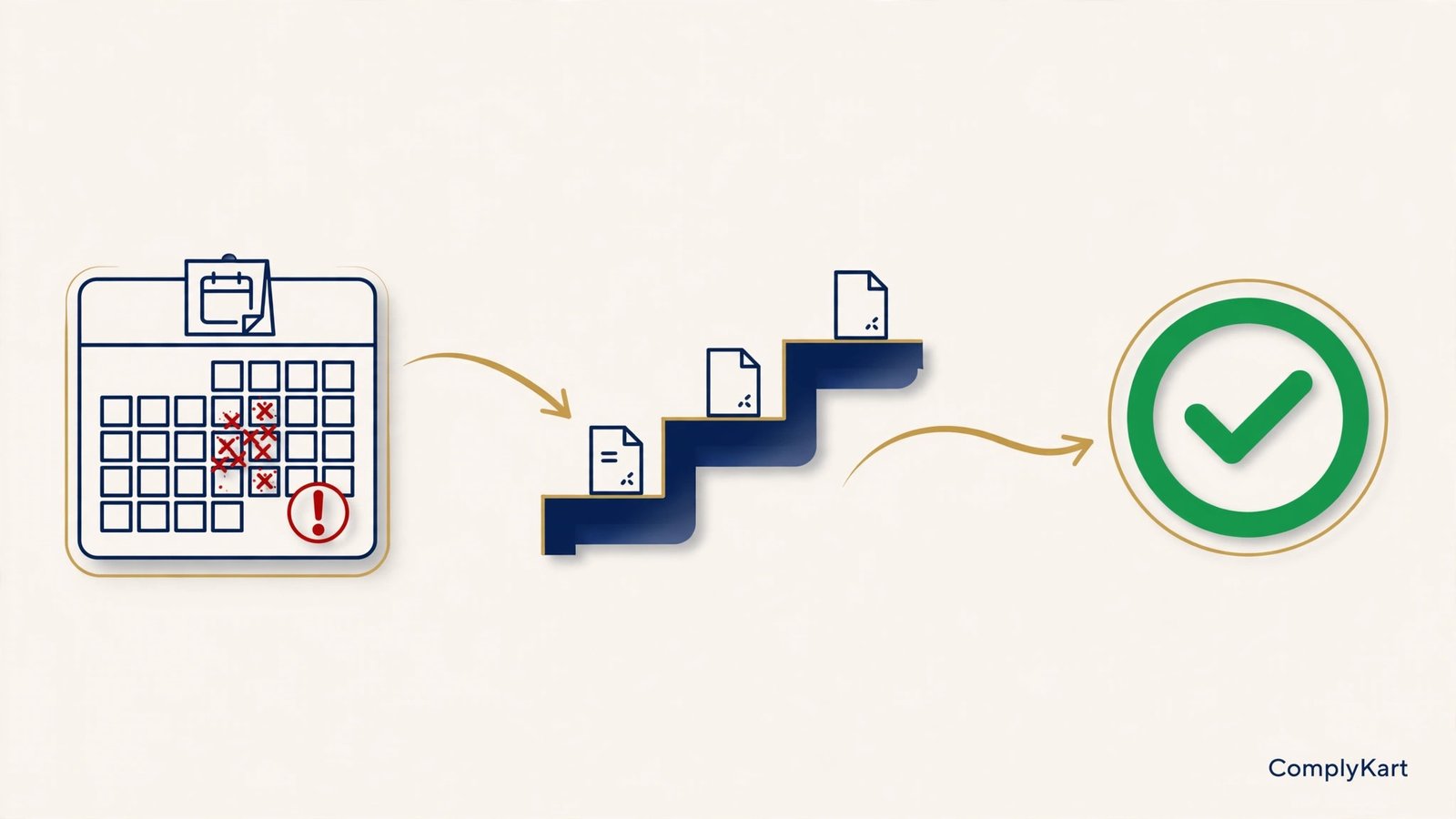
The short answer: if you missed your ROC annual filing, file the oldest year first — AOC-4 before MGT-7 within each year — and pay ₹100 per day, per form, in additional fees. There is no cap on the fee, and paying it closes the default for that form. But do not let three consecutive years go unfiled: directors face disqualification under Section 164(2).
Breathe. You're not the first, and the system has a door marked for exactly this.
Every filing season, directors discover — usually via a notice, sometimes because a bank started asking — that last year's AOC-4 or MGT-7 never got filed. Sometimes both forms; sometimes two years' worth. The reaction is guilt plus paralysis, and the paralysis is the expensive part: the fee meter doesn't pause for feelings.
So let's replace the dread with a plan.
Key takeaways
- File the oldest financial year first; within each year, AOC-4 before MGT-7.
- Additional fee: ₹100 per day, per form, no cap — one missed AOC-4 for a year costs roughly ₹35,000.
- Three consecutive unfiled years trigger director disqualification under Section 164(2) for five years.
- Paying the late fee closes the form's default — it is not compounding under Section 441.
- DIR-3 KYC is now triennial (next due 30 June 2028), not an annual September exercise.
Step zero: how to assess the damage honestly
Before you file anything, find out exactly where you stand. Pull the filing history on the MCA portal and list every financial year with a missing AOC-4 or MGT-7. Check ADT-1 — the auditor's appointment — for those years too, because it usually wasn't filed either.
Then check the two things people always forget: are your directors' DINs still active, and are their DSCs valid? Discovering a dead DIN on filing day is a misery ten minutes of checking now will prevent.
And confirm the company hasn't been struck off. If it has, you're not in catch-up territory anymore — you're in restoration territory, through the NCLT: longer, costlier. Most readers won't be there, but check, because the remedy is completely different.
How much does a missed ROC filing actually cost?
Additional fees run at ₹100 per day, per form, from the day after the due date until the day you file. There is no cap. It just runs.
So: one missed AOC-4, due around 29 October 2025, filed today — roughly 348 days late — costs about ₹34,800 in additional fees alone. Miss both forms for the same year and you're looking at roughly double. Two full years on both forms can cross a lakh. I have done this arithmetic across from directors who went quiet for a moment. Then they filed — because the number only grows.
One clarification worth making: this is a fee for late filing, and paying it closes the matter for that form. It is not the same as compounding under Section 441, which deals with actual offences. Don't let anyone conflate the two to frighten you into a bigger engagement than you need.
The three-year line: Section 164(2) disqualification, explained
Here's the real deadline hiding behind the fee meter. If a company fails to file its financial statements or annual returns for three consecutive financial years, its directors face disqualification under Section 164(2) — they become ineligible to be appointed as directors of any company for five years.
Read that again. Not a fine. Not a notice. Disqualification from directorship itself, across every company they serve.
If you're at one or two missed years, you're in fee territory — unpleasant but fixable. If you're approaching three, treat this as urgent in a way that fees alone never convey. The calendar matters more than the money now.
What order should you file missed ROC forms in?
File oldest year first. Within each financial year, file AOC-4 before MGT-7 — the annual return draws on the financials, and keeping the sequence right keeps the record coherent.
So if FY 2023-24 and FY 2024-25 are both pending: AOC-4 for 2023-24, then MGT-7 for 2023-24, then AOC-4 for 2024-25, then MGT-7 for 2024-25. File ADT-1 for the auditor appointments alongside the relevant years.
Each filing needs that year's financials finalised and audited — no shortcuts. If the books were never closed, the accounting comes first. Be honest about this: the forms are the easy part. Reconstructing two years of books is where the real work sits. Start there.
What "caught up" actually gets you
Once every pending form is filed and the fees paid, the record is clean. Banks, investors, and government tenders all read the MCA record — and "filed late, fees paid" reads infinitely better than open defaults. One is a company that stumbled; the other is a company that might not exist properly.
While you're in there, check your directors' KYC status. DIR-3 KYC is now triennial — since 31 March 2026, it's once every three years, with the next one due 30 June 2028 — not the annual September exercise it used to be. If someone told you it's due this September, they're working from the old rule. Don't let an outdated reminder create a fresh default while you're clearing old ones.
How to never miss an ROC filing again
The catch-up is the hard part; staying current is easy by comparison. Calendar the AGM the day it's decided. Engage your auditor before year-end. And keep one named person — a director, a CS, a filing desk — responsible for the October–November window every year.
Companies rarely default out of defiance. They default out of diffusion: everyone assumed someone else was handling it. Name the someone.
Frequently asked questions
Can I file AOC-4 and MGT-7 together for a missed year?
File them in sequence, not simultaneously: AOC-4 first, then MGT-7, because the annual return draws on the financials. And always work oldest year first — 2023-24's forms before 2024-25's — since each year's record builds on the last. The sequence keeps your MCA record coherent, and a coherent record is what banks and investors actually read.
Is there a maximum late fee for missed ROC filings?
No. The additional fee is ₹100 per day, per form, from the day after the due date until you file — with no ceiling. One missed AOC-4 for a full year runs to roughly ₹35,000; two forms over two years can cross a lakh. The meter only stops when you file.
What if the ROC has struck off the company?
Then you're past catch-up and into restoration, which runs through the NCLT — a longer, costlier process with its own paperwork and hearings. Check the company's status on the MCA portal before you do anything else, because the remedy for a struck-off company is completely different from late filing, and starting down the wrong path wastes months.
Does paying the late fee wipe the default completely?
For that form, yes — the additional fee settles the late filing, and the company's record shows filed-with-fees-paid rather than open default. Lenders and investors read those two very differently. It is not compounding under Section 441, which deals with actual offences.
My consultant says DIR-3 KYC is due this September. Is that right?
No — that's the old rule, and it's still floating around in a lot of compliance checklists. Since 31 March 2026, DIR-3 KYC is triennial: once every three years, next due 30 June 2028. Don't let an outdated reminder create a fresh default while you're clearing old ones — verify the rule before you act on any reminder.
If the backlog feels too tangled to unwind yourself — multiple years, books never closed, a struck-off scare in the back of your mind — this is exactly the kind of mess our team at ComplyKart untangles every filing season. Bring us the company name; we'll map the damage and the path back, before the meter runs any further.


Comments
No comments yet — ask the first question below.
Join the discussion
Questions go straight to our expert desk. Comments appear after a quick review — no spam, no noise.