
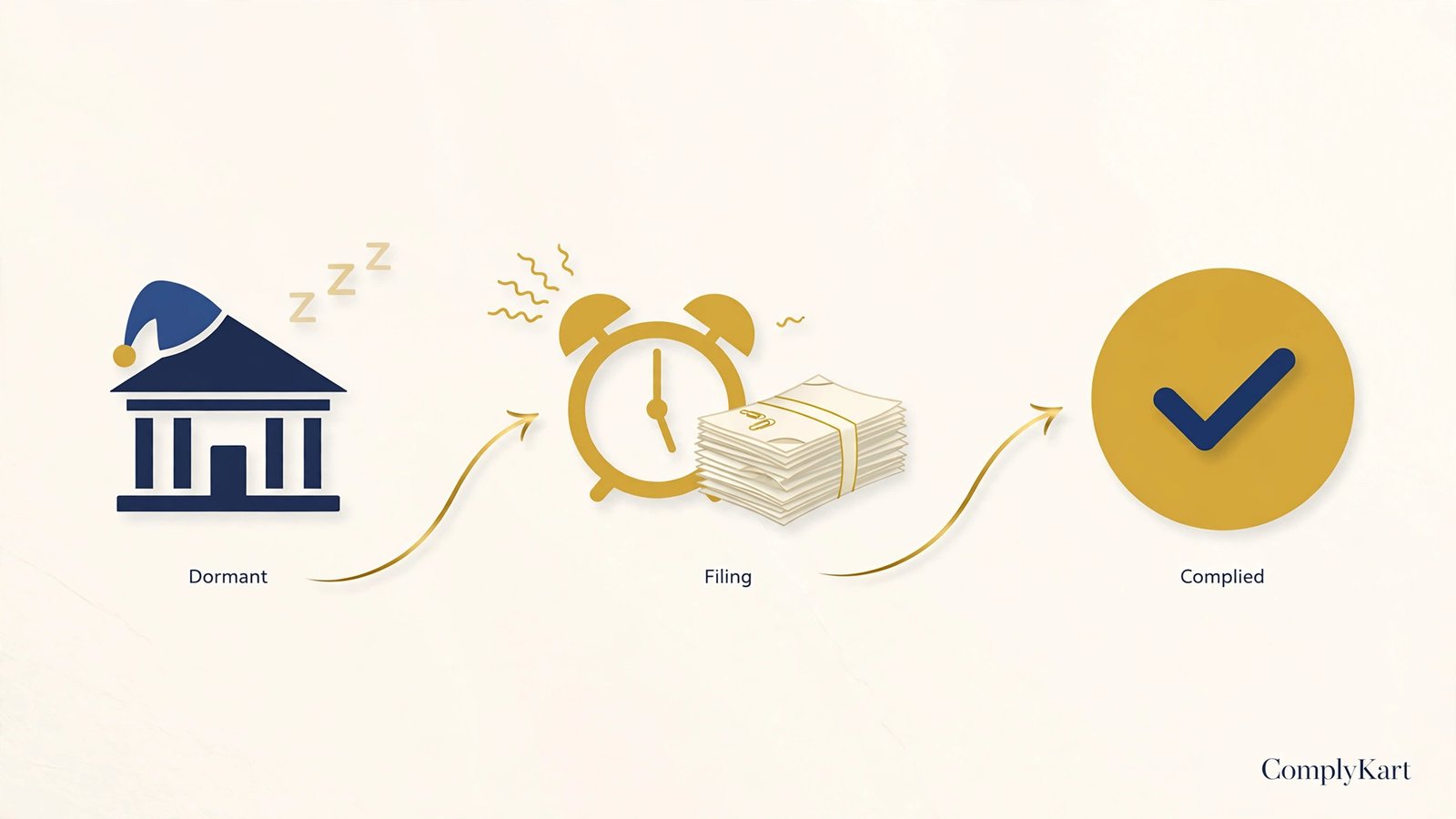
Short answer: yes — a dormant company files ROC returns every year: MSC-3 (its own annual return), AOC-4 (financial statements) and MGT-7/MGT-7A (annual return). Dormant status cuts board meetings and some disclosures. It has never cancelled a single filing.
Let me be direct
"Dormant" is a legal status. It is not a pause button.
I say this because I keep meeting directors who shut down operations, stopped answering the company's mail, and assumed the compliance stopped too. Two years later they discover the ROC has been keeping score the entire time — and the bill is not small.
So here's the straight version: what dormant status actually gives you, what it doesn't, and what happens if you treat it as an excuse to disappear.
Key takeaways
- Dormant is a legal status, not a pause button — MSC-3, AOC-4 and MGT-7/MGT-7A are all still due every year.
- "No significant accounting transaction" is narrow: essentially ROC fees, auditor payments and compliance costs only.
- Every missed form accrues ₹100 per day in additional fees; three silent years can disqualify directors under Section 164.
- Reactivation needs Form MSC-4 with the backlog cleared first — reviving costs multiples of staying compliant.
Two ways to become dormant. One of them is a warning.
The clean way: you apply for dormant status in Form MSC-1, backed by a special resolution. You tell the ROC, upfront, "we're parking this company." The law respects that.
The other way: you simply stop filing. No financials, no annual returns, two years running. The ROC notices — it always does — issues a notice, and enters your company's name in the register of dormant companies itself. Read that again: the Registrar can mark you dormant because you went quiet. That is not a favour. That's the system labelling you as a company that stopped answering.
What does dormant status actually trim?
Fairness first — dormant status does reduce some burden. Board meetings drop to one per half-year. A few provisions around rotation and disclosures ease off. If the company genuinely has no significant transactions — and the law defines that narrowly, basically just ROC fees, auditor payments, and the like — you're not running a full compliance marathon.
But here's what dormant does not cancel:
- MSC-3 — the dormant company's own annual return, due within 30 days of the financial year end, carrying a practising professional's certification.
- AOC-4 — financial statements still get filed. The audit still happens.
- MGT-7 / MGT-7A — the annual return still gets filed.
- Statutory registers, a registered office that actually exists, and board minutes that actually get written.
Dormant means "no business." It has never meant "no paperwork."
One-line versions: MSC-3 is the dormant company's own annual return, due within 30 days of the financial year end. A dormant company is one with no significant accounting transaction — and the law keeps that list very short.
"No significant transaction" — narrower than you think
Dormant status hinges on one phrase: no significant accounting transaction. Directors hear "no business" and assume it covers everything. The law's list of what still counts as insignificant is short — ROC fees, payments to auditors, compliance-related professional fees, and little else.
Sold an old laptop the company owned? Received interest on the company's bank balance? Congratulations — those are transactions, and they can puncture the "dormant" claim. If money moved for any real reason during the year, tell your CA before filing MSC-3, not after. A dormant return that quietly hides real transactions is worse than no return at all.
What do missed dormant-company filings cost?
Every missed form accrues additional fees at ₹100 per day. Per form. From the day after the deadline, with no reminder and no grace period.
Do the arithmetic yourself: three forms, two silent years. That's roughly ₹2,00,000 in additional fees alone — before a single professional fee, before any compounding application. I've seen directors go pale at this number. It was always in the statute. Nobody read it to them until the notice arrived.
And it gets worse than money. If a company fails to file its financial statements or annual returns for three continuous financial years, its directors face disqualification under Section 164 — not just from that company, from every board they sit on. Your dormant shell can quietly end your directorship in your active, thriving company. Let that sink in.
How do you reactivate a dormant company?
Another thing people get wrong: reactivation isn't informal. To bring a dormant company back to life, you apply in Form MSC-4 — and the ROC expects the backlog cleared first. Unfiled years, unpaid fees, updated registers. The company that "we'll revive when the market turns" usually revives at triple the cost of having stayed compliant, because every quiet year added its own layer of fees.
And if a dormant company keeps ignoring its obligations, the ROC has the final move: strike-off. The company's name gets removed from the register. The directors' liabilities don't evaporate with it.
Your two honest options
Option one: keep it dormant, properly. File MSC-3, AOC-4, and MGT-7 every year. Hold your two board meetings. For a company with no transactions, this costs far less than people imagine — the audit is simple because there's almost nothing to audit.
Option two: close it properly. Strike-off under Section 248 wipes the slate clean, legally, finally. What you must not do is option three — the unofficial one, where you just stop and hope. Hope is not a compliance strategy. The ROC has a register, a calendar, and a fee table, and it is more patient than you are.
Dormant companies are cheap to maintain and expensive to neglect. If yours has been quiet for a while and you're not sure where it stands, get a status check done — ComplyKart's team pulls the ROC record, maps the backlog, and tells you the cheapest way out. Before the meter runs another day.
Frequently asked questions
We stopped operating two years ago and filed nothing. How bad is it?
Bad, but fixable. Three forms a year at ₹100 per day per form adds up fast — do the arithmetic before you panic, then file oldest-first. The real danger line is three continuous years of non-filing, which risks director disqualification under Section 164. Move now, not next quarter.
Can the ROC really mark us dormant on its own?
Yes. Stop filing for two years and the Registrar can enter your name in the register of dormant companies itself, after notice. That's not a favour — it's the system labelling you as a company that stopped answering. Apply via MSC-1 if you want dormant status; don't earn it by silence.
Does dormant status cancel the audit?
No. The audit still happens and AOC-4 still gets filed — there's just almost nothing to audit, which is exactly why maintaining a dormant company costs far less than people imagine. Cheap to maintain, expensive to neglect. Those are the only two settings.
We want to shut it down instead. What then?
Strike-off under Section 248 wipes the slate clean, legally and finally — but only with filings current. You can't strike off a company with a filing backlog; clear the dues first, then close it properly. That's option two, and it's an honest one.
Is DIR-3 KYC due for dormant company directors?
Not this season. Director KYC runs once every three years now — next due 30 June 2028 — dormant or active alike. One less thing on the list, which is a mercy, because the ROC forms are the ones that actually matter here.




Comments
No comments yet — ask the first question below.
Join the discussion
Questions go straight to our expert desk. Comments appear after a quick review — no spam, no noise.