
IN BRIEF
Udyam registration is the Government of India's free online registration for micro, small and medium enterprises under the Micro, Small and Medium Enterprises Development Act, 2006. It replaced Udyog Aadhaar on 1 July 2020 and is what 'MSME registration' means today: the same filing, done on the Udyam portal, which records an enterprise as micro, small or medium and issues a permanent Udyam Registration Number.
A bank asks for your MSME certificate. A buyer asks for your Udyam number. A consultant offers to do your "MSME registration" for ₹2,000. Are these three different things? No. They are the same filing, wearing three different names — and the confusion around the names is exactly where owners lose money.
The short answer: Yes. Udyam registration is the official way to register as a micro, small or medium enterprise in India, so "MSME registration" and "Udyam registration" mean the same thing today. MSME is the category — micro, small or medium — and Udyam is the name of the online registration that records it. The registration is free on the official portal, udyamregistration.gov.in.
That settles the question. The rest of this guide is about the two traps that still catch owners who know the answer: paying a look-alike website for a free filing, and trusting a Udyog Aadhaar number that stopped counting in June 2022.
So what is the difference between Udyam and MSME registration?
Think of it as a club and a membership card. MSME is the club — the category of enterprise the government recognises as micro, small or medium under the Micro, Small and Medium Enterprises Development Act, 2006. Udyam is the membership card — the online registration, on the Ministry of MSME's portal, that proves your enterprise belongs to the club and records which tier it sits in.
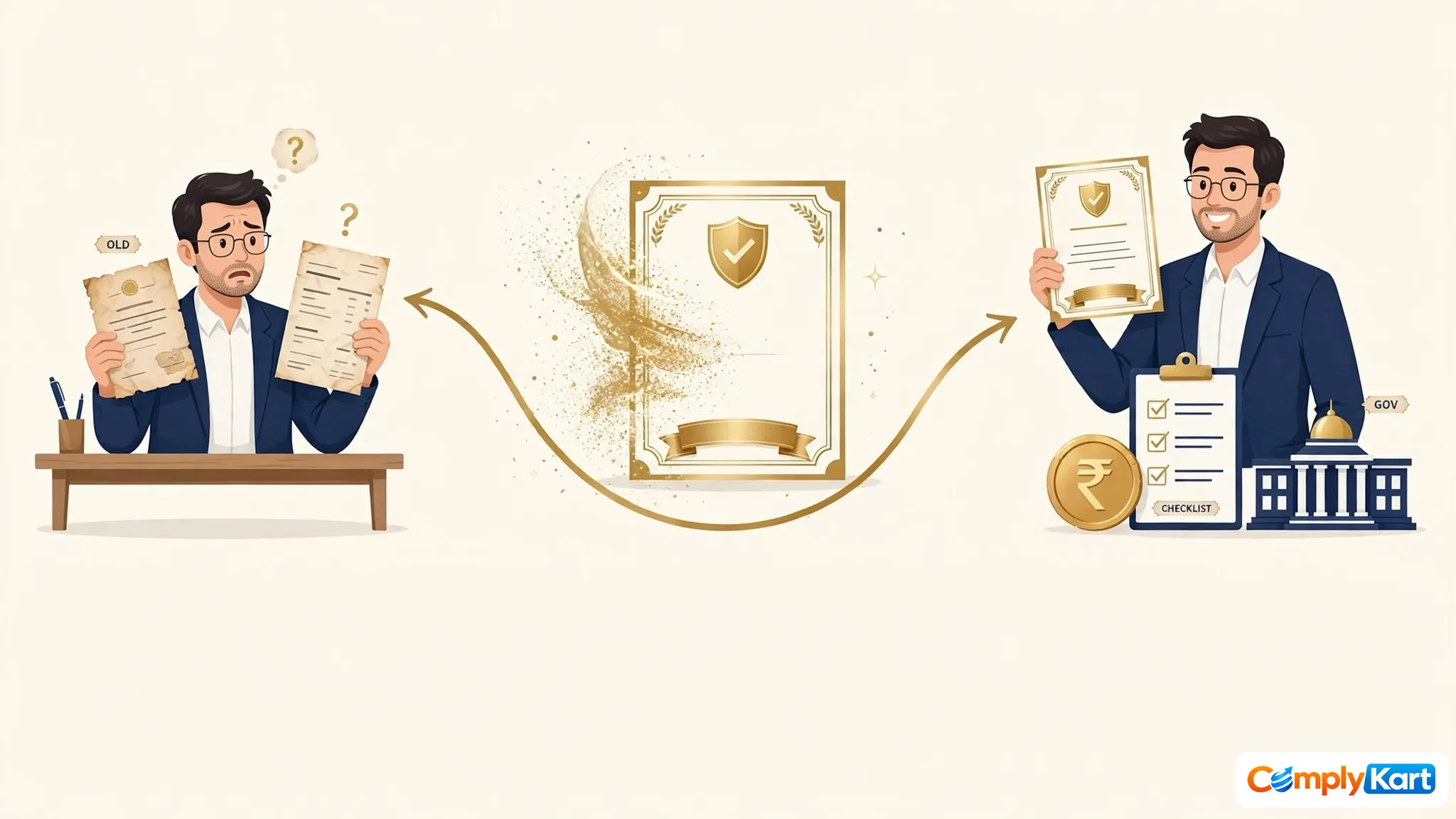
Before July 2020 the card had a different name: Udyog Aadhaar. The government replaced it with Udyam registration on 1 July 2020, under notification S.O. 2119(E) dated 26 June 2020. The old name still floats around in search results, on agents' websites and in old paperwork, which is why the question never dies. If someone offers you "MSME registration" today, they are offering to file your Udyam registration. If someone offers you "Udyog Aadhaar", they are offering you a dead form.
One more distinction matters, because it decides which benefits you can actually claim: Udyam is not a licence to run a business. It does not replace GST registration, a company incorporation or a trade licence. It certifies size. GST registration makes you a taxpayer under the CGST Act, 2017. MCA registration creates your company or LLP. Udyam registration certifies that the business is a micro, small or medium enterprise — and that certificate is what opens the door to the MSME benefits.
Which category are you — micro, small or medium?
The limits changed on 1 April 2025, and a surprising number of articles still show the old ones. If you read that a micro enterprise means investment up to ₹1 crore and turnover up to ₹5 crore, you are reading pre-2025 law. The revised limits, notified on 21 March 2025 in S.O. 1364(E), are:
| Category | Investment in plant, machinery or equipment | Annual turnover |
|---|---|---|
| Micro | Up to ₹2.5 crore | Up to ₹10 crore |
| Small | Up to ₹25 crore | Up to ₹100 crore |
| Medium | Up to ₹125 crore | Up to ₹500 crore |
The test is a composite one, and this is the part owners get wrong. Both numbers must sit inside your category's limits. Cross either ceiling and you move up — even if the other number is tiny. Take a manufacturer with ₹2 crore invested in plant and machinery and turnover of ₹12 crore. On investment alone it is micro. On turnover it has crossed the micro ceiling of ₹10 crore. So it is small, not micro. Now take the same ₹2 crore of investment with turnover of ₹9 crore. Both numbers sit inside the micro limits, so it stays micro.
Two details complete the picture. Export turnover does not count towards the turnover test, so an export-heavy unit can stay in a lower category than its gross sales suggest. And the category is not frozen: if you grow past a ceiling you move up, and if you shrink you move down — but a move down takes effect only from 1 April of the following financial year. There is a cushion on the way up, too. If you move to a higher category, you keep the non-tax benefits of your old category — tender preferences, delayed-payment protection — for three years from the change, under notification S.O. 4926(E) of 18 October 2022.
Your figures are not taken on trust alone. Investment and turnover are pulled from your income tax and GST records, linked to your PAN. You must also update the registration with the previous year's income tax and GST details; an enterprise that does not update its information in time can have its status suspended. The system checks, so the numbers you declare need to match the numbers you filed.
What does Udyam registration actually get you?
The certificate itself is a piece of paper. What it opens up is the list below, and the first two items are the ones that pay for themselves.
Collateral-free loans. Registered MSMEs can borrow under the Credit Guarantee Fund Trust for Micro and Small Enterprises, the CGTMSE scheme, without putting up security. The guarantee is what makes a bank comfortable lending to a business with no property to pledge. Our guide to collateral-free loans under CGTMSE walks through the limits and the catch — the guarantee covers the loan, not your business judgment.
The 45-day payment rule. This is the sharpest tool in the MSME kit. Under sections 15 and 16 of the MSMED Act, a buyer must pay a micro or small supplier within the agreed period — never more than 45 days from acceptance of the goods or services — and within 15 days if no period was agreed. Pay late and the buyer owes interest at three times the RBI Bank Rate, compounded monthly. The Bank Rate stands at 5.75% after the RBI's decision of 7 October 2026, so the interest is 17.25% a year. On a ₹5 lakh invoice paid 45 days late, that is ₹10,634 on simple interest — monthly compounding pushes it a touch higher. The buyer also loses the tax deduction: since 1 April 2026, the old section 43B(h) of the Income-tax Act, 1961 lives on as section 37(2)(g) of the Income-tax Act, 2025, and an unpaid micro or small supplier's invoice can be claimed only in the year it is actually paid. The full recovery route, through the MSME Samadhaan portal and the Facilitation Council, is in our guide to recovering a payment delayed beyond 45 days.
Tenders and procurement. Registered MSMEs get preference in government tenders, including on the GeM portal, and exemptions from earnest money deposits in many cases. Guarantee schemes such as Stand-Up India and the CGSS sit alongside the same registration for founders who need credit without collateral.
Schemes and subsidies. Interest subsidies, reimbursement of ISO certification costs, and assistance with patent and trademark costs all run through the Udyam number. The registration is the key that opens these doors; it does not guarantee any single loan, subsidy, contract or tax exemption, and anyone who promises otherwise is selling, not advising.
One honest caveat. Traders can register on Udyam — retail and wholesale trade are in the system, and trading is now the largest source of employment reported under Udyam. But the Ministry has clarified that trading enterprises do not get the delayed-payment protection or the procurement preferences. Some practitioners still argue the point, so if you are a trader, treat the certificate as proof of size and a route to credit, not as a payment weapon. The protection belongs to micro and small manufacturers and service providers.
The scale tells you this is not a niche formality. As on 31 July 2026, 9.16 crore enterprises were registered across the Udyam Registration Portal and the Udyam Assist Platform, up from 1.65 crore on 1 April 2023. The Assist Platform, launched on 11 January 2023 and run by SIDBI, brings informal micro enterprises without GST or income tax registration into the formal economy. The Ministry put employment from these enterprises at over 38 crore people in July 2026.
What changed in October 2026?
If you registered years ago, the law around your registration changed under your feet. Parliament passed the Micro, Small and Medium Enterprises Development (Amendment) Bill, 2026 in August — Rajya Sabha on 3 August, Lok Sabha on 7 August — and it received Presidential assent on 13 August 2026. The commencement notification, S.O. 5575(E) dated 12 October 2026, brought most of it into force on 15 October 2026.
Three changes matter to an owner. First, the twin-criterion classification — investment and turnover together — is now written into the Act itself, and Udyam registration has statutory permanence as a digital, free and voluntary platform. Second, registration is voluntary for every MSME, and the old compulsory filing for medium manufacturing enterprises is gone. Third, the Act decriminalises: furnishing false information in the registration now draws a warning the first time and a penalty of ₹1,000 to ₹50,000 for the second and subsequent instances, instead of criminal fines. Online dispute resolution and mandatory TReDS onboarding for central public sector enterprises are in the same amendment, but the dispute-resolution sections (sections 8 to 10) have not been notified yet — until they are, the existing sections 18 and 19 continue to apply, and the 45-day payment rule itself is unchanged.
Trap 1: paying for a registration that costs nothing
Search "Udyam registration" and the first results are often ads. Many lead to look-alike websites that copy the government portal's colours, use words like "Udyam", "MSME" or "Udyog Aadhaar" in the domain name, and charge anywhere from ₹499 to a few thousand rupees to file the same free form. One large platform's own page quotes ₹1,499 for the service. In September 2022, PIB Fact Check publicly called out a site, eudyogaadhaar.org, that was asking ₹2,700 just to "print" the registration certificate.
The official portal says it plainly: the process is totally free, and no costs or fees are to be paid to anyone. It carries a "Beware of Fake Sites" warning stating that no private online or offline system, service, agency or person is authorised to do MSME registration, except the portal itself and the government's Single Window Systems. There is no payment page anywhere on the official portal. If a website asks you to pay before it shows you a certificate, you are not on the government site.
Three checks take ten seconds. First, look at the address bar, not the logo: the real portal is udyamregistration.gov.in — an address ending in .gov.in. Anything ending in .org, .com, .in or .net is private, even with "udyam" in the name. Second, never share your Aadhaar OTP with anyone on the phone — the OTP is what lets a stranger file in your name. Third, skip the sponsored results at the top of the search page; type the address yourself. If you already paid a private site, check that the certificate it gave you shows a Udyam number that verifies on the official portal — the registration itself is usually valid, you have simply paid for nothing — and report the site through the portal's grievance channel or by email to support@udyam.gov.in. The portal helpline is +91 8308809334, Monday to Friday, 10 am to 6 pm.
A consultant charging a professional fee for advice is a different thing from a website charging a "government fee" that does not exist. Know which one you are paying.
Trap 2: running on a Udyog Aadhaar number that expired in 2022
The second trap is quieter, and it hurts more. Udyog Aadhaar was the MSME registration from 2015 until Udyam replaced it on 1 July 2020. Old Udyog Aadhaar numbers were given time to migrate, and the government extended their validity three times. The final extension, notification S.O. 2134(E) of 6 May 2022, kept them valid only until 30 June 2022. After that date, a Udyog Aadhaar number is not MSME proof. It is a printout of a filing you made before July 2020.
The timeline is short enough to remember:
- 2015: Udyog Aadhaar launches as the online MSME registration.
- 1 July 2020: Udyam registration replaces it (S.O. 2119(E), 26 June 2020).
- 30 June 2022: the last extended validity of old Udyog Aadhaar numbers ends (S.O. 2134(E), 6 May 2022).
- Today: only a Udyam Registration Number counts as current MSME proof.
If you still hold only a Udyog Aadhaar number, the fix is simple and free. Go to udyamregistration.gov.in and choose the "UAM Migration to Udyam" option. You enter the old UAM number and verify with an OTP to the mobile or email you gave when you filed it. Migration is not a renewal of the old number — you get a new Udyam Registration Number and a fresh e-certificate, and your enterprise is classified again using the current limits. The migration option is still open in 2026; only the old number's validity ended.
Do not put this off until a bank or a buyer asks. The delayed-payment protection runs from your Udyam registration date, so supplies made while you held only a lapsed Udyog Aadhaar number are not protected. A lapsed number is the same as no number when a payment dispute lands.
How to register on Udyam in about fifteen minutes
The portal asks for very little, because most of it is pulled from government records. Keep these ready: the Aadhaar number of the proprietor, partner or director; the PAN of the enterprise; and the GSTIN, which has been required since 1 April 2021. One Udyam Registration is issued per enterprise, and any number of manufacturing or service activities can be added inside it.
The steps are: open udyamregistration.gov.in and choose "For New Entrepreneurs who are not Registered yet as MSME"; enter the Aadhaar number and name as on the Aadhaar card, then verify with the OTP; enter the PAN and let the portal validate it; fill in the enterprise details, the NIC codes for your activities, and the bank account; submit the self-declaration. The certificate, with the Udyam Registration Number and a QR code, is generated online. There is no fee at any step, no document upload, and no renewal — the registration is permanent, and you update the details when they change. If you need a GST registration first, get that done before you start, because the portal will ask for the GSTIN. And if you want to register as an MSME with professional help, make sure the help is what you are paying for — the filing itself is free.
Five mistakes that cost owners the benefits
- Paying a look-alike portal. The government fee is ₹0. Anything else is a private charge for a free form.
- Quoting a dead Udyog Aadhaar number. It stopped counting on 30 June 2022. Migrate, then quote the Udyam number.
- Reading stale limits. Any article showing micro at ₹1 crore investment and ₹5 crore turnover is pre-April 2025. The current limits are ₹2.5 crore and ₹10 crore.
- Testing only one number. Investment and turnover both count. Cross either ceiling and you move up a category.
- Forgetting the yearly update. Update the income tax and GST details on the portal each year, or risk suspension of the status you registered for. If the maths on a late payment looks large, run the numbers for your own case before you decide whether to chase it.
Should you do it yourself or hire someone?
For most owners, do it yourself. The form is one page, the fee is zero, and the portal validates PAN and GSTIN for you. Hire someone only if your case is genuinely tangled — multiple enterprises under one PAN, a business that straddles manufacturing and trading, or a classification that sits on a borderline. Even then, pay for advice, not for the filing. The filing costs nothing, and no agent can make the government move faster than the portal does.
Questions owners keep asking
Is Udyam registration the same as MSME registration?
Yes. MSME is the category and Udyam is the registration that records it. Since 1 July 2020, "MSME registration" means registering on the Udyam portal.
Is Udyam registration free?
Yes. Registration, the certificate, printing it again, updating it and recovering a forgotten number all cost nothing on udyamregistration.gov.in. The portal itself says no costs or fees are to be paid to anyone.
Does Udyam registration expire?
No. The Udyam Registration Number is permanent and there is no renewal. You only update the details when they change — address, activity, bank account or turnover — and you refresh the income tax and GST figures each year.
Can I register more than one business on one PAN?
One Udyam Registration is issued per enterprise, and all the activities of that enterprise sit inside it. Separate enterprises under the same PAN register separately.
What if my turnover crosses the limit mid-year?
You move up a category when either the investment or the turnover ceiling is crossed, and you keep the non-tax benefits of your old category for three years from the change. A move down takes effect from 1 April of the following financial year.
What is the Udyam Assist Platform?
A separate platform, launched on 11 January 2023 and run by SIDBI, that registers informal micro enterprises — those without GST or income tax registration — and brings them into the formal economy through banks and NBFCs.
MSME is the club. Udyam is the membership card. Get the card from the only place that issues it, for free, and check that the number you quote is a live one — not a Udyog Aadhaar relic from before 2020. Everything the certificate gives you access to, from collateral-free credit to the 45-day payment rule, starts from that one free filing.





Comments
No comments yet — ask the first question below.
Join the discussion
Questions go straight to our expert desk. Comments appear after a quick review — no spam, no noise.