
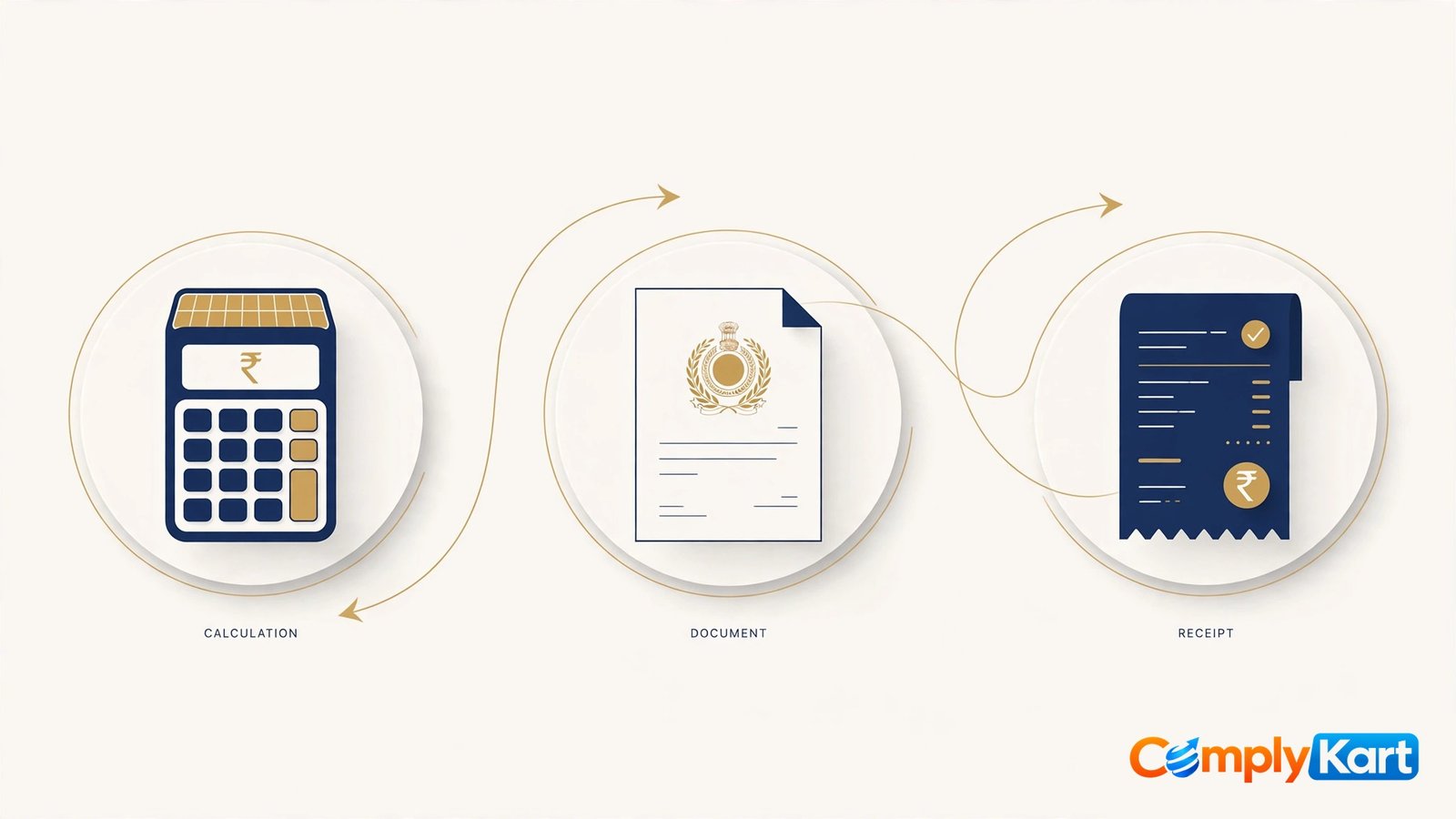
Private limited company registration cost in India breaks down as: ₹0 MCA SPICe+ fee up to ₹15 lakh authorised capital, ₹1,000 for name approval, ₹1,000–2,500 per director for DSC, state-wise stamp duty, and ₹5,000–15,000 in professional fees. Plan for 7–10 working days end to end.
Let's talk actual numbers
If you've priced incorporation lately, you've seen two extremes. One consultant quotes ₹35,000. An ad banner promises ₹6,999 all-inclusive. Both can be technically true and both can mislead you — because the real cost of registering a private limited company in India isn't one number. It's a stack of government charges, state stamp duty, and professional fees, and the only way to judge a quote is to know what's inside it.
I've built incorporation cost sheets for founders for years. Here's the honest breakdown, line by line.
Key takeaways
- The MCA's SPICe+ filing fee is ₹0 for companies with authorised capital up to ₹15 lakh — confirmed through MCA and PIB communications in August 2025.
- Name reservation (SPICe+ Part A) costs ₹1,000 per filing; a rejected name means filing and paying again.
- DSCs cost ₹1,000–2,500 per director, and stamp duty on the MOA/AOA varies by state — it's the largest variable in the whole exercise.
- Professional fees of ₹5,000–15,000 cover name search, drafting, filing, and MCA resubmissions for a standard two-director incorporation.
Is the MCA government fee really ₹0?
Yes — and this surprises most first-time founders. The Ministry of Corporate Affairs made the SPICe+ filing fee effectively zero for companies with authorised capital up to ₹15 lakh, confirmed through MCA and PIB communications in August 2025. That covers the core SPICe+ Part B filing, the Memorandum and Articles of Association, and the bundled PAN, TAN, EPFO and ESIC registrations.
Note the cap: above ₹15 lakh authorised capital, slab-based fees kick in — so most startups simply stay at or below ₹10 lakh and never pay this. No two-founder startup needs ₹50 lakh authorised capital on day one; you can raise it later.
How much does name approval cost?
SPICe+ Part A — the name reservation — carries a ₹1,000 fee. One filing covers two proposed names in order of preference. Both rejected? You file and pay again — so spend an hour on a proper name search first. Common words and names too close to existing companies get knocked back routinely.
What does a DSC cost per director?
Every director needs a Digital Signature Certificate to sign the incorporation forms. Budget ₹1,000 to ₹2,500 per director depending on the certifying authority (a Class 3 DSC is required for filings). Two directors means two DSCs — a per-person cost, not per-company. PAN/TAN costs around ₹143, bundled through SPICe+ Part B. If anyone quotes ₹2,000 for "PAN charges," walk away.
Why does stamp duty change every quote?
Here's the part that makes every "all-inclusive" quote wobbly. Stamp duty on the Memorandum and Articles is levied state-wise — by state, by authorised capital, sometimes by the city of the registered office. In practice it's usually the largest variable cost in the whole exercise, and it's the one item a national fixed-price package cannot honestly bake in without either padding it or billing "at actuals" later.
When a package says "stamp duty included," ask for which state and up to what capital. When it says "stamp duty at actuals," that's actually the honest version — just make sure you know the actuals for your state before you sign off. Rates change — check current schedules rather than any blog post for the exact figure.
What should professional fees cost?
This is what you pay the CA, CS, or filing firm to do the work: name search, document drafting, DSC coordination, form filing, resubmissions when MCA raises queries, and the follow-through until the Certificate of Incorporation lands in your inbox.
The honest band is ₹5,000 to ₹15,000 for a standard two-director incorporation with clean paperwork. Below ₹5,000, ask what they're skipping — often the drafting quality or the post-incorporation handholding. Above ₹15,000 for a plain-vanilla incorporation, ask what extra you're buying. Complex shareholding, foreign directors, or sectoral licences are different conversations with different pricing.
How do firms advertise ₹6,999 all-inclusive?
Usually it's a base professional fee plus the government-side costs that are currently zero or near-zero — and it works out fine as long as stamp duty is billed at actuals and disclosed upfront. The trouble starts when "all-inclusive" quietly excludes DSCs, excludes stamp duty, excludes a second name filing, or covers only one round of MCA resubmission.
Here's a simple test for any quote. Ask for five things in writing: (1) professional fee, (2) stamp duty — included or at actuals, with the estimate for your state, (3) DSC charges per director, (4) how many name filings and resubmissions are covered, and (5) what happens after incorporation — bank account support, first board meeting paperwork, share certificates. A good firm answers all five without blinking. A quote that survives those five questions is one you can trust.
Want to see how the pieces add up for your own situation? Run the numbers on our incorporation cost calculator — plug in your state, capital, and number of directors and see the realistic total instead of a headline price.
How long does incorporation take?
Anyone promising "incorporation in 24 hours" is selling you the DSC step, not the company. Realistic: 1–2 days for name approval, a day or two for DSC issuance, 2–3 days for drafting and signatures, and 3–5 working days for MCA processing of SPICe+ Part B. Government timelines move with workload, so 7–10 working days end to end is the number I'd plan around — build your launch plans on that, not the fastest headline.
A final word on "cheap"
Incorporation is the cheapest compliance event your company will ever have. The annual filings, audits, and tax returns cost more, every year, for the life of the company. Saving ₹3,000 on the thinnest package and getting a sloppy MOA is the worst trade here. A clean incorporation — proper objects clause, correct authorised capital, share certificates issued on time — saves you multiples of that in your first year alone.
Judge quotes on what's inside them, not the headline. And if a number looks too good, read the exclusions — that's always where the money is.
Frequently asked questions
What is the minimum cost to register a private limited company in India?
With the ₹0 SPICe+ fee up to ₹15 lakh authorised capital, the floor is roughly ₹10,000–₹12,000: ₹1,000 name approval, DSCs for two directors, state stamp duty at actuals, and a lean professional fee. Anything advertised far below that is almost certainly excluding DSCs, stamp duty, or resubmissions — check the exclusions before comparing.
Is the ₹0 SPICe+ government fee really true?
Yes, for companies with authorised capital up to ₹15 lakh — confirmed through MCA and PIB communications in August 2025. It covers the SPICe+ Part B filing, MOA/AOA, and bundled PAN, TAN, EPFO and ESIC registrations. Above ₹15 lakh authorised capital, slab-based fees apply, which is why most startups incorporate at ₹10 lakh or below.
Why do two quotes for the same incorporation differ so much?
Because quotes bundle different things. Stamp duty varies by state and is often billed at actuals; DSCs are per director; some quotes include only one name filing or one MCA resubmission round. Run every quote through the five-question test — fee, stamp duty, DSC, refilings covered, post-incorporation support — and the differences explain themselves.
How long does private limited company registration take?
Seven to ten working days is realistic: 1–2 days for name approval, a day or two for DSCs, 2–3 days for drafting and signatures, and 3–5 working days for MCA processing. Timelines shift with MCA workload. Anyone promising 24-hour incorporation is quoting the DSC step, not the company.
What do most incorporation packages leave out?
Commonly: stamp duty at actuals, DSC charges, additional name filings after a rejection, extra MCA resubmission rounds, and post-incorporation work like share certificates and the first board meeting. None of these are scams — they're legitimate costs. The problem is only when they're hidden. Ask for all five in writing.
Get a fixed, itemised incorporation quote from a practicing professional team — talk to ComplyKart and we'll walk you through the real cost for your state before you commit to anything.



Comments
No comments yet — ask the first question below.
Join the discussion
Questions go straight to our expert desk. Comments appear after a quick review — no spam, no noise.