
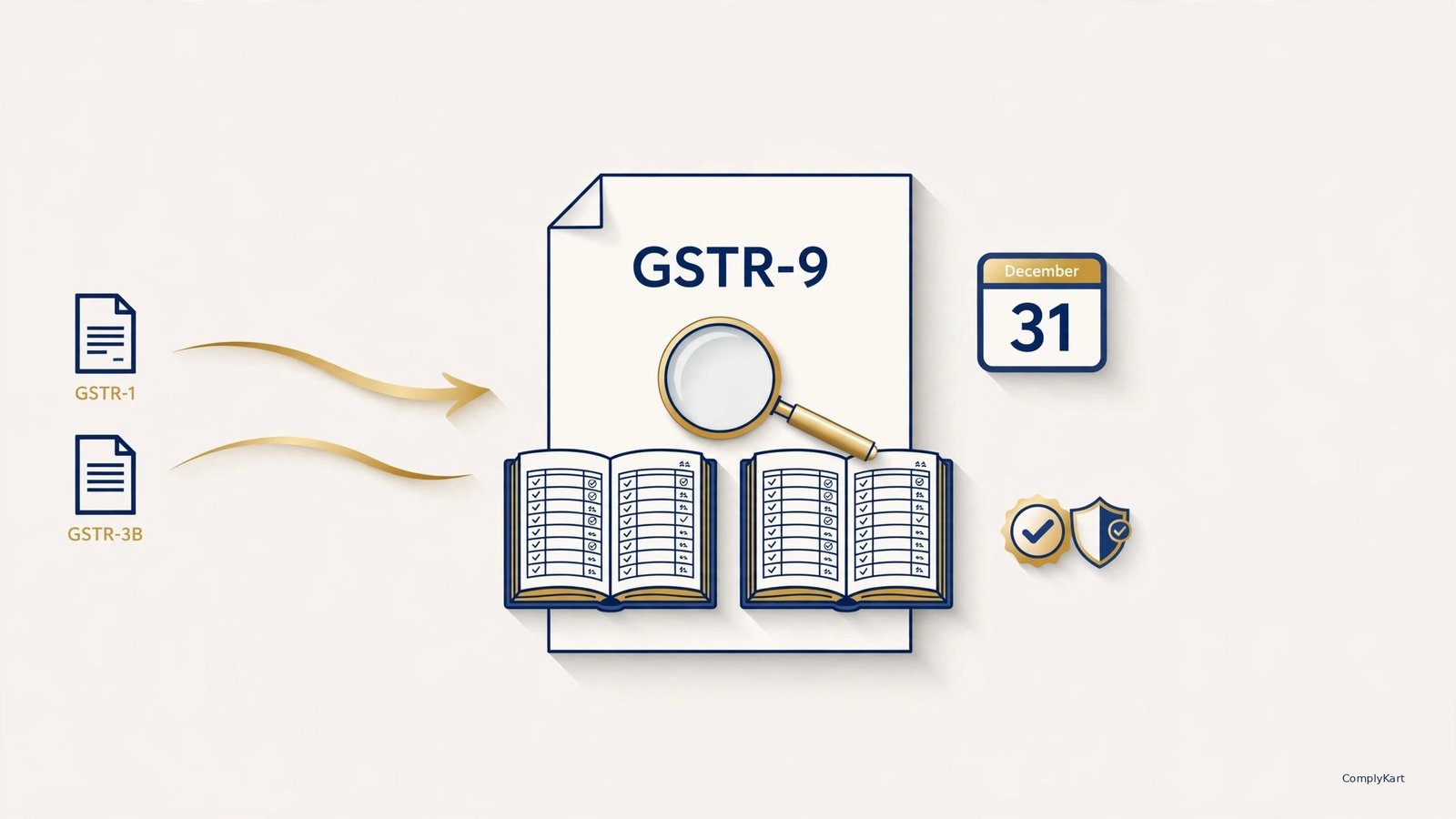
On 10 October, the GST portal quietly switched on the filing panel for GSTR-9 and GSTR-9C for FY 2025-26. If your turnover crossed ₹2 crore last year, your next GST deadline is now set: 31 December 2026. Mark it. December has a way of arriving faster than your accountant admits.
Every year around this time, clients ask me the same thing: “We already filed twelve GSTR-1s and twelve GSTR-3Bs. Why does the government want another return?” Fair question. Here is the honest answer.
GSTR-9 is not a fresh tax calculation. It is a year-end reconciliation — a single statement where everything you declared during the year is laid side by side with what your books of account actually show. The portal pulls your GSTR-1 and GSTR-3B figures, you set them next to your audited books, and you explain or correct the gaps.
Think of it like this. Your monthly returns are the daily tapes from a shop’s billing counter — each one a small snapshot. GSTR-9 is the year-end tally where the owner totals every tape and compares it with the day-book. If the two don’t match, someone is going to ask why. That, in one sentence, is the whole point of this return: the department wants to know that your monthly filings and your books told the same story all year.
Who has to file it?
The rule comes from Section 44 of the CGST Act, 2017, read with Rule 80 of the CGST Rules. Under Notification No. 15/2025–Central Tax (17 September 2025), the position for FY 2025-26 is:
- Aggregate turnover above ₹2 crore — GSTR-9 is mandatory.
- Aggregate turnover up to ₹2 crore — exempt, filing is optional.
- Aggregate turnover above ₹5 crore — you also file GSTR-9C, the reconciliation statement, alongside GSTR-9.
GSTR-9C is the part many businesses stumble on. It reconciles the GSTR-9 figures with your books of account and is filed only above the ₹5 crore mark. Since FY 2020-21 it is self-certified — no longer signed off by a CA or cost accountant — but don’t let that word fool you. “Self-certified” means you take responsibility for the reconciliation, not that the reconciliation is casual.
A few taxpayers are outside this return entirely: composition scheme taxpayers (they deal with GSTR-4), input service distributors, casual taxable persons, non-resident taxable persons, and TDS/TCS deductors under Sections 51 and 52. If that is you, this deadline is not yours.
What is different this year
Three things deserve your attention before you open the filing panel.
First, the Invoice Management System. Several ITC fields in GSTR-9 are now auto-populated off the new IMS dashboards (through Notifications 13/2025 and 16/2025–Central Tax). Auto-populated does not mean correct. Run the figures against your GSTR-2B and your books anyway. Blind reliance on portal data is how ASMT-10 scrutiny notices are born.
Second, the rate changes. The revised GST rates took effect on 22 September 2025 (Notifications 9/2025 and 15/2025 (Rate)). Your HSN-wise summary in Table 18 has to reflect two rate regimes inside one financial year. This is where most reconciliation gaps will hide this year — pull the rate-wise split from your billing system now, not in December.
Third, a portal glitch worth knowing about. Some taxpayers are seeing the portal demand “pending” GSTR-1 or GSTR-3B filings even though everything is filed, which disables the annual-return option for them. No official GSTN fix has been announced yet. If you hit this wall, screenshot everything and wait for the clarification — do not re-file returns you have already filed.
The checks that actually matter
Most of the return is mechanical. These five checks are where filings go wrong:
- Table 4 vs your GSTR-1. Outward supplies declared month by month must match the annual summary. Amendments made during the year should already sit in the right tables — verify, don’t assume.
- Table 9 vs GSTR-3B and 2B. Input tax credit claimed in 3B, credit available in 2B, and credit in your books — three numbers, one truth. Any gap you leave unexplained becomes a question in a future notice.
- The 30 November cut-off. Under Section 16(4), ITC on invoices of FY 2025-26 can be availed only until 30 November 2026 or the date you file the annual return, whichever is earlier. The same cut-off applies to issuing credit notes under Section 34(2). Miss it and the credit is gone. Permanently.
- The late fee. ₹200 per day (₹100 CGST + ₹100 SGST), capped at 0.25% of turnover in the state per Act under Section 47(2). It is not catastrophic. It is also completely avoidable.
- No revision allowed. Once GSTR-9 is filed, you cannot go back and fix it. One shot. Literally. This is the single biggest behavioural difference from your monthly returns, and the reason last-week filings produce the worst errors.
How I would run this
Start in October. Download the system-computed summary from the portal now and hand your accountant three things: the books, the 2B data, and the HSN-wise rate split. Reconcile while there is still time to act on what you find — especially the 30 November ITC cut-off, which is a deadline inside the deadline.
And one practical warning: the portal crawls every December. Last year the pattern repeated itself — filers who waited for the final week fought timeouts and DSC errors. The return cannot be revised, so a rushed December filing is the most expensive kind. File early, reconcile properly, and close the year with a clean record instead of an ASMT-10.





Comments
No comments yet — ask the first question below.
Join the discussion
Questions go straight to our expert desk. Comments appear after a quick review — no spam, no noise.