
Tax Planning for Doctors with Private Clinics: 44ADA, Expenses & GST
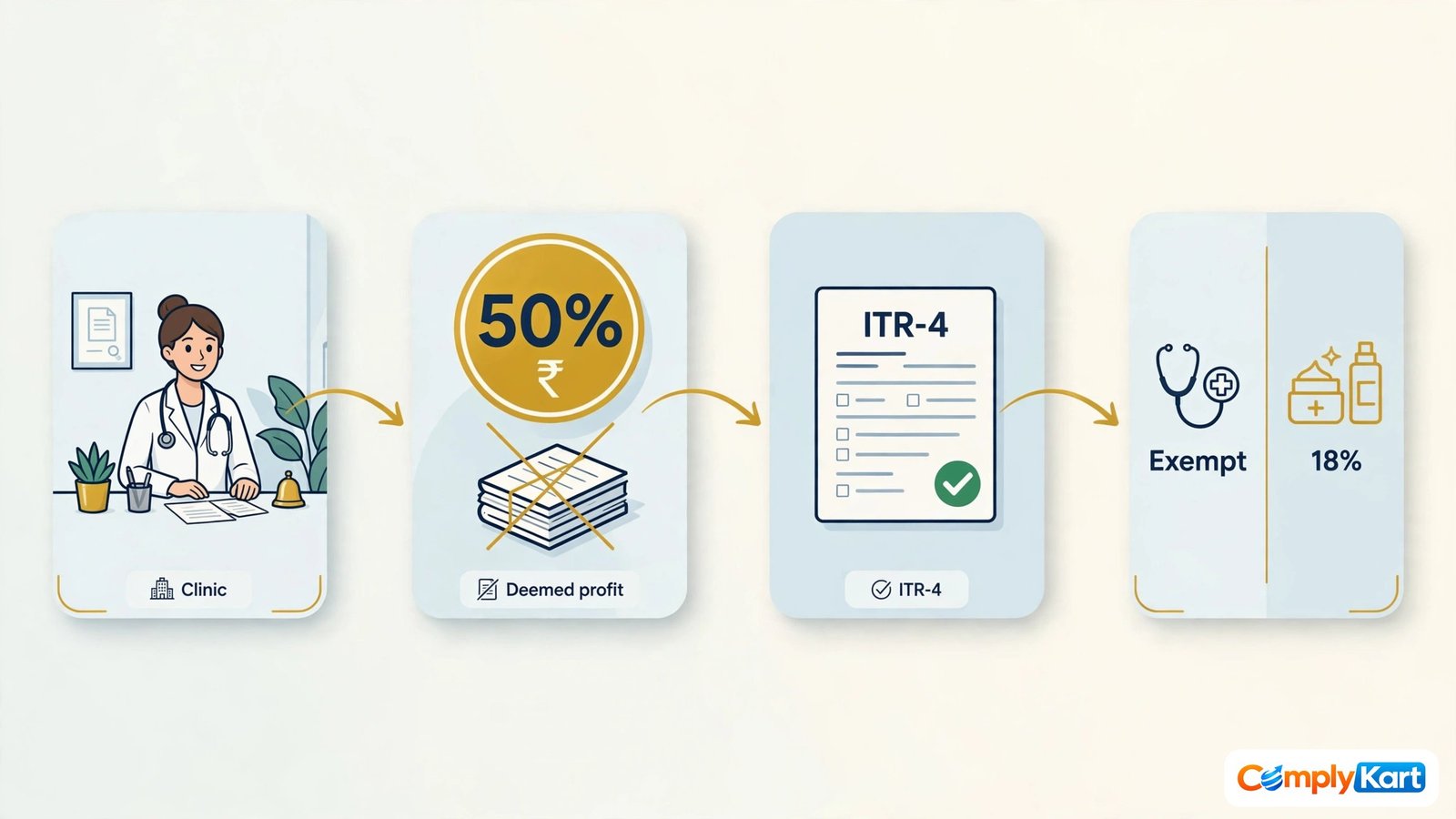
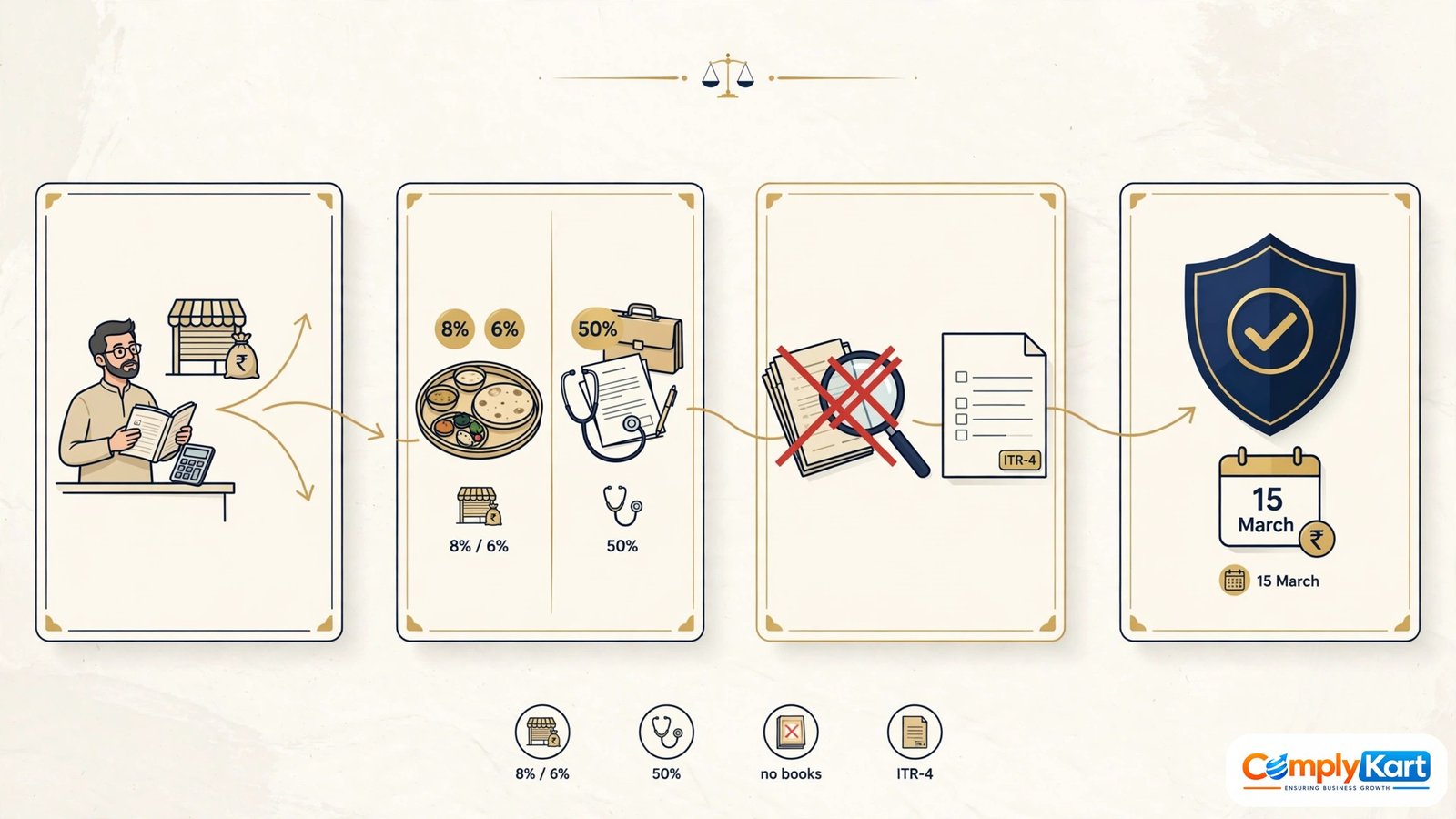
Most doctors I meet run two businesses without realising it: a clinic and paperwork. Section 44ADA of the Income-tax Act, 1961, exists for this — it lets a doctor declare 50% of gross professional receipts as taxable income, skip books of account entirely, and file with the simplified ITR-4. The limit is ₹50 lakh of gross receipts, rising to ₹75 lakh if cash receipts stay at or below 5%. Consultations themselves attract no GST (Entry 74, Notification 12/2017-CGST), but purely cosmetic procedures pull 18% GST and over-the-counter medicine sales are taxable per HSN.
Who can actually use 44ADA?
Not every doctor. The scheme covers resident individuals and resident partnership firms engaged in a "specified profession" — and medicine is explicitly on that list (section 44AA(1), with the Board having notified company secretaries, authorised representatives, film artists and IT professionals as additions). Two exclusions matter. Run the clinic through an LLP or company and 44ADA is unavailable — full books and statutory audit apply. Be a non-resident for the year and the scheme is closed to you too.
Gross receipts means your professional receipts for the year — consultation fees, procedure charges, hospital retainers. GST collected on taxable services stays out of it.
How does the 50% maths work?
Simple. Take ₹40 lakh of gross receipts. Your taxable professional income is deemed to be ₹20 lakh — half. The law treats every deduction as already given: rent, staff salaries, equipment, electricity, consumables. You cannot subtract them again. Depreciation is deemed to have been allowed, and your assets' written-down values are adjusted accordingly.
Think of it as a fixed-fare taxi versus the meter. 44ADA is the fixed fare: 50% of receipts, no arguing about the route. Maintaining books and declaring actual profit is the meter: it measures your real journey. Take the fixed fare when your real margin comfortably exceeds 50% — most consultation-heavy practices sit here, with costs well below half of revenue. Take the meter when your real costs are heavy: equipment on EMI, leased premises, several staff on payroll. A surgeon with a ₹60-lakh equipment loan and five nurses may find real expenses chewing through 60–70% of receipts; 44ADA would tax phantom profit. Run both scenarios through our income-tax calculator with your own numbers before deciding. Five minutes, and the answer is usually obvious.
What if you declare less than 50%?
Then the deal changes. Declare below the deemed 50% and, once your total income crosses the basic exemption limit, you must maintain books under section 44AA and get them audited under section 44AB. Skipping that audit draws a penalty under section 271B: 0.5% of gross receipts or ₹1,50,000, whichever is lower.
One relief: 44ADA carries no five-year lock-in. Section 44AD's lock-in (opt out, lose the scheme for five years) doesn't apply to professionals — you choose afresh each year, so long as the year's numbers qualify. Read our tax audit guide if receipts are nearing the thresholds.
Crossing the threshold: ₹50 lakh or ₹75 lakh
The standard ceiling is ₹50 lakh, rising to ₹75 lakh (Finance Act, 2023, from FY 2023-24) if cash received doesn't exceed 5% of total gross receipts. Note the asymmetry: the audit threshold tests both receipts and payments; 44ADA tests receipts only. Non-account-payee cheques count as cash, so route everything through banking channels if you're anywhere near the line.
Cross the applicable limit and 44ADA ends for that year: full books, and audit past section 44AB's ₹50-lakh profession threshold. If your practice is growing past ₹75 lakh, start the bookkeeping transition a year early rather than scrambling in March.
What about GST on your clinic?
Healthcare services by a clinical establishment, an authorised medical practitioner, or paramedics are exempt under Entry 74 of Notification 12/2017-CGST — consultations, diagnosis, treatment, inpatient care. Exempt means zero GST charged, but also zero input tax credit on the costs behind those services.
Three boundary cases catch doctors out. First, hair transplant, cosmetic and plastic surgery are expressly excluded from "health care services" — unless undertaken to restore or reconstruct anatomy affected by congenital defects, developmental abnormalities, injury or trauma. A purely aesthetic rhinoplasty, botox, laser resurfacing or hair transplant attracts 18% GST. Document clinical necessity when a procedure sits near the line; the exemption is your position to defend. Second, medicines sold from your clinic's pharmacy counter to walk-in patients are taxable at the HSN rate — typically 5% for most drugs, 12% for some OTC products. A separate line-item pharmacy invoice is taxable; bundled billing with admitted-patient treatment can stay composite and exempt. Third, GST registration: exempt-only healthcare needs none, even above ₹20 lakh turnover. Add taxable cosmetic procedures or pharmacy sales and registration kicks in past ₹20 lakh (₹10 lakh in special-category states). Our GST registration service covers the mechanics; here's what registration actually costs.
How do advance tax and filing work?
44ADA assessees pay advance tax in a single instalment by 15 March — no quarterly schedule. Miss it and sections 234B/234C interest applies. Filing is on ITR-4 (Sugam): your P&L is essentially one line. Our ITR filing service handles the profession-specific schedules if you'd rather not DIY.
The mistakes I keep seeing
Three, repeatedly. One: doctors count cash receipts casually and breach the 5% test — a cash-heavy stretch of home visits can quietly pull the ceiling from ₹75 lakh back to ₹50 lakh. Two: mixing cosmetic-procedure revenue into exempt billing at nil GST — the 18% gap plus interest is what audits hunt for. Three: running the clinic as an LLP while still filing under 44ADA — the scheme doesn't apply, and the return gets corrected. Our compliance fee calculator prices the full books-and-audit route, so you can compare it honestly against 44ADA's simplicity.
FAQs
Is 44ADA available if my clinic is an LLP?
No. Section 44ADA covers only resident individuals and resident partnership firms — LLPs and companies are expressly excluded. An LLP must maintain books and face audit regardless of turnover.
What happens if my gross receipts cross ₹75 lakh?
44ADA stops applying for that year. Maintain books of account under section 44AA, and get a tax audit under section 44AB if receipts exceed ₹50 lakh and income exceeds the basic exemption limit. The penalty for a missed audit is 0.5% of receipts or ₹1,50,000, whichever is lower (section 271B).
Do I need to maintain books under 44ADA?
No — that's the point of the scheme. The 50% deemed profit is treated as final; no books, no audit, no further deduction claims. Only if you declare below 50% (with income above the exemption limit) do books and audit kick in.
Is GST applicable on clinic consultations?
No. Consultations, diagnosis and treatment by an authorised medical practitioner or clinical establishment are exempt under Entry 74 of Notification 12/2017-CGST. You charge nil GST — but you also can't claim input tax credit on related costs.
What GST applies to cosmetic procedures like botox or hair transplant?
18%. The notification expressly excludes hair transplant, cosmetic and plastic surgery from "health care services" unless they restore or reconstruct anatomy affected by congenital defects, developmental abnormalities, injury or trauma. Bill them separately at 18%.

Comments
No comments yet — ask the first question below.
Join the discussion
Questions go straight to our expert desk. Comments appear after a quick review — no spam, no noise.