
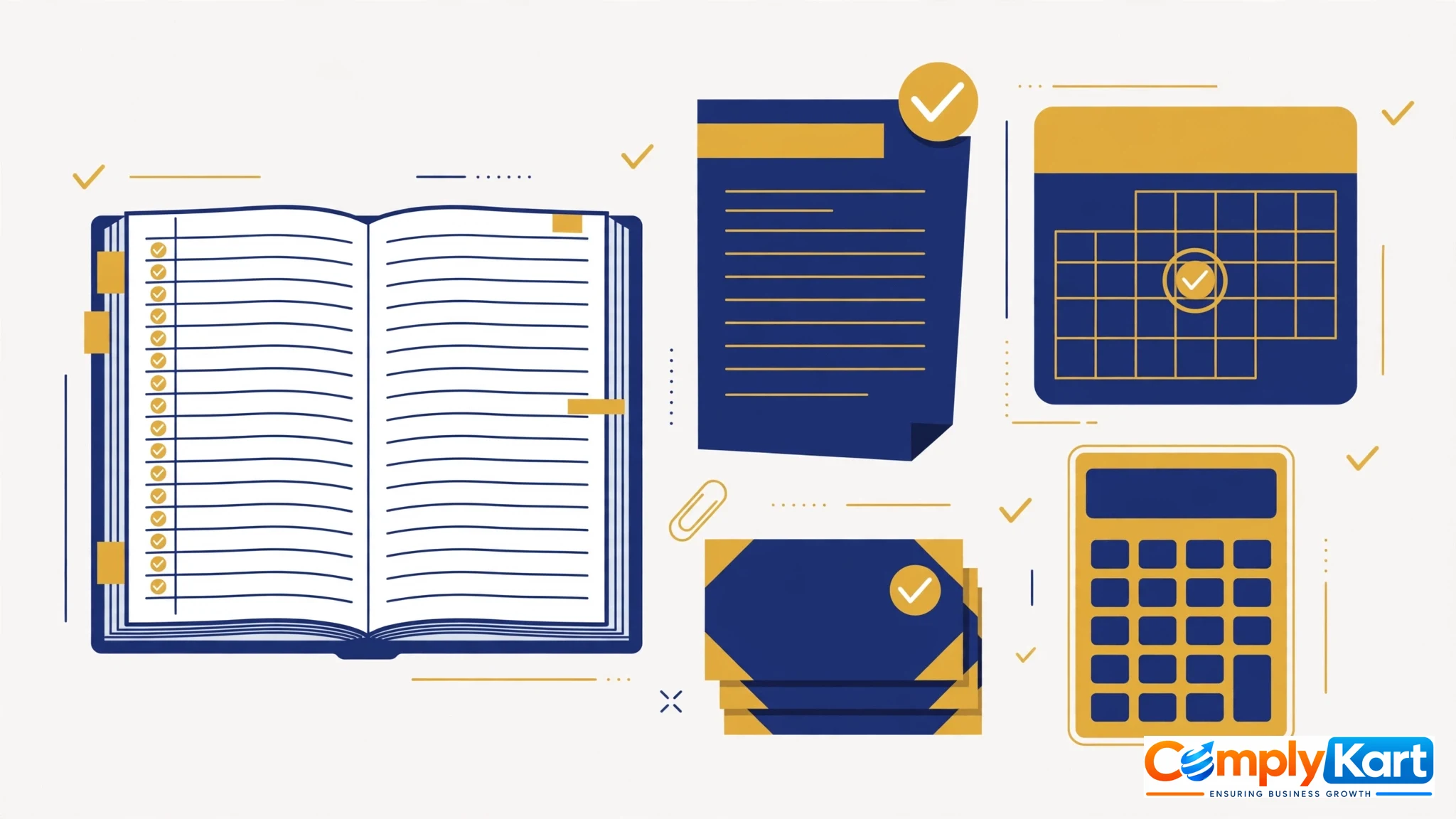
IN BRIEF
A weekly bookkeeping routine is a thirty-minute Friday habit for small business owners: keeping a separate business bank account, recording every invoice the day it arrives, reconciling records against the bank statement, and reviewing unpaid invoices monthly. It keeps GST input tax credit intact and filings ready, since GSTR-1 falls on the 11th and GSTR-3B on the 20th for monthly filers.
Most small businesses don't die from bad products. They die from not knowing where the money went. This is a thirty-minute weekly routine that keeps your books honest — no accounting degree required.
The short answer: do your bookkeeping weekly, not monthly. Keep one bank account only for the business, record every invoice the day it arrives, reconcile against the bank statement every Friday, and review unpaid invoices once a month. Thirty minutes a week prevents the year-end pile-up, protects your GST input tax credit, and keeps you loan-ready.
The real reason bookkeeping fails
It isn't laziness. It's the monthly marathon.
Most founders batch their bookkeeping. Receipts pile up in a drawer, invoices sit in an inbox, and one weekend a month they try to reconstruct reality from fading memory. It takes hours. It's miserable. So they quit.
The fix is not better software. It's smaller sessions. Weekly beats monthly, every single time, because memory is fresh and the pile never grows teeth. Here is the whole system. Four rules. Thirty minutes a week.
Rule one: separate the money
If you take one thing from this article, take this.
Open a bank account that belongs only to the business. Run every business rupee through it. Never pay a supplier from your personal account. Never pay your home electricity bill from the business account.
Mixed money is where bookkeeping goes to die. The moment personal and business expenses share an account, every transaction needs a judgment call — was that restaurant bill a client dinner or a family lunch? You won't remember in March. One account. One rule. No exceptions.
Rule two: capture every invoice the day it arrives
The habit is simple: the day an invoice arrives — from a supplier, a freelancer, a vendor — record four things. The date. The vendor's name. The amount. And whether GST was charged, with the GSTIN if it was. A phone photo of the invoice works. A spreadsheet row works. The format doesn't matter. Speed matters.
Why the day it arrives? Because this is also how you claim input tax credit. Under GST, GSTR-1 is due on the 11th of the following month and GSTR-3B on the 20th — for monthly filers. If you file under the QRMP scheme, your GSTR-1 and GSTR-3B run quarterly instead (GSTR-3B by the 22nd or 24th, depending on your state), but the habit stays the same: an invoice missing from your books is credit missing from your return, money left on the table — or worse, a mismatch notice later. Our GST returns desk sees this exact gap every month, and our guide to the GST invoice format shows what a complete invoice must carry.
Capture daily. It takes ninety seconds per invoice.
Rule three: reconcile every Friday
Reconciliation is a scary word for a simple act. It means this: compare your records with the bank's records, and make them agree.
Once a week, sit with your bank statement and tick off each transaction against your own records. Money in: match. Money out: match. Anything that doesn't match gets investigated right then, while the week is still fresh in your mind.
Found a charge you don't recognise? Call the bank this week, not in three months. The classic weekly catch is the double payment — the same invoice paid twice because one copy arrived by email and another by WhatsApp. Small mismatches caught weekly stay small; at year-end they become a full-day archaeology project.
Rule four: review your receivables once a month
Sales mean nothing until the cash lands.
Once a month, list every unpaid invoice: who owes you, how much, and how many days overdue. Then act on it. A polite reminder at seven days. A firmer one at thirty. A phone call at forty-five.
Most founders hate chasing money. But a client who pays at ninety days is lending you money interest-free, and you never agreed to be a bank. Put payment terms in writing before you start the work — "payment within 15 days of invoice" — so the chase is just enforcing what was agreed.
What goes wrong in month two
The routine is easy to start and easy to abandon. By week five, a busy Friday arrives, you skip the session, and tell yourself you'll do two weeks next Friday. You won't. The pile doubles and the habit quietly ends. The fix is simple: never let a skip become two skips. Miss a Friday? Do it Monday morning.
The second killer is the "I'll remember" trap. A cash payment here, a UPI transfer there, no invoice captured because it felt too small to matter. Small amounts are exactly what you forget. If money moved, it gets recorded.
The third is letting someone else do it without checking. Handing the books to a bookkeeper is fine — abdication is not delegation. Glance at the weekly summary yourself; the founder who can't say roughly what's in the bank is flying blind.
The Friday routine, step by step
- Open your spreadsheet or accounting app. Record any invoices received since last Friday.
- Record every payment made and every receipt received. Date, party, amount.
- Download the week's bank statement. Tick each entry against your records.
- Flag anything unmatched. Resolve it today — call, message, check.
- Glance at the bank balance and this month's receivables. Are you okay? You now know.
Spreadsheet or software?
Start with a spreadsheet. Seriously. At low volumes a spreadsheet is faster, cheaper, and teaches you the discipline. Graduate to software when you catch yourself dreading the spreadsheet, usually around a few dozen transactions a week — or hand the routine to our bookkeeping services team, while you keep reading the summary.
What this discipline buys you
First, tax filings stop being painful. When GSTR-3B is due, your data is already there. The late fee is ₹50 a day — ₹20 a day for nil returns — and it keeps running until you file. Run your own figures through the GST calculator and you'll see how quickly a casual delay adds up.
Second, you become loan-ready without trying. Every lender asks for books, and clean, current records are the difference between a loan approved in a week and one stuck in a document chase.
Third, you spot problems early — a shrinking cash balance, a client drifting later on payments, a month where costs crept up — in your Friday glance, not when the account runs dry. (Our explainer on accrual vs cash accounting shows why income timing matters as much as the amount.)
Start this Friday
- Today: open a separate business bank account if you don't have one.
- This week: photograph every invoice the day it arrives and log it.
- Friday: do the first thirty-minute reconciliation. Statement against records. Resolve every mismatch.
- This month: list all unpaid invoices and send the first round of reminders.
- Repeat. The second Friday takes half the time of the first.
Thirty minutes a week is the cheapest insurance your business will ever buy.
Questions business owners ask us about bookkeeping
How often should a small business do its bookkeeping?
Weekly. A thirty-minute Friday session keeps records current while memory is fresh. Monthly bookkeeping turns into reconstruction, and quarterly bookkeeping is how invoices — and GST credit — go missing.
Why do I keep losing input tax credit?
Usually because supplier invoices were recorded late or not at all. ITC flows from your supplier's GSTR-1 into your GSTR-2B and then your GSTR-3B. Capture every invoice the day it arrives, with the GSTIN.
When should I move from a spreadsheet to accounting software?
When the spreadsheet starts costing you time — typically a few dozen transactions a week, or when you need GST reports and receivables tracking in one place. The tool doesn't create the habit; the routine makes any tool work.
What happens if I file GSTR-3B late?
A late fee of ₹50 per day of delay (₹20 per day for a nil return), subject to caps, plus interest on the tax. Weekly books mean the data is ready before the due date, so the fee never arises.




Comments
No comments yet — ask the first question below.
Join the discussion
Questions go straight to our expert desk. Comments appear after a quick review — no spam, no noise.