
IN BRIEF
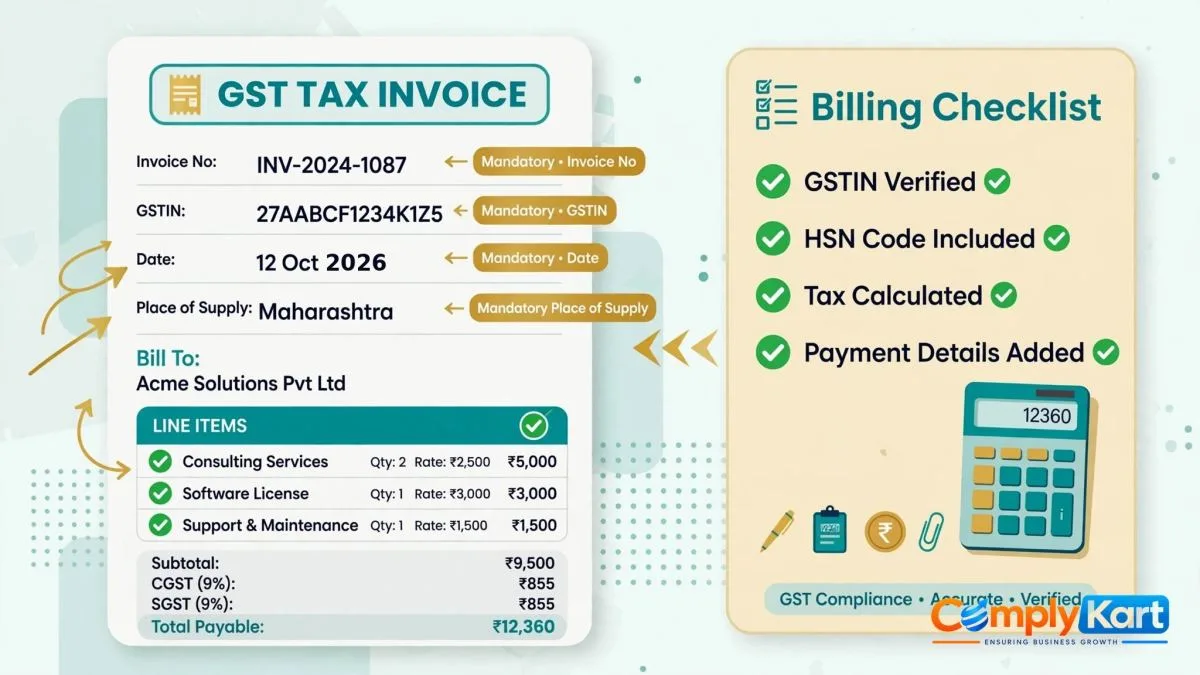
A GST tax invoice is the legal document a registered supplier issues for a supply, and it must carry all 16 particulars listed in Rule 46 of the CGST Rules — GSTINs, serial number, date, HSN or SAC code, taxable value, tax rate and amount, place of supply and signature. Missing any one makes the invoice technically invalid and blocks the buyer's input tax credit.
GST Invoice Format: Every Field Your Invoice Must Have
An invoice is not just a bill. Under GST, it is a legal document — the thing your buyer needs to claim input tax credit, the thing the department matches in GSTR-2B, and the thing that gets questioned first when a notice arrives. Get the format right and nobody looks twice. Get it wrong and a routine scrutiny turns into months of correspondence.
The law doesn't prescribe a fixed layout — your invoice can look however you want. But Rule 46 of the CGST Rules lists 16 particulars that every tax invoice must contain. Miss one, and the invoice is technically not a valid tax invoice. Let's go through them the way an officer would.
The short answer: Every GST tax invoice must carry the 16 particulars in Rule 46 of the CGST Rules — supplier and buyer GSTINs, serial number, date, HSN/SAC codes, taxable value, tax rate and amount, place of supply, and signature. Miss any single one and the invoice is technically invalid, which means your buyer cannot claim input tax credit on it.
What are the 16 mandatory fields on a GST invoice?
One: your name, address and GSTIN as the supplier. Two: a consecutive serial number — unique for the financial year, alphanumeric, capped at 16 characters. Three: the date of issue. Four: the recipient's name, address and GSTIN if they're registered. Five: if the recipient is unregistered and the invoice exceeds ₹50,000, their name, address and state code.
Six: the HSN code for goods or SAC code for services. Seven: description of the goods or services. Eight: quantity and unit. Nine: the total value of supply. Ten: the taxable value — after discounts, before tax. Eleven: the rate of tax. Twelve: the amount of tax, split into CGST, SGST/UTGST or IGST, plus cess if applicable.
Thirteen: place of supply with the state name and code. Fourteen: the delivery address, if different. Fifteen: whether tax is payable on reverse charge — a clear yes or no. Sixteen: your signature or digital signature, or that of your authorised representative.
Think of the 16 fields like a boarding pass. Name, date, flight number, gate, seat — the airline doesn't care whether the pass is pretty, but leave one detail blank and the gate scanner rejects it. Your invoice works the same way: the department's matching engine is the gate scanner and GSTR-2B is the gate. One missing field, and your buyer's credit doesn't board.
Sixteen fields sounds like a lot until you realise most billing software captures them as a matter of course. The businesses that get into trouble are the ones still invoicing from Word templates or Excel sheets, where field eleven quietly disappears and nobody notices until the notice does. (New to the system? Start with GST registration — and if you're evaluating the new fast-track route, our Rule 14A eligibility checker tells you in five questions whether you qualify.)
Tax invoice vs bill of supply: what's the difference?
Not every GST document is a tax invoice. If you're a composition dealer, or you're supplying exempt goods or services, you issue a bill of supply instead. The bill of supply looks similar but carries no tax breakup — because no tax is being charged — and it must state that tax isn't payable.
The mistake I see: regular dealers issuing bills of supply "to keep it simple," or composition dealers issuing tax invoices and charging GST they aren't allowed to charge. Each document has exactly one correct user. Using the wrong one doesn't just confuse your buyer — it misstates your tax position on record.
When must a GST invoice be issued?
For services, the tax invoice must be issued within 30 days of the supply (45 days for banks, insurers and NBFCs, under Rule 47). For goods, it's before or at the time of removal or delivery.
Why does the timing matter? Because the time of supply — which decides when GST becomes payable — is the earlier of the invoice date and the payment receipt date. Issue the invoice and the tax liability clock starts, whether or not your client has paid you. Late invoicing doesn't defer your liability; it just compresses the time you have to arrange the cash. Invoice on time, every time — your working capital will thank you.
E-invoicing and the QR code
If your aggregate turnover crossed ₹5 crore in any financial year since 2017–18, your B2B invoices need something extra: reporting to the Invoice Registration Portal, which returns an Invoice Reference Number (IRN) and a signed QR code. That QR code must appear on the invoice. An invoice issued without IRN/QR by a business in the e-invoicing net is, under Rule 48(5), not treated as an invoice at all — which means your buyer can't claim credit on it.
If you're below the threshold, no QR code is required and your invoice stands on its 16 fields alone. But keep the threshold in mind as you grow: the day you cross it, your invoicing process has to change, not just your invoice format. Our e-invoicing applicability guide explains exactly who the ₹5 crore net catches.
Five invoice mistakes that trigger notices
One: wrong GSTIN — yours or theirs. A single transposed digit and the invoice can't be matched in GSTR-2B. Your buyer's credit gets stuck, and you get the angry phone call. Validate GSTINs when you onboard a customer, not when you raise the tenth invoice.
Two: missing or wrong HSN/SAC. HSN codes are mandatory, with the digit-depth depending on your turnover. Wrong HSN means wrong tax rate applied — the classic route to a short-payment notice.
Three: wrong place of supply. This decides whether you charge CGST+SGST or IGST. Get the state code wrong on an inter-state supply and you've charged intra-state tax on what was legally an inter-state transaction. Officers check this first because it's the easiest error to spot.
Four: duplicate or broken invoice series. Serial numbers must be consecutive within the financial year. Gaps invite questions about suppressed sales; duplicates invite questions about everything. If you messed up a series mid-year, document the correction — don't just quietly restart numbering.
Five: charging tax on exempt supplies. Tax on an exempt supply isn't "extra compliance" — it's a misstatement. And conversely, issuing a bill of supply for a taxable supply deprives your buyer of credit they were entitled to. Match the document to the nature of the supply, every single time.
Make the format automatic
The honest truth: nobody gets all 16 fields right by being careful. People get them right by using a system that won't let them get it wrong — software that validates the GSTIN, pulls the HSN, enforces the series and won't save an invoice with the place of supply blank. If you're still invoicing manually, our free invoicing tool at complykart.com/invoicing builds GST-compliant invoices with the mandatory fields handled for you — worth a look before your next billing run.
GST invoice: quick answers
What happens if my invoice misses a mandatory field?
Technically, it isn't a valid tax invoice — and your buyer can't claim input tax credit on it. In practice, expect the mismatch to surface in GSTR-2B reconciliation or during scrutiny, followed by notices to both sides. Fix the template, don't keep issuing defective invoices.
What's the difference between a tax invoice and a bill of supply?
A tax invoice is issued by regular dealers and carries the full tax breakup (CGST/SGST or IGST). A bill of supply is for composition dealers and exempt supplies — no tax breakup, because no tax is charged. Using the wrong document misstates your tax position on record.
Within how many days must I issue a GST invoice for services?
Within 30 days of the supply (45 days for banks, insurers and NBFCs, under Rule 47). For goods, it's before or at the time of removal or delivery. Remember: the invoice date starts your tax liability clock, whether or not the client has paid.
Do I need a QR code on my invoice?
Only if you're in the e-invoicing net — aggregate turnover above ₹5 crore in any year since 2017–18. Then the Invoice Registration Portal returns an IRN and signed QR code that must appear on the invoice; without them, the invoice isn't treated as an invoice at all.
Can I issue a GST invoice without the buyer's GSTIN?
For B2B supplies to a registered buyer, no — their GSTIN is a mandatory field, and without it they can't claim credit. For unregistered buyers on invoices above ₹50,000, you must capture their name, address and state code instead. Setting up the business properly from the start helps — see our private limited company registration guide.
Sixteen fields, one correct document type, thirty days. That's the whole discipline. Master it once and invoicing becomes the quietest part of your compliance — which is exactly what it should be. And if your past invoices have any of the five mistakes above baked in, getting them reviewed and corrected now is far cheaper than defending them later — the kind of cleanup our team does every week.




Comments
No comments yet — ask the first question below.
Join the discussion
Questions go straight to our expert desk. Comments appear after a quick review — no spam, no noise.