
IN BRIEF
Compliance by design is the principle that incorporation software should hand a founder the obligation map on day one — every filing the company owes, its trigger and its deadline — rather than producing the certificate. It applies to any private limited company set up in India, where the Companies Act 2013 clocks for the first AGM, financial statements, annual return and auditor appointment start ticking at incorporation.
ComplyKart is a Delhi-based legaltech for businesses: we set up companies and then carry their filings — ROC, GST, tax, trademarks — with a practitioner reviewing every submission before it goes. This piece explains the design principle the platform is built on, because it is the question every founder should ask any provider, including us.
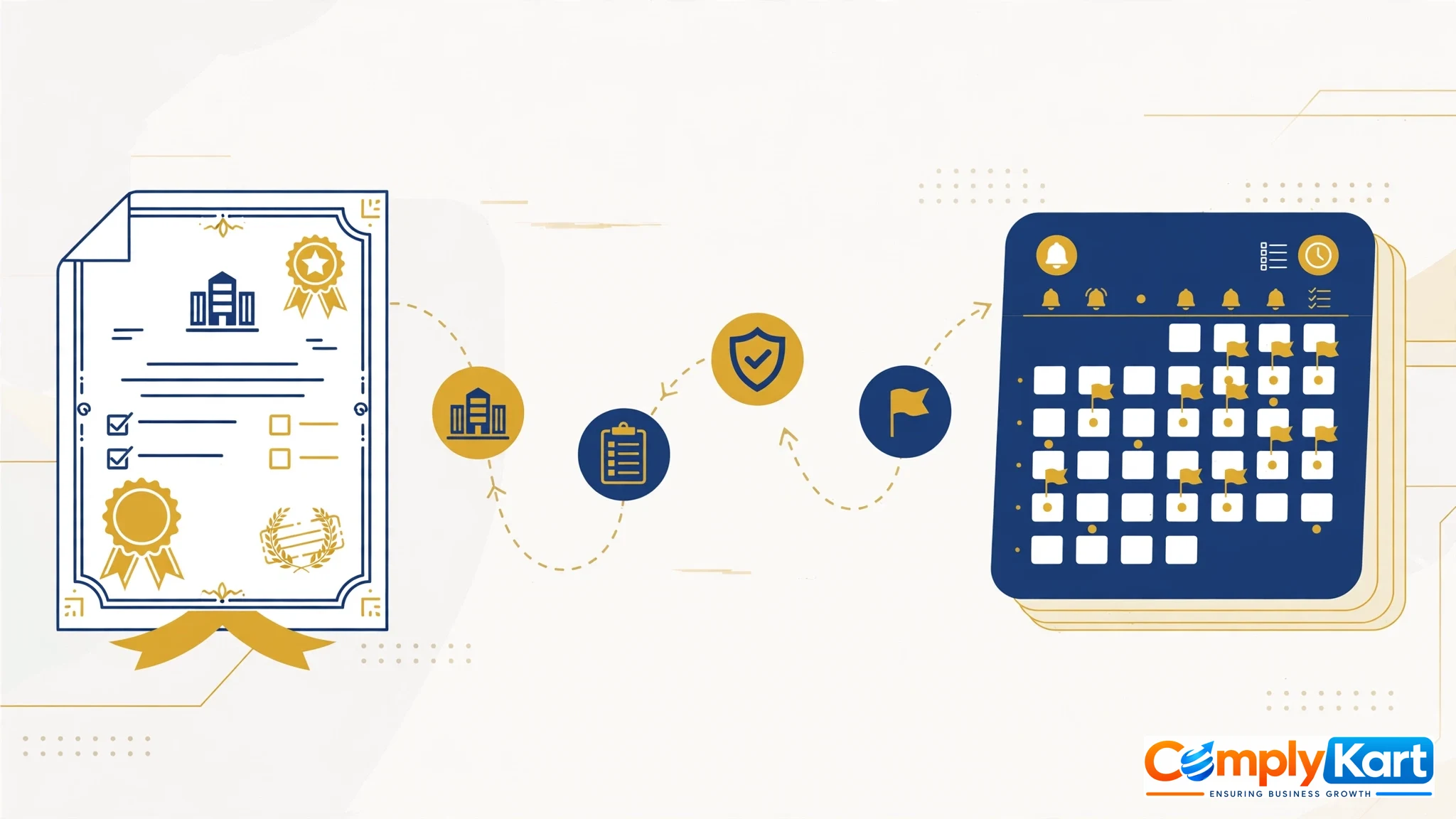
The short answer: incorporation software is good at producing a company and poor at telling the founder what that company now owes. The certificate is a starting gun, not a finish line — the first AGM, financial statements within 30 days of it, the annual return within 60, and the auditor filing within 15 all start ticking at incorporation. Buy — or build — the product that hands you the obligation map on day one, not the one that only hands you forms.
Incorporation software has never been better at producing companies. It has never been worse at telling founders what a company owes once it exists. That gap — between the form and the obligation — is where legaltech keeps failing, and where the fix is a design problem, not a bigger form library.
The certificate is a starting gun
Nobody reads the Companies Act for fun. Founders least of all.
So when a founder finishes incorporation — certificate in hand, directors appointed, name approved — they experience what the software shows them: a completed task. A green tick. Done. What the software doesn't show them is the part that matters: a private limited company now owes the Registrar a set of filings on clocks that started ticking the day it was born. The first annual general meeting, due within nine months of the first financial year-end. The financial statements within 30 days of it. The annual return within 60. The auditor's appointment within 15.
That realisation usually lands about eleven months in, on a call that starts with "nobody told us." They are right. Nobody told them — because the product they used was designed to complete an incorporation, not to begin a compliance relationship. That is exactly the gap our own private limited company setup service is structured against: the engagement starts at incorporation, it doesn't end there.
What the software can't see
Filing software sees forms. It does not see any of the following, and each one is where companies actually get hurt.
The fifteen-day fuse. When shareholders appoint the statutory auditor at the AGM, that appointment must reach the Registrar within 15 days — while the signed minutes are still being drafted, while the auditor's consent letter sits in someone's inbox. This filing dies in the gap between "the board decided it" and "somebody filed it." Software that waits for the user to open the form has already lost; the fuse is half-burned before anyone thinks to look.
The meeting that never happened. Some companies never hold the AGM at all. No meeting, no minutes, no trigger anyone diarised — so none of the downstream clocks visibly start, and the founders assume silence means safety. Then, a year or two later, someone checks the MCA portal and finds every filing overdue at once, each on its own daily meter of ₹100. The software knew the forms existed. It never asked the one question that mattered: did the meeting happen?
The review nobody did. The highest-value fifteen minutes in any filing happen just before submission: does the balance sheet tie to the board report? Is the auditor's name spelled the way the appointment form spelled it? Is the share capital in the annual return the same number as in the financials? These are judgement calls. Products that let a user go straight from form to Registrar, no review step, are optimising for speed at the exact point where speed is dangerous.
None of these is a form problem. They are timing, governance, and judgement problems. A bigger form library fixes none of them.
Software should carry the map. Humans make the calls.
Here's the honest answer, and it's less exciting than the pitch decks: software will not replace compliance review. What software can do — and mostly doesn't — is carry the entire obligation map in memory: which filings a specific company owes, which clocks are running, which triggers haven't fired yet. A private limited company with two directors and no foreign investment owes different things than one with an overseas parent and an ESOP trust. The map should be generated on day one, from the company's actual facts — the full first-year set is in our post-incorporation compliance guide — not reconstructed after a missed deadline.
And the human reviewer should sit inside the loop, not after it. The tool flags what needs eyes today; the practitioner brings what the tool can't — reading a messy board resolution, spotting that a casual share transfer has tax consequences. Tooling plus review, not tooling instead of review. The map half of that design is visible in our compliance fee calculator.
Three things I'd change
First, incorporation would end with a calendar, not a certificate. The deliverable on day one should be the company's specific obligation map — every filing, its trigger, its deadline — generated from its structure, capital, and director profile. Not a generic checklist. A map of this company.
Second, consequences in plain language, not section numbers. "File within 60 days of the AGM" is accurate and useless to someone who hasn't held an AGM. "Your first AGM falls due within nine months of your year-end; two filings follow within weeks; each late day costs ₹100" — that's something a business owner can act on.
Third, review as a gate, not an upsell. The pre-submission review should be part of the product's default path, not a premium add-on. The fifteen minutes that catch the mismatched auditor name are worth more than every automation feature in the brochure.
The cross-border stress test
Nothing exposes the obligations gap faster than an international founder incorporating in India. The forms go through smoothly — the portal doesn't care where you live. Behind them, the obligations multiply: foreign shareholding reporting, transfer-pricing documentation, a beneficial-ownership trail across jurisdictions.
Foreign founders discover these a year after incorporation, from a notice, at the worst possible moment. A practitioner-led product would have drawn a different map on day one — the map for a Delhi founder and a Singapore founder is not the same map, even when the forms are identical.
That is the design insight this industry keeps missing. The form is the commodity. The map is the product.
The practical takeaway
If you're building legaltech: stop measuring success at the certificate. Measure it at the first filing deadline — did your user know it existed, and did they meet it? If you're buying it — as a founder choosing a provider — ask a single question: does this product know what I owe, or only what I've already decided to file? The first kind builds the map. The second just hands you a pen.
Questions founders ask us about company setup
What does ComplyKart do after my company is incorporated?
The obligation map comes first: every filing your company owes, with its trigger and deadline, generated from your structure. Then the filings themselves — ROC annual filings, GST, tax, event-based changes — each one reviewed by a practitioner before submission, with reminders driven by the calendar, not by your memory.
What is the first filing a new private limited company owes?
The sequence starts early — commencement and first-auditor steps right after incorporation — and the first big cluster follows the first AGM: financial statements within 30 days, the annual return within 60, and the auditor appointment filing within 15. Miss them and each form accrues ₹100 per day, uncapped.
Can't software file everything automatically?
Software can compute deadlines and prepare forms. It should not be the last eyes on a filing. The errors that hurt — a mismatched auditor name, share capital that differs between two forms, a meeting that never happened — are judgement calls. Our position is simple: machine computes, human approves, machine reminds.



Comments
No comments yet — ask the first question below.
Join the discussion
Questions go straight to our expert desk. Comments appear after a quick review — no spam, no noise.